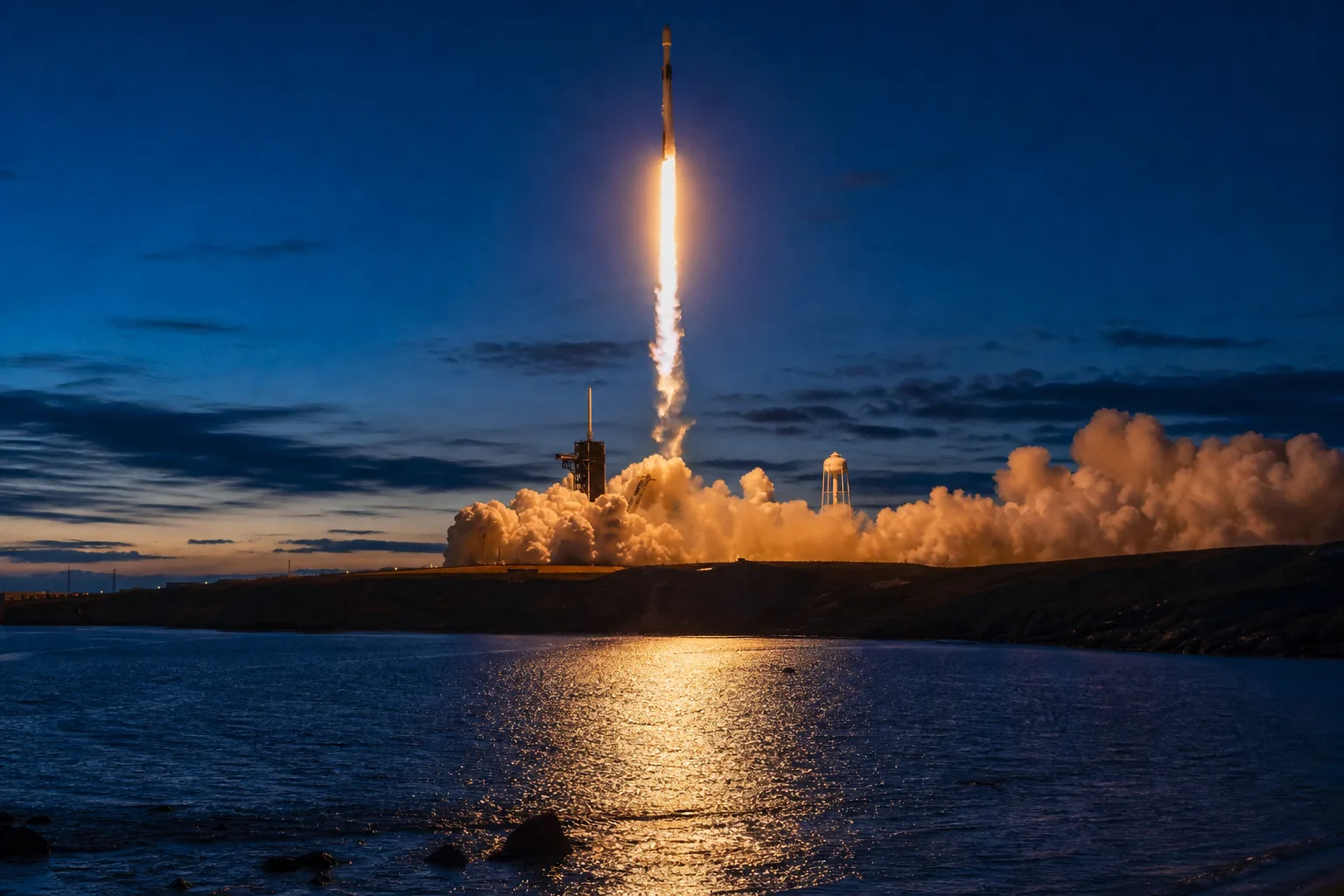
Just three days after completing the largest initial public offering in history, SpaceX wasted no time getting back to work. Monday’s Starlink satellites launch — designated Group 17-54 — sent 24 more broadband units into orbit from Vandenberg Space Force Base in California, lifting the total active constellation to 10,660 satellites and signalling, loudly, that the company’s operational tempo isn’t slowing down for Wall Street fanfare.
- The Starlink satellites launch on June 15 pushed SpaceX’s active megaconstellation to 10,660 orbital units.
- Monday’s Starlink satellites launch was SpaceX’s 69th Falcon 9 mission of 2025, with over 80% dedicated to Starlink.
- SpaceX completed its historic IPO on June 12, valuing the company at $1.77 trillion — the largest ever.
- Booster B1093 successfully landed on a drone ship after its 14th flight, extending SpaceX’s reuse record.
Table of Contents
The Launch: Business as Usual at Extraordinary Scale
A Falcon 9 rocket lifted off from Space Launch Complex 4 East at 11:34 a.m. EDT on June 15, carrying the latest batch of flat-panel broadband satellites. Deployment was confirmed roughly an hour later. It was, by any normal measure, a routine Starlink satellites launch — and that’s exactly the point. SpaceX has industrialised orbital launches to the degree that a 24-satellite deployment barely rates a footnote internally. For context, Monday’s flight was the company’s 69th Falcon 9 mission of the year, and more than 80% of those flights have been dedicated to growing the Starlink constellation. That pace is staggering. No other launch provider on Earth is operating anywhere close to that cadence.
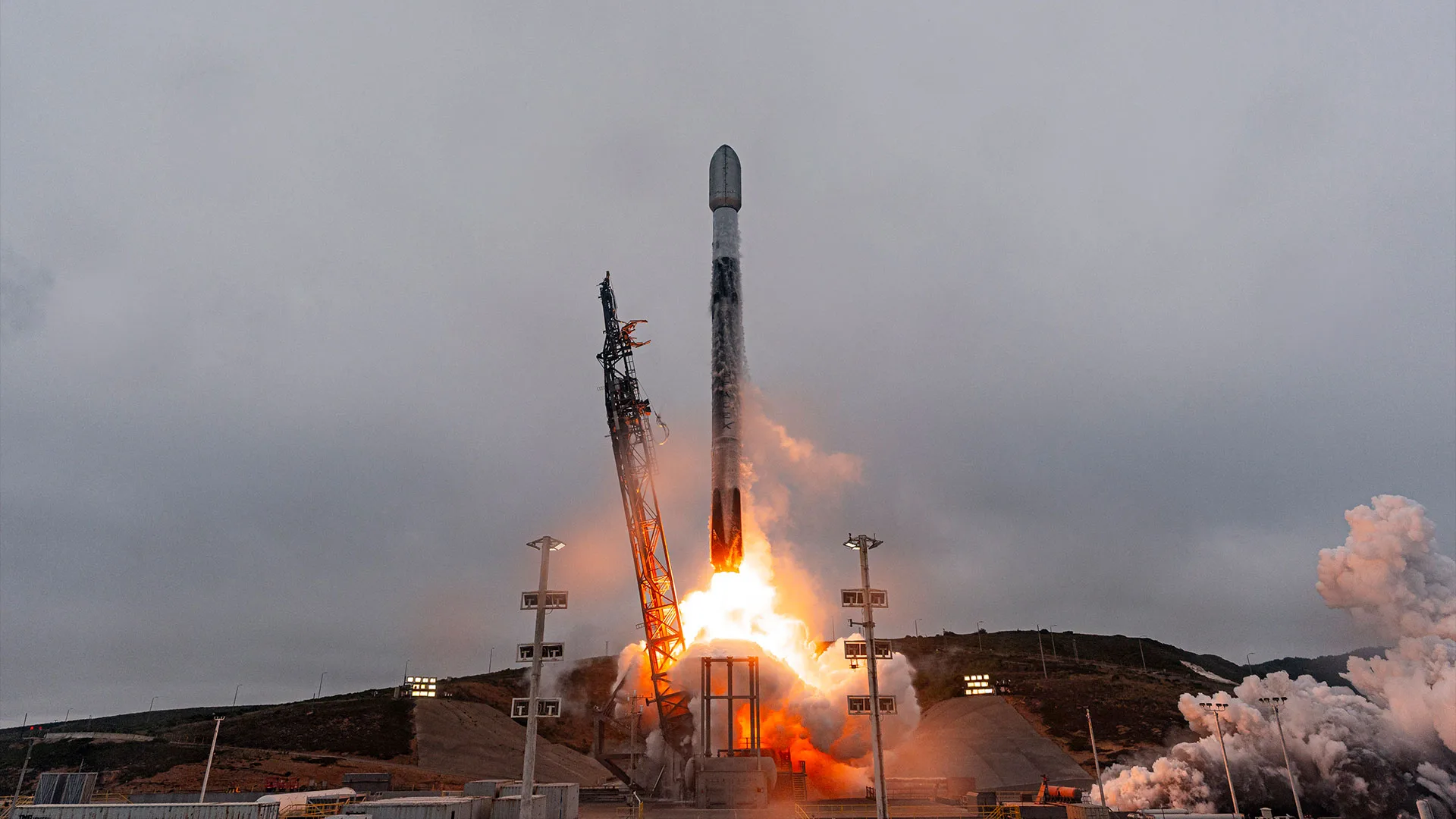
About 8.5 minutes after liftoff, Booster B1093 — the first stage responsible for hauling this payload skyward — separated and made its way back down for a pinpoint landing on the autonomous drone ship ‘Of Course I Still Love You’, positioned out in the Pacific. It was that booster’s 14th flight, another small data point in SpaceX’s ongoing proof that rocket reusability isn’t just viable; it’s the entire economic engine powering everything else the company does.
Starlink Satellites Launch Count Hits a New Milestone
The Group 17-54 deployment pushed the active Starlink megaconstellation to 10,660 units, according to orbital tracker Jonathan McDowell, who maintains one of the most respected independent records of objects in Earth orbit. That number deserves a moment’s pause. Ten thousand satellites. From a single company. It took humanity roughly six decades of collective spaceflight to put the first few thousand objects into orbit — SpaceX has surpassed that figure on its own and is still adding to the stack at a rate that most national space agencies couldn’t match in a decade.

Each new Starlink satellites launch adds capability to a network that has quietly evolved far beyond its original pitch as rural broadband. Today, Starlink underpins in-flight Wi-Fi on select airlines, offers direct-to-cell connectivity for certain mobile carriers, and provides internet access in conflict zones and disaster-stricken regions where terrestrial infrastructure simply doesn’t exist. The question is no longer whether Starlink works — it demonstrably does — but how dominant it will become as SpaceX continues to widen the gap over rivals like Amazon’s Project Kuiper and the now-struggling OneWeb (rebranded Eutelsat OneWeb).
The IPO Elephant in the Room
Any coverage of this particular Starlink satellites launch has to acknowledge what happened the Friday before. SpaceX went public on June 12 under the ticker SPCX on the Nasdaq, and the market responded with the kind of enthusiasm that makes even seasoned analysts do a double-take. The IPO valued SpaceX at $1.77 trillion — the largest valuation attached to any company going public in history, eclipsing previous record-holders by a wide margin. The stock had already climbed nearly as many percentage points as the 24 satellites launched by the time Monday’s rocket cleared the launch tower, a coincidence that SpaceX’s social media team presumably appreciated.
For Elon Musk, the IPO crystallised a designation that has never applied to any individual in recorded history: the world’s first trillionaire. Whether that title carries any practical meaning beyond the symbolic is debatable, but it does reflect the sheer scale of what SpaceX has built. Equally striking is what the listing means for the workforce. More than 4,400 past and present SpaceX employees are projected to have become millionaires through their equity stakes — a wealth distribution event of a kind that Silicon Valley used to produce regularly but has delivered less frequently in recent years as mega-companies stayed private longer.
Trading above $180 per share in the days following the offering, SPCX immediately joined the conversation about the most valuable companies on the Nasdaq. Whether that valuation holds, grows, or corrects will depend heavily on Starlink’s revenue trajectory — and that, in turn, depends on how many more satellites SpaceX can put into orbit and how many subscribers the network can attract. Each scheduled Starlink satellites launch is, in that sense, both a routine operational mission and a direct investment thesis in action.
What This Means for the Satellite Internet Industry
The competitive picture in low-Earth-orbit broadband is becoming clearer and starker simultaneously. Amazon finally began deploying Project Kuiper satellites in earnest this year, but it’s chasing a moving target. Every new Starlink satellites launch extends a network effect that grows harder to replicate: more satellites mean better coverage, lower latency, and greater capacity — which attracts more subscribers, generates more revenue, and funds yet more launches. It’s a flywheel that SpaceX has been spinning for years, and public market capital will only accelerate it.
There’s a regulatory dimension worth watching too. SpaceX already operates under coordination agreements with the FCC, ITU, and various national bodies, but as the constellation pushes past 10,000 active units — with applications for tens of thousands more already filed — the conversation around orbital congestion, spectrum allocation, and satellite disposal standards is getting louder. Astronomers have raised persistent concerns about Starlink’s impact on ground-based observation, and while SpaceX has made hardware tweaks to reduce reflectivity, the issue hasn’t disappeared. A newly public SpaceX, accountable to quarterly earnings expectations, may face shareholder pressure to expand even faster — which could intensify those tensions. Every planned Starlink satellites launch on the manifest will draw renewed scrutiny from both regulators and the astronomy community as a result.
For now, though, the scorecard reads simply: 10,660 active satellites, 69 launches and counting this year, and a freshly minted public company with a $1.77 trillion mandate to keep the rockets flying. If Monday’s mission proved anything, it’s that for SpaceX, going public was never going to slow the cadence. It was just another Monday.