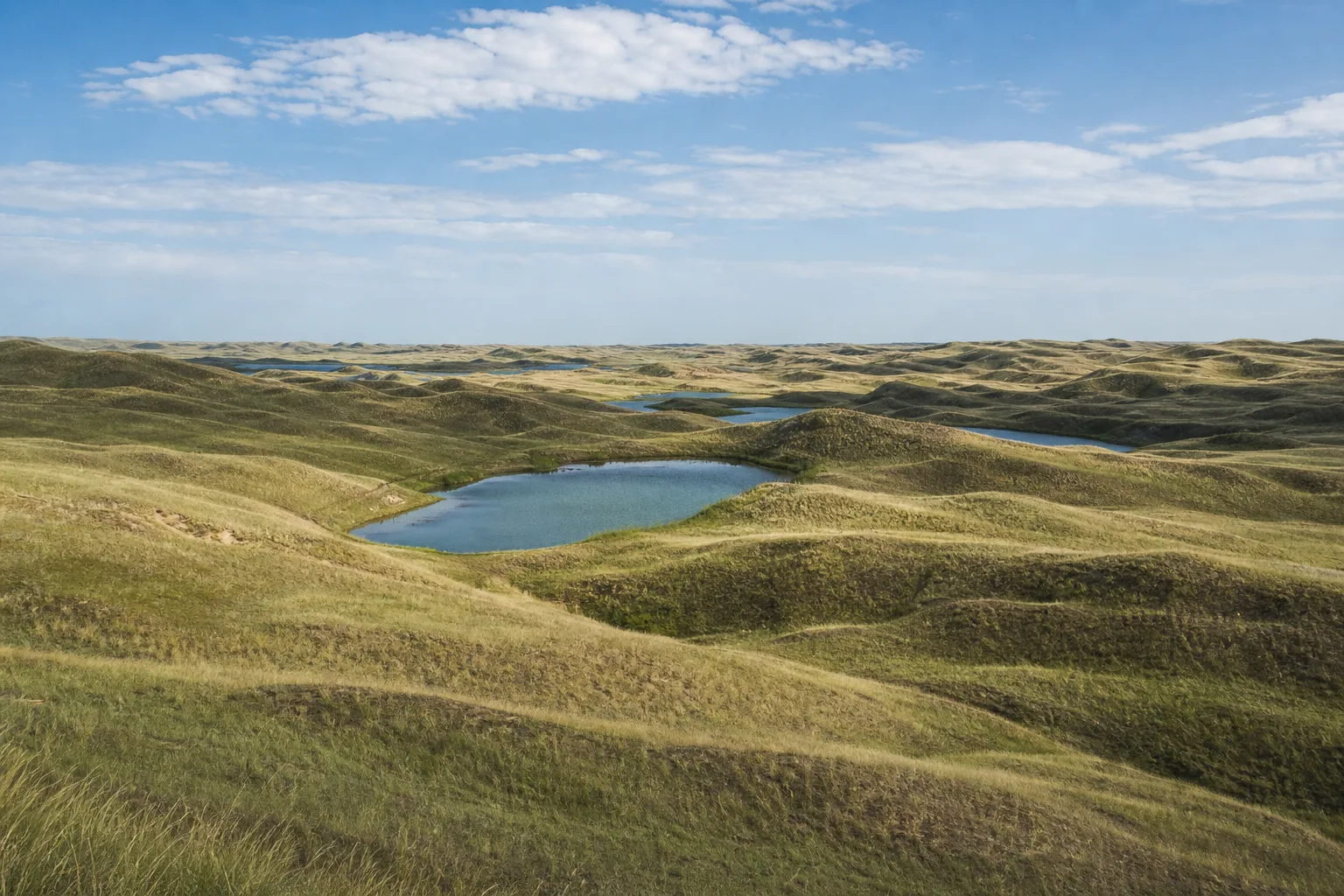
When people picture great dune fields, they tend to imagine the Sahara, the Arabian Peninsula, or Namibia’s coastal desert. What almost nobody pictures is north-central Nebraska. Yet the Nebraska Sandhills — a vast, grass-blanketed expanse of ancient dunes rolling across roughly 20,000 square miles — represent the single largest sand dune system in the entire Western Hemisphere. NASA’s Earth Observatory recently trained its Landsat sensors on the region, and the resulting imagery makes a compelling case that this overlooked corner of the American heartland deserves far more attention than it gets.
- The Nebraska Sandhills span 20,000 square miles, making them the largest sand dune system in the Western Hemisphere.
- Nebraska Sandhills dunes reach up to 400 feet tall, shaped over thousands of years by wind patterns and Rocky Mountain erosion.
- Grassland vegetation stabilized the dunes roughly 3,500 years ago, turning a shifting desert into productive ranchland.
- The Nebraska Sandhills shelter rare species including the whooping crane and western prairie fringed orchid in their wetland valleys.
Table of Contents
Nebraska Sandhills: A Landscape Built Over Millions of Years
The story of the Nebraska Sandhills starts in the Rocky Mountains, not on the plains. Rivers eroded rock and sediment from the Rockies and carried it eastward, depositing vast quantities of sand across the Great Plains during the Pleistocene epoch. That alone doesn’t explain the dunes — plenty of rivers deposit sand without building 400-foot ridges. The key was drought. When dry periods hit and riverbeds dried out, winds predominantly blowing from the north and south picked up exposed sand and started stacking it. Gradually, over thousands of years, those winds sculpted the Nebraska Sandhills into one of Earth’s most distinctive landforms.
About 3,500 years ago, the dunes stopped moving. Grassland vegetation colonized the hills and locked the sand in place — a natural stabilization event that transformed what had been an active, shifting desert into the rolling green landscape visible today. Without that grass cover, the dunes could theoretically reactivate. Extended drought is still considered one of the primary risks to long-term stability in the region, a point that carries added weight as climate patterns across the American West grow increasingly unpredictable.
The Geometry of Wind: What Dune Shapes Tell Scientists
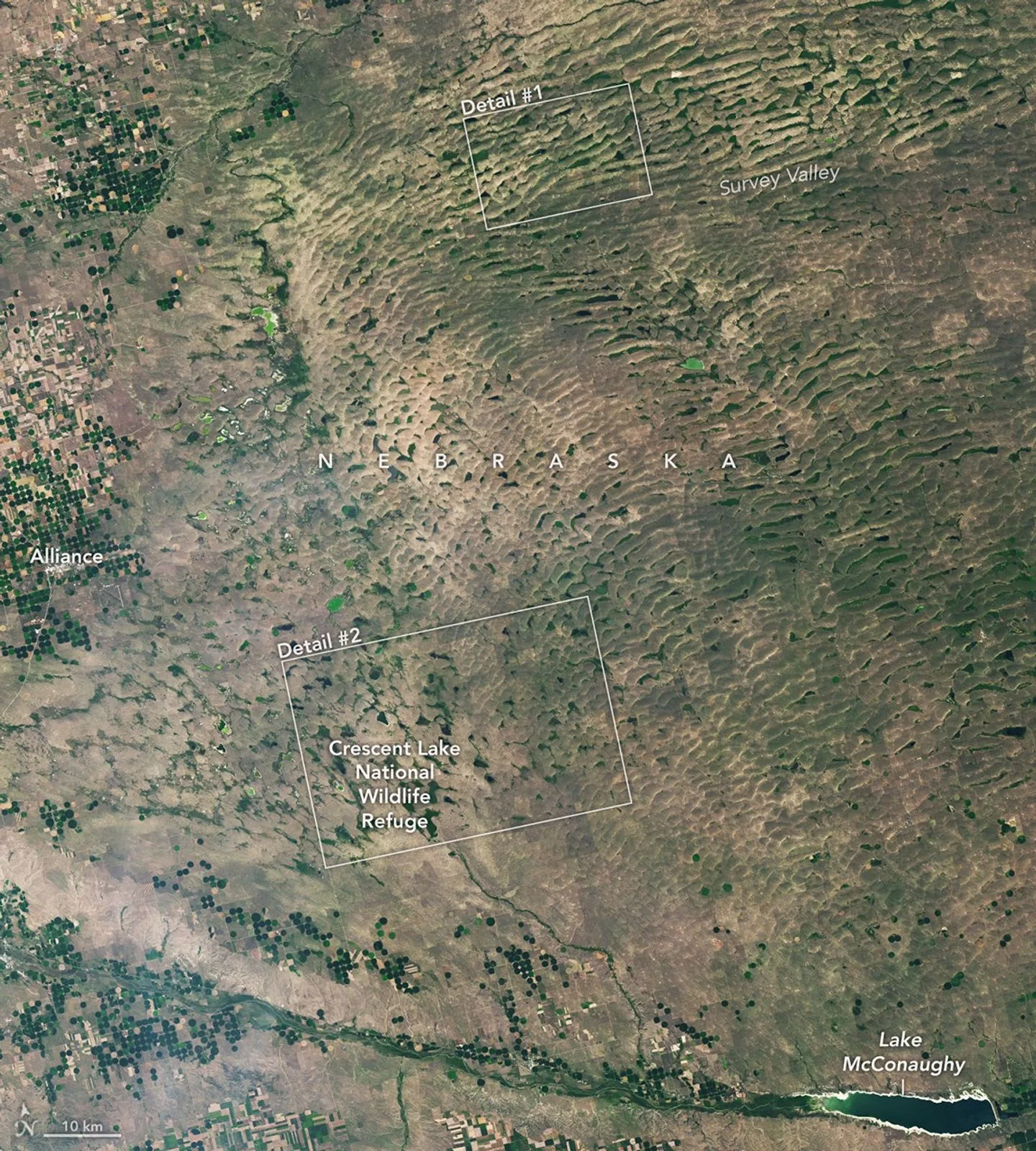
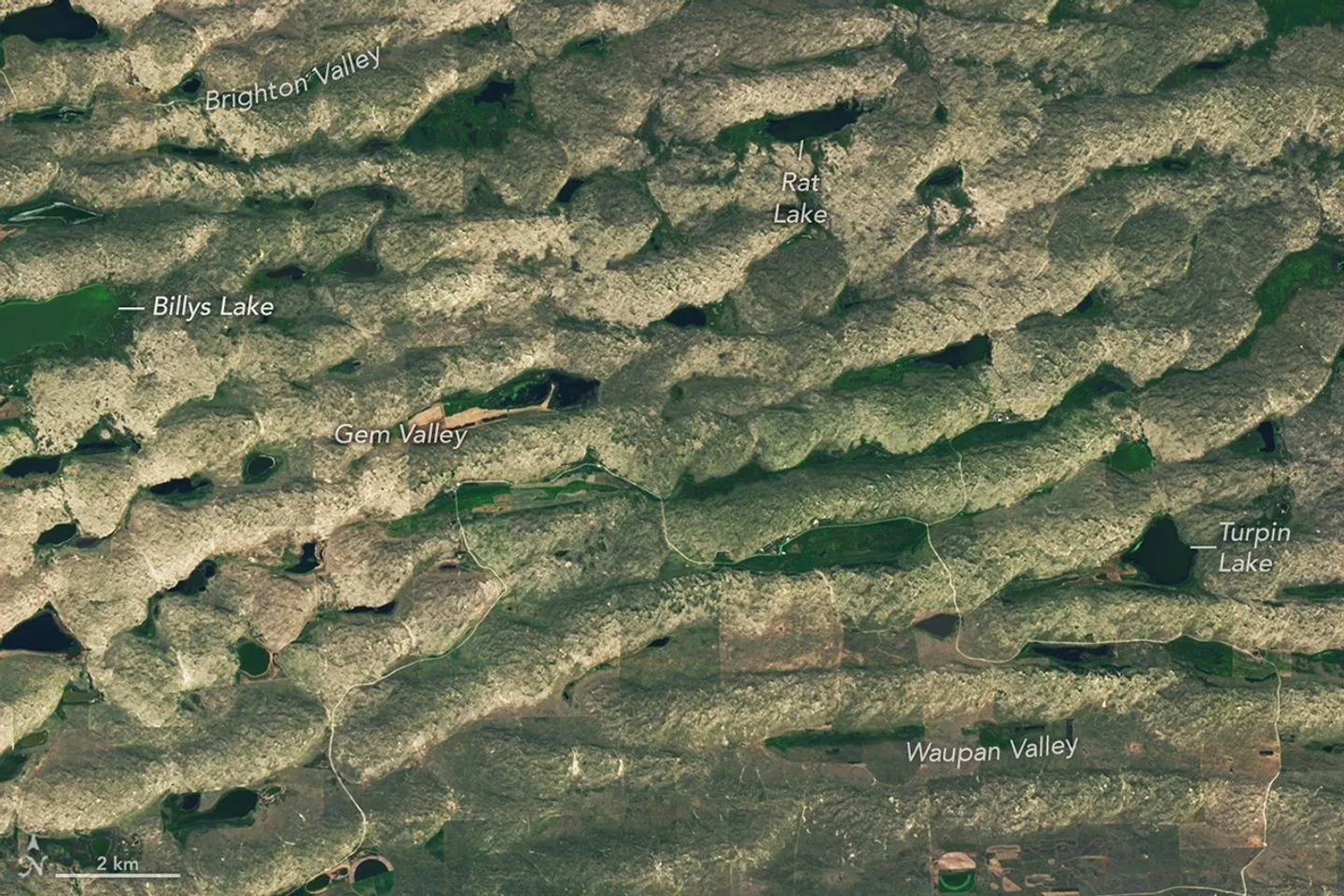
The Nebraska Sandhills aren’t a uniform landscape — they’re a record of atmospheric history written in sand. NASA’s Landsat imagery captures this clearly. In the northern reaches of the region, large transverse dunes dominate: parallel ridges that stand up to 400 feet tall and extend for several miles. These dunes are asymmetric — their northern slopes are gentler than their southern slopes — which directly reflects the dominant influence of northerly winds during their formation. The wind was blowing harder and more consistently from the north, so sand piled up and slid more steeply on the southern side.
Elsewhere in the Sandhills, dunes take on a more symmetric profile. Here, winds from the north and south blew with roughly equal force, alternating seasonally, so neither direction dominated the shaping process. The result is a landscape that effectively maps historical wind patterns across a huge area. For geologists and climate researchers, that’s genuinely useful information — the kind of long-term atmospheric record that instruments can’t replicate.
The Kinkaid Act and the Rise of Sandhills Ranching
Human history in the Nebraska Sandhills took a decisive turn in 1904 with the passage of the Kinkaid Act, a federal law that allocated 640-acre parcels of land to settlers willing to ranch in the region. At the time, the standard Homestead Act parcel of 160 acres was widely considered too small to support a viable operation in the Sandhills, where the land required much larger grazing areas to support cattle. The Kinkaid Act fixed that, and ranching expanded rapidly as a result.
More than a century later, the region’s character hasn’t fundamentally changed. The Nebraska Sandhills today are home to far more cattle than people. Half of Nebraska’s nearly 23 million acres of rangeland and pastureland sit within the Sandhills region — a staggering share for a single geographic area. Some ranchers have adopted rotational grazing strategies explicitly designed to mimic the movement patterns of the massive bison herds that once roamed the Great Plains, cycling cattle across sections of land to allow grass recovery in ways that parallel natural ecosystems. Research from the University of Nebraska–Lincoln has examined how these approaches support long-term grassland health across the region.
It’s a pragmatic form of conservation — not wilderness preservation in the traditional sense, but a model where working land and ecological health aren’t mutually exclusive. Whether that balance holds as land values, beef markets, and climate pressures shift is a question ranchers and ecologists are both watching closely.
Nebraska Sandhills Wetlands: An Unlikely Ecological Hotspot
Dunes and wetlands don’t sound like they belong together, but the Nebraska Sandhills defy that assumption. Between the ridges, valley floors fill with water — shallow lakes, marshes, wet meadows — fed by precipitation that seeps straight down through the porous sand rather than running off through streams. The result is a landscape that functions almost like a slow-motion sponge, continuously recharging the High Plains Aquifer (also called the Ogallala Aquifer), one of the most critical groundwater reserves in the United States. What happens in the Sandhills doesn’t stay in the Sandhills — it ultimately affects water availability across a huge swath of the agricultural Midwest.
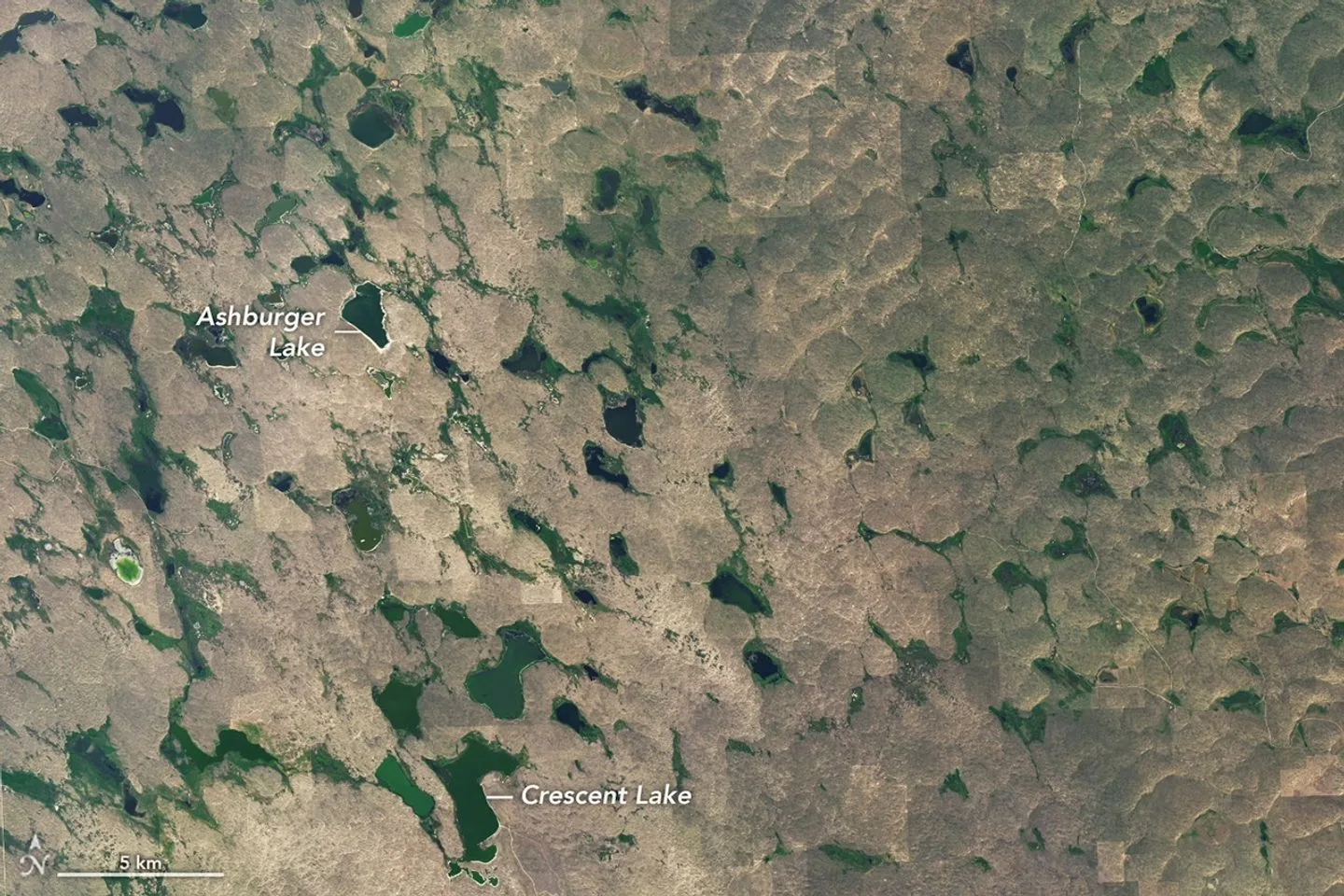
For wildlife, those wetlands are extraordinary. The Nebraska Sandhills sit along the Central Flyway, one of North America’s four major migratory bird corridors, making the region a critical stopover point for dozens of waterfowl, marsh bird, and shorebird species. Crescent Lake National Wildlife Refuge, managed by the U.S. Fish and Wildlife Service on the southwestern edge of the Sandhills, protects a significant slice of this habitat. The refuge shelters rare and endangered species including the whooping crane — one of North America’s most iconic conservation stories — as well as the western prairie fringed orchid and the Topeka shiner, a small fish species that’s become a useful indicator of healthy Great Plains stream ecosystems.
Turtles, too, thrive in the ponds and prairies here in unusual variety. It’s the kind of biodiversity you’d expect from a tropical river delta, not from a semi-arid dune field in the interior of the continent — which is exactly what makes the Nebraska Sandhills such a scientifically interesting place.
What Satellite Imagery Reveals That Ground-Level Surveys Miss
NASA Earth Observatory’s Lauren Dauphin assembled the Landsat images that brought renewed attention to the region, and they illustrate something important about how satellite data is changing our understanding of large-scale landscapes. From the ground, the Nebraska Sandhills read as an endless series of grassy hills punctuated by the occasional lake. From orbit, the full geometric logic of the dune system becomes visible: the parallel ridges, the asymmetry, the distribution of wetlands, the scale. Twenty thousand square miles is roughly the size of West Virginia — hard to hold in your head until you see it laid out from above.
That orbital perspective also has monitoring value. As drought conditions intensify across the American West and Great Plains, Landsat and its successors offer one of the best tools available for tracking vegetation cover across the Sandhills. If the grass starts to thin in significant patches, the early warning signal will likely show up in satellite data before it registers in ground surveys. Given the dunes’ demonstrated capacity to reactivate under drought conditions — they did it repeatedly during the Holocene — keeping a close eye on the Sandhills isn’t just ecologically interesting. It’s practically necessary.
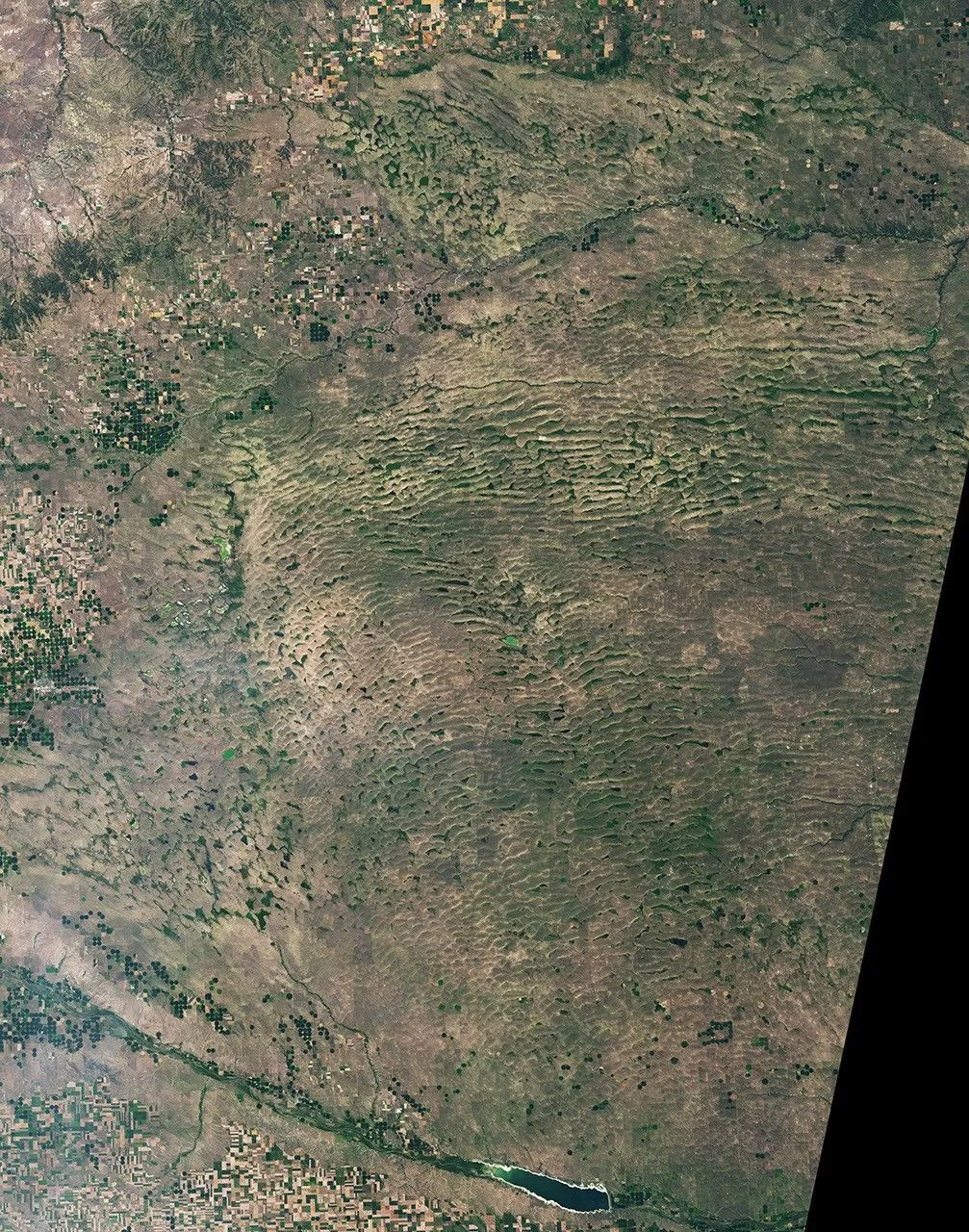
The Nebraska Sandhills are easy to miss on a map and almost impossible to appreciate from a car window. But they represent a genuinely rare combination: a geologically significant landform, a productive agricultural landscape, and a biodiversity hotspot, all in the same place. As remote sensing tools grow sharper and climate pressures grow more acute, expect this overlooked corner of the Great Plains to attract considerably more scientific — and perhaps policy — attention in the years ahead.
Frequently Asked Questions
How were the Nebraska Sandhills formed?
The Nebraska Sandhills formed from sand eroded out of the Rocky Mountains during the Pleistocene epoch. Rivers carried that material onto the Great Plains, and during droughts, northerly and southerly winds built it into dunes. Grassland vegetation stabilized them around 3,500 years ago.
How big are the Nebraska Sandhills?
The Nebraska Sandhills cover roughly 20,000 square miles, or about 52,000 square kilometers — approximately one quarter of the entire state of Nebraska. Some individual transverse dunes in the northern part of the region stand as tall as 400 feet.
What wildlife lives in the Nebraska Sandhills?
The Sandhills support a wide range of wildlife, including whooping cranes, dozens of species of waterfowl and shorebirds, several turtle species, and rare plants like the western prairie fringed orchid and Topeka shiner fish. Crescent Lake National Wildlife Refuge is a key protected area within the region.
Why are the Nebraska Sandhills important for ranching?
The grass-covered dunes provide extensive grazing land for livestock. Ranching expanded dramatically after the Kinkaid Act of 1904 granted 640-acre parcels to settlers. Today, the Sandhills account for half of Nebraska’s roughly 23 million acres of rangeland and pastureland.