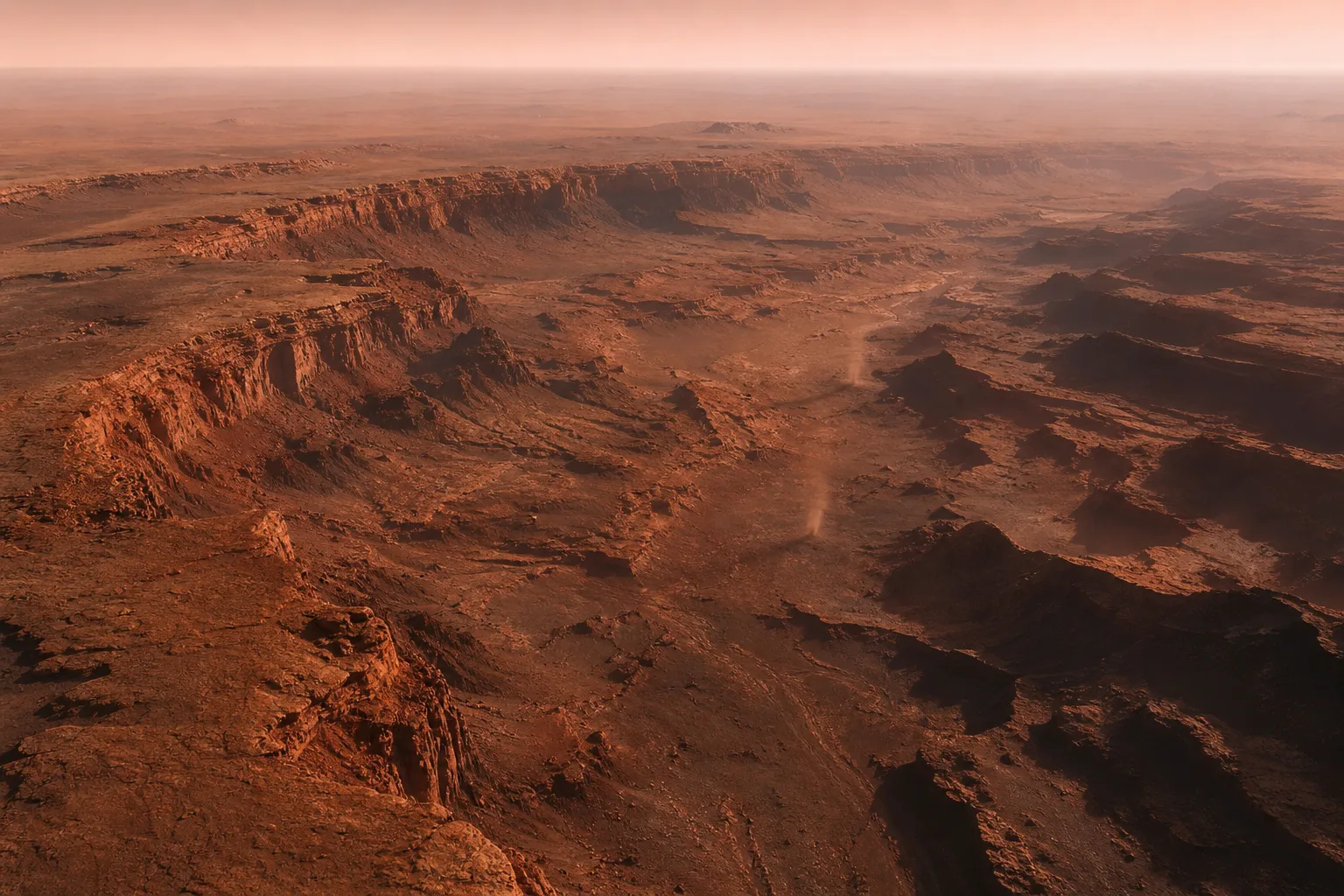
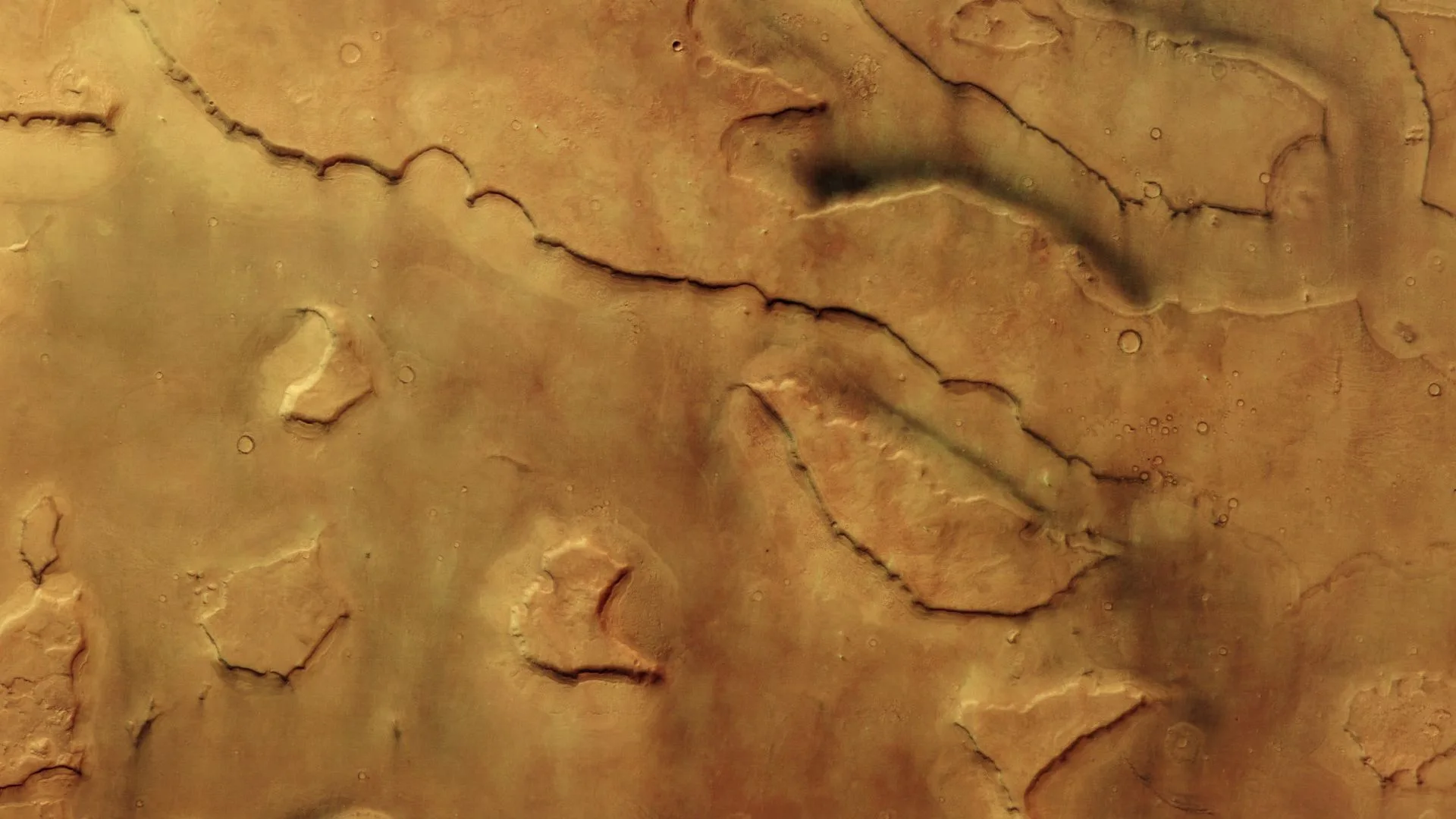
There’s something quietly extraordinary about the fact that, right now, while you’re reading this, a European spacecraft is circling Mars and sending back images like the one that dropped this week. ESA’s Mars Express orbiter has photographed Mamers Valles — a sprawling canyon network in the planet’s northern hemisphere — and tucked inside that image are 30 Mars dust devils, spinning silently through one of the oldest landscapes in the solar system.
- Mars dust devils — 30 of them — were spotted by ESA’s Mars Express orbiting the vast Mamers Valles canyon system.
- Mars dust devils can tower nearly 5 miles high and travel at speeds of up to 148 feet per second, dwarfing anything on Earth.
- Mamers Valles stretches nearly 600 miles and connects Mars’ ancient southern highlands to its northern lowlands.
- Debris-covered glaciers buried in the valley region likely hold water ice beneath the surface, a key target for future missions.
Table of Contents
What Mars Dust Devils Actually Are
Mars dust devils are, at their core, exactly what they sound like: vortices of wind that spiral upward while dragging loose surface dust along for the ride. Think of them as cousins to the dust devils you might see crossing a dry field on a hot summer afternoon — except on Mars, they’re operating on an entirely different scale. While Earth’s dust devils rarely exceed a few hundred feet in height, Martian versions can climb to almost 5 miles (around 8 kilometres) tall. Their horizontal speed can hit around 148 feet (45 metres) per second. These aren’t gentle curiosities. They’re serious atmospheric events.
What makes the Mars Express image particularly striking is the sheer number caught in a single frame. Thirty Mars dust devils, visible as small yellow dots trailing pinkish shadows across the valley floor. ESA has helpfully annotated the image for anyone who wants a guided tour, but hunting for them yourself is genuinely entertaining — the Martian equivalent of a very arid ‘Where’s Waldo.’
This isn’t the first time we’ve documented these phenomena in impressive numbers. Mission teams have previously tracked around 1,000 dust devils racing across the Red Planet in a single observational window. And NASA’s Perseverance rover — currently working the Jezero Crater region — has delivered some of the most memorable footage yet, including a clip of two separate devils merging into one larger vortex, and audio recordings in which a passing devil produces an audible crackling sound. The fact that we’ve now heard a Martian dust devil is still, frankly, remarkable.
Mamers Valles: 3.8 Billion Years of Martian History
The backdrop for all of this — Mamers Valles — deserves attention in its own right. Stretching nearly 600 miles (roughly 1,000 kilometres) across Mars’ northern hemisphere, this valley system is estimated to be about 3.8 billion years old. To put that in context, that predates complex life on Earth. It’s not just old; it’s ancient in a way that’s hard to fully process.
Geologically, Mamers Valles plays a significant connecting role. According to ESA, the system links Mars’ ancient southern highlands — the heavily cratered, geologically older terrain — to the smoother northern lowlands. That kind of transitional geography tends to be scientifically rich, preserving records of how the planet evolved across billions of years.
But perhaps the most mission-relevant detail is what’s hiding along the valley edges: glaciers. Not active ones — Mars hasn’t had those for a very long time — but debris-covered remnants, buried under layers of rock and dust. ESA’s assessment is that water ice almost certainly lies beneath that debris cover. And water ice on Mars is, to put it mildly, a big deal. It’s a potential resource for future crewed missions, a possible habitat for microbial life (past or present), and a window into the planet’s wetter geological history.
Why Tracking Mars Dust Devils Has Real Scientific Value
Beyond the visual spectacle, Mars dust devils are doing something genuinely useful for planetary scientists: they’re making the invisible visible. Mars’ wind patterns can’t be directly observed from orbit in the way that, say, cloud formations can. But dust devils leave tracks — literal lines scraped across the surface where the vortex has swept away the top layer of reddish dust to expose darker material beneath. By tracking where Mars dust devils form, how they move, and how frequently they appear in specific regions, researchers can build detailed wind maps for areas that ground-based instruments might never reach.
That data has direct practical applications. Future Mars missions — whether robotic or eventually crewed — will need precise atmospheric and wind data for landing site selection, surface operations planning, and trajectory modelling. Getting that wrong isn’t an option when you’re talking about missions costing billions of dollars and potentially involving human lives. The dust devils, in other words, are doing some of the reconnaissance work for us.
There’s also the broader atmospheric science angle. Mars’ thin atmosphere — roughly 1% the density of Earth’s — behaves differently from anything we can model purely from terrestrial data. Every storm system, every dust devil, every seasonal wind shift adds to our understanding of how planetary atmospheres work under conditions radically different from our own. That has implications beyond Mars exploration, feeding into comparative planetology and even climate modelling here on Earth.
Mars Express: Still Delivering After Two Decades
It’s worth pausing to appreciate what Mars Express represents. Launched in 2003, the spacecraft has been orbiting Mars for over two decades — an operational lifespan that has far exceeded its original design. ESA has repeatedly extended the mission, and the orbiter continues to return high-quality imagery and atmospheric data. The Mamers Valles image is just the latest example of why that investment has been worthwhile.
Mars Express isn’t alone up there. NASA’s Mars Reconnaissance Orbiter, MAVEN, and the UAE’s Hope Probe are also currently active around the Red Planet, each contributing different observational capabilities. Between them, these spacecraft are building one of the most detailed pictures of another planet ever assembled. And on the surface, Perseverance and the Ingenuity helicopter (which completed its final flight in January 2024 after suffering rotor damage) have added ground-level context that orbital imagery alone can’t provide.
What Comes Next for Mars Exploration
The debris-covered glaciers spotted in and around Mamers Valles point toward an obvious question: could a future mission drill down into that ice? The scientific return would be enormous. Water ice preservation on Mars could mean preserved organic compounds, potential biosignatures, or at minimum a detailed chemical record of the planet’s climatic past. The Mars Ice Mapper mission concept — a collaboration between NASA, ESA, JAXA, and the Canadian Space Agency — was specifically designed to map subsurface ice deposits. Budget pressures have complicated its timeline, but the scientific case for it hasn’t weakened.
Crewed Mars missions remain further out on the horizon, contingent on factors ranging from the trajectory of NASA’s Artemis lunar programme to the development of reliable life-support and propulsion systems. SpaceX’s Starship, which Elon Musk has positioned as the eventual vehicle for Mars transit, continues its own incremental test programme.
In the meantime, Mars dust devils spotted by a 20-year-old European orbiter quietly remind us of how much this planet still has to offer — and how much of it we’re only beginning to map. The next image from Mars Express might just contain another 30.
Frequently Asked Questions
What exactly are Mars dust devils and how do they form?
Mars dust devils are whirling columns of wind that pick up surface dust as they spin, essentially functioning like small tornadoes. On Mars they can reach nearly 5 miles tall and travel at roughly 148 feet per second.
Why do scientists study Mars dust devils so closely?
Mars dust devils act as natural tracers for the planet’s wind patterns, which are otherwise invisible. Mapping those winds helps researchers plan for future missions and also contributes to broader understanding of the Martian environment, including the planet’s watery past and evolution over time.
What is Mamers Valles and why does it matter for Mars exploration?
Mamers Valles is a roughly 600-mile-long valley system estimated to be around 3.8 billion years old. It links the planet’s ancient southern highlands to its northern lowlands and contains debris-covered glaciers believed to hold water ice beneath the surface.
Has any Mars rover directly observed dust devils before?
Yes. NASA’s Perseverance rover has filmed dust devils on multiple occasions, including footage of two separate devils merging into a single larger one. Perseverance has also captured audio in which dust devils produce a distinct crackling sound as they pass.