
The Ether price is caught in an uncomfortable standoff. At just under $1,700, ETH can’t push higher, but it hasn’t completely collapsed either — and that’s exactly what’s worrying analysts right now. When a market stalls at resistance, it rarely ends quietly. The data coming out of derivatives platforms and on-chain trackers is pointing in one direction: another selling wave could be building.
- Ether price is struggling at $1,700 resistance as Binance records 57,700 ETH in net inflows, a classic sell signal.
- Ether price futures open interest has collapsed 31% to a year-low of $10.3 billion, reflecting fading trader conviction.
- The estimated leverage ratio dropped from an all-time high of 1.10 on June 2 to just 0.83, marking the biggest unwind in months.
- Analysts identify $1,384 as the next key liquidity target if buying pressure fails to hold the current demand zone.
Table of Contents
Binance Inflows and the Ether Price Pressure Problem
One of the clearest red flags on-chain right now is what’s happening with Binance. Crypto analyst Pelin Ay, citing CryptoQuant data, flagged that roughly 57,700 ETH flowed into Binance on a net basis over the past few days. That’s not a trivial number. When tokens move from cold wallets to exchanges at this scale, it typically means holders are getting ready to sell — and Binance, as one of the most liquid crypto trading venues on the planet, is where you go when you’re ready to exit a position.
What makes this reading more concerning is the context sitting alongside it. The number of new ETH depositors — a proxy for fresh demand entering the market — is sitting at roughly 320 addresses. That’s well below what analysts would expect to see during any healthy demand surge. Without new buyers coming in to absorb that supply, the Ether price is essentially dependent on existing holders staying put. That’s a fragile equilibrium at best.

Ay noted that daily ETH issuance stands near 2,791 ETH, a relatively modest figure since Ethereum’s EIP-1559 upgrade in 2021 introduced a base fee burn mechanism that permanently altered the network’s supply dynamics. That does offer some structural counterweight to selling pressure — fewer new tokens entering circulation limits how fast supply can overwhelm demand. But it’s not enough on its own to counteract what exchange flow data is showing right now.
Futures Open Interest Hits a Year-Low — What That Tells Us
The derivatives picture for the Ether price is equally sobering. Futures open interest across all exchanges fell to $10.3 billion — down from $15 billion just a month ago. That’s a 31% decline and the lowest aggregate reading since April 2025. In derivatives markets, open interest represents the total value of outstanding contracts. When it drops this sharply, it means traders are unwinding, not building, positions.
This matters because futures markets are where a significant chunk of crypto’s speculative energy lives. A healthy bull run is almost always accompanied by rising open interest — it’s a sign that new money is flowing in and conviction is growing. The current trend is the opposite. Traders who were leaning into ETH exposure in early June have largely closed out, and there’s little evidence that new speculative positioning is filling the gap.
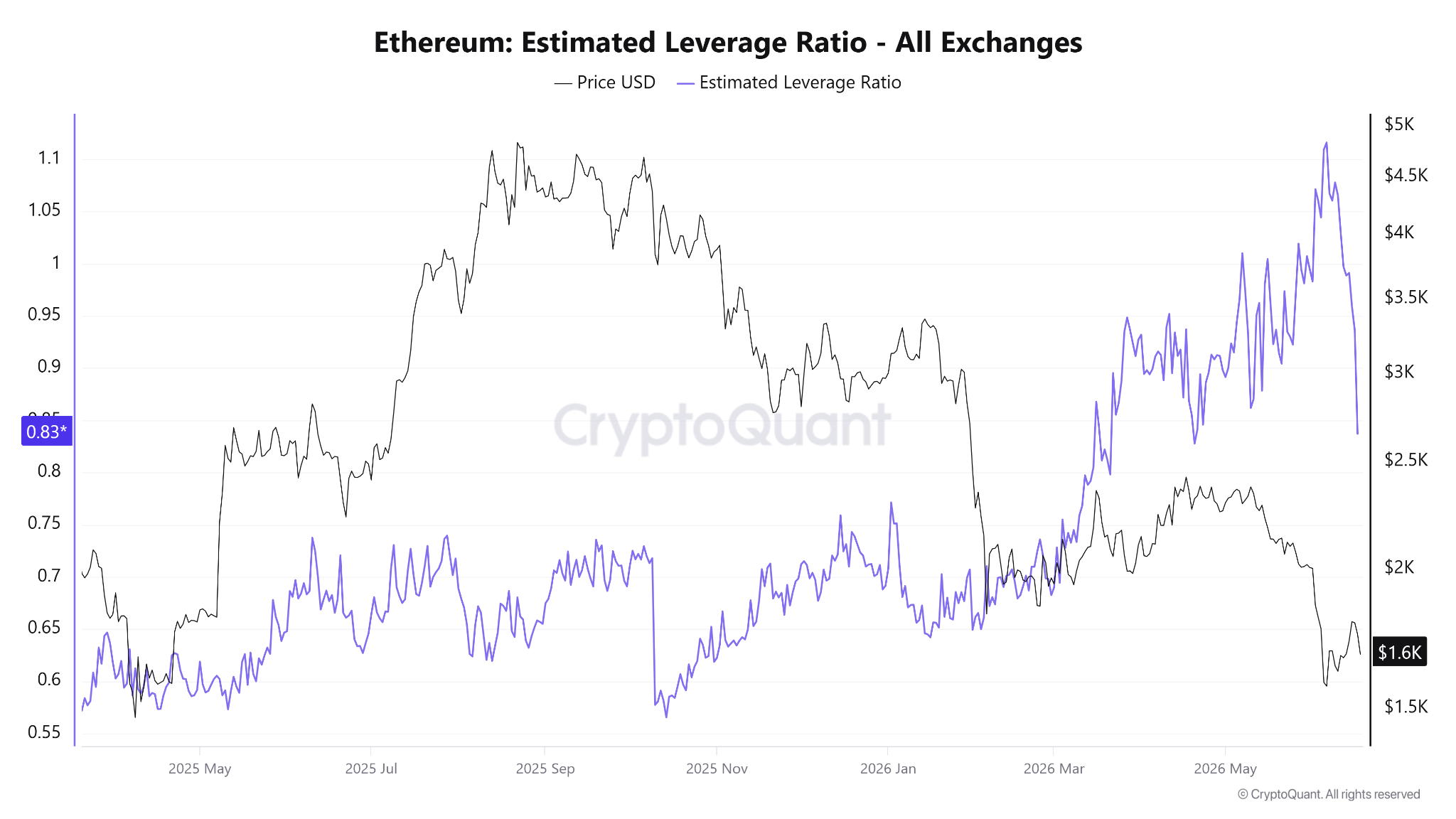
The estimated leverage ratio (ELR) tells a similar story. The metric, which measures how much leverage traders are carrying relative to the total market size, dropped to 0.83 from an all-time high of 1.10 recorded on June 2. That represents the largest leverage unwind since October 2025, when the ELR slid from 0.72 to 0.56. Lower leverage does reduce the risk of a violent, cascade-style liquidation event — but it also tells you that traders aren’t particularly excited about this market. Caution and conviction don’t coexist well.
Can the Ether Price Hold Its Demand Zone?
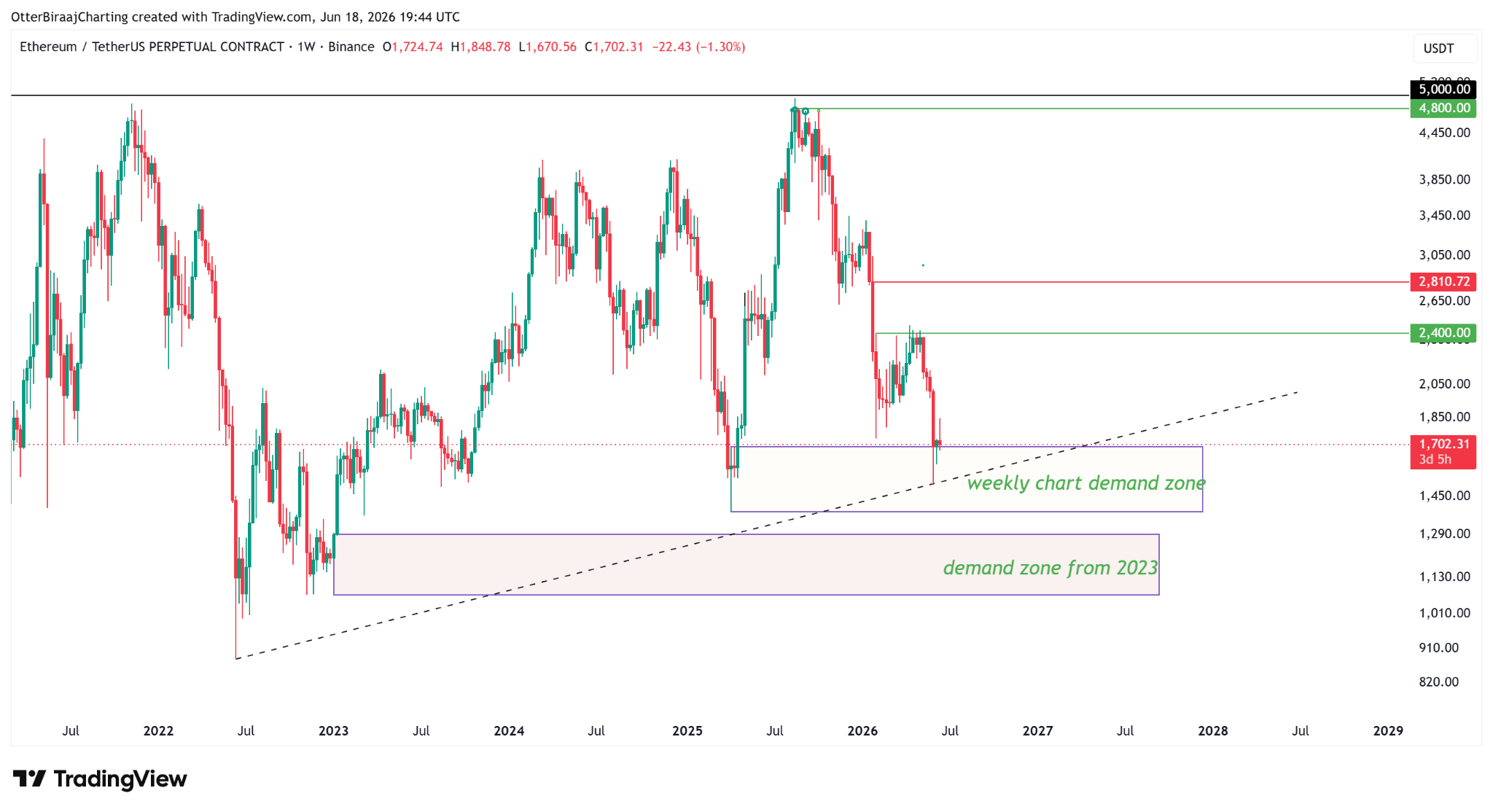
Zoom out to ETH’s weekly chart, and the picture is stark. The Ether price is down roughly 30% over the past 42 days — a meaningful decline that has dragged it back into a critical demand zone that analysts place between $1,400 and $1,700. This isn’t just a random price range. It’s where buyers and sellers have historically done the most work, and where the balance of power between the two groups will likely determine ETH’s medium-term trajectory.
Below that zone, the first obvious level of concern is the April 2025 low at $1,384. That’s the nearest external liquidity target — the kind of price level where stop-losses cluster and where a breakdown could accelerate quickly. Below that, analysts are pointing to a demand zone that stretches from $1,071 to $1,289, last tested during the downturn of January 2023. If ETH reaches those levels, it would represent a significant reset of the market’s value assumptions about Ethereum’s near-term outlook.
Technical Bottoming Signals — Don’t Ignore Them Entirely
It would be a mistake to read only the bearish side of this picture, though. Crypto trader Ardi offered a more measured take last week, pointing out that some technical bottoming signals are beginning to emerge. The Ether price recently touched the lower band of a long-term acceptance range — the kind of area that has historically aligned with macro lows. That doesn’t mean a recovery is guaranteed, but it does mean the risk/reward at these levels is at least worth examining.
The RSI readings are striking, too. ETH’s weekly RSI is sitting near 31 — technically approaching oversold territory. More dramatically, during the recent sell-off, the daily RSI hit 11, its lowest ever recorded level. Extreme RSI readings in either direction don’t predict reversals on their own, but they do indicate that the market has moved far and fast. Markets that move that far, that fast, often find some degree of stabilisation — even if it’s temporary.
Ardi also flagged the ETH/BTC pair as a critical chart to watch. It’s continued to trend lower, meaning Ethereum is losing ground relative to Bitcoin regardless of what dollar prices do. For institutional and sophisticated traders, that relative performance is often more important than the outright price. As long as ETH/BTC remains in a downtrend, the argument for rotating into Ether over Bitcoin is a hard one to make.
The Bigger Picture for Ethereum Right Now
The Ether price situation isn’t happening in isolation. Ethereum’s broader narrative has faced headwinds this year — competition from faster, cheaper Layer 1 chains hasn’t gone away, and while Ethereum’s Layer 2 ecosystem has grown substantially, much of that activity doesn’t directly drive ETH demand the way pure L1 usage did in earlier cycles. There’s a legitimate debate in the crypto community about whether ETH’s monetary premium — the argument for holding ETH as a scarce, yield-generating asset — still resonates as clearly as it once did.
That debate doesn’t get resolved at $1,700. But the confluence of signals right now — elevated exchange inflows, collapsing open interest, a deleveraging derivatives market, and muted new participation — paints a picture of a market that hasn’t yet found its floor. If ETH does see a relief rally toward resistance, the on-chain data suggests sellers may be waiting to meet it. Whether buyers can absorb that pressure will tell us a great deal about where Ethereum stands heading into the second half of 2025.
Frequently Asked Questions
Why is the Ether price struggling to break above $1,700?
The Ether price is facing a wall of supply pressure driven by large exchange inflows on Binance, declining new depositor numbers, and falling futures open interest. Together, these signals suggest more sellers than buyers are positioned at this level, making a clean breakout difficult without fresh capital entering the market.
What does falling futures open interest mean for ETH?
Falling futures open interest means traders are closing positions rather than opening new ones. For ETH, open interest dropped from $15 billion to $10.3 billion in a month, its lowest since April 2025. This reflects reduced speculative appetite and weaker conviction in near-term price direction.
What are the key support levels analysts are watching for Ether?
Analysts are closely watching the $1,400–$1,700 demand zone. If that fails, the April 2025 low of $1,384 becomes the next target. Below that, the demand zone between $1,071 and $1,289 — established back in January 2023 — is the next meaningful area of interest.
Are there any signs that Ether price could be bottoming out?
Some technical signals are encouraging. The weekly RSI is near 31 after touching a record low daily RSI of 11 during the recent sell-off. Trader Ardi also noted that ETH recently touched the lower band of its long-term acceptance range, a level that has historically aligned with macro lows.