

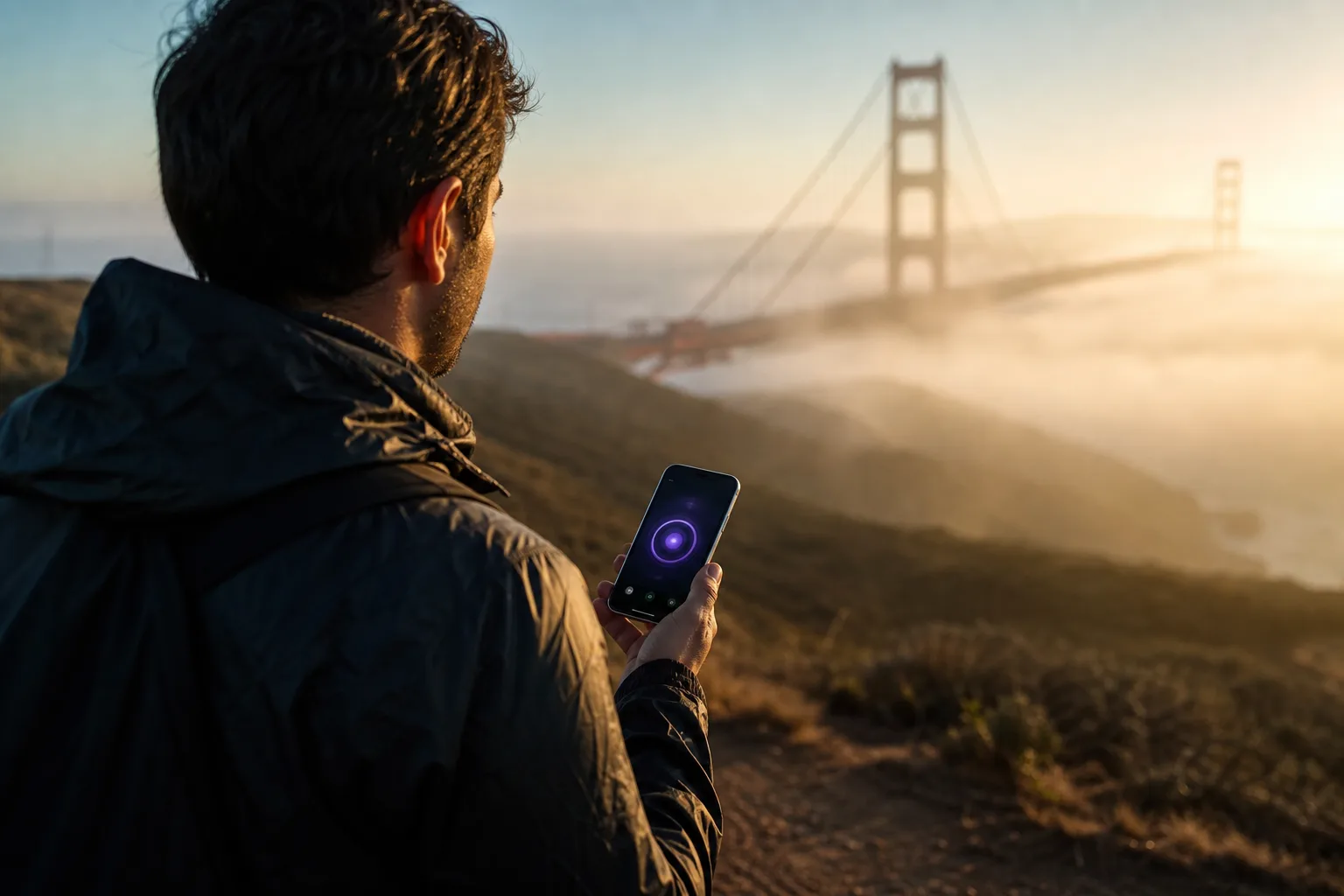
Siri AI — Apple’s long-overdue, deeply personal, and genuinely smarter voice assistant — is almost here. After years of Siri being the butt of every ‘why can’t it just do that?’ joke, Apple is preparing to ship something that actually feels like it belongs in 2025. A developer beta tied to iOS 27 is already in the wild, and early time spent with it paints a surprisingly capable picture.
- Siri AI launches with iOS 27, powered by Google Gemini, marking a major shift in how Apple’s voice assistant works.
- Siri AI uses hyper-personalization — scanning your messages, photos, and emails — to deliver genuinely context-aware responses.
- Apple’s Private Cloud Compute means Siri AI only accesses your data on-demand and doesn’t store it on Apple’s servers.
- Full Siri AI features are limited to iPhone Air, iPhone 17 Pro, and iPhone 17 Max, leaving older devices with a scaled-back experience.
Table of Contents
What Siri AI Actually Is — and Why It Took This Long
Siri AI isn’t just a software update. It’s effectively a ground-up rethink of what Apple’s voice assistant is supposed to be. Announced at WWDC 2026, the new Siri is built on top of Apple Intelligence — and crucially, that framework is now partially powered by Google’s Gemini model, the result of a partnership that raised eyebrows when it was first revealed. Apple, the company that built a business on controlling its own stack, is leaning on a direct competitor’s AI to make its assistant competitive. That’s how far behind the old Siri had fallen.
The previous Siri was fine for setting timers and calling your mum. Ask it anything genuinely open-ended — ‘What should I do this weekend?’ or ‘Find me photos from my trip to Costa Rica’ — and you’d get a list of web links and an awkward pause. That gap between Siri and rivals like Google Assistant or Amazon’s Alexa (let alone OpenAI’s ChatGPT voice mode) had been widening for years. iOS 27 is Apple’s answer to that problem, and it’s a significant one.
Siri AI in the Real World: A Day of Testing
Testing Siri AI on an iPhone 16 Pro Max around San Francisco, the experience is markedly different from anything the old assistant offered. The interface alone signals a shift — Siri now lives inside the iPhone’s search bar and surfaces when you swipe down from the middle of the screen. A translucent, animated orb pulses at the top of the display when it’s listening or thinking. It’s a small visual detail, but it feels intentional. This Siri wants you to notice it’s doing something.
Conversational continuity is one of the headline improvements. You can speak to Siri naturally, swipe down on its reply to continue the conversation in text, and all of those exchanges are logged in a dedicated app. That means you can return to a previous thread — something that sounds minor until you realise how often you lose context mid-task with the old assistant. It also means Siri is no longer an event; it’s closer to a persistent layer sitting across the whole phone.
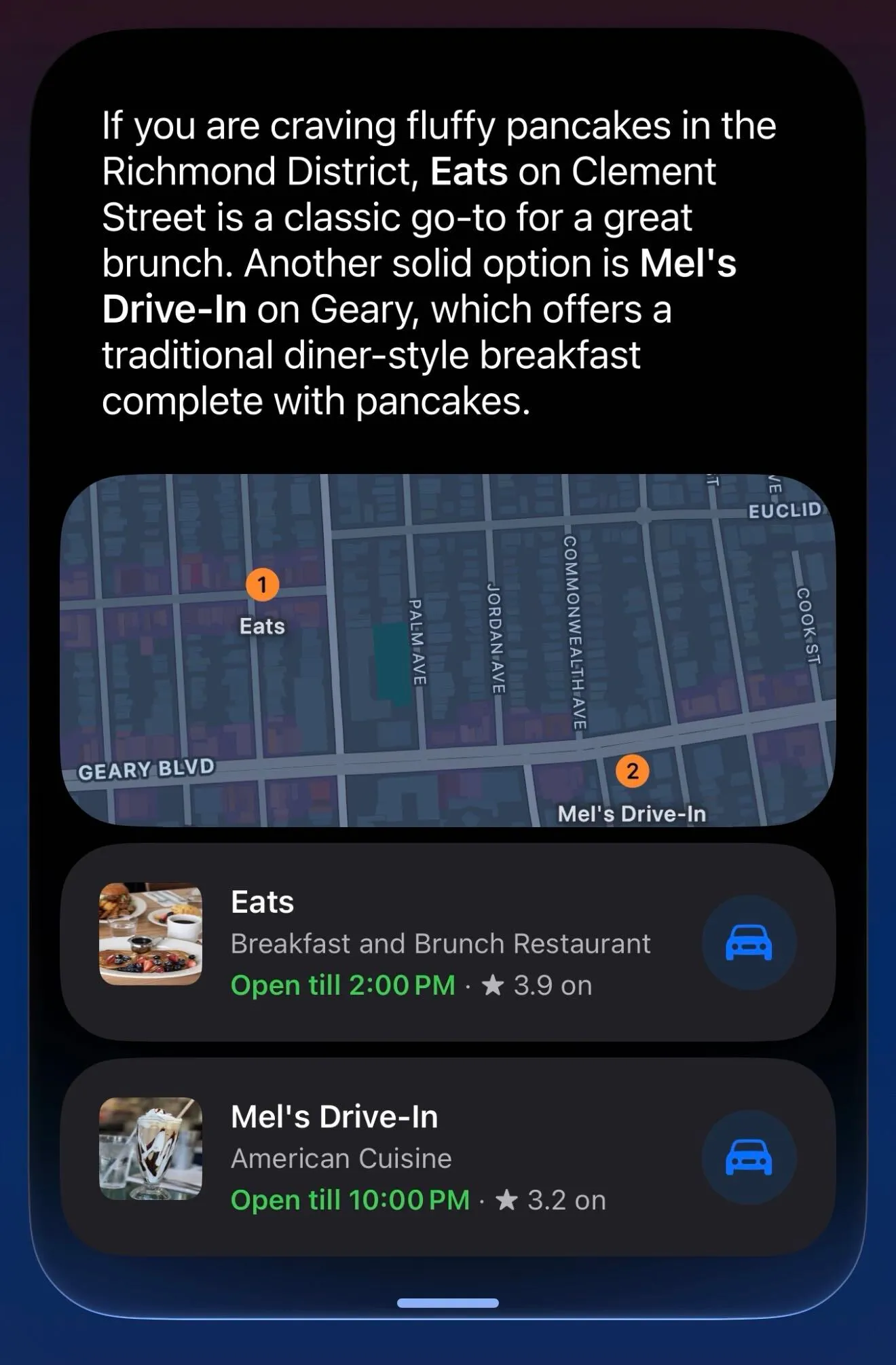
Response length is worth calling out too. Where many AI assistants — ChatGPT, Gemini’s own interface, Copilot — tend toward verbose, multi-paragraph answers that require scrolling, Siri AI keeps things tight. Typically a single paragraph, with key terms bolded for quick scanning. When asked for a sunrise hike route near the Golden Gate Bridge, it surfaced two specific options — one in the Presidio, one in the Marin Headlands — with enough detail to act on immediately, not a wall of caveats. That brevity is a deliberate design choice, and it works well for an assistant you’re talking to on the move.
Siri AI and Hyper-Personalization: The Real Differentiator
The most striking thing about Siri AI isn’t the Gemini integration or the new interface. It’s the personalization. This version of Siri indexes your entire device — messages, photos, emails, calendar — and uses that data to inform every response. Ask ‘What should I do today?’ and instead of pulling up a generic list of San Francisco attractions, Siri combed through recent conversations and surfaced unfinished plans that had been discussed but never locked in. That kind of contextual awareness is something Google has been attempting in its own assistant for years with mixed results. Apple’s angle here is that it can do this while keeping the data on your device, not sending it to a remote server.
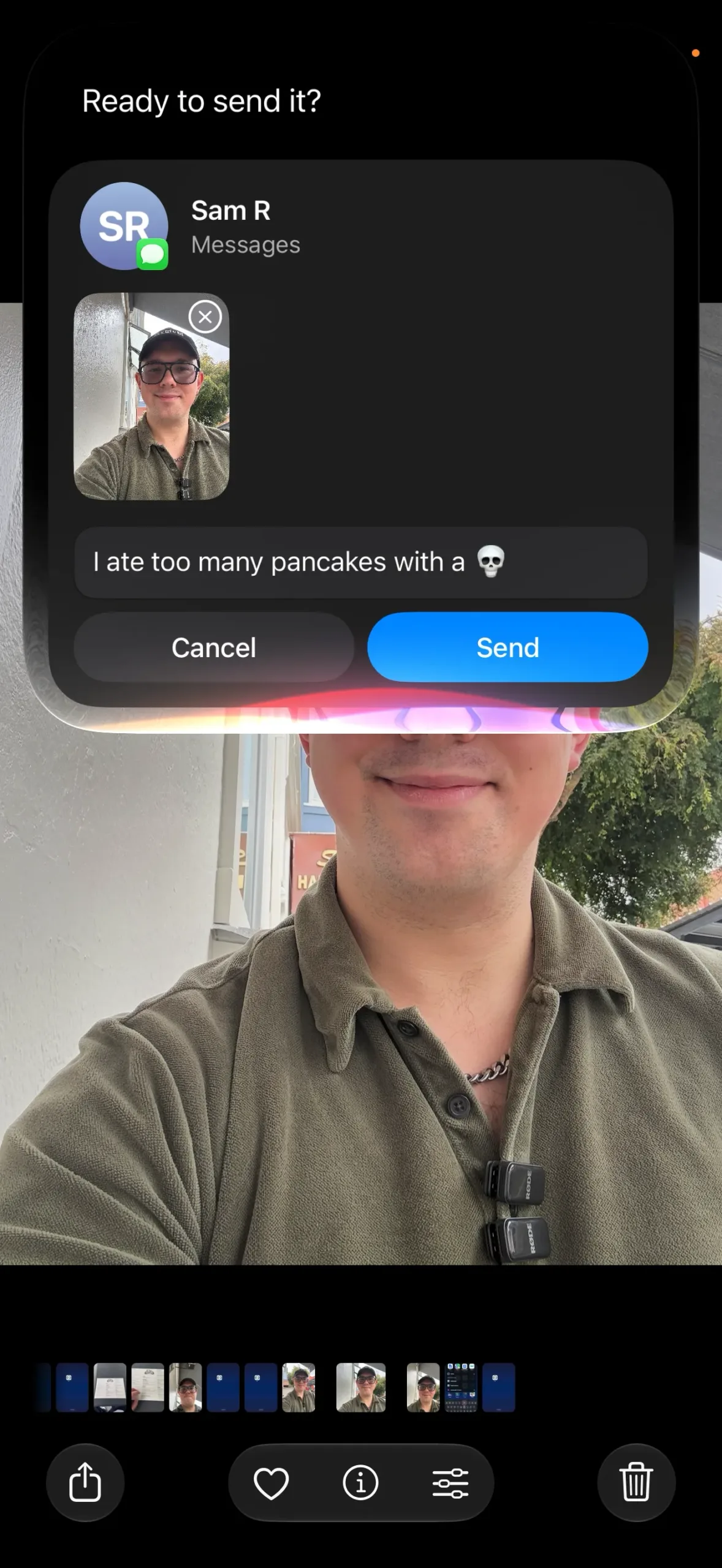
Photo search is another area where this personalization pays off. Ask Siri to find photos from a trip two years ago, and it surfaces them directly in the Siri app without you having to dig through the Camera Roll yourself. It’s genuinely useful — though the system isn’t perfect. When asked to find photos from a hot pot dinner, Siri correctly returned images from that meal, but also flagged photos from a hot tub on vacation. ‘Hot pot’ and ‘hot tub’ share enough visual and semantic overlap to trip the model up. It’s a reminder that even in its more impressive moments, this is still a beta.
There was also a camera integration hiccup worth mentioning. When shown a photo of a foggy tree-lined path near the Golden Gate, Siri identified the trees correctly as Monterey cypress — but then described the famous Cypress Tree Tunnel at Point Reyes National Seashore, which is an hour’s drive away. For someone unfamiliar with the Bay Area, that’s a meaningful error. Confident wrongness is one of the persistent failure modes across the entire AI assistant category, and Siri AI isn’t immune to it.
Privacy, Compatibility, and the Limits of the Launch
Apple leaned heavily on privacy messaging at WWDC 2026. Its Private Cloud Compute architecture is the technical backbone behind the promise that Siri AI doesn’t retain your personal data. The system only pulls from device data reactively — when you ask a question — rather than continuously syncing to Apple’s servers. Users who’d rather not participate can disable Siri AI entirely through settings, same as before.
This is a meaningful position to stake out in 2025. The AI assistant space has a trust problem — from Google’s ad-driven data practices to Amazon’s history of Alexa recording mishaps — and Apple is betting that privacy-first design is a genuine differentiator, not just a marketing line. Whether Apple’s privacy claims can withstand independent scrutiny is a separate question, and it’s one the security research community will no doubt get to work on once iOS 27 ships publicly.
On the hardware side, there’s a real fragmentation story playing out. Testing on an iPhone 16 Pro Max means accessing most, but not all, of Siri AI’s features. The full experience — including more varied voice options and every capability Apple has announced — is reserved for the iPhone Air, iPhone 17 Pro, and iPhone 17 Max. Every iPhone 16 model and above, plus the iPhone 15 Pro and Pro Max, will run a version of Siri AI. Anyone on an older device gets nothing. It’s a familiar Apple playbook, but it’s worth being clear-eyed about: a significant chunk of the installed base will be left out at launch.

Where Siri AI Fits in the Broader AI Assistant Race
The voice assistant market has never been more crowded or more competitive. Google is iterating fast on Gemini’s assistant features. Microsoft has Copilot woven through Windows and its app suite. Amazon is rebuilding Alexa from scratch around its own large language models. And OpenAI’s Advanced Voice Mode has set a high bar for naturalness and personality in conversational AI. Siri AI is entering a race that was already well underway.
What Apple has that none of its rivals can fully replicate is the iPhone’s installed base and the depth of data that lives on those devices. By keeping that data local and using it to personalise responses, Apple is playing to a structural advantage — not just a feature advantage. If it can execute on that promise consistently, and fix the rough edges that are expected in any beta, Siri AI could genuinely reposition Apple in a category it has effectively ceded for the past several years.
The public rollout tied to iOS 27 will be the real test. Betas are controlled environments; hundreds of millions of iPhone users are anything but. Whether Siri AI holds up at scale — and whether Apple can keep tightening the model without compromising the privacy story it’s built the whole thing on — will define whether this relaunch is remembered as a turning point or just a well-timed catch-up.
Frequently Asked Questions
Which iPhones will support Siri AI when iOS 27 launches?
All iPhone 16 and iPhone 17 models will run Siri AI, along with the iPhone 15 Pro and Pro Max. The full feature set — including more varied voice options — is exclusive to the iPhone Air, iPhone 17 Pro, and iPhone 17 Max. Older iPhones won’t be compatible at all.
Does Siri AI store your personal data on Apple’s servers?
Apple says no. Under its Private Cloud Compute framework, Siri AI only pulls from your personal data when you ask it a direct question. Apple claims this data isn’t stored server-side, though users who aren’t interested in Siri AI can turn it off in settings.
What role does Google Gemini play in Siri AI?
Google’s Gemini model now powers the underlying intelligence in Apple Intelligence, the framework behind Siri AI. This partnership drives the assistant’s improved natural language understanding and its ability to deliver genuinely useful, contextually relevant answers rather than just returning search links.
Can Siri AI work with third-party apps like Meta Messenger?
Yes. Siri AI isn’t locked into Apple’s own ecosystem. When drafting messages, for example, it will ask whether you want to send via Apple Messages or Meta’s Messenger — a meaningful shift from the old Siri, which largely operated within Apple’s walled garden.

