
Morgan Stanley wants to win the next crypto ETF race before it’s even properly started. On June 18, the bank filed amended registration statements for proposed ETH and SOL ETFs carrying a 0.14% annual delegated sponsor fee on both products — a number that immediately drew attention from market observers and, by any honest reading, repositions the competitive landscape for institutional crypto exposure.
- Morgan Stanley’s ETH and SOL ETFs propose a 0.14% annual fee, undercutting every major US competitor including BlackRock’s 0.25% ETHA.
- The ETH and SOL ETFs both include staking, with the SOL trust able to stake up to 100% of holdings and retain 95% of rewards.
- Institutional flow data for 2026 shows episodic, not sustained, demand for ETH and SOL — making Morgan Stanley’s timing a calculated bet.
- Both products still need SEC approval, with staking treatment and custody arrangements potentially requiring further filing amendments.
Table of Contents
The Lowest Fee in the Field — By Design
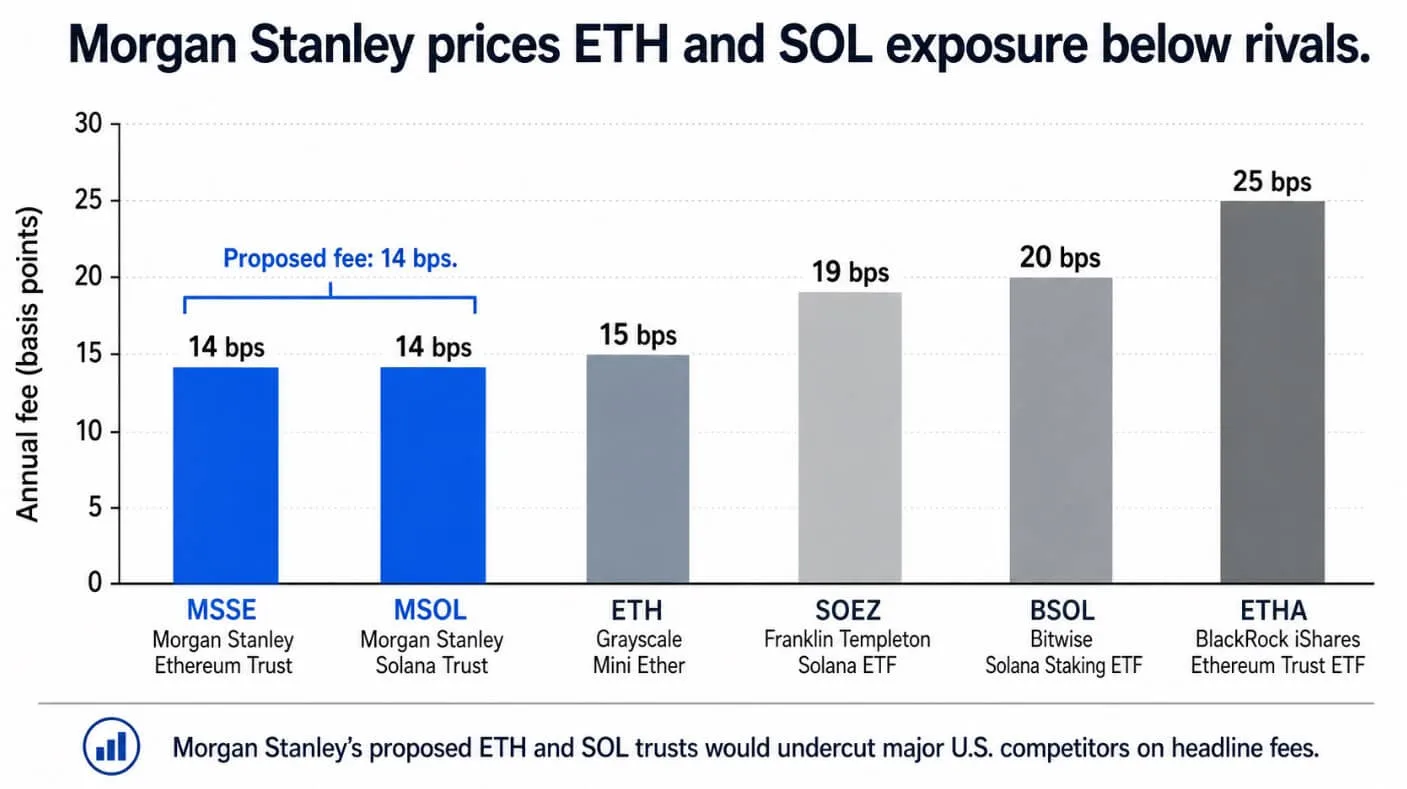
Fourteen basis points is a deliberate statement. Bloomberg senior ETF analyst Eric Balchunas described Morgan Stanley’s proposed fee as the lowest among ETH and SOL ETFs available anywhere globally. To put that in context: BlackRock’s iShares Ethereum Trust ETF (ETHA) charges 0.25%. Grayscale’s mini Ether product sits at 0.15%. On the Solana side, Bitwise’s staking ETF (BSOL) launched at 0.20%, and Franklin Templeton’s SOEZ carries a 0.19% net expense ratio. Morgan Stanley’s proposed MSSE and MSOL undercut every one of them, in some cases by a meaningful margin.
This isn’t accidental. The firm manages approximately $1.8 trillion in assets under management or supervision through Morgan Stanley Investment Management — figures reported as of September 30, 2025 — and operates across 42 countries. That distribution network is the real asset here. A 14 bps fee attached to a Morgan Stanley brand isn’t just competitive pricing; it’s a bid for advisor shelf space at scale. When a wealth manager at a Morgan Stanley branch goes to build a digital asset sleeve for a client, the ETH and SOL ETFs MSSE and MSOL are already priced to win the internal comparison before the conversation even begins.
ETH and SOL ETFs With Staking Built In
The fee is only part of the story. What distinguishes these ETH and SOL ETFs from simpler spot vehicles is how aggressively both trusts are structured around staking economics. The Ethereum trust — expected to trade on NYSE Arca under the ticker MSSE — intends to stake between 50% and 80% of its holdings under normal market conditions. Staking service providers and custodians would take an aggregate 5% of rewards, with the trust retaining the remaining 95%.
The Solana trust (MSOL) pushes that model further, allowing up to 100% of holdings to be staked under the same 95% retention structure — and with the delegated sponsor explicitly receiving no portion of staking rewards. Using Bitwise’s disclosed gross staking reward rate of 6.28% as a market benchmark, a fully staked SOL product retaining 95% of those rewards would generate roughly 5.97% annually before the 14 bps fee is applied. That’s a materially different proposition than a plain-vanilla spot ETF sitting at 20 basis points with no yield.
On the Ethereum side, assuming a hypothetical 3% gross staking yield with 50%–80% of holdings staked, the trust’s retained staking contribution lands somewhere between roughly 1.29% and 2.14% after fees. These aren’t guaranteed numbers — staking yields fluctuate with network conditions — but the framework matters. Advisors evaluating these ETH and SOL ETFs aren’t just comparing expense ratios anymore. They’re running fee-minus-staking economics: gross yield, the percentage staked, the trust’s 95% cut, and the sponsor fee all feed into a single effective-cost-of-exposure calculation. Against a competitor charging 20 bps with no staking, a 14 bps staking product is structurally very hard to argue against on numbers alone.

What the Flow Data Actually Says
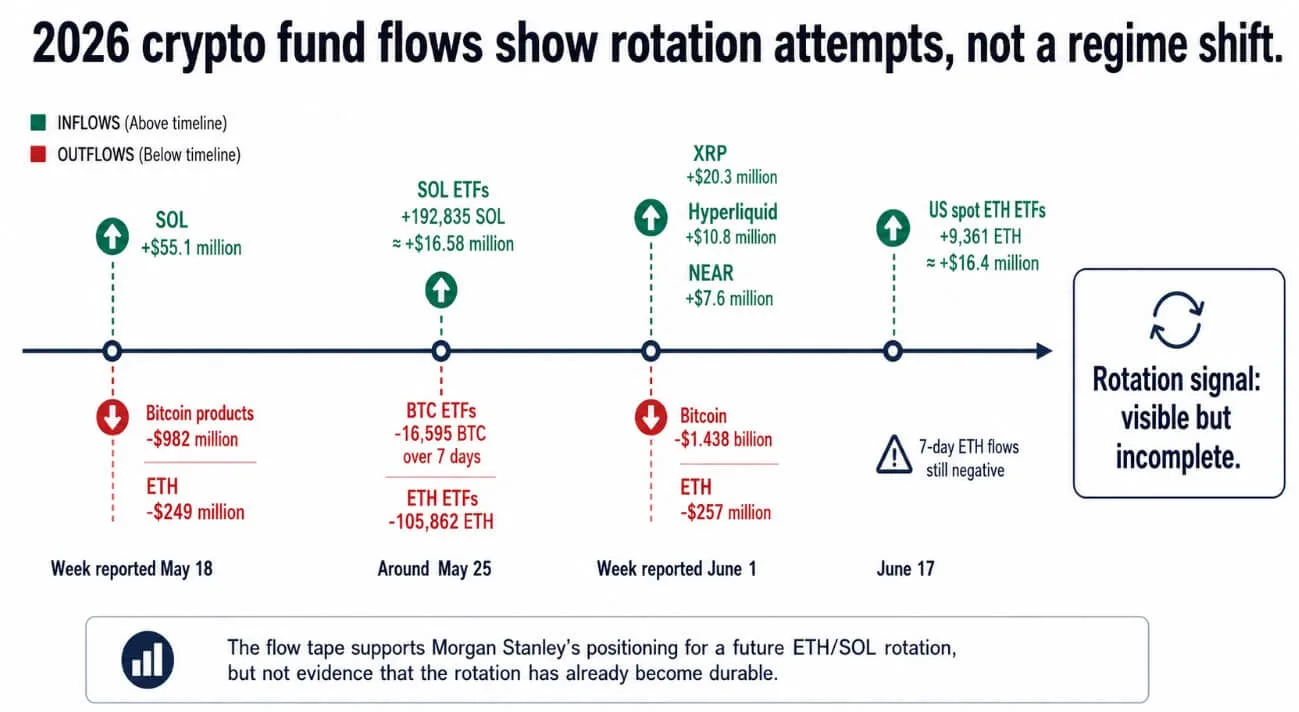
Here’s where things get complicated. Morgan Stanley is pricing its ETH and SOL ETFs for a rotation that the actual flow data describes as episodic and incomplete. The 2026 record shows crypto inflows arriving in patches, not waves.
The week reported May 18 saw Bitcoin products absorb $982 million in outflows, while Solana drew $55.1 million in inflows and Ethereum saw $249 million leave. Around May 25, US spot ETF data showed BTC ETFs shedding roughly 16,595 BTC over seven days, while SOL ETFs added approximately $16.58 million worth of Solana, and ETH ETFs shed 105,862 ETH. By the week ending June 1, Bitcoin outflows hit $1.44 billion and ETH posted another $257 million in outflows — with the positive pockets being XRP at $20.3 million, Hyperliquid at $10.8 million, and NEAR at $7.6 million. On June 17, US spot ETH ETFs logged a single-day inflow of 9,361 ETH (roughly $16.4 million), but seven-day flows for ETH remained negative at week’s end.
What that data paints is a picture of SOL picking up occasional demand while ETH consistently lags, and neither asset attracting anything like a sustained, durable institutional rotation. Altcoin-specific bids are landing on XRP and Hyperliquid — not on the ETH and SOL ETFs pairing as a unit. Morgan Stanley is building products for an allocation trend that hasn’t yet arrived as a structural fact.
The Bull and Bear Cases for This Bet
The bull case is fairly straightforward. Bitcoin ETFs demonstrated that institutional access transforms asset flows. BlackRock’s IBIT crossed $70 billion in assets under management within just 18 months of launch — solving the access problem for institutions seeking Bitcoin exposure. ETH and SOL ETFs, packaged cheaply enough and wrapped in familiar ETF infrastructure with staking yield built in, could follow a similar trajectory once advisors have a repeatable allocation argument. If four or more consecutive weeks of combined ETH and SOL inflows arrive alongside Bitcoin flows going flat or turning positive, 14 bps becomes a structural weapon. Competitors priced at 0.19%–0.25% face a stark choice: cut fees or cede shelf space to a firm with Morgan Stanley’s distribution muscle.
The bear case is harder to dismiss. The Federal Reserve held its policy rate at 3.50%–3.75% through mid-2026, with nearly half of policymakers flagging a possible rate hike for the year and inflation forecasts revised upward. In that macro environment, the case for including ETH and SOL ETFs as portfolio components — rather than staying in Bitcoin-only or cash-equivalent positions — faces a tighter cost-of-capital argument than it did when rates were falling in 2024. Low fees and staking yields only matter after advisors have cleared the first hurdle: convincing clients that the allocation makes sense at all. Morgan Stanley is ready with the price. The broader market still needs to be convinced of the thesis.
When ETH and SOL ETFs Could Actually Trade
There’s also a procedural dimension that shouldn’t be glossed over. Both filings remain preliminary. The SEC must declare each registration statement effective before MSSE or MSOL can trade, and neither has reached that threshold yet. The outstanding questions aren’t trivial — staking treatment carries real regulatory complexity, custody arrangements need to satisfy the agency’s requirements, and tax handling for staking rewards inside an ETF wrapper is genuinely unsettled territory. Any of those issues could force further amendments, extending the timeline.
None of that changes what Morgan Stanley is signaling with 14 basis points. This is a firm that sees the ETH and SOL ETFs space developing into a fee war, and it’s pre-positioning to win that war on price and distribution before the institutional rotation has fully materialized. Whether the market arrives to meet these products on schedule — or whether advisors stay cautious while the macro picture remains uncertain — will determine whether the 0.14% fee becomes a structural advantage or a well-priced vehicle waiting for passengers.
Frequently Asked Questions
What fees are proposed for Morgan Stanley’s ETH and SOL ETFs?
Morgan Stanley filed for a 0.14% annual delegated sponsor fee on both its Ethereum (MSSE) and Solana (MSOL) trust ETFs. Bloomberg senior ETF analyst Eric Balchunas described this as the lowest fee among ETH and SOL products worldwide, undercutting BlackRock’s ETHA at 0.25% and Grayscale’s mini Ether at 0.15%.
How does staking work in Morgan Stanley’s proposed crypto ETFs?
The Ethereum trust plans to stake 50%–80% of holdings under normal conditions, retaining 95% of rewards. The Solana trust can stake up to 100% of holdings on the same 95% retention structure, with the delegated sponsor receiving no portion of staking rewards.
Are Morgan Stanley’s Ethereum and Solana ETFs approved to trade yet?
No. As of the June 18 filing, both registration statements are preliminary and must be declared effective by the SEC before shares can trade. Staking treatment, custody arrangements, and tax handling could all require further amendments before either product launches.
How do ETH and SOL ETF inflows compare to Bitcoin ETF flows in 2026?
Flow data has been mixed and inconsistent. Bitcoin has seen major outflow episodes, while SOL attracted episodic inflows and ETH has generally lagged. No sustained multi-week rotation into ETH and SOL as a combined allocation has emerged yet in 2026.