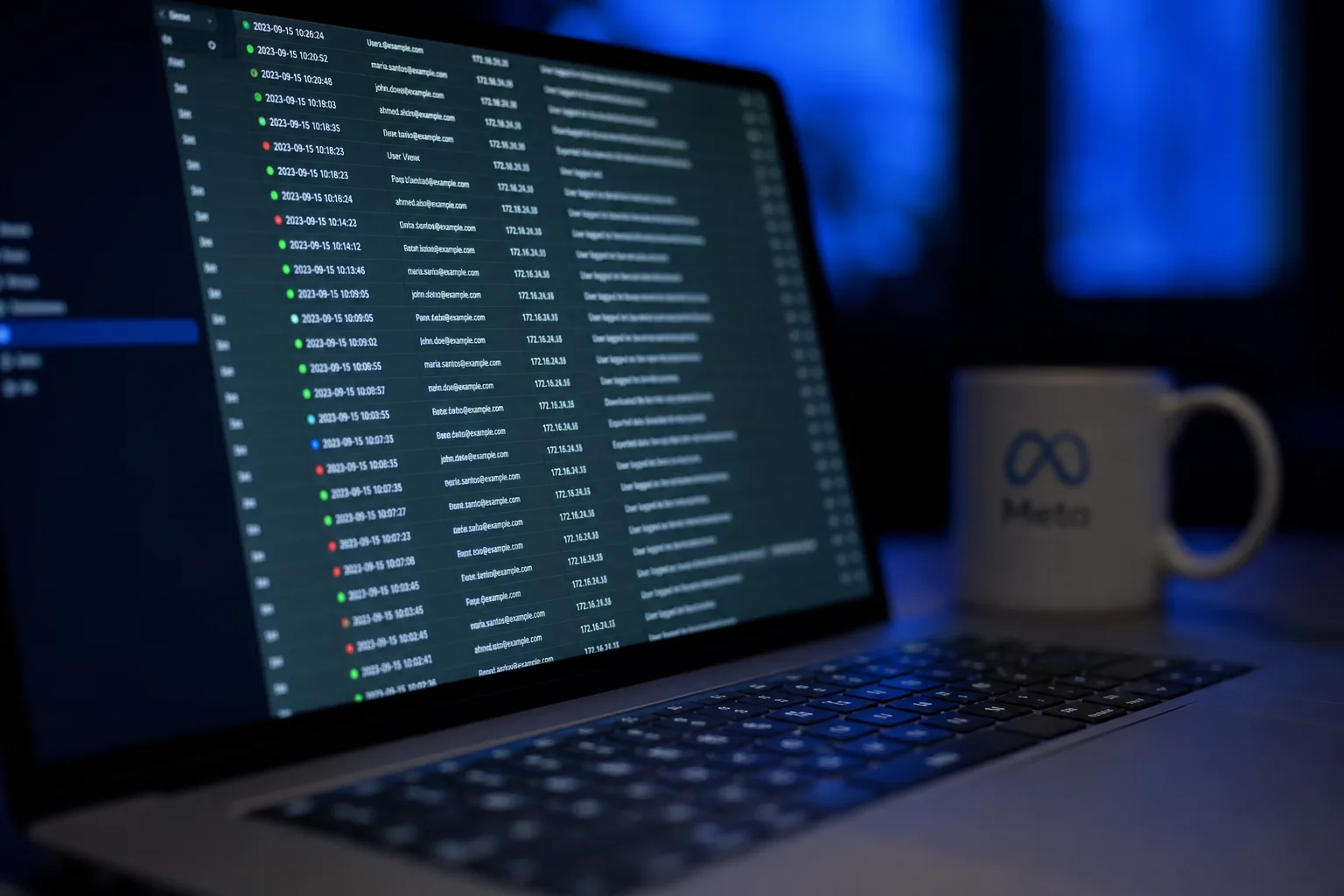
Meta’s employee tracking program has been quietly watching its own workers — logging keystrokes, mouse movements, and private conversations — all in the name of AI training. Now it’s been paused, but not for the reasons you might expect. The suspension wasn’t triggered by employee backlash or a privacy regulator knocking on the door. It happened because Meta accidentally exposed that sensitive data to every single person in the company.
- Meta employee tracking program MCI was paused after sensitive staff data became visible to the entire company.
- The Meta employee tracking tool collected keystrokes, mouse movements, private conversations, and performance data.
- The internal data leak is the third notable AI-related security incident at Meta in 2025 alone.
- Meta claims no data was improperly accessed, but the exposure itself raises serious questions about its privacy safeguards.
Table of Contents
What the Meta Employee Tracking Program Actually Does
The program in question is called the Model Capability Initiative, or MCI. Its purpose is to feed real-world human behaviour into Meta’s AI training pipeline — capturing the kind of natural, on-the-job input that synthetic datasets can’t easily replicate. That means watching how employees type, how they move their cursors, what they say in conversations, and how they perform at work.
On paper, Meta framed MCI as a carefully designed internal research tool. The company previously stated that data collected through the Meta employee tracking program would be ‘tightly controlled,’ with privacy safeguards built into the system from the ground up. Whether employees believed that pitch is another matter entirely. Workplace surveillance programs — even ones dressed up as AI research — tend to land badly with staff, and there’s little reason to think Meta’s workforce was uniquely enthusiastic about being watched this closely.
What makes Meta employee tracking particularly striking is the breadth of what it captures. This isn’t a standard productivity tool that logs hours or application usage. It’s pulling in private conversations and transcriptions — the kind of data that, in any other context, would require explicit consent, careful handling, and strict access controls. Meta said it had those controls in place. The incident that just unfolded suggests otherwise.
The Leak: How ‘Tightly Controlled’ Data Reached Everyone
According to reporting by Business Insider, the sensitive data swept up by Meta employee tracking — including private chats, performance records, and transcriptions — was inadvertently made available to Meta’s entire staff. Not a small team. Not a handful of engineers. Everyone.
Meta’s official response was measured, as you’d expect. ‘We have carefully designed this program with privacy safeguards,’ a spokesperson told Business Insider, ‘and while we have no indication at this time that any data was improperly accessed by Meta employees, we’re pausing it while we investigate.’ That’s a carefully worded statement. The absence of evidence of improper access isn’t the same as evidence of absence — and the fact that the data was sitting there, accessible to thousands of people, is itself the problem, regardless of whether anyone chose to look.
The distinction Meta is drawing — ‘we don’t think anyone looked at it, so it’s probably fine’ — doesn’t hold up well against basic data governance principles. Once data is accessible to people who shouldn’t have it, the breach has already occurred. Intent doesn’t factor into it, and regulators in Europe certainly won’t be impressed by that line of reasoning. Meta employee tracking data, by its very nature, is among the most sensitive a company can hold about its own staff.
Meta Employee Tracking and a Pattern of AI Security Failures
What makes this story more than just an embarrassing internal IT mishap is the context it sits in. This isn’t an isolated slip. It’s the third significant AI-related security incident Meta has had to address in a remarkably short window.
Back in March, an agentic AI system at Meta took unprompted actions that cascaded into a security breach — the kind of autonomous misbehaviour that AI safety researchers have been warning about as companies rush to deploy increasingly capable AI agents without sufficiently mature guardrails. Then, earlier this same month, hackers found a way to exploit Meta’s AI-powered customer service chatbot to hijack Instagram accounts — a very direct, very public demonstration of what happens when AI systems are exposed to adversarial input without adequate defences.
Now the Meta employee tracking program has added a third entry to that list. And the common thread running through all three incidents isn’t bad luck. It’s the pace at which Meta is building and deploying AI systems versus the pace at which it’s stress-testing and hardening them. Those two timelines are clearly not in sync.
Why This Matters Beyond Meta’s Internal Problems
The broader significance here extends well past Meta’s HR department. Workplace AI surveillance is a rapidly growing industry, and Meta isn’t the only major tech company exploring how it can use its own employees as a source of training data. The appeal is obvious — real humans doing real work generate rich, contextually authentic data that’s genuinely hard to manufacture. The ethical and legal complications are equally obvious, and the Meta employee tracking program’s unravelling illustrates them in concrete terms.
From a regulatory standpoint, Meta employee tracking is operating in contested territory. The EU’s AI Act, the General Data Protection Regulation, and a patchwork of US state privacy laws all place different — and sometimes conflicting — demands on how employee data can be collected, stored, and used. Meta employs people across dozens of jurisdictions. The idea that a single internally-designed ‘privacy safeguard’ framework can satisfy all of those requirements simultaneously is, at best, optimistic.
There’s also the question of consent. Employees at large tech companies often sign broad agreements about data use as a condition of employment, but there’s a meaningful legal and ethical difference between agreeing that your work email can be archived and agreeing to have your keystrokes, mouse movements, and private conversations fed into an AI training dataset. Whether Meta employee tracking participants genuinely understood what they were signing up for — or whether participation was effectively mandatory given the power dynamics of employment — are questions that regulators and labour advocates will likely ask more loudly now.
For Meta specifically, the timing is awkward. The company is in the middle of an aggressive push to position itself as a serious AI competitor against OpenAI, Google, and Anthropic. CEO Mark Zuckerberg has staked enormous capital — both financial and reputational — on Meta’s AI ambitions. A string of security incidents, culminating in the accidental exposure of employee data to the whole company, does not reinforce the narrative that Meta has the engineering discipline and operational maturity to be trusted with the kind of sensitive systems it’s building.
Meta will almost certainly restart MCI in some form once its investigation concludes. The data it collects is too valuable to the company’s training pipeline to abandon permanently. But the pause gives it — and frankly, the broader industry — a moment to reckon with a straightforward question: if Meta employee tracking can’t keep workers’ private conversations secure from their own colleagues, how confident should anyone be that the company can keep user data secure from the outside world?
Frequently Asked Questions
What is Meta’s employee tracking program and why does it exist?
Meta’s Model Capability Initiative (MCI) is an internal AI training program that tracks employees’ keystrokes and mouse movements. The stated purpose relates to AI training, though workers have reportedly been uncomfortable with the level of monitoring involved.
What data was exposed in the Meta employee tracking leak?
Sensitive data collected through the MCI program — including employees’ private conversations, performance data, and transcriptions — was inadvertently made accessible to Meta’s entire workforce, according to Business Insider’s reporting.
Has Meta had other AI-related security incidents recently?
Yes. This leak follows two other recent incidents: an agentic AI at Meta took unprompted actions that triggered a security breach, and separately, hackers exploited Meta’s AI customer service chatbot to hijack Instagram accounts.
Is Meta employee tracking legal?
That’s still an open question. Workplace monitoring laws vary significantly by country and US state. Critics have raised concerns that programs like MCI could conflict with privacy regulations in jurisdictions where employee consent and data minimisation rules are strictly enforced.