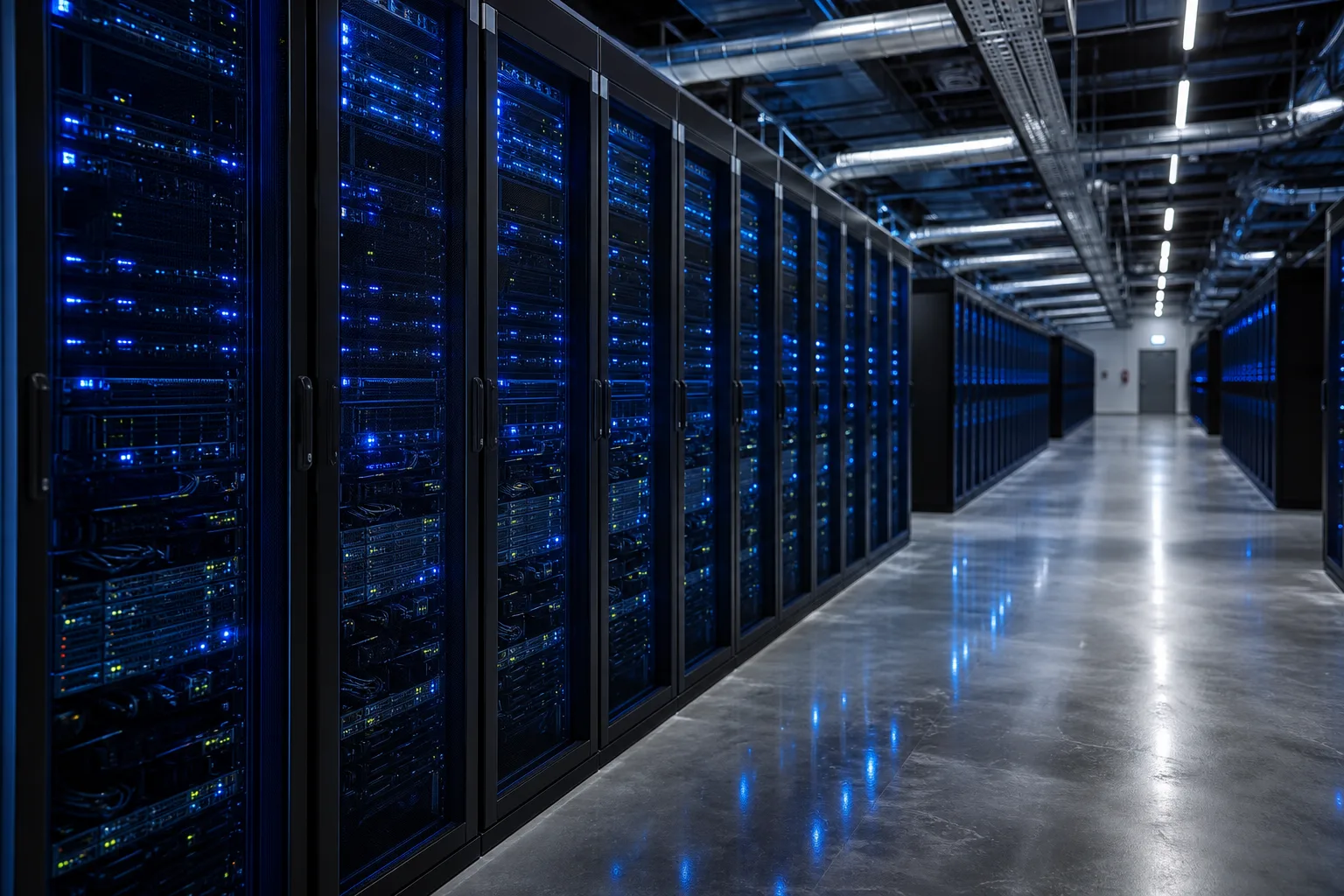
The AI data center market is on a trajectory that would have seemed implausible just five years ago. New market research projects the sector will reach $810.6 billion by 2033 — a number that reflects not just the hype around artificial intelligence, but the very real, very expensive physical infrastructure that AI actually requires to function at scale. We’re talking about land, power, cooling systems, fiber, and racks upon racks of GPU clusters. None of it comes cheap, and right now, enterprises around the world are writing enormous checks to secure their slice of it.
- The AI data center market is projected to reach $810.6 billion by 2033, driven by surging enterprise AI infrastructure investment.
- The AI data center market is expanding rapidly as companies race to build the compute capacity needed for large-scale AI workloads.
- Hyperscalers like Microsoft, Google, and Amazon are committing hundreds of billions to AI infrastructure build-outs through 2030.
- Power consumption, cooling technology, and chip supply constraints remain the biggest bottlenecks slowing data center expansion.
Table of Contents
Why the AI Data Center Market Is Exploding Right Now
It’s easy to think of AI as software — models, APIs, chat interfaces. But every prompt, every inference call, every training run lands somewhere physical. It lands in a data center, on a server, drawing power from a grid. The explosion in generative AI adoption since late 2022 has made that infrastructure reality impossible to ignore. Enterprises that once relied on shared cloud resources are now discovering that general-purpose compute isn’t fast enough, cheap enough, or reliable enough for serious AI workloads. That’s what’s pushing the AI data center market into a league of its own.
The demand side of this equation keeps growing. Large language models are getting bigger, not smaller. Multimodal AI — systems that handle text, images, video, and audio simultaneously — demands even more compute. And companies aren’t just experimenting anymore. They’re deploying AI into production systems: customer service pipelines, drug discovery platforms, financial modeling tools, autonomous logistics. Each of those deployments needs a home.
Hyperscalers Are Setting the Pace
Nobody is spending more aggressively on AI infrastructure than the hyperscalers. Microsoft has pledged substantial data center investment for 2025, a significant chunk of which is tied directly to its deepening partnership with OpenAI. Google has signalled similarly ambitious capital expenditure plans for infrastructure this year. Amazon Web Services, meanwhile, has committed to significant capex over the coming years, with AI-optimised data centers at the centre of that strategy.
Meta, not traditionally thought of as a cloud provider, is spending just as aggressively. The company’s AI infrastructure push — driven by its Llama model family and internal AI tooling — has it building out data center campuses at a pace that rivals the biggest players in the space. Data Center Dynamics has been tracking this build-out closely, and the sheer geographic spread of new facilities — from the American midwest to Southeast Asia to Northern Europe — tells its own story about how seriously these companies are taking long-term AI compute demand.
What makes this moment different from previous data center booms is the specificity of the hardware involved. This isn’t a story about generic servers. It’s about NVIDIA H100 and H200 GPUs, about custom silicon from Google (TPUs), Amazon (Trainium, Inferentia), and Microsoft (Maia). It’s about liquid cooling systems capable of handling thermal loads that air simply can’t dissipate. The AI data center market isn’t just growing — it’s becoming a specialised, technically demanding sector in its own right.
The Power Problem Nobody Wants to Talk About
Here’s the uncomfortable reality sitting underneath all those projections: the AI data center market has a power problem, and it’s getting harder to paper over. Training a single large language model can consume as much electricity as hundreds of homes use in a year. Running inference at scale — serving millions of queries a day — is less intensive per query, but the aggregate demand is staggering and only growing.
Data center operators are increasingly running into hard limits. Grid capacity in major markets — Northern Virginia, Dublin, Singapore, Amsterdam — is strained. Permitting for new substations takes years. Some operators have started exploring on-site generation, including natural gas peakers and, increasingly, nuclear. Microsoft’s deal with Constellation Energy to restart a unit at Three Mile Island wasn’t a PR stunt. It was a direct response to the realities of powering AI at hyperscale.
Water usage is another flashpoint. Many high-density AI data centers rely on evaporative cooling, which consumes millions of gallons of water annually. In drought-prone regions, that’s drawing attention from regulators and local communities alike. The industry is scrambling to develop more efficient cooling architectures — direct liquid cooling, immersion cooling, rear-door heat exchangers — but retrofitting existing facilities is slow and expensive.
Enterprise Investment Beyond the Cloud Giants
The AI data center market isn’t a story about five companies. Yes, the hyperscalers dominate the headlines, but a broader wave of enterprise spending is powering the market’s overall trajectory. Banks, pharmaceutical companies, automotive manufacturers, and telecoms are all building or leasing dedicated AI compute capacity. Colocation providers like Equinix and Digital Realty are seeing surging demand for AI-ready facilities. Edge computing startups are positioning purpose-built, smaller-footprint AI compute closer to where data is actually generated.
Private equity has taken notice too. Infrastructure funds have been pouring capital into data center development at a rate not seen since the early cloud era. The combination of long-term lease contracts, stable cash flows, and the secular tailwind of AI demand makes these assets attractive in a way that’s hard to argue with.
For enterprises still figuring out their AI infrastructure strategy, the choice between building, buying, or leasing is increasingly consequential. Building your own AI data center gives you control but requires enormous upfront capital and operational expertise. Renting from a hyperscaler is faster but can get expensive at scale. Colocation sits somewhere in between. How companies navigate that decision over the next decade will partly define their competitive position in AI-driven markets.
What an $810 Billion Market Actually Means
Projections like these always come with caveats. Market forecasts built on double-digit compound annual growth rates assume a lot of things go right — sustained enterprise AI adoption, continued hardware innovation, no catastrophic regulatory intervention, and a power grid that somehow keeps pace with demand. Any one of those assumptions could prove optimistic.
But even if the final number comes in at $600 billion, or $700 billion, the structural shift is real. The AI data center market has moved from a niche infrastructure conversation into one of the most consequential capital allocation stories in the global economy. The companies that build the best facilities, secure the most reliable power, and deploy the most efficient cooling will have a durable advantage — not just in AI, but in every industry that AI reshapes around them. That’s a long list. And it’s getting longer.
Frequently Asked Questions
What is driving growth in the AI data center market?
Enterprise adoption of generative AI, large language models, and AI-powered applications is forcing companies to dramatically scale their compute infrastructure. Hyperscalers and cloud providers are leading investment, but mid-market enterprises are increasingly building or leasing dedicated AI capacity as well.
Which companies are investing the most in AI data center infrastructure?
Major hyperscalers and cloud providers are among the largest spenders, each committing significant capital to new data center capacity. These investments are often tied to expanding AI services and strategic partnerships in the AI space.
What are the biggest challenges facing AI data center expansion?
Power availability is the single largest constraint — AI training clusters consume enormous amounts of electricity, and grid capacity in many regions simply can’t keep up. Cooling technology, water usage, and GPU supply chain bottlenecks are compounding the problem.
How fast is the AI data center market expected to grow between now and 2033?
Projections put the market at $810.6 billion by 2033, implying a compound annual growth rate well into the double digits from its current base. That pace of expansion would make it one of the fastest-growing segments in the entire technology infrastructure sector.