

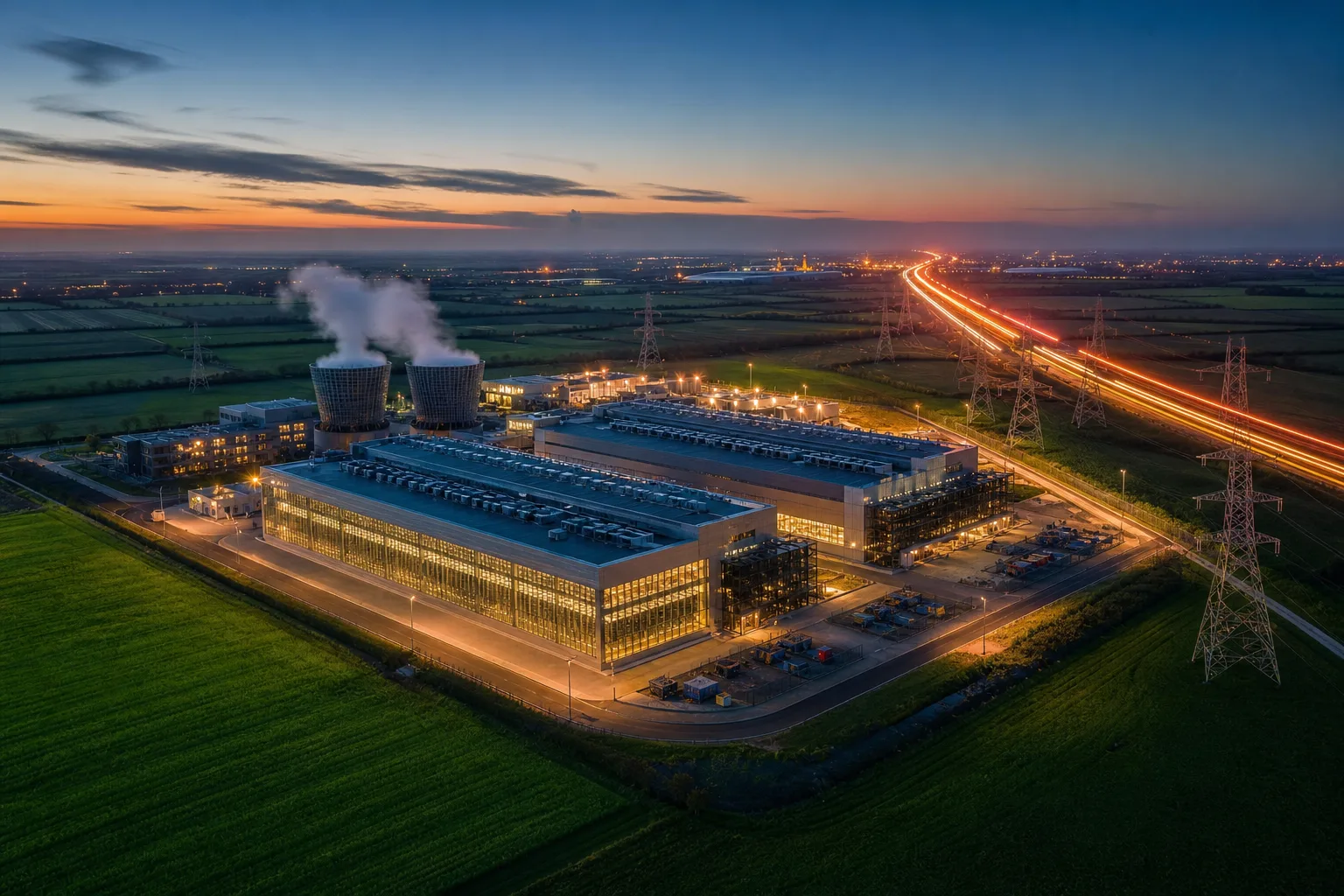
There’s a quiet arms race happening beneath the surface of the global economy, and it has nothing to do with weapons. The digital infrastructure race — the scramble to build the data centres, fibre networks, subsea cables, and 5G towers that underpin modern digital life — is redrawing competitive boundaries across the technology, media and telecommunications (TMT) sector. The stakes couldn’t be higher, and the pace of investment is unlike anything the industry has seen before.
- The digital infrastructure race is fundamentally reshaping the technology, media and telecommunications sector globally.
- Massive investment in digital infrastructure — data centres, fibre, and 5G — is accelerating as AI demand surges.
- Telecoms operators face mounting pressure to monetise their networks as hyperscalers build competing capacity.
- Governments are treating digital infrastructure as a strategic asset, triggering a new wave of industrial policy.
Table of Contents
What’s Actually Driving the Digital Infrastructure Race
It would be easy to chalk this up to hype. But the numbers tell a different story. Hyperscalers — Amazon Web Services, Microsoft Azure, Google Cloud — have collectively committed enormous sums in capital expenditure, the bulk of it flowing into digital infrastructure. Data centres are being built at a speed and scale that would have seemed implausible a decade ago. Microsoft’s deal to reopen Three Mile Island nuclear plant to power its AI data centres wasn’t a quirky PR moment — it was a signal about how serious the power and capacity crunch has become.
The trigger behind much of this spending is artificial intelligence. Training and running large language models requires extraordinary amounts of compute, and that compute has to live somewhere. Every major AI product launch — whether it’s OpenAI’s latest model or Google’s Gemini rollout — translates almost directly into more rack space, more cooling, more fibre, and more electricity demand. Digital infrastructure has effectively become the physical layer of the AI economy.
But AI is only part of the story. Streaming video continues to consume bandwidth at scale — Netflix alone accounts for a significant share of global internet traffic during peak hours. Cloud migration, still far from complete across enterprise sectors, is driving steady baseline demand. And the slow but inexorable rollout of IoT devices is adding billions of new endpoints that all need connectivity and processing capacity behind them.
Telecoms Operators: Caught in the Middle
For traditional telecoms operators, the digital infrastructure boom is both an opportunity and an existential pressure. On one hand, the demand for connectivity — particularly fibre-to-the-premise and 5G — gives carriers a genuine reason to invest. On the other, they face a structural problem that’s been simmering for years: the hyperscalers are building their own backbone infrastructure, reducing their dependence on the carriers they once relied on entirely.
BT, Deutsche Telekom, Orange, and their peers are spending billions on fibre rollouts while simultaneously watching the likes of Google lay their own subsea cables and Microsoft build point-to-point private networks. The risk isn’t that telecoms companies disappear — it’s that they get reduced to ‘dumb pipes,’ moving bits for others without capturing meaningful value from the traffic they carry.
The responses vary. Some operators are doubling down on the network itself, positioning premium connectivity — low latency, guaranteed throughput, edge computing nodes — as a differentiator. Others are trying to move up the stack, acquiring content or building B2B cloud services to diversify away from pure connectivity revenue. None of these strategies is a clean win. The capital expenditure required is punishing, and return timescales are long.
Digital Infrastructure as a Geopolitical Asset
Something has shifted in how governments think about digital infrastructure. For much of the last two decades, the assumption was that markets would sort it out — private capital would build what was needed, and regulators just needed to keep competition healthy. That assumption has collapsed.
The European Commission’s Gigabit Infrastructure Act is one example of how policymakers are now treating connectivity as a strategic imperative rather than a market outcome. The US CHIPS and Science Act, while focused on semiconductors, reflects the same underlying logic: that certain categories of digital infrastructure are too important to leave entirely to market forces. In the UK, the government’s full-fibre targets have been repeatedly accelerated. In Southeast Asia, state-linked investment funds are backing data centre campuses as part of explicit industrial policy.
The concern driving much of this is supply chain concentration. The Huawei episode taught Western governments that dependence on a single vendor for critical network equipment creates unacceptable security exposure. The same logic is now being applied to cloud providers, data centre locations, and submarine cable routes. Diversification — even at higher cost — is increasingly the policy default.
Who’s Actually Winning the Race
If you’re looking for winners in the short term, the hyperscalers are the clearest candidates. They have the capital, the engineering talent, and the customer relationships to keep building at pace. AWS, Azure, and Google Cloud aren’t just building for their own needs — they’re becoming the default digital infrastructure layer for the organisations that can’t or won’t build their own.
Specialist data centre operators — Equinix, Digital Realty, NTT — are also in a strong position. The hyperscaler buildout doesn’t eliminate demand for colocation and interconnection facilities; in many ways it amplifies it, because every hyperscaler campus needs dense interconnection with the broader internet ecosystem. Equinix’s extensive network of International Business Exchange data centres across numerous cities has become something close to critical infrastructure for the modern internet.
Tower companies and neutral host providers are quietly benefiting from 5G densification. As operators deploy more small cells to improve urban coverage and capacity, the companies that own the physical assets — masts, rooftops, in-building systems — are collecting long-term lease income without bearing the spectrum or customer acquisition risk.
For media companies, the picture is more complicated. Streaming has forced everyone from Disney to the BBC to rebuild their entire technical stack around cloud-native delivery. That’s expensive. But it’s also created a kind of infrastructure floor — the companies that get their platform architecture right have a durable cost and quality advantage over those still running legacy broadcast and distribution infrastructure.
The Capital Problem No One Wants to Talk About
All of this costs money. Enormous amounts of it. And the question of who funds the next wave of digital infrastructure investment is genuinely unresolved. Pension funds and infrastructure investors have piled into data centres and fibre assets over the last few years, attracted by long-duration, relatively predictable cash flows. But valuations have risen sharply, and the energy consumption profile of AI-era data centres is introducing new variables that traditional infrastructure underwriting models weren’t built for.
Telecoms operators, meanwhile, are dealing with debt loads accumulated during previous investment cycles. Returning meaningful capital to shareholders while funding a 5G and fibre buildout simultaneously is a genuine balancing act. Some have responded by spinning off infrastructure assets — tower companies, duct networks, subsea cable systems — into separate vehicles that can attract specialist capital. It works, but it also means giving up long-term control of assets that may prove to be strategically critical.
The digital infrastructure race isn’t going to slow down. If anything, the arrival of AI at scale has shifted it into a higher gear. The companies and countries that get their infrastructure position right in the next five years will have structural advantages that compound for decades. The ones that don’t will find themselves perpetually dependent on whoever did. That’s not a comfortable position, and it explains why the spending — and the strategic anxiety — shows no sign of letting up.
Frequently Asked Questions
Why is digital infrastructure investment growing so fast right now?
The surge in AI workloads, video streaming, cloud computing, and connected devices has driven demand for data capacity to unprecedented levels. Major technology players are committing significant capital to data centres and network infrastructure, prompting telecoms operators and governments to respond in kind.
How does the digital infrastructure race affect telecoms companies specifically?
Telecoms operators find themselves squeezed between rising capital expenditure and fierce competition from large technology companies building their own backbone networks. Monetising that infrastructure without becoming a commodity ‘pipe’ is the central strategic challenge for the sector.
Which sectors are most exposed to the digital infrastructure buildout?
Technology, media and telecommunications — collectively known as TMT — sit at the epicentre of this transformation. The broader ripple effects extend to other industries drawn into supporting and financing the rapid buildout of digital capacity.
Are governments getting involved in the digital infrastructure race?
Governments are increasingly treating digital infrastructure as a matter of national security and economic competitiveness. Various policy measures are being deployed to accelerate deployment and reduce dependence on single suppliers.

