

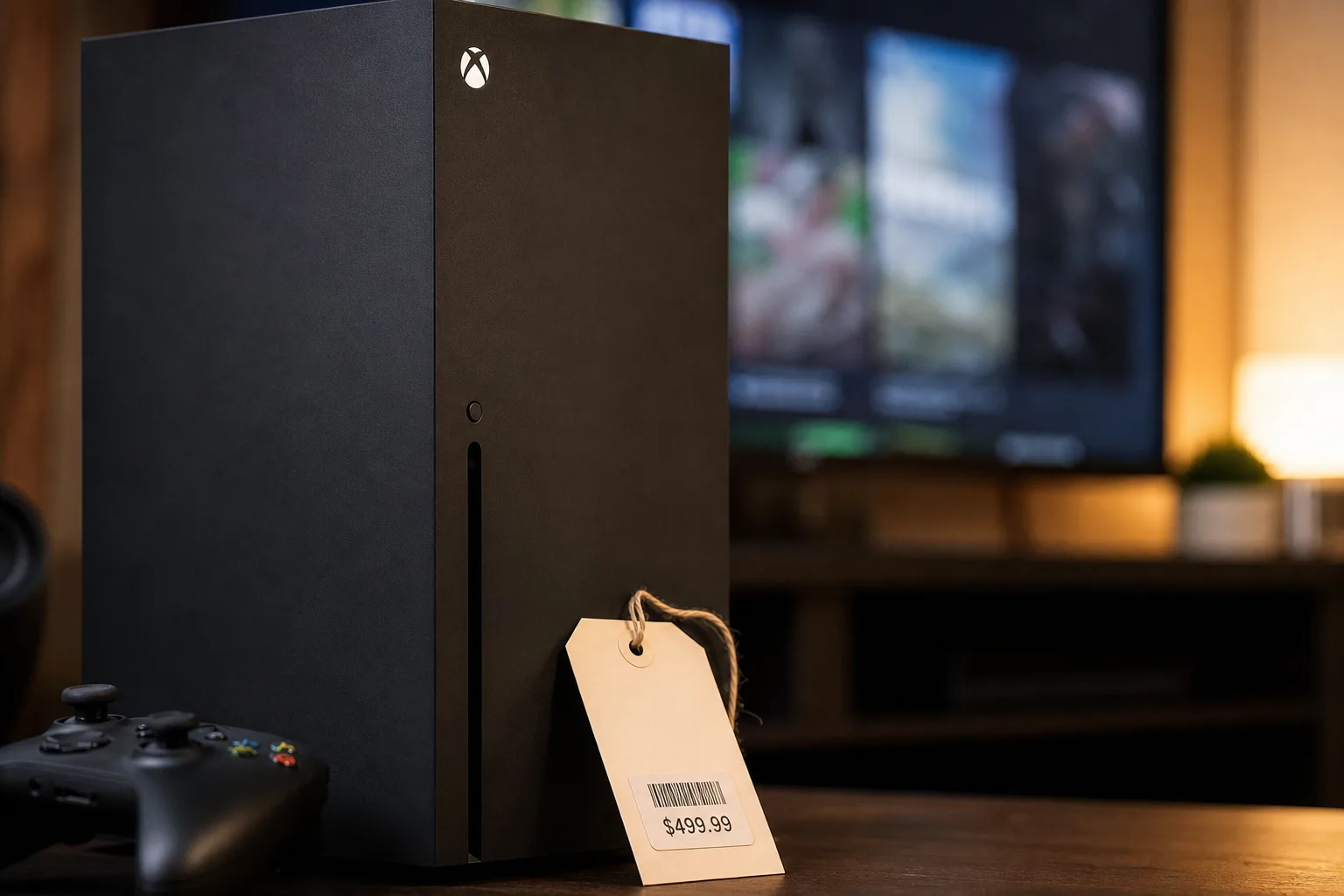
With Xbox prices rising for a third time since the start of 2025, Microsoft has officially turned one of gaming’s best-value entry points into a premium purchase — and the company has no one to blame but its own boardroom decisions. Starting August 1, the 512GB Xbox Series S jumps to $500, up $100. Every 1TB model climbs $150. The Xbox Series X with a disc drive will now set you back $800. The 2TB Series X is gone entirely.
- Xbox prices rising for a third time in 2025 will push the Series X to $800 starting August 1.
- Xbox prices rising are tied to memory and storage costs that have surged more than 2.5x, with further increases expected.
- Microsoft’s own AI data center spending is directly contributing to the component shortage hitting its console division.
- Sony, Nintendo, and Valve have all raised hardware prices, signalling a broader crisis across the consumer electronics industry.
Table of Contents
The Full Breakdown of New Xbox Prices
To put the scale of these increases in perspective, consider that Xbox prices rising for the third time since January 2025 represents a fundamental repricing of the entire ecosystem. Microsoft raised prices in May last year, and has now increased them further on multiple occasions since. For consoles that launched in November 2020, these are not minor adjustments — they mark a dramatic shift in what it costs to enter the Xbox ecosystem.
Here’s where things stand from August 1:
- Xbox Series S (512GB): $500
- Xbox Series S (1TB): $600
- Xbox Series X Digital (no disc drive): $750
- Xbox Series X (disc drive): $800
The increases apply globally. The 2TB Series X variant is being discontinued — likely because Microsoft can’t justify the component cost of shipping that much storage in a box it’s still effectively selling below cost.

Why Xbox Prices Rising Keeps Happening — and Who’s Really Responsible
Microsoft’s official explanation, published in a blog post from the Xbox team, is that storage and memory prices have ballooned by more than 2.5 times, with a further doubling expected before the end of 2027. The company says it spent months working with suppliers to find alternatives before concluding another price increase was unavoidable. With Xbox prices rising at this pace, even loyal customers are beginning to question whether the hardware is worth it.
‘We hoped another price increase would not be necessary, and we have spent the last several months working with suppliers on options. Unfortunately, console storage and memory prices have increased by more than 2.5x and we expect another doubling by the fall of 2027.’
That explanation is technically accurate. What the blog post carefully avoids mentioning is that Microsoft itself is one of the single largest drivers of the memory and storage demand that’s pushing those component prices up. The company has been ploughing enormous capital into AI data center buildouts — part of its broader commitment to investing $500 billion in AI infrastructure across the US. Data centers consume NAND flash and DRAM at a scale that dwarfs the consumer electronics market. When hyperscalers like Microsoft, Google, and Amazon are all competing for the same memory supply chains, prices go up — for everyone, including Microsoft’s own gaming hardware division.
It’s a genuinely strange situation. One arm of Microsoft is spending aggressively on AI infrastructure and compressing global memory supply. Another arm — Xbox — is then forced to pass those supply chain costs onto the consumers it’s been trying to retain. The left hand isn’t just not knowing what the right hand is doing; they’re actively working against each other. The result is Xbox prices rising in ways that have nothing to do with the console business itself.
Xbox Isn’t Alone — But That’s Not Actually Reassuring
The Xbox team’s blog post is quick to note that the ‘entire consumer electronics industry is struggling with the current components crisis.’ That’s true. Sony has raised PlayStation 5 prices in multiple markets. Nintendo bumped the Switch 2’s price before it even shipped in the US. This week, Valve confirmed the component crisis has hit the Steam Machine too — it now starts at a rather steep $1,049. Still, seeing Xbox prices rising alongside competitors offers little comfort to consumers who were already stretching their budgets.
But there’s a specific wrinkle for consoles that the blog post does acknowledge: unlike phones, laptops, or speakers, consoles are traditionally sold at or below manufacturing cost. The business model depends on recouping losses through software sales, subscriptions, and accessories. When component costs spike this sharply, the maths collapse faster than they would for a smartphone maker that bakes a profit margin into the hardware from day one.

For Microsoft especially, the timing couldn’t be worse. Xbox is already navigating what the company is calling a divisional ‘reset’ — a corporate euphemism that has historically preceded significant layoffs. Reports suggest another round of job cuts is expected after Microsoft’s fiscal year ends on June 30. The head of Xbox Game Studios has stepped down. Studios including Ninja Theory, Double Fine, and Compulsion Games are reportedly on the chopping block, with their leadership teams said to be negotiating buyouts or independent spin-offs. Xbox prices rising in the middle of that internal upheaval are not going to help morale — or public perception.
Microsoft’s Mitigation Options Are Limited
To its credit, Microsoft isn’t just announcing higher prices and walking away. The company is pointing customers toward a few ways to soften the impact: buy-now-pay-later through Microsoft Stores, zero percent APR financing via Amazon, and the availability of certified refurbished and second-hand consoles.
What’s notably absent from that list is Xbox All Access — the subscription-style programme that bundled a console with Game Pass Ultimate on a monthly payment plan. Microsoft has confirmed it’s not bringing that back, at least not now. Given that Game Pass is arguably Xbox’s most important strategic asset at this point, the decision to leave All Access on the shelf feels like a missed opportunity to make these new prices hurt a little less. With Xbox prices rising steeply, a financing bundle would have gone a long way toward easing the sting for budget-conscious players.
What This Means for Gaming’s Biggest Hardware Question
With Xbox prices rising to levels that would have seemed absurd for this hardware generation even two years ago, the broader question for Microsoft’s gaming strategy gets sharper. An $800 Xbox Series X isn’t just expensive — it’s PlayStation 5 Pro territory, competing against Sony’s premium offering rather than the mass-market console Microsoft originally positioned the Series X as.
The Series S at $500 is now the price of the base PS5 at launch. The budget entry point into Xbox hardware is no longer budget. And with Microsoft increasingly signalling that its gaming future is more about Game Pass, cloud streaming, and software than about selling boxes, there’s a real question about whether the company sees Xbox prices rising as a short-term crisis response or the beginning of a longer-term retreat from the traditional console hardware race. If component costs genuinely double again by 2027 as Xbox is projecting, the current pricing may still look like a bargain by then.

