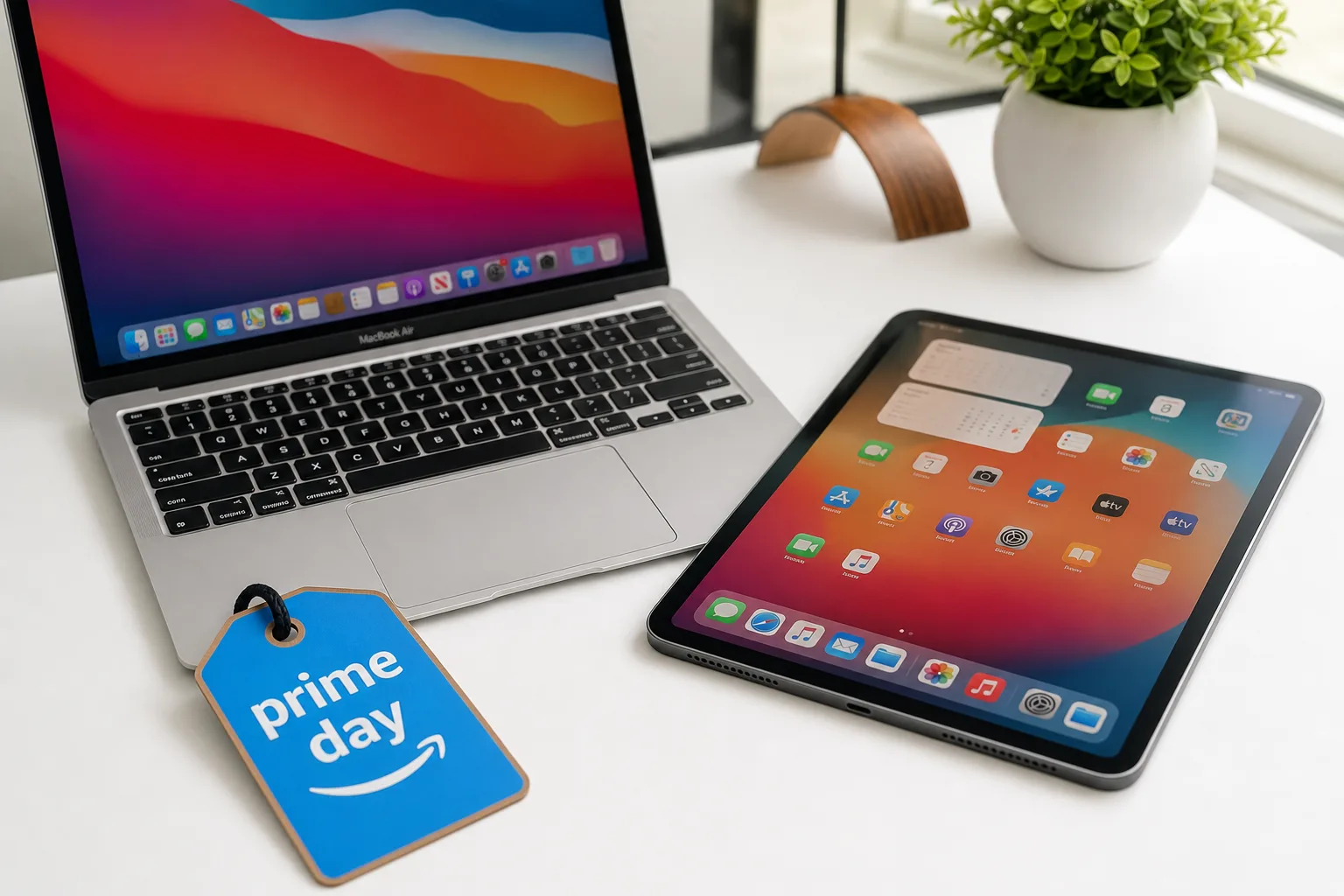
Apple iPad and Mac price hikes landed without much fanfare on Wednesday, quietly updating Apple.com with significantly higher sticker prices across nearly the entire product lineup. The base iPad, multiple MacBook models, the HomePod, and more all got more expensive. But here’s the thing — Amazon hasn’t caught up yet. If you’ve been sitting on the fence about any of these devices, this is one of the narrower buying windows you’re likely to get.
- Apple iPad and Mac price hikes are now live on Apple.com, with some models jumping by $300 or more overnight.
- Apple iPad and Mac price hikes haven’t hit Amazon yet, giving buyers a rare window to purchase at pre-increase prices.
- The M5 MacBook Air is available at $949 on Amazon — $350 less than its new Apple.com price of $1,299.
- Prime Day timing makes the window even more valuable, as several affected devices are currently on sale.
Table of Contents
Apple iPad and Mac Price Hikes: What Changed and By How Much
The scale of these Apple iPad and Mac price hikes is hard to ignore. Apple didn’t nudge prices up by $20 or $30 — it made substantial moves across the board. The standard iPad, which sat at $299, now lists for $449 on Apple.com, a $150 jump for Apple’s most accessible tablet. The M4 iPad Air climbed from $519 to $749, a $230 increase that pushes it firmly into premium territory. And the M5 iPad Pro? That went from $899 to $1,199 — a full $300 more for Apple’s flagship tablet.
The Mac side of the ledger looks equally stark. The M5 MacBook Air, one of Apple’s best-selling laptops and widely considered the sweet spot of the lineup, is currently available on Amazon at a Prime Day sale price of $949, compared to the new Apple.com baseline of $1,299. The M5 MacBook Pro is listed on Amazon at $1,549, while Apple.com now shows $1,999. Even the HomePod mini-speaker category got clipped, with the full-size HomePod going from $299 to $349. And the MacBook Neo — a product that had already been positioned as an entry-level option — nudged from $589.99 to $699 at Apple.com. Taken together, these Apple iPad and Mac price hikes represent one of the broadest single-day pricing shifts Apple has made in years.

What’s driving the Apple iPad and Mac price hikes? Apple hasn’t issued a detailed public explanation, but the timing lines up with broader pressures on consumer electronics pricing — supply chain recalibration, component costs, and the persistent strength of the US dollar all play into what manufacturers can sustainably charge in different markets. Apple has historically absorbed more of these costs than rivals, which makes a broad, simultaneous increase across this many product categories notable. This isn’t a single product refresh with adjusted pricing — it’s a portfolio-wide recalibration.
The Amazon Window: How Long Does It Last?
Third-party retailers don’t update pricing the moment a manufacturer changes its own website. There’s always a lag — sometimes hours, sometimes longer during high-traffic sales periods like Prime Day, when Amazon’s backend pricing systems are handling enormous transaction volumes. That lag is your opportunity right now, and it’s entirely a consequence of the Apple iPad and Mac price hikes rolling out faster than retail systems can respond.
At the time of writing, Amazon is still showing pre-hike prices on affected Apple devices. The M5 MacBook Air, for instance, is listed at $949 — that’s $350 below what Apple is now charging directly. The M5 MacBook Pro sits at $1,549 versus Apple’s new $1,999. The M4 iPad Air is at $519 versus $749. These aren’t rounding errors; they’re meaningful differences that represent real money. For shoppers who pay attention to the Apple iPad and Mac price hikes as they happen, this kind of gap is exactly the opportunity worth acting on.

The window won’t stay open indefinitely. Once Amazon’s vendor agreements and automated pricing tools register the manufacturer price change, those listings will update. In some cases that happens within hours. In others — particularly when a retailer has existing inventory purchased at the old wholesale price — it can take a day or two. Either way, the clock is ticking, and the Prime Day context adds another layer: some of these devices are actually on sale right now, meaning you’re potentially catching both a Prime Day discount and a pre-hike price simultaneously.
Which Deals Are Worth Acting On?
Not every item on this list represents the same value proposition. Here’s a clear-eyed look at where the real opportunities sit as a result of the Apple iPad and Mac price hikes:
- M5 MacBook Air at $949: This is the standout deal. The M5 chip is genuinely fast for everyday computing, creative workflows, and even light professional work. At $949 it was already a reasonable buy. At $350 below the new Apple price, it’s a no-brainer if you’ve been in the market for a MacBook.
- M5 iPad Pro at $899: A $300 saving versus Apple’s new price of $1,199. The Pro’s OLED display and M5 chip make it one of the most capable tablets available. Whether you actually need that capability is a different question — but if you do, now’s the time.
- M4 iPad Air at $519: The Air sits in a sweet spot between the base iPad and the Pro. At $519 versus the new $749, the saving is $230, and for most users who want something more powerful than the entry-level model without paying Pro prices, this is the one to grab.
- Base iPad at $299: The entry-level iPad is still the most affordable way into Apple’s tablet ecosystem, and at $299 versus the new $449, it’s a $150 saving. It’s a fine device for students, casual users, or as a secondary screen.
- HomePod at $299: A smaller absolute saving ($50), but if you’re already invested in the Apple ecosystem and have wanted a HomePod, this is a decent reason to pull the trigger before it climbs to $349.
- M5 MacBook Pro at $1,549: The saving versus Apple’s new $1,999 price is significant in dollar terms, but at $1,549 this is still a serious purchase. Make sure you actually need Pro-level performance before committing.
- MacBook Neo at $589.99: The entry into the Mac laptop lineup now looks more attractive as a gateway product, sitting $109 below the new $699 Apple price.
The Bigger Picture: Apple’s Pricing Strategy Is Shifting
For years, Apple maintained a reputation for consistent pricing — particularly in the US market. Products launched at a price and stayed there until replaced. Occasional education discounts and seasonal promotions aside, you knew what an iPhone or MacBook cost, and that price didn’t move much. The current Apple iPad and Mac price hikes signal something meaningfully different from that long-standing pattern.
As Apple continues expanding its services revenue and grows its installed base globally, the company has more pricing flexibility than it did a decade ago. Users who are deep in the Apple ecosystem — paying for iCloud, Apple One, Apple TV+, and Apple Music — are less likely to defect over a $150 price bump on hardware. Apple knows this. The stickiness of the ecosystem is partly what makes these kinds of Apple iPad and Mac price hikes viable at scale.
That said, there’s a real risk at the entry level. The base iPad moving from $299 to $449 is a 50% price increase. That’s not a small adjustment — it fundamentally changes who can afford to buy in. At $299, the iPad competed with budget Android tablets and was a genuinely accessible option for schools and families. At $449, it starts to look expensive next to capable alternatives from Samsung and Lenovo. Apple has always been premium, but there’s a floor below which you lose the ‘aspirational but attainable’ positioning that drives volume. The Apple iPad and Mac price hikes at the entry level are where that tension is most acute.
The broader consumer electronics market is watching carefully. If Apple can push through Apple iPad and Mac price hikes across this many categories simultaneously without a significant sales dip, it validates the premium pricing strategies that rivals like Microsoft, Samsung, and Google have been inching toward on their own flagship products. If the blowback is sharper than expected, expect Apple to quietly introduce a lower-cost variant or an education-focused SKU to plug the gap.
For now, though, the immediate question isn’t about long-term strategy — it’s about whether you want to pay the new prices or act while Amazon’s listings still reflect yesterday’s reality. The Apple iPad and Mac price hikes are already in effect on Apple.com. That window is open. It won’t be for long.
Frequently Asked Questions
How much have Apple iPad and Mac price hikes increased costs?
The increases vary significantly by product. The base iPad jumped from $299 to $449 — a $150 rise. The M4 iPad Air went from $519 to $749, and the M5 MacBook Air climbed from $949 to $1,299. Some models saw increases of $300 to $350.
Why hasn’t Amazon updated its Apple prices yet?
Third-party retailers like Amazon typically take time to reflect manufacturer price changes, especially during major sales events. The lag can last hours or days, creating a brief window where shoppers can still buy at the old price.
Is the M5 MacBook Air a good deal at $949 on Amazon right now?
At $949, the M5 MacBook Air is $350 below its new Apple.com price of $1,299. Even before the hike, it was discounted by $150. That’s a strong deal for one of Apple’s best everyday laptops, particularly during Prime Day.
Which Apple products are affected by the price increases?
The price hikes cover the base iPad, M4 iPad Air, M5 iPad Pro, MacBook Neo, M5 MacBook Air, M5 MacBook Pro, and HomePod, with updated pricing now live on Apple.com.