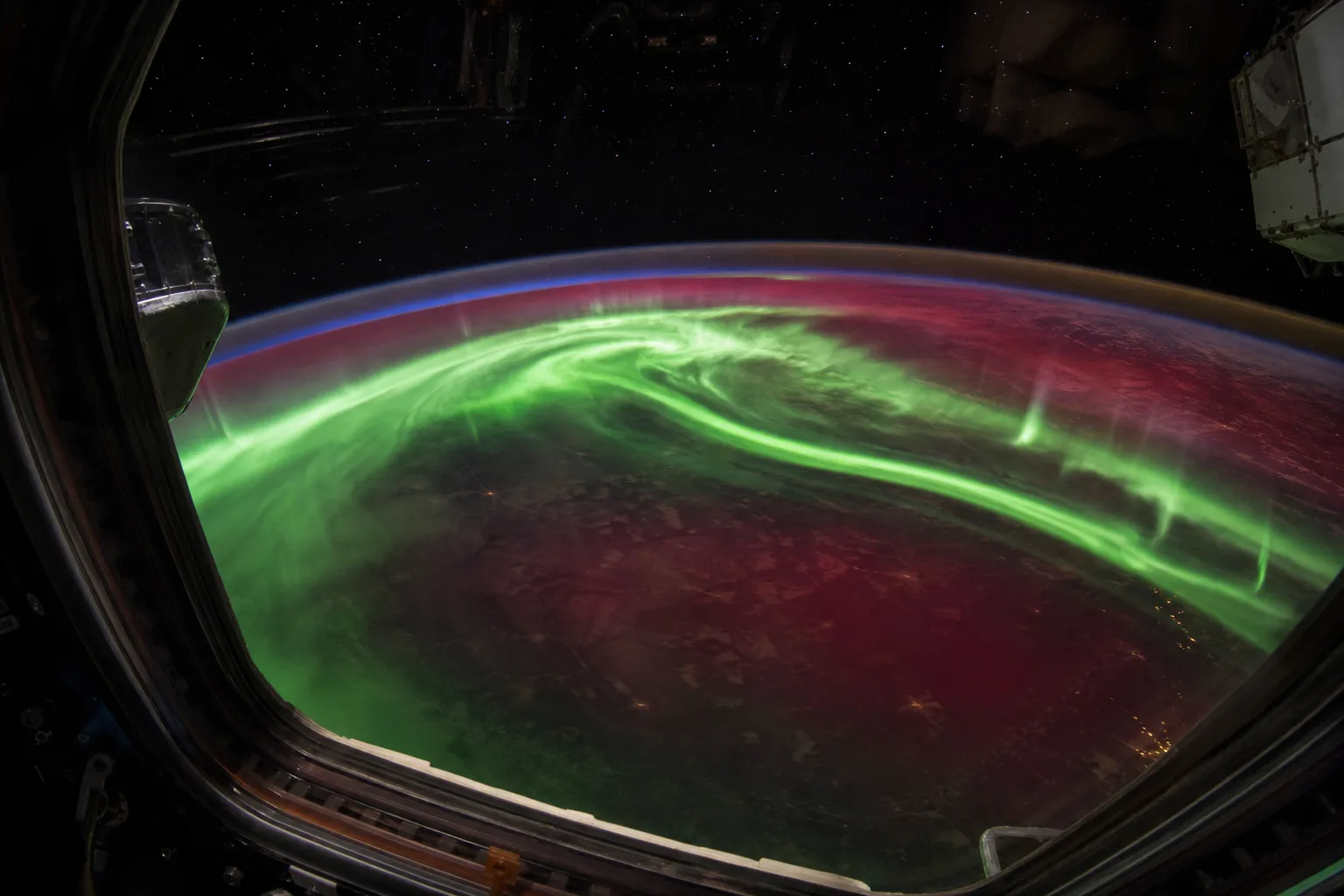
Seeing an aurora from the ground is already the kind of experience people plan entire trips around. But seeing aurora australis from space — from 400 kilometres above Earth, moving at 28,000 kilometres per hour — is something else entirely. That’s exactly the perspective ESA astronaut Sophie Adenot shared this week from aboard the International Space Station, and the image is one of the most striking orbital aurora photographs in recent memory.
- ESA astronaut Sophie Adenot photographed aurora australis from space during day 127 of her ISS epsilon mission.
- The aurora australis from space appeared as neon green swirls and crimson hazes intense enough to illuminate the space station itself.
- Solar wind particles interacting with Earth’s atmosphere produce auroras — visible both from the ground and from low Earth orbit.
- Adenot said this aurora was unlike any she had seen before, forcing the crew to abandon their usual camera settings entirely.
Table of Contents
What Sophie Adenot Saw From the ISS
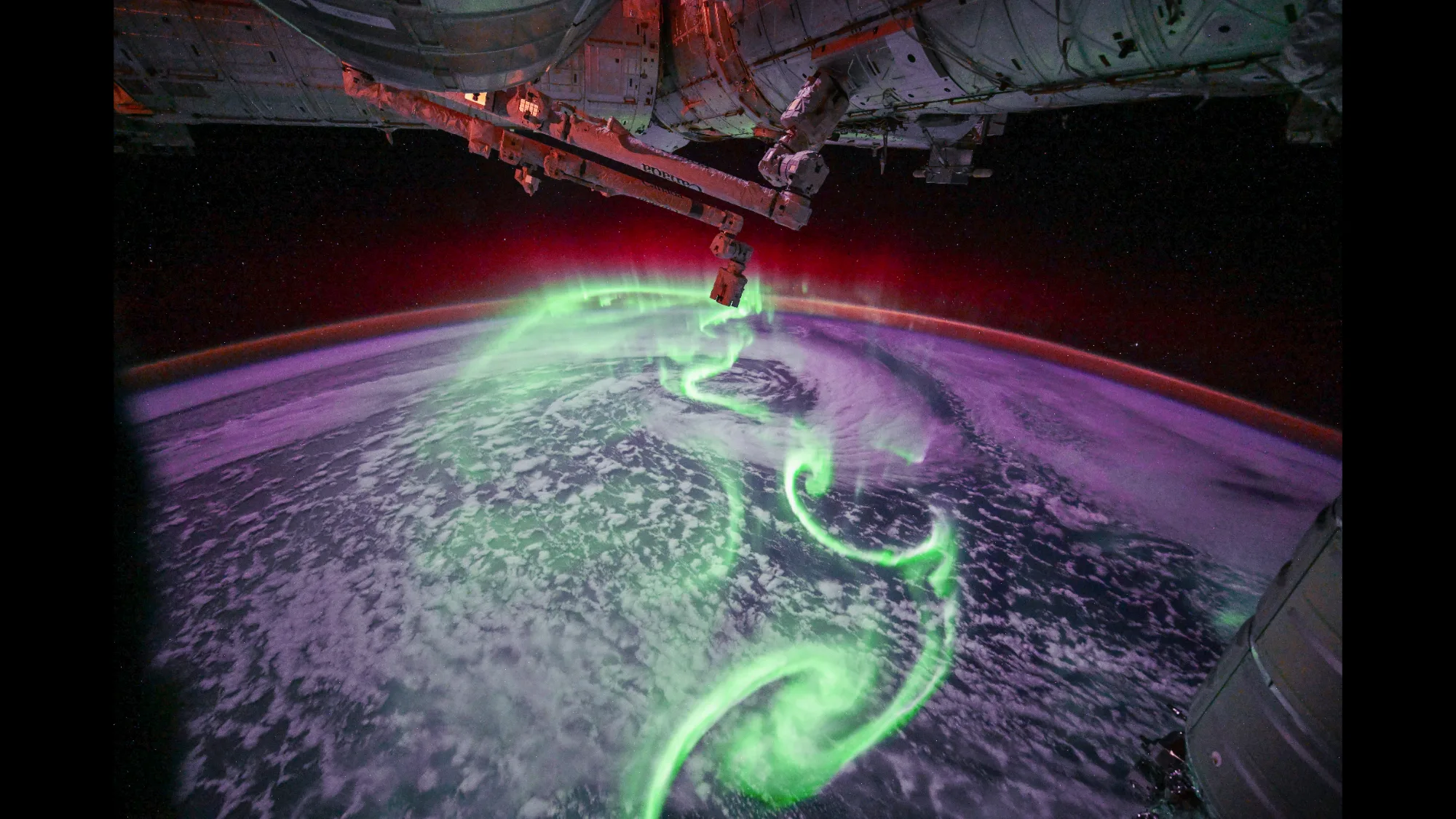
Adenot, currently 127 days into her epsilon mission aboard the ISS, captured a photograph of the aurora australis from space that’s been making the rounds for good reason. The image shows neon green light curling across the Southern Hemisphere in great luminous sweeps, set against a backdrop of deep purple and a ruby-red atmospheric glow that wraps around the planet’s limb. It’s the kind of image that makes you feel the scale of Earth in a way that maps and statistics simply can’t.
What makes it particularly striking isn’t just the colours — it’s the intensity. Adenot shared the image on social media alongside a candid account of what the crew actually experienced in the moment.
‘Day 127, orbit 1968 — That aurora was absolutely spectacular… shimmering and dancing beneath us, stretching as far as the eye could see, and so intense it lit up the Station in shades of green,’ Adenot wrote. ‘We’ve seen several since the beginning of the mission, but this one was on a completely different level — far too bright for my usual aurora camera settings. Moments like these never get old up here; the whole crew suddenly find themselves vying for a good spot at a window!’
That detail about blown-out camera settings is worth sitting with. Adenot is a trained astronaut who has been observing auroras from the ISS for months. For her to say this particular display overwhelmed her usual photographic setup suggests we’re talking about an exceptional solar event, not just a run-of-the-mill geomagnetic storm.
The Science Behind Aurora Australis From Space
Auroras are the visible product of solar wind — a constant stream of charged particles flowing outward from the sun. When those particles reach Earth, our planet’s magnetic field funnels them toward the poles, where they collide with gas molecules in the upper atmosphere. Those collisions release energy as light: oxygen at higher altitudes glows red, oxygen lower down produces the iconic green, and nitrogen contributes blues and purples. The result is the layered, multicoloured spectacle Adenot photographed.
Observing aurora australis from space strips away the limitations that ground observers face. On the surface, your view is constrained by your horizon, by cloud cover, by light pollution, and by the fact that you’re looking up at the underside of the phenomenon. From the ISS, you’re looking down at the aurora’s full geometry — the arcs, curtains, and spirals that stretch across hundreds of kilometres of atmosphere simultaneously. It’s the difference between watching a fireworks show from inside the crowd and watching it from a drone at altitude.
The European Space Agency has long used the ISS as a platform for Earth observation, and astronaut photography has become one of its most publicly resonant outputs. Adenot’s aurora shot fits squarely into that tradition — scientifically interesting and viscerally beautiful at the same time.
Why This Aurora Was Particularly Intense
We’re currently deep into Solar Cycle 25, which has been tracking more active than initial predictions suggested. Solar maximum — the peak of the sun’s roughly 11-year activity cycle — is expected around 2025 to 2026, meaning Earth is receiving a higher-than-average bombardment of solar wind and coronal mass ejections right now. That’s the broader context for why ground observers at unusually low latitudes have been spotting auroras over the past year or two, and it’s almost certainly why the display Adenot photographed was strong enough to illuminate the station’s exterior.
For anyone who caught the widespread aurora borealis events that reached as far south as the continental United States in 2024, the mechanism is the same — just viewed from the opposite side of the atmosphere and the opposite pole. Capturing aurora australis from space during a solar maximum is about as optimal a convergence of conditions as you can get, and the results speak for themselves.

Real-Time Spaceflight in the Social Media Era
There’s another layer to this story that’s easy to overlook: the fact that we get to see it at all. Adenot shared this image directly from orbit, in real time, with a public audience of thousands. That’s a relatively recent development in the history of human spaceflight, and it’s changed the relationship between astronauts and the public in a meaningful way.
Earlier generations of astronauts brought back film canisters that took days or weeks to process and publish. Now, images taken at 1,968 orbits into a mission are on social media the same day, accompanied by a first-person account from the person who pressed the shutter. It makes the ISS feel less like a remote scientific outpost and more like a shared vantage point — one that happens to be 400 kilometres straight up.
That accessibility matters for public engagement with space programmes, particularly at a time when agencies like ESA and NASA are competing for funding and political goodwill alongside a growing cohort of commercial operators. An image like Adenot’s aurora photograph does more for public enthusiasm about human spaceflight than any press release could.
Aurora Australis From Space — a Rarer View Than You’d Think
It’s worth remembering just how few people have ever witnessed aurora australis from space directly. The ISS has hosted around 280 people since its first crewed mission in 2000. Of those, only a fraction happened to be on board during intense enough geomagnetic activity with clear viewing conditions and a window nearby. Adenot and her crewmates scrambling for spots at the windows is a reminder that even for the people who live in space, this kind of display is an event — not background noise.
Ground-based aurora tourism has exploded in recent years, with Scandinavia, Iceland, New Zealand, and Patagonia all marketing themselves as prime viewing destinations. But the orbital view Adenot captured isn’t a destination anyone can book. It’s the exclusive province of a tiny number of humans at any given moment, which is precisely what makes sharing it publicly feel like something genuinely generous.
As Solar Cycle 25 continues toward and potentially past its peak, there’s every reason to expect more displays like this — both for ground observers and for whoever happens to be aboard the ISS at the right moment. Witnessing aurora australis from space may become a defining draw for future commercial space station passengers; the question of whether operators will market it as such is one the industry hasn’t fully answered yet. But given how visceral Adenot’s description is — a crew abandoning their tasks to crowd around a window — it’s not hard to imagine the demand.
Frequently Asked Questions
What does aurora australis from space actually look like?
From the ISS, aurora australis appears as neon green swirls against a haze of bright purple, with Earth enveloped in a ruby red glow. Sophie Adenot described the display as so intense it lit the exterior of the station itself in shades of green.
What causes auroras to appear in different colors?
Color variation in auroras depends on altitude and the type of atmospheric gas the solar wind particles strike. Oxygen at high altitudes produces red hues, oxygen at lower altitudes creates green, and nitrogen generates blue and purple tones. That layering is especially vivid when seen from orbit.
What is ESA’s epsilon mission on the ISS?
The εpsilon mission is a European Space Agency spaceflight assignment aboard the International Space Station. Sophie Adenot is the ESA astronaut currently representing the agency on the ISS as part of that mission.
How is aurora australis different from aurora borealis?
Aurora australis occurs over the Southern Hemisphere, while aurora borealis occurs over the Northern Hemisphere. Both are caused by the same mechanism — solar wind particles interacting with Earth’s atmosphere — but they are mirror phenomena occurring at opposite poles simultaneously.