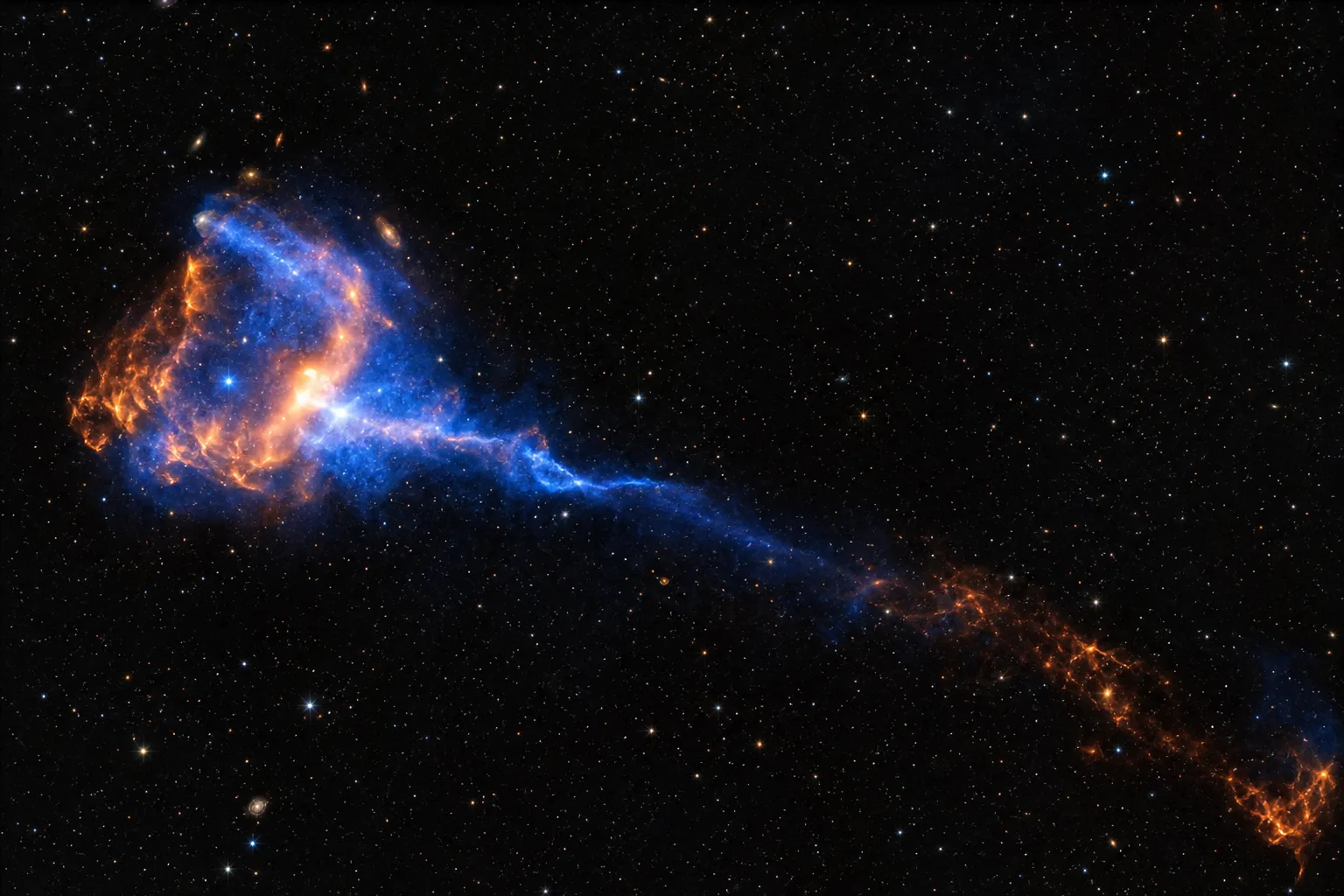
A citizen scientist has done what decades of professional sky surveys couldn’t: spot a truly one-of-a-kind radio galaxy that appears to trace a massive cosmic shock wave carved by a galaxy plunging supersonically through one of the universe’s densest environments. The object, formally designated RAD-BAARG — shorthand for Radio Bow-And-Arrow Radio Galaxy — stretches nearly 1.8 million light-years across, or about 18 times the diameter of the Milky Way. And according to the researchers who followed up the find, nobody has ever seen anything quite like it.
- RAD-BAARG is a cosmic shock wave structure spanning 1.8 million light-years, roughly 18 times the width of the Milky Way.
- The cosmic shock wave was first spotted by a citizen scientist, not a professional astronomer, using the RAD@home Collaboratory.
- The galaxy’s extreme asymmetry — a bow on one side, an arrow-like tail on the other — has never been seen before in 25 years of research.
- Future surveys using the Square Kilometre Array Observatory may reveal many more systems like RAD-BAARG hiding in plain sight.
Table of Contents
A Cosmic Shock Wave Nobody Expected to Find
The story starts with the RAD@home Astronomy Collaboratory, an India-based citizen science program that invites volunteers to comb through radio telescope data and flag anything that looks odd. It’s the kind of initiative that looks unglamorous on paper but keeps delivering results that matter — because the universe is enormous, datasets are vast, and trained human eyes still catch things algorithms miss.
In this case, a volunteer spotted RAD-BAARG and brought it to the attention of professional astronomers, who then turned the full power of the LOFAR (Low Frequency Array) Two-meter Sky Survey — LoTSS — onto the object. What they found stopped them cold. The galaxy’s radio structure doesn’t look like anything in the existing catalogue.
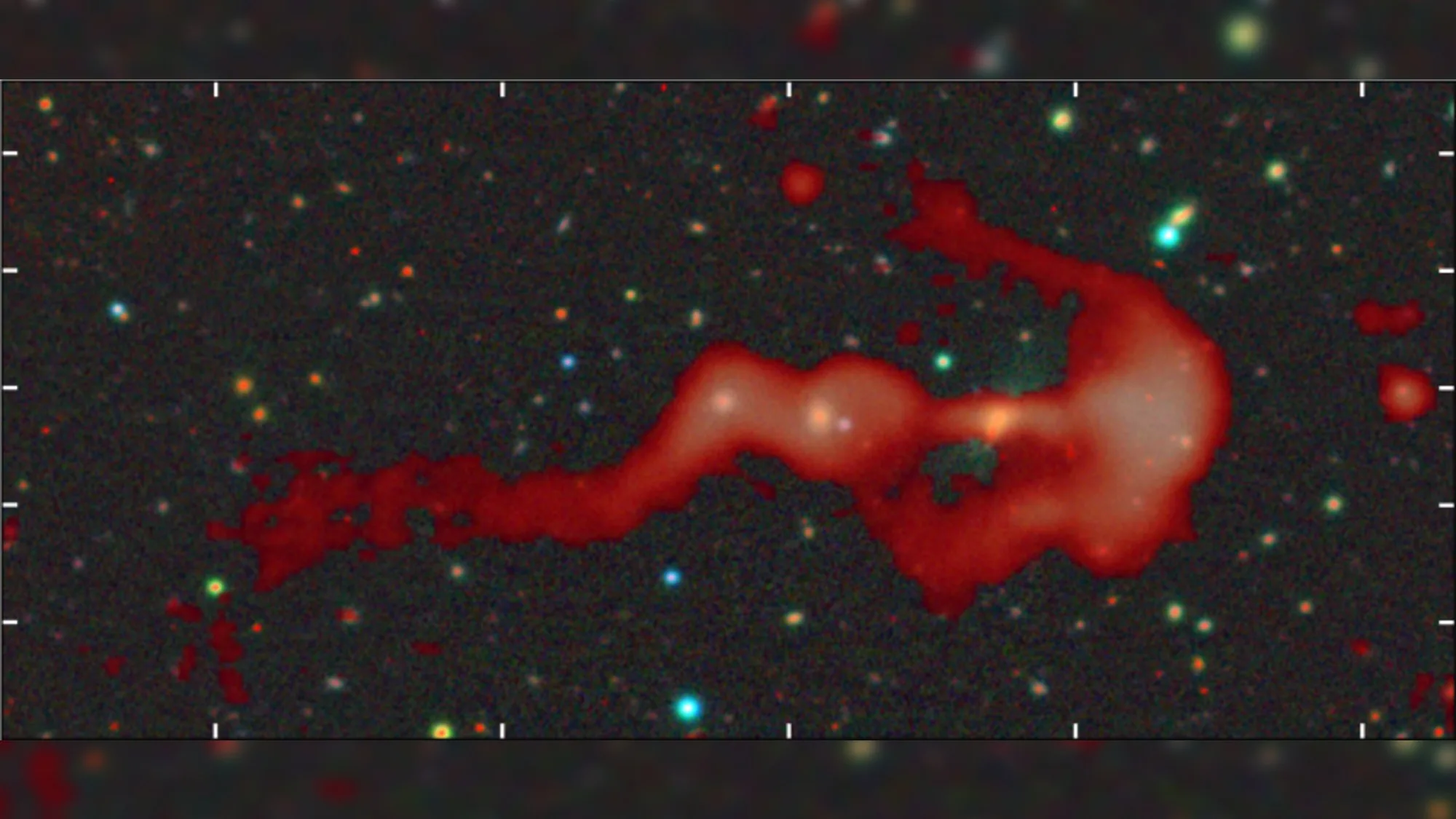
‘The structure of this source is unlike that of any radio galaxy I have seen in the last 25 years,’ said Ananda Hota of the University of Mumbai, in a statement published by the Royal Astronomical Society. Twenty-five years is a long time in observational astronomy. That’s not a throwaway comment from someone who hasn’t seen much — it’s a meaningful signal that RAD-BAARG represents a genuinely rare configuration, and one that may owe its entire shape to a cosmic shock wave propagating through the surrounding cluster gas.
The team published their findings on June 22 in Monthly Notices of the Royal Astronomical Society: Letters.
What the Bow-and-Arrow Structure Actually Tells Us
Most radio galaxies follow a recognisable template. A supermassive black hole at the centre fires two jets of charged particles in opposite directions. Those jets inflate lobes of radio-emitting plasma that sit more or less symmetrically on either side of the host galaxy, like a cosmic dumbbell. It’s not a simple picture, but it’s a familiar one.
RAD-BAARG throws that template out entirely. One jet expands into a wide, wedge-shaped region that curves backward into a sweeping arc — the ‘bow.’ The other jet twists into an S-shaped form and fades into a long, trailing tail — the ‘arrow.’ Together they create a lopsided structure that the researchers liken to a bow drawn across an arrow. That asymmetry is the key data point here, because it demands an explanation that goes beyond normal jet dynamics.
The leading hypothesis is that RAD-BAARG’s host galaxy is moving at supersonic speeds through the hot, diffuse gas — called the intracluster medium — that fills galaxy clusters. As the galaxy falls toward the cluster’s gravitational centre, it generates a cosmic shock wave: a compression wave, like the wake in front of a speeding boat, but scaled to millions of light-years. That cosmic shock wave compresses magnetic fields and accelerates charged particles, distorting the plasma jets into the asymmetric shapes LOFAR is now mapping in detail.
Crucially, the team found that RAD-BAARG sits inside a complex ‘multi-halo’ environment — a region containing several overlapping reservoirs of hot gas. That layered context makes it an unusually rich laboratory for studying how cluster environments physically reshape the galaxies falling into them, and for understanding precisely how a cosmic shock wave of this scale forms and sustains itself over millions of light-years.
Why LOFAR Was the Right Tool for This Discovery
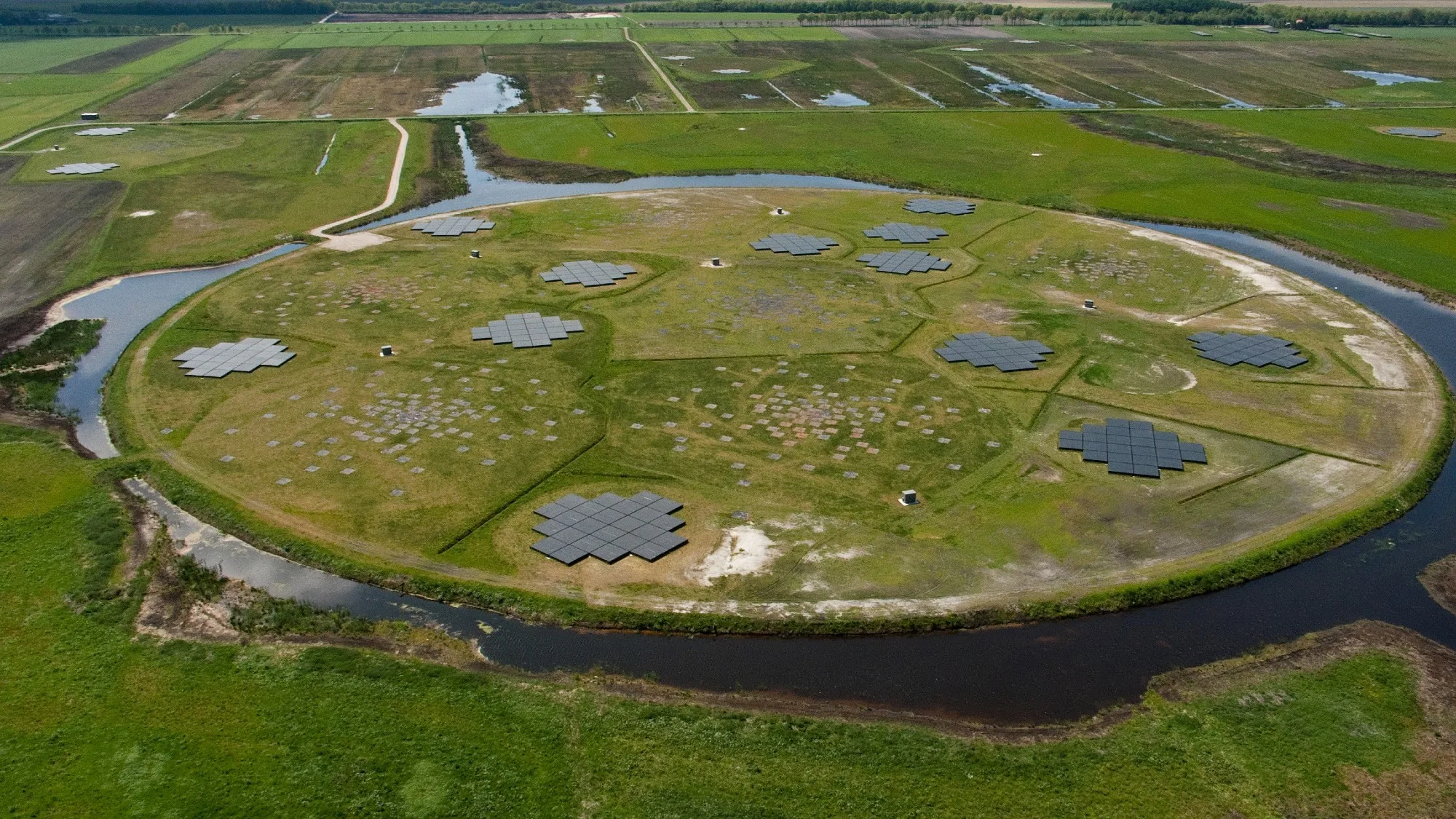
The cosmic shock wave in RAD-BAARG wouldn’t be visible without the right telescope. At low radio frequencies, aged populations of electrons that have lost much of their energy — and therefore glow faintly — become detectable in ways they simply aren’t at optical wavelengths or higher radio frequencies. LOFAR, which operates at metre-scale wavelengths and spans stations across much of Europe, is purpose-built for exactly this kind of faint, diffuse emission.
LoTSS is one of the deepest low-frequency radio surveys ever run, and it’s increasingly turning up structures that were effectively invisible to previous generations of instruments. That’s not a coincidence — it’s the direct result of a decade of investment in low-frequency radio astronomy infrastructure, and RAD-BAARG is one of the clearest illustrations yet of why that investment paid off.
‘LOFAR allows us to see this faint, low-surface-brightness emission in remarkable detail,’ said Pratik Dabhade, co-lead author of the study from the National Center for Nuclear Research in Poland. He added that LoTSS’s third data release — DR3 — and the eventual arrival of the Square Kilometre Array Observatory (SKAO) could reveal ‘many more systems where radio galaxies reveal otherwise invisible interactions between jets, galaxies, and their environments,’ including further examples of cosmic shock wave activity on this extraordinary scale.
The Broader Picture: Citizen Science Keeps Delivering
There’s a broader point worth sitting with here. This discovery didn’t originate in a control room full of PhD astronomers. It started with a volunteer, sifting through publicly available data, noticing something that didn’t fit. Programs like RAD@home are quietly responsible for a string of discoveries that professional surveys, optimised for efficiency, would have passed over.
That matters for how science is funded and structured. The case for citizen science isn’t just about public engagement — it’s about the reality that the universe is too big and telescopes are too productive for any team of professionals to process everything that comes in. Human pattern recognition, applied at scale across distributed volunteers, remains a surprisingly powerful filter.
RAD-BAARG is also a reminder that radio astronomy is still producing genuinely new types of objects decades into the field’s maturity. The cosmic shock wave interpretation, if it holds up to further scrutiny, would make RAD-BAARG ‘one of the clearest known radio signatures of a giant bow shock generated by a galaxy falling supersonically into a cluster environment,’ according to the Royal Astronomical Society statement. That’s a strong claim, and the team acknowledges confirmation is still needed — but the structure is striking enough that dismissing it seems harder than engaging with it seriously.
What Comes Next for RAD-BAARG Research
The immediate next step is more data. LoTSS DR3 will extend the survey’s coverage and depth, offering more context for RAD-BAARG’s environment and potentially surfacing similar objects for comparison. But the real leap forward comes with the SKAO — the Square Kilometre Array Observatory — which is currently under construction in South Africa and Australia and will dwarf existing radio arrays in sensitivity.
If the cosmic shock wave hypothesis is confirmed, RAD-BAARG could become a reference object: a textbook case of how supermassive black hole jets get physically deformed by the environments their host galaxies move through. That’s not a small thing. Understanding how jets interact with the intracluster medium has direct implications for models of galaxy evolution — specifically for the long-standing question of how clusters suppress star formation in the galaxies that fall into them.
More immediately, it raises the question of how many other RAD-BAARGs are hiding in existing survey data, misclassified or simply overlooked. Each one would represent a new window into cosmic shock wave dynamics and the violent physics of galaxy cluster infall. If this structure is as distinctive as Hota and his colleagues suggest, finding a second or third example could come quickly once researchers know what to look for — and once SKAO is online, the search will get significantly more powerful.
Frequently Asked Questions
What is the cosmic shock wave in RAD-BAARG caused by?
Astronomers believe the cosmic shock wave forms as the galaxy falls supersonically into a dense galaxy cluster. The galaxy ploughs through hot gas between other galaxies, compressing magnetic fields and charged particles and reshaping the radio-emitting plasma into the distinctive bow-and-arrow structure.
How was RAD-BAARG discovered?
A citizen scientist participating in the RAD@home Astronomy Collaboratory spotted RAD-BAARG while reviewing telescope data. The collaboratory lets volunteers flag unusual features that professional astronomers might overlook in large datasets.
What telescope was used to study RAD-BAARG in detail?
Researchers used the LOFAR Two-meter Sky Survey (LoTSS), one of the deepest low-frequency radio surveys ever conducted. LOFAR is especially sensitive to the faint, diffuse radio emissions produced by aged electrons — exactly the kind RAD-BAARG produces.
How big is RAD-BAARG compared to our galaxy?
RAD-BAARG spans nearly 1.8 million light-years, making it almost 18 times wider than the Milky Way. That scale is part of what makes its structure so striking and scientifically significant.