On paper, the Galaxy S26 Ultra battery life story looked identical to every Samsung Ultra that came before it: same 5,000mAh cell, same familiar spec sheet, another year of playing it safe. It was the kind of thing that makes a phone feel like a refresh rather than a release. But specs sheets have a habit of lying — and this time, Samsung’s conservatism on paper is masking something genuinely impressive under the hood.
- Galaxy S26 Ultra battery life defied expectations despite Samsung reusing the same 5,000mAh cell from prior models.
- Real-world testing showed nearly 50% remaining after 5 hours 37 minutes of screen time over a full day of use.
- The 60W wired charging is faster than Google’s Pixel lineup and more conservative in its time estimates than the phone delivers.
- Galaxy S26 Ultra battery life held above 35% after heavy road-trip use including wireless Android Auto, data streaming, and GPS.
Table of Contents
Why Everyone Wrote Off the S26 Ultra Early
When Samsung unveiled the Galaxy S26 Ultra, the battery capacity didn’t move a single milliamp-hour from the S25 Ultra. For a phone sitting at the top of Samsung’s lineup — and commanding a price to match — that felt like a miss. The upgraded 60W wired charging was welcome, sure, but without a bigger battery to back it up, it read more like a footnote than a feature. Most reviewers, reasonably, assumed the Galaxy S26 Ultra battery life story would be roughly the same as 2024’s model. That assumption turned out to be wrong.
What changed isn’t immediately obvious from the numbers Samsung published. Qualcomm’s Snapdragon 8 Elite Gen 2 — almost certainly the chip powering the S26 Ultra globally — brings meaningful efficiency improvements over its predecessor, and Samsung’s One UI 9 has tightened up background process management considerably. Efficiency gains at the silicon and software level can do more for real-world endurance than simply bolting on a bigger battery, and that appears to be exactly what happened here.
Galaxy S26 Ultra Battery Life in Real-World Numbers
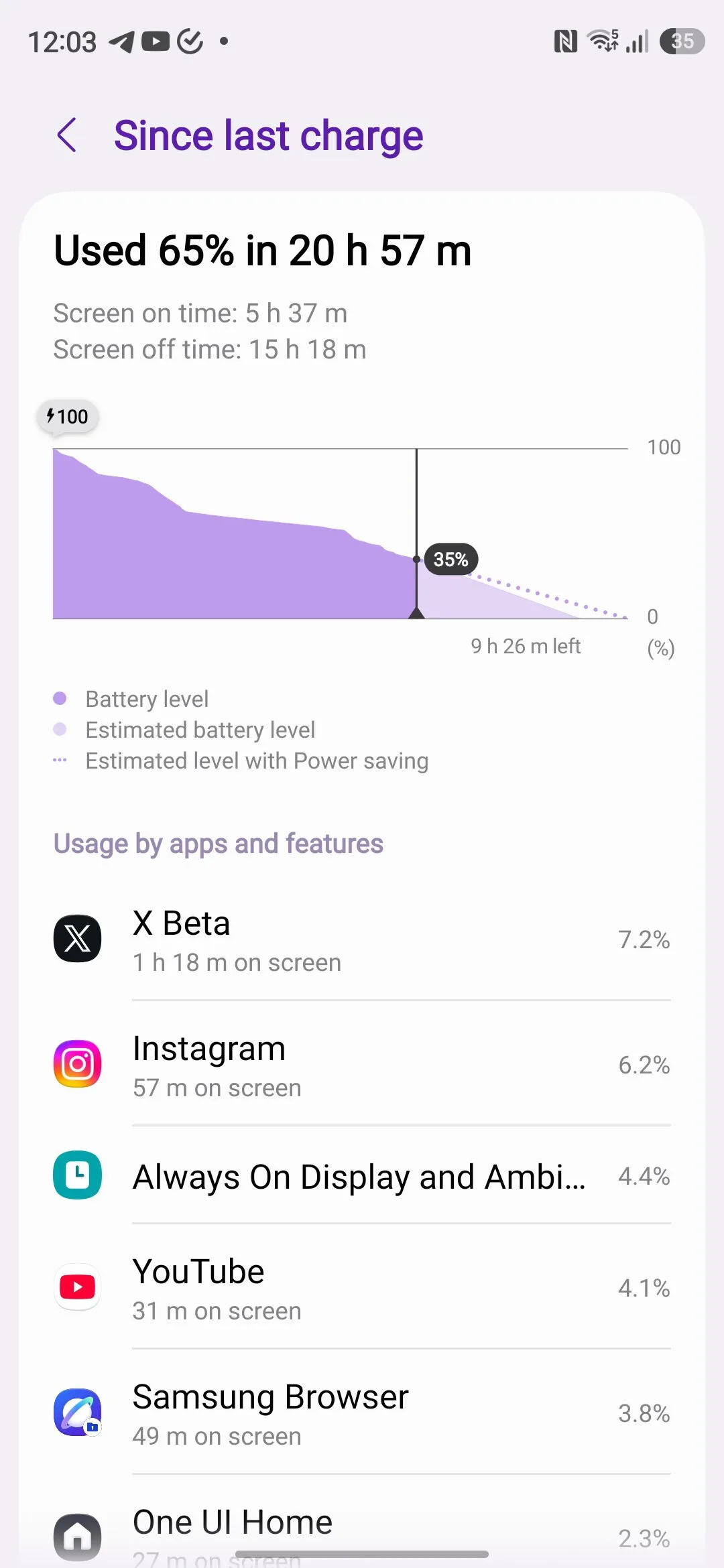
The numbers coming out of extended daily use are the kind that make you re-evaluate what you expect from a flagship Android phone. After a full day of active use — think messaging, browsing, app switching, and social media — one tester went to bed without bothering to plug the phone in. The next morning, after more than five and a half hours of screen-on time, the S26 Ultra still had close to 50% battery remaining. That’s not a benchmark. That’s a phone sitting on a nightstand, uncharged, ready for another full day.
The second day of that same charge continued all the way until 7 PM before the phone was finally plugged in. Two consecutive days of use on a single charge is the kind of real-world result that rarely shows up in controlled lab tests — and it’s the kind of result that makes a phone genuinely useful rather than just technically impressive. That particular stretch was predominantly on Wi-Fi, which favours battery endurance, but the Galaxy S26 Ultra battery life held up under harder conditions too.
On days involving long road trips — wireless Android Auto running for hours, music streaming over mobile data, and GPS navigation active throughout — the phone still landed above 35% by bedtime. That’s a workload that drains most flagships well into the red. The S26 Ultra treated it like a normal Tuesday.
The Charging Speed Catch-Up Samsung Needed
Samsung’s charging speeds have been a sore point for years. While Chinese Android manufacturers have been shipping 100W, 120W, and even 240W fast-charging solutions, Samsung sat at 45W and called it a day. The jump to 60W in the S26 Ultra won’t close that gap with Xiaomi or OnePlus, but it’s a meaningful step forward — and in practice, it performs better than the spec suggests. Considered alongside the broader Galaxy S26 Ultra battery life picture, the improved charging speed makes the overall package genuinely compelling.
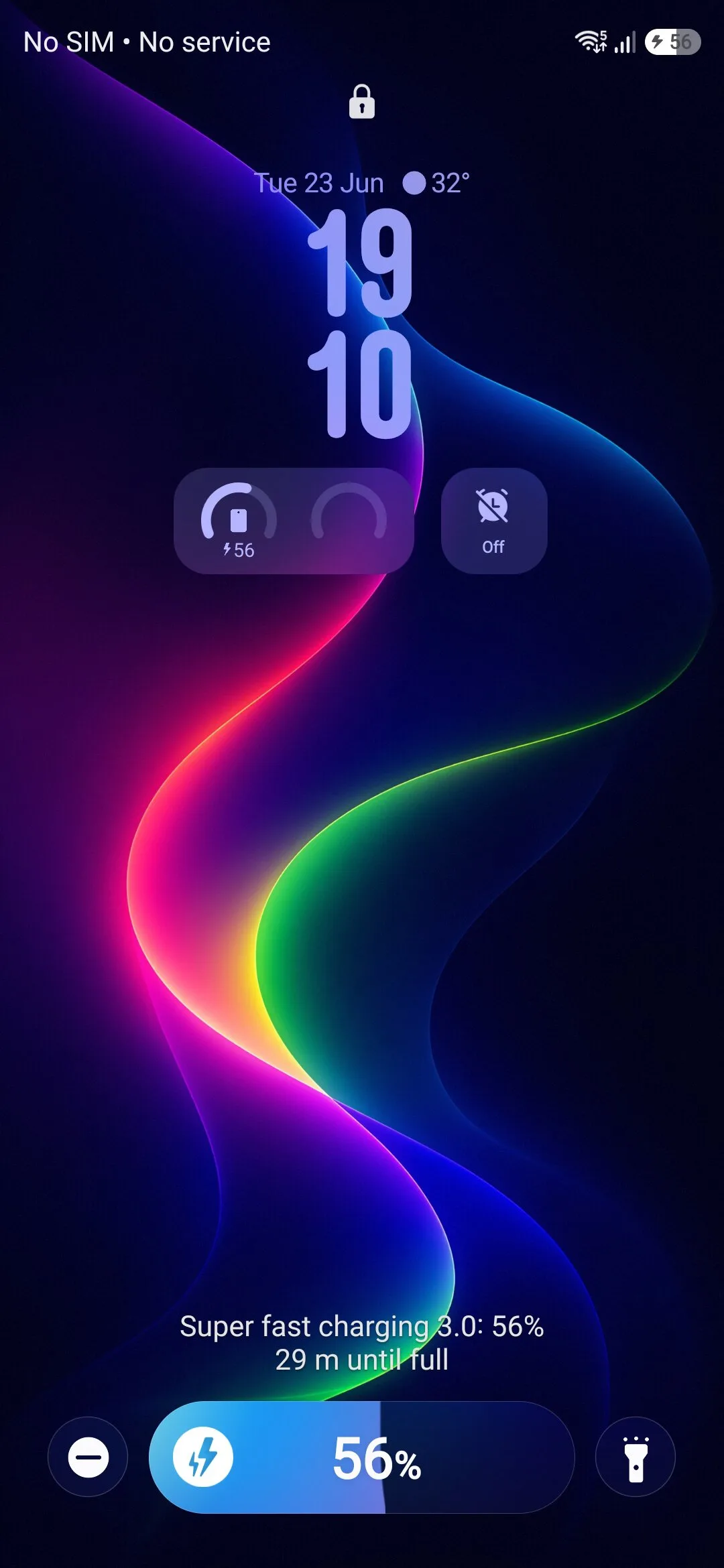
The phone has a habit of underestimating its own speed. When plugged in at 56%, the S26 Ultra displayed an estimated 29 minutes to reach a full charge — a figure that consistently came in ahead of schedule. In one test, charging from 30% to 68% took less than 20 minutes. For context, that’s a window most people fill with a quick shower or a coffee. And crucially, it’s faster than anything Google currently offers in the Pixel lineup, which still trails on wired charging speeds despite Google’s broader hardware ambitions.
The Pixel Problem That Put This in Perspective
Part of what made the Galaxy S26 Ultra battery life so striking is the context in which it got a proper test. Google’s Pixel 10 Pro — a phone many consider the best pure Android experience available — developed a significant battery drain issue that sent its owner hunting for a replacement daily driver. The S26 Ultra, running the One UI 9 beta, stepped into that gap and didn’t flinch.
That’s a telling contrast. Google’s software-first reputation hasn’t translated into battery reliability, at least not consistently. Samsung, a company frequently criticised for software bloat and aggressive background restrictions, has apparently threaded the needle on efficiency in a way that matters more in day-to-day life than any benchmark spreadsheet. Whether Google addresses the Pixel 10 Pro’s drain issues in a future update remains to be seen — but the longer the fix takes, the longer the S26 Ultra gets to make its case as the endurance leader.
What This Means for the Android Flagship Race
The Galaxy S26 Ultra battery life story is a reminder that the spec sheet is only half the picture. Flagship Android phones have spent years competing on paper — camera megapixels, display refresh rates, peak brightness numbers — while the metric that matters most to most people, how long the phone lasts through a real day, gets comparatively little attention until something genuinely changes.
Samsung has historically relied on its brand and its ecosystem to hold the flagship crown. What’s different about the S26 Ultra is that its Galaxy S26 Ultra battery life now delivers an endurance argument that doesn’t need asterisks. It’s not ‘great battery life for a Samsung’ or ‘fine if you’re mostly on Wi-Fi.’ It’s, by most real-world measures, among the best you can get on any Android device right now. The Motorola Razr Fold has apparently pushed those limits further still — but for a slab-form flagship, the S26 Ultra has reset what the baseline should look like.
If Samsung can carry this efficiency advantage into the S27 series while finally closing the gap on charging speeds with its Asian rivals, the argument for buying anything else gets significantly harder to make. And for the rest of the Android industry, that’s the real pressure point — because ‘it lasts two days’ is a feature that sells phones in a way that an extra camera sensor simply doesn’t.
Frequently Asked Questions
How good is the Galaxy S26 Ultra battery life in real-world use?
Extended testing shows the Galaxy S26 Ultra battery life is exceptional, with nearly 50% charge remaining after a full day and over 5.5 hours of screen time. Even on demanding days with wireless Android Auto, music streaming, and GPS navigation, the phone retained over 35% by bedtime.
Does the Galaxy S26 Ultra have the same battery size as the S25 Ultra?
Yes — Samsung kept the same 5,000mAh capacity in the S26 Ultra. However, the source does not attribute the real-world gains to any specific cause such as software or processor efficiency improvements.
How fast does the Galaxy S26 Ultra charge at 60W?
Testing shows the S26 Ultra charged from 30% to 68% in under 20 minutes, outpacing its own on-screen estimates. The phone conservatively displays longer charge times than it actually takes.
How does Galaxy S26 Ultra battery life compare to the Pixel 10 Pro?
Based on hands-on experience, the S26 Ultra outlasted the Pixel, which suffered from notable battery drain issues that prompted the switch. After experiencing the S26 Ultra’s longevity, the author found it would be hard to return to a phone that doesn’t last as long.