
Meta smart glasses have quietly crossed a line that hardware makers usually try to avoid: charging a monthly fee to access a feature that runs entirely on hardware you’ve already paid for. As first reported by The Verge, Meta has introduced a three-hour-per-month cap on Conversation Focus — the noise-reduction tool built into its Ray-Ban Meta glasses — and pointed users toward a $19.99/month subscription if they want more.
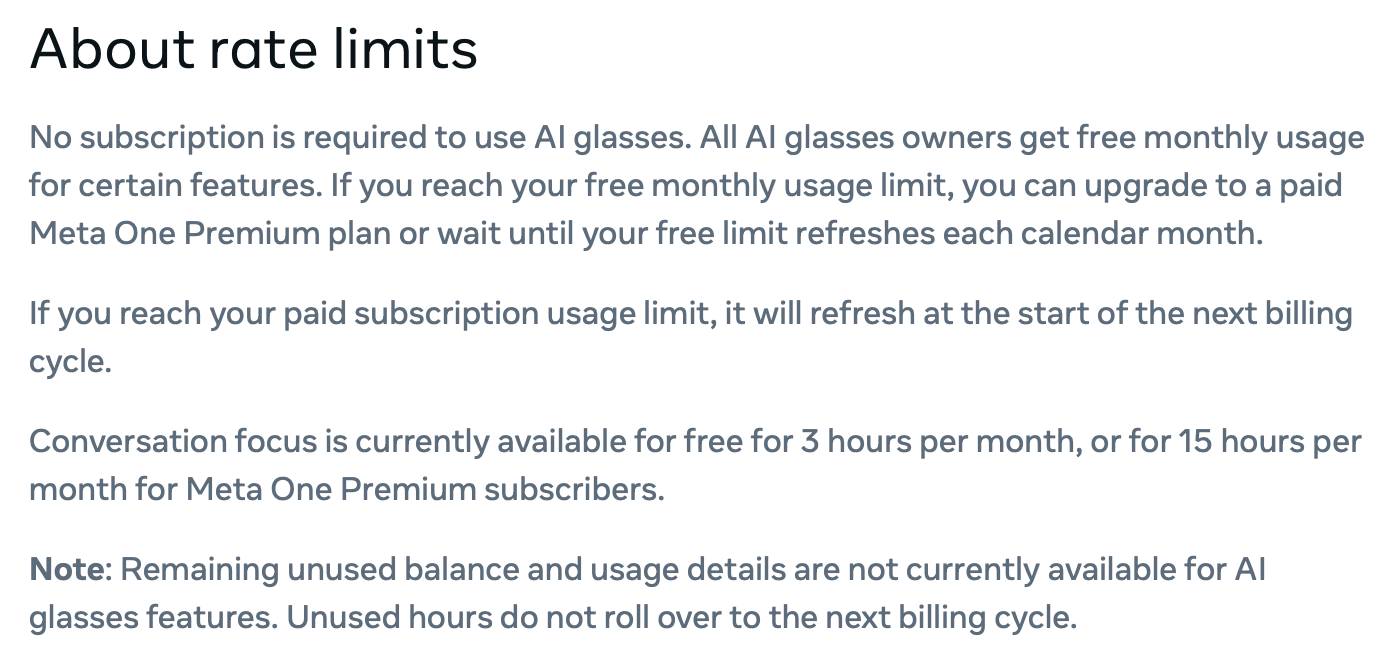
- Meta smart glasses now limit the Conversation Focus feature to just three hours of use per month before a paywall kicks in.
- Meta smart glasses owners can unlock 15 hours of Conversation Focus monthly by paying $19.99 for the Meta One subscription.
- Conversation Focus runs entirely on the glasses hardware without any internet connection, making this paywall approach unusually aggressive.
- The move sets a troubling precedent for other on-device wearable features potentially ending up behind recurring subscription fees.
Table of Contents
What Is Conversation Focus and Why Does It Matter?
If you haven’t used it, Conversation Focus is one of the more practically useful things the Ray-Ban Meta glasses do. It suppresses ambient noise — the clatter of a busy restaurant, the announcements echoing through an airport terminal, the general chaos of a crowded event — and brings the voice of whoever is in front of you to the foreground. It’s an audio tool, and for people who struggle to follow conversations in loud spaces, it’s genuinely valuable. Importantly, it doesn’t offload any of that work to the cloud. There’s no ping to Meta’s servers, no Wi-Fi dependency, no latency from a round trip to a data centre. The glasses handle all of it on-chip, in real time.
That local processing is precisely what makes the new usage cap so striking. This isn’t like throttling AI image generation or capping the number of queries to a large language model — capabilities that genuinely cost money to run on remote infrastructure. Conversation Focus costs Meta nothing extra once the Meta smart glasses are in your hands. The hardware is already there. The feature already works. The cap is a business decision dressed up as a product tier.
Meta Smart Glasses and the New Paywall Structure
Here’s how the tiers now break down. Every Ray-Ban Meta smart glasses owner gets three hours of Conversation Focus use per month at no additional cost. If you want 15 hours per month, you’ll need to subscribe to Meta One at $19.99 per month. That’s it — those are currently the only two options.
Meta, when asked by The Verge to explain the decision, said that most users don’t come close to three hours of Conversation Focus use in a given month, framing the subscription as a tool for ‘power users’ who want expanded access alongside other premium benefits. It’s a standard defence for usage-based pricing — position the free tier as sufficient for most people, and the paid tier as a thoughtful upgrade for edge cases.
The problem is that three hours isn’t a generous allowance once you map it onto actual behaviour. A couple of lunch meetings in a loud office cafeteria. Three or four dinners out across the month. One moderately busy travel day. You can hit three hours without even thinking about it. For anyone using Meta smart glasses as a regular social or professional tool — which is presumably the point of buying them — the cap is a genuine friction point rather than an edge case.

The On-Device Paywall Problem
The subscription economy in tech is nothing new. We’ve watched it sweep through software, through streaming, through cloud storage, through mobile apps. Most of those cases involved ongoing costs — server maintenance, content licensing, API calls, continuous model updates. There’s at least a coherent argument for recurring fees when there are recurring expenses behind them.
On-device features are different. When a capability lives entirely on hardware you’ve purchased outright, the economics of a subscription are harder to justify. Meta smart glasses cost a few hundred dollars. The chip that runs Conversation Focus is already inside them. The software that powers the feature was presumably factored into the original product development cost. Introducing a monthly fee for access to something that runs locally starts to feel less like a fair exchange and more like artificial scarcity.
This isn’t entirely unprecedented in hardware. Apple has periodically gated certain features to specific device tiers or operating system upgrades. Some car manufacturers — BMW drew significant criticism for this back in 2022 — have experimented with subscription fees for features like heated seats that were already installed in the vehicle. The backlash in those cases was swift and significant. BMW eventually reversed course on several of those subscriptions. Meta may be banking on the fact that Meta smart glasses occupy a newer, less emotionally charged category where users have less established expectations about what should be free.
What Meta One Actually Offers Right Now
It’s worth being clear about what Meta One is at this stage: quite thin. Fifteen hours of Conversation Focus and premium device support. That’s the full list of current benefits for $19.99 a month — $240 a year. Meta will almost certainly expand the subscription over time, adding features and justifying the cost with a broader bundle. That’s the standard playbook: launch lean, build value, raise the floor on what’s expected to be paid for.
The concern isn’t necessarily that Meta One will stay this limited. It’s that the architecture is now in place. A subscription tier exists. Features can be moved into it. And the first feature to land there runs on the Meta smart glasses themselves, not on Meta’s servers. That’s the signal worth paying attention to.
A Precedent That Could Reshape the Wearables Market
Meta smart glasses have been one of the more credible consumer hardware success stories of the past two years. The Ray-Ban collaboration gave them mainstream appeal that earlier smart glasses — Google Glass, Spectacles — never quite achieved. They’re genuinely wearable, genuinely useful, and selling well enough that Meta has committed to continuing the line.
That commercial success makes Meta’s choices here influential. If the Conversation Focus cap proves acceptable to consumers — if churn stays low, if the backlash doesn’t materially affect sales — other wearable manufacturers will notice. The calculus becomes: we built the hardware, we shipped the feature, now we can meter access to it. Fitness trackers, hearing-aid-adjacent earbuds, AR headsets — every device category that includes on-board processing and ambient intelligence features could eventually look at this model.
For consumers, the right question to ask isn’t just ‘is three hours enough?’ It’s ‘what else might get capped next?’ Meta’s response to The Verge specifically left the door open for additional subscription features — ‘other premium benefits’ was the phrase used, without elaboration. At some point, what you paid for at the register and what you can actually use day-to-day on your Meta smart glasses could become two noticeably different things. That gap is where the real tension in this story lives.