

Table of Contents
Origins and Ideals
The Humane AI Pin arrives with an ambition that has long animated the wearable-technology business: make computing feel less like an activity performed through a screen and more like a quiet layer of everyday life. In an era dominated by technological innovation, that idea has obvious appeal. Consumers already carry powerful computers throughout the day, and developers continue to look for ways to make access to information, communication, and assistance feel more immediate.
Humane’s proposition is not simply to make another connected gadget. The AI Pin is conceived as a small wearable computer equipped with sensors and communication tools, intended to act as a constant companion that can offer assistance and insight when needed. That is a far more demanding brief than adding notifications or fitness tracking to something worn on the body. A companion device must know when to help, respond quickly enough to be useful, and avoid becoming another source of friction.
The underlying ideal is compelling: technology that blends into the fabric of daily existence rather than repeatedly demanding attention. But “blending in” is not just a design philosophy. It is a practical test. If a device asks users to change familiar habits without giving them a clear advantage in return, its elegant premise can quickly turn into an awkward compromise.
Hardware With a Clear Point of View
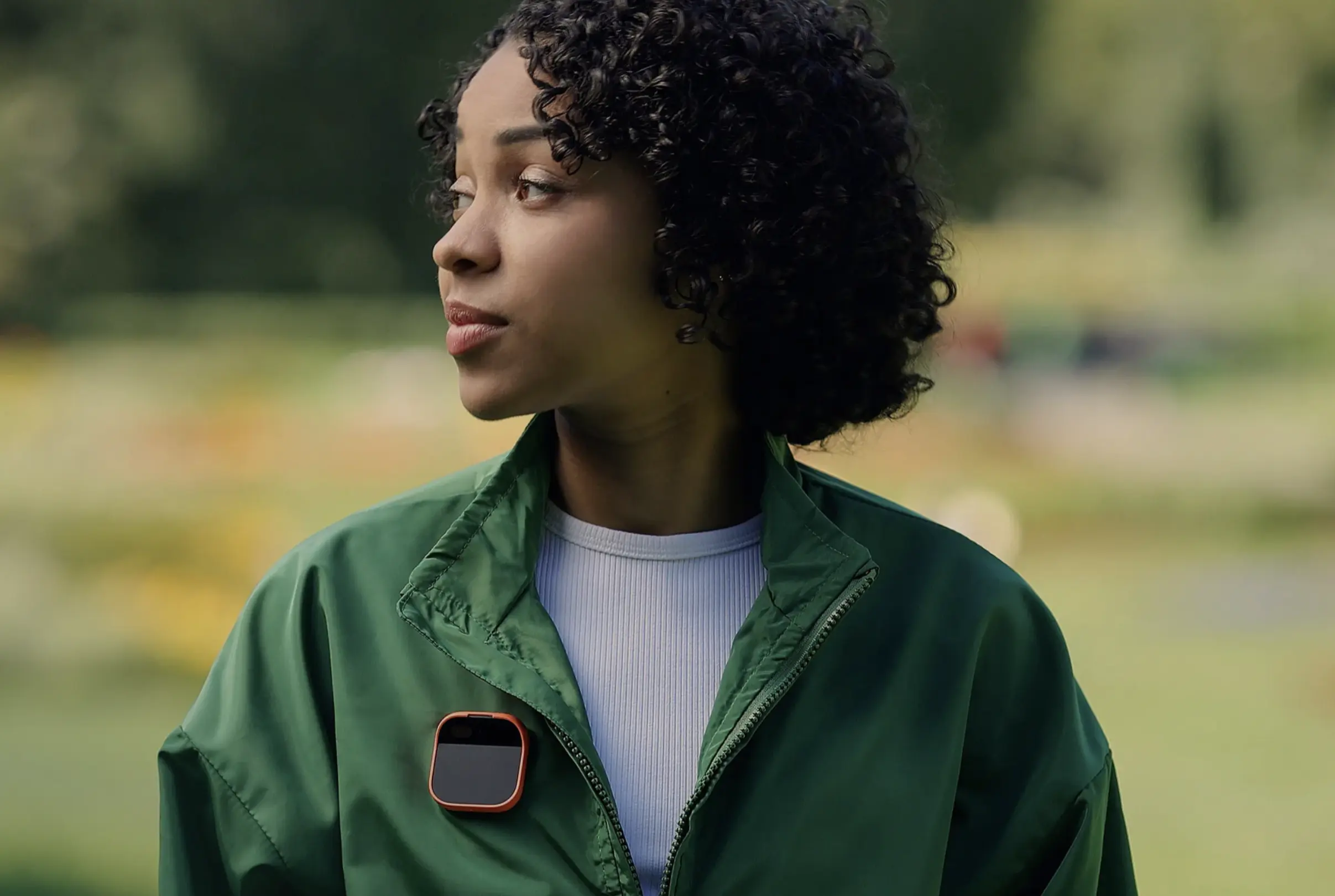
The hardware of the Humane AI Pin makes the company’s intentions unusually visible. Crafted from solid aluminum and fitted with sensors, lights, and a miniature projector, the device presents itself as a serious attempt to rethink the personal computer in wearable form. The camera, microphone, touchpad, AI assistant, and projection element are not incidental additions; together, they suggest an effort to replace parts of the interaction model people normally expect from a phone.
Its construction also speaks to the realities of a device designed to be worn. Magnets secure it to clothing, while a reflective charging case is intended to support its longevity. These details matter because wearables live or die on routine. A product can be technically capable yet still fail if it is cumbersome to attach, uncomfortable to keep on, or too easy to leave uncharged when heading out the door.
There is a tension in the AI Pin’s physical design. On one hand, a compact object with fewer overt demands than a smartphone can feel liberating. On the other, shrinking computing into a small wearable does not shrink the expectations surrounding it. Users may tolerate some limitations from an accessory. They are less forgiving when a product positions itself as an alternative way to access the digital world.
The polished exterior therefore creates a high bar. Solid aluminum, sensors, lights, magnets, and a miniature projector all give the Pin a distinct identity, but attractive engineering cannot settle the more difficult question: whether the interaction is dependable enough to become habitual. The gap between an impressive object and an indispensable device is where many ambitious consumer products struggle.
Functionality Is the Harder Problem
At its core, the Humane AI Pin is meant to be an intuitive and intelligent companion. The combination of an AI assistant, camera, microphone, and touchpad points toward interactions that are more conversational and contextual than tapping through a conventional interface. In theory, that can reduce the small burdens of daily device use: opening an app, searching through menus, switching attention from the physical world to a screen.
In practice, the current iteration faces a familiar problem for cloud-reliant AI products: delay changes the entire experience. The article’s concern that cloud computing leads to delays and inaccuracies goes to the heart of the Pin’s proposition. An assistant does not need to be perfect to be useful, but it does need to be predictably useful. When responses arrive too slowly or fail to match the user’s request, the supposed convenience can become less convenient than reaching for a smartphone.
Accuracy carries similar weight. A wearable companion is asked to interpret speech, context, and intent in situations that can be messy and unpredictable. The device has little room for ambiguity if it is meant to be a natural part of a person’s day. A missed request is not merely a technical blemish; it interrupts trust. Once users expect a device to misunderstand them, they tend to revert to tools with more explicit controls.
The lack of integration with popular apps and services is equally consequential. Modern personal technology is not defined only by hardware. Its value is bound up in the networks of tools people already use for work, communication, media, travel, and everyday administration. The Pin’s standalone nature means it is disconnected from that ecosystem, limiting its practical appeal for the average consumer. That limitation is especially damaging for a product that asks users to imagine doing things differently.
The Smartphone Is Not Just a Competitor
The Humane AI Pin faces formidable competition, chief among it the ubiquitous smartphone. This is not a simple comparison between a new device and an old one. Smartphones have become the default place where many services, habits, and personal workflows meet. Their versatility is not only a matter of features; it comes from familiarity. People know how to use them, know where their information lives, and know what to do when something goes wrong.
Against that standard, the Pin pales in comparison to the versatility, convenience, and superior functionality of smartphones. That does not make the wearable idea worthless. It does mean the product cannot succeed merely by offering a different form factor or a more futuristic story. It needs to establish situations in which its approach is clearly better, not simply novel.
A device designed to reduce screen dependence also faces an unavoidable paradox. The less it resembles a smartphone, the more it must prove that important tasks can still be handled with confidence. The more it depends on a smartphone-like ecosystem to fill its gaps, the weaker its claim to independence becomes. Humane is confronting that trade-off directly.
A Promising Idea Meets Present Realities
Despite the challenges, the Humane AI Pin should not be dismissed as a frivolous experiment. Its vision addresses a genuine unease with the way personal technology often works: screens pull attention away from the people and places directly in front of us, even when the task at hand is small. A wearable computer that can offer help without making the screen the centre of every interaction remains an attractive goal.
But the current iteration illustrates why that goal is difficult to achieve. The hardware may be sophisticated, yet the everyday experience depends on consistent performance, reliable responses, and a useful relationship with the services people already rely on. Those are not secondary details. They are the conditions that determine whether a device feels like a companion or an unfinished substitute.
Developers and engineers may continue to refine the hardware and software, and there is room for the AI Pin to improve its usefulness over time. Still, hope alone does not resolve the central issue. Humane must confront the harsh realities of technological advancement: new interaction models require patience from users, while consumer expectations are shaped by products that already work well enough.
The Humane AI Pin represents both the promise and the peril of wearable technology. Its future-facing vision is compelling, but its present limitations cannot be waved away by design ambition. The sensible response is neither blind optimism nor reflexive skepticism. It is to judge the Pin by the standard it sets for itself: whether it can become a truly indispensable companion rather than an intriguing object that asks people to compromise.

