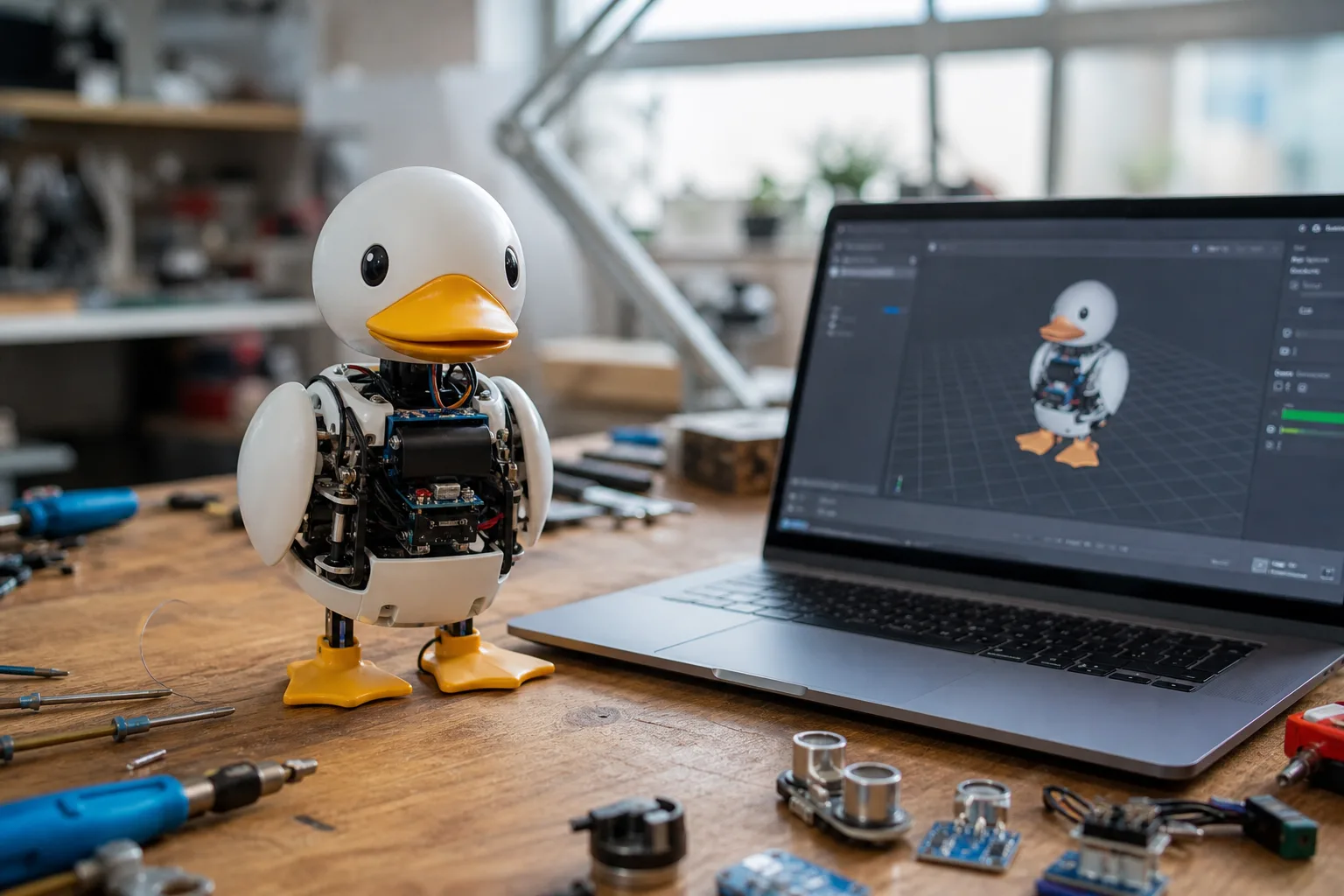
- Hugging Face’s $399 Microduck robot is a 25-centimeter developer machine built for experiments with open-source physical AI.
- The Microduck robot can walk, crouch, recover from falls, carry up to 800 grams, and even move on roller skates.
- Its training stack lets developers teach behaviors in simulation before sending policies to the physical machine.
- Open code improves inspectability, but third-party robot apps may still create privacy risks around cameras and collected data.
Table of Contents
A small duck with a serious job
A robot duck that costs $399 sounds like the sort of thing designed to go viral for a weekend and then gather dust beside an unused bread maker. But the Microduck robot Hugging Face has put on sale is aimed at a more serious crowd: developers who want to teach a physical machine new behaviors without buying industrial hardware or signing up for a closed platform.
The 25-centimeter-tall bot can waddle, crouch, stand back up after falling, pick up objects with its beak, and roller skate. Its stated payload is up to 800 grams, which is not going to transform your kitchen logistics, but it is plenty for a desk-scale machine that exists to test perception, balance, and manipulation. Hugging Face CEO Clem Delangue described it as an open-source robot that users can teach new tricks through reinforcement learning.
That is the important bit. Most people know Hugging Face as the place where AI researchers and developers find model weights, datasets, demos, and tooling. The company is trying to make the same basic proposition in robotics: give people access to the machinery underneath, rather than asking them to treat a robot as a sealed appliance.
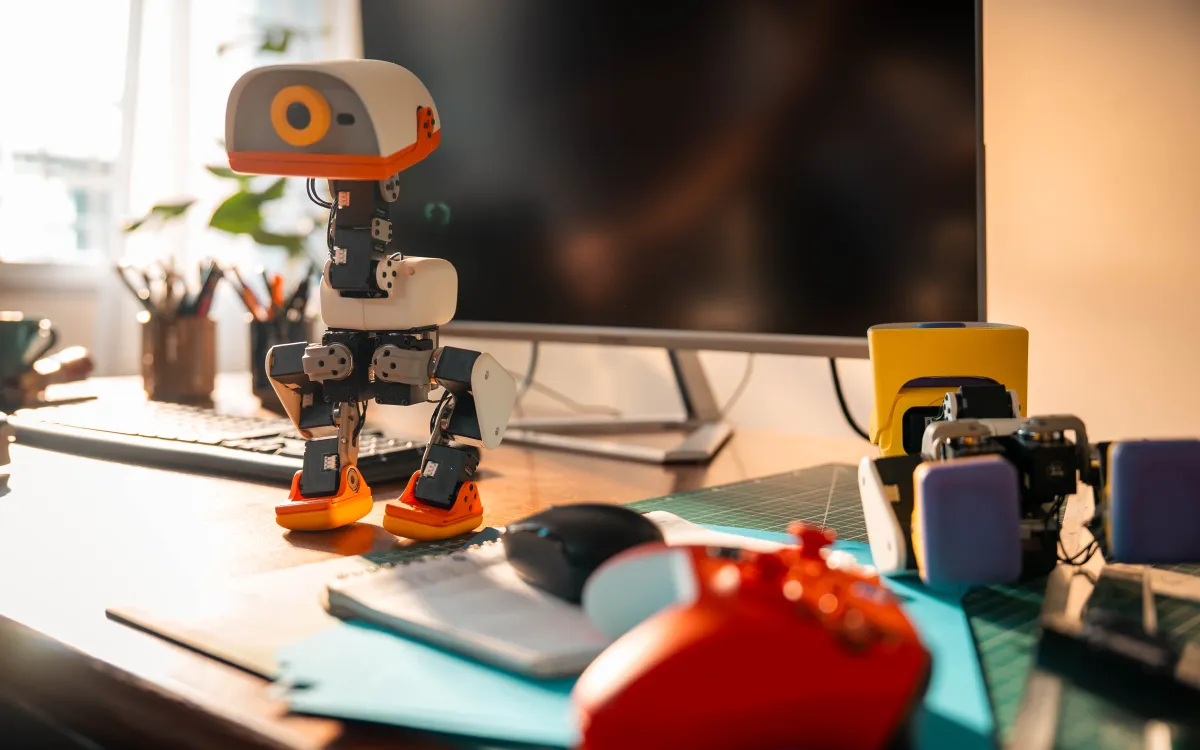
Shipping is planned before Christmas, and the price puts the Microduck robot below many hobbyist humanoid kits and far below the research platforms typically used for locomotion experiments. For developers, the Microduck robot is an inexpensive way to test ideas that would otherwise require far more costly hardware. The duck form is also less frivolous than it looks. A low, wide body and simple beak-like gripper offer a manageable way to experiment with movement and object handling without attempting the nightmare scenario of a bipedal robot in a living room.
Why Hugging Face is betting on open robotics
Hugging Face entered this corner of hardware in earnest when it acquired French startup Pollen Robotics in April 2025. Pollen had already built a reputation around Reachy, a modular research robot, and the partnership soon produced the smaller Reachy Mini line. The company now sells a $499 Reachy Mini with an onboard Raspberry Pi and a $399 Lite version that depends on a Mac or PC.
The Microduck robot is the more playful sibling, but it follows the same strategy. Hardware is only useful to Hugging Face if the surrounding software community can modify it, publish work, and build on one another’s results. Pollen says users can train behaviors in simulation, deploy them onto the physical unit, then fine-tune and retrain. Its SDK, simulator, and full reinforcement-learning training stack are available through Pollen Robotics’ GitHub organization.
That workflow is standard thinking in advanced robotics. Training directly on real machines is slow, expensive, and occasionally destructive. Anyone who has watched a robot repeatedly face-plant into a foam mat will understand the appeal. Simulators let developers run vast numbers of attempts cheaply, then transfer the resulting policy to a real device. The hard part is the so-called reality gap: simulated friction, lighting, weight distribution, and sensor noise never perfectly match the messy physical world.
Still, a cheap platform can make that mismatch easier to study. University labs and well-funded startups have long had access to expensive hardware from companies such as Boston Dynamics, Unitree, and Franka. A $399 machine won’t compete with those systems on capability. Frankly, it doesn’t need to. Its value is that a student, a small lab, or an independent developer can break something, learn why it broke, and try again without filing a capital-equipment request.
The Microduck robot has real sensors, and real privacy questions
Under the cute shell, the Microduck robot carries a camera, lidar, and two inertial measurement units, or IMUs. The camera and lidar help it perceive nearby objects and space; the IMUs track movement and orientation. That is a credible sensor package for a small experimental robot, particularly one intended to learn locomotion and simple manipulation rather than hold conversations with house guests.
But an affordable robot with a camera is still a camera with wheels, legs, or in this case webbed feet. Delangue has argued that open-source models offer a privacy advantage over black-box systems controlled by a small number of organizations. There is truth in that. Open software can be inspected, self-hosted, changed, and audited in ways that cloud-first consumer devices generally cannot.
My read is that openness is a tool, not a privacy guarantee. Once users install third-party applications, those applications can access sensor data and potentially send it elsewhere. The danger is not necessarily Hugging Face spying on a bedroom or workshop; it is a developer ecosystem where permissions, network connections, and data practices vary wildly. We have seen this movie with smartphone apps, smart speakers, and cheap security cameras. A source-available stack does not magically make every add-on trustworthy.
Why a duck makes sense for physical AI
The timing matters. Generative AI has made software models easier to access, while robotics remains expensive, fragile, and concentrated among a relatively small number of companies. Hugging Face wants to push against that imbalance by turning physical AI into something closer to a developer platform. Delangue framed the launch as part of an era of affordable open-source robots and world models.
Behind the launch sits a larger business question. Hugging Face has reportedly been the subject of acquisition discussions involving Nvidia at a valuation around $13 billion, though neither company had publicly confirmed such a deal at the time of reporting. Nvidia has been a long-running infrastructure partner and has loudly supported open AI development where it aligns with its GPU business. Whether that relationship produces an acquisition or not, robots are an obvious next destination for compute companies chasing AI’s biggest future market.
The Microduck robot will not make domestic robots normal overnight. It may never leave the desks, labs, classrooms, and very patient hobbyists for which it was built. Yet that is almost beside the point. Cheap, modifiable hardware has a habit of producing ideas that polished consumer products miss. If Hugging Face can build a community around this odd little duck, the interesting question is not whether it can skate. It is what developers teach it to do once nobody has to ask permission first.