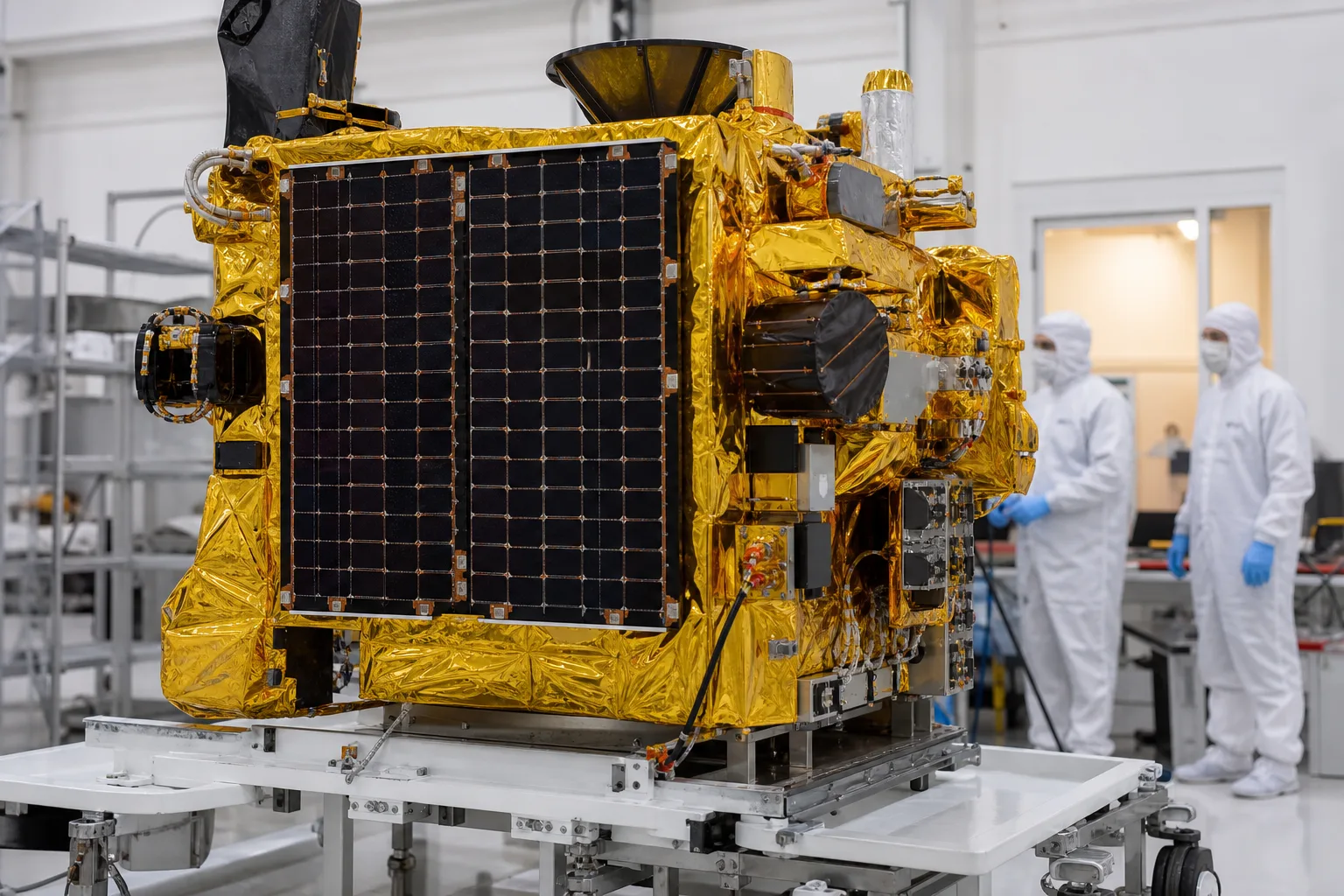
- Project Suncatcher will launch four Google TPUs aboard SpaceX’s Transporter-18 mission to test computing hardware in low Earth orbit.
- Google’s Project Suncatcher must prove chips can survive radiation, brutal launch forces, and heat rejection without air before orbital AI becomes plausible.
- The prototype mission follows laboratory radiation testing and will inform a planned two-satellite laser-link demonstration in 2027.
- Orbital computing could tap abundant sunlight, but launches, networking, cooling, and repair remain formidable economic obstacles.
Table of Contents
Project Suncatcher’s first test is about failure, not spectacle
Google is about to put four of its Tensor Processing Units into orbit, and Project Suncatcher may be one of the more revealing AI experiments of the year. Not because four chips will create a data center in space — they plainly will not — but because this is where a seductive presentation deck meets vibration, radiation and physics.
The prototype is scheduled to fly on SpaceX’s Transporter-18 rideshare mission, with Planet Labs involved in developing the spacecraft. Google says the flight is meant to expose its TPU hardware to the conditions that would confront any serious attempt at orbital AI computing. The company put it plainly in its announcement: “This first launch is about seeing what works, identifying points of failure, and applying those findings to future missions.” That’s the right framing. Space projects that begin by admitting they expect things to break tend to be more credible than the ones selling inevitability.
Google first outlined Project Suncatcher as a research effort aimed at a bold proposition: clusters of satellites could eventually run AI workloads using solar power and high-speed laser connections between spacecraft. In low Earth orbit, solar arrays can receive far more sunlight than a ground-based installation, and Google has estimated the usable energy opportunity could be up to eight times higher than on Earth.
That number needs context. A satellite does not get free electricity simply because it is closer to the Sun; it still passes through Earth’s shadow, needs panels, batteries, power electronics and a way to shed waste heat. But the underlying appeal is real. AI data centers are becoming electrical infrastructure on a colossal scale, drawing scrutiny from communities worried about grid capacity, water use and power prices. Moving some computing off-world has a certain sci-fi gloss, sure, but it is also an attempt to find a new ceiling for an industry running into very terrestrial limits.

Why AI chips have a rougher life above the atmosphere
The rocket launch alone is a fairly nasty introduction. Google says the roughly 10-minute trip to low Earth orbit can subject the spacecraft to forces around 10 times Earth gravity, while some individual components can briefly see loads between 50 and 100 g. Your laptop doesn’t need to survive being shaken like a paint mixer. A TPU headed to orbit does.
Once it arrives, the difficult part changes rather than ends. Cosmic rays and solar events can strike electronics and trigger so-called bit flips, in which stored data changes state unexpectedly. In an AI workload, a bit flip might be harmless, it might produce a wrong calculation, or it might crash a process at precisely the wrong moment. Space hardware designers use shielding, redundancy and error-correction techniques to manage that risk, but all of those measures add mass, complexity or power draw.
Google has already done some ground testing at the University of California, Davis’s Crocker Nuclear Laboratory, where it exposed its Trillium TPUs to a proton beam while running AI tasks. The company said the chips survived a radiation dose greater than the exposure expected during a typical five-year mission. That is encouraging, though laboratory radiation tests are not a substitute for operating hardware through launch, orbital temperature swings and the messy reality of a full spacecraft system.
The official Google Research overview of Project Suncatcher describes this as a long-term research program, which is the sensible label. These chips were designed for data centers with controlled power, service technicians and cooling infrastructure measured in buildings. In orbit, every connector, thermal interface and software recovery routine matters.
Cooling could be Project Suncatcher’s make-or-break problem
AI accelerators are hungry little furnaces. On Earth, operators remove that heat with fans, chilled water loops and increasingly elaborate liquid-cooling systems. In the vacuum of space, there is no air to move heat away. The only practical exit is radiation: carry heat to a radiator and emit it into space.
That sounds straightforward until you consider the trade-offs. Bigger radiators add surface area and mass. They must point in useful directions, survive the launch and avoid absorbing too much sunlight. A satellite may be power-rich when it is sunlit but constrained when it is not. And a system that runs hot enough to damage components is not a cloud platform; it is expensive debris.
For Project Suncatcher, Google says it is testing a combination of heat pipes and radiators. The team has used a thermal vacuum chamber to simulate the vacuum and temperature conditions of space, and this flight will provide the first operational check. Frankly, thermal management is where I would keep my eye. The industry knows how to launch electronics. It knows how to deploy solar panels. Running dense AI hardware continuously while getting rid of its heat is the less glamorous, much harder trick.
Space-based data centers have competition — and a cost problem
Google is not alone in treating orbit as a potential extension of cloud infrastructure. Starcloud has pursued space-based computing and reportedly launched an Nvidia H100 GPU in 2025. SpaceX has also discussed orbital AI infrastructure as part of its broader business ambitions. The common pitch is easy to understand: use sunlight in space, process data close to Earth-observing sensors, and connect satellite nodes with optical links rather than bringing every raw bit back to the ground.
The practical case is narrower, but it is real. An Earth-observation satellite could analyze imagery onboard and send alerts rather than downlinking oceans of raw data. That saves bandwidth and can reduce latency for time-sensitive work such as wildfire monitoring, maritime tracking or disaster response. Those are much stronger near-term cases than claiming ChatGPT-scale training will float above us anytime soon.
Training frontier models requires enormous fleets of accelerators, fast networking, storage, regular upgrades and relentless maintenance. A failed server in a terrestrial data center is swapped out by a technician. A failed orbital server becomes a procurement and launch problem. Laser links may solve part of the bandwidth equation, but they need precise pointing and reliable network coordination across fast-moving spacecraft. Then there is the awkward accounting question: even if the sunlight is abundant, is the system cheaper once launches, radiation hardening, satellite production and replacement are included?
Google plans a larger next step in 2027, when it expects to launch two satellites and test the high-bandwidth optical links central to its vision. That mission may tell us more about the viability of Project Suncatcher than this initial TPU flight. Computing in space is no longer a ridiculous idea. Making it economical, maintainable and useful at data-center scale remains another matter entirely.
My read is that Project Suncatcher is best understood as Google buying an option on a future nobody can yet price. If AI’s appetite for electricity keeps outrunning grid construction, the companies that tested unconventional infrastructure early may look prescient. But if orbital computing turns out to be a very expensive answer to a problem better solved with cleaner grids and more efficient chips, Google will at least have learned that before ordering a constellation.