

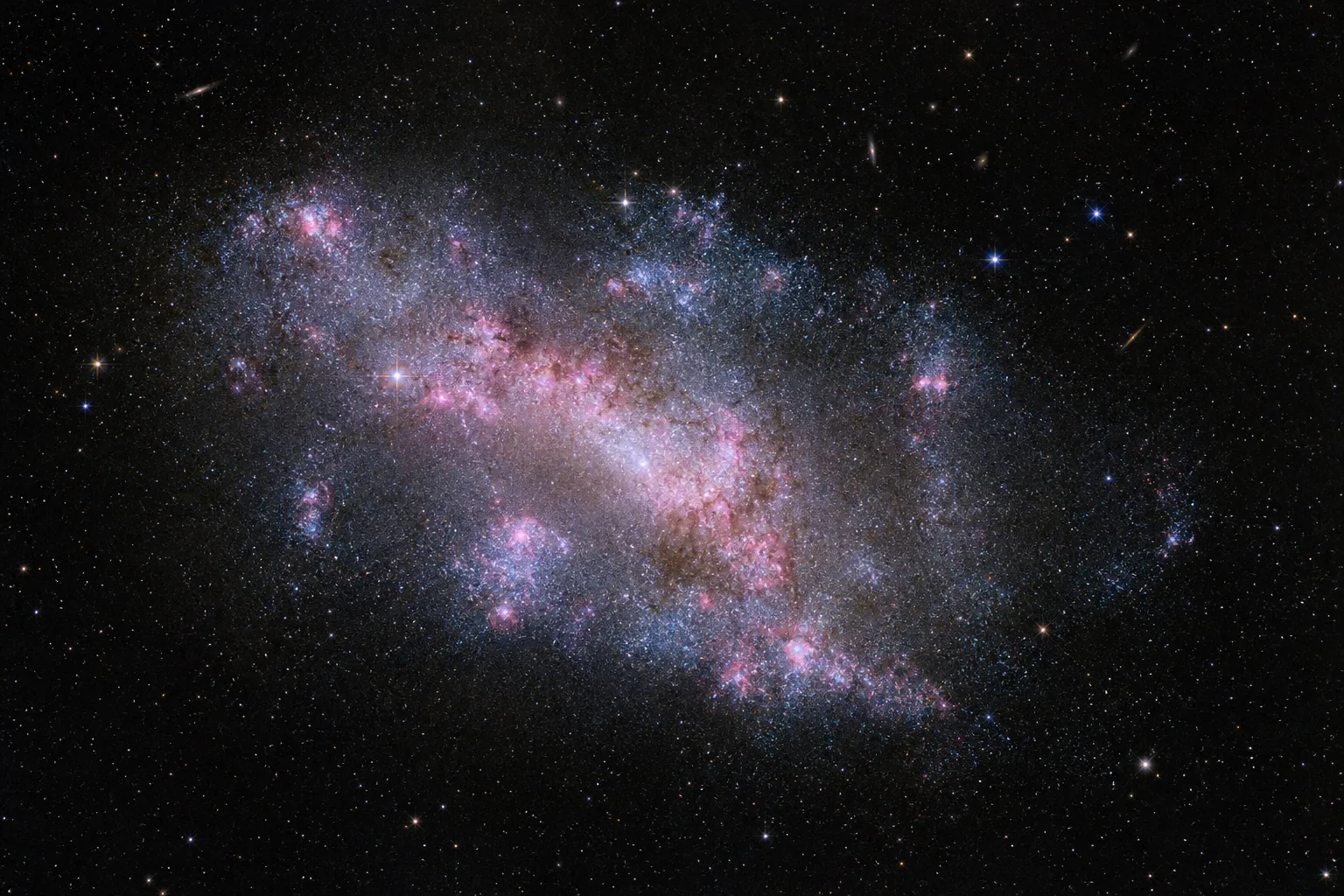
- NGC 4449 is a compact dwarf galaxy whose bright star-forming regions give it a surprisingly large influence on its cosmic neighborhood.
- Observations of NGC 4449 point to strong stellar winds and supernovae pushing oxygen and other heavy elements beyond the galaxy.
- Dwarf galaxies are far more common than giant galaxies and may have helped distribute material needed for later stars and planets.
- Hubble’s resolved view of nearby galaxies lets researchers connect individual stars, gas flows, and the larger history of chemical evolution.
Table of Contents
NGC 4449 makes a small galaxy hard to dismiss
NGC 4449 looks like the kind of galaxy that should be easy to overlook: a relatively small, irregular patch of stars and glowing gas beside the giant spirals that dominate astronomy posters. But that instinct is exactly backwards. New attention on this Hubble Space Telescope target reinforces a bigger point about the universe: small galaxies may be among its most effective chemical delivery systems.
The Milky Way spans roughly 100,000 light-years and contains hundreds of billions of stars. Dwarf galaxies are commonly around one-tenth that scale, often holding only a few billion stars. Yet their size has never made them marginal. They are the dominant kind of galaxy by number, and their history is tied to how the cosmos acquired oxygen, carbon, iron, and the other elements that eventually wind up in rocks, oceans, electronics, and people.
That’s the appeal of NGC 4449. Hubble’s image captures a galaxy with a messy, active appearance: bright blue star clusters, lanes of dust, and pinkish clumps where hot young stars energize surrounding hydrogen gas. It has the visual character of a workshop after a long night shift. Things are clearly being built, but material is also being flung everywhere.
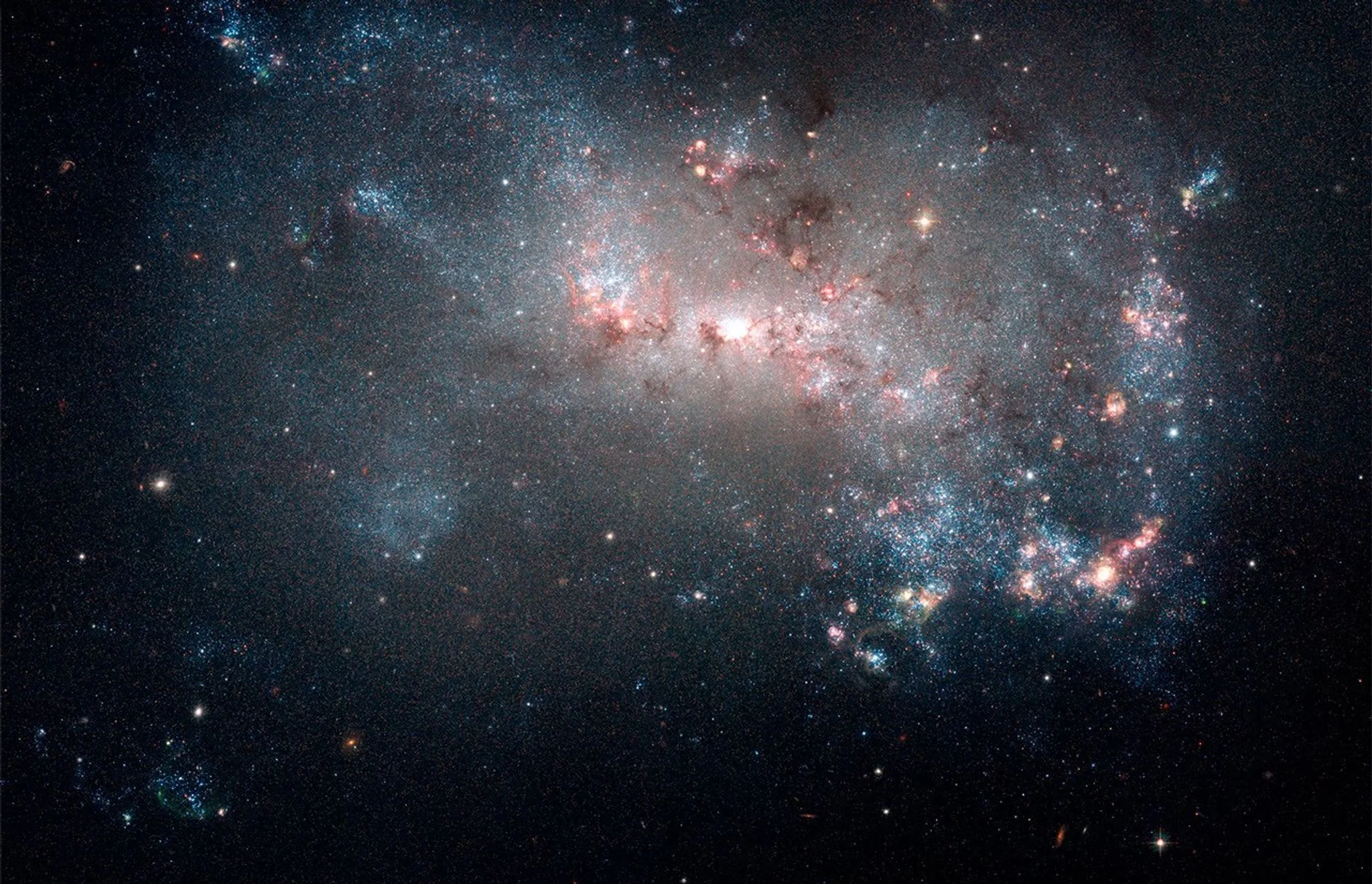
NASA’s Astronomy Picture of the Day description puts the scientific tension plainly: dwarf galaxies including NGC 4449 appear to be missing more oxygen than standard expectations would predict. Oxygen is not vanishing into thin air, obviously. The more plausible explanation is that the galaxy has lost a meaningful share of its enriched gas.
Why missing oxygen changes the story
Stars begin with mostly hydrogen and helium. In their hot interiors, and especially during their deaths, they create and distribute heavier elements. Massive stars also produce ferocious outflows during their lifetimes. Then come supernovae, which can dump enormous amounts of energy into nearby gas. In a large galaxy, much of that gas may stay bound by gravity, cool down, and later become raw material for another generation of stars.
In a smaller system, the escape route is less demanding. NGC 4449 may be a case where stellar winds and supernova blasts are efficient enough to drive oxygen-rich gas out of the galaxy’s gravitational grip. Think of the difference between tossing a ball from a valley and tossing it from a low hill. The force can be the same; the outcome is not.
That matters far beyond one photogenic galaxy. If dwarf systems routinely lose enriched gas, they can seed the wider environment around galaxies with the ingredients made by stars. Those atoms do not remain loyal to their original address. Over immense spans of time, gas can mix into larger reservoirs, fall into other galaxies, and participate in future star and planet formation.
My read is that this is where the public shorthand of galaxies as isolated island universes starts to fail. They are more like towns connected by weather, waterways, and supply chains, except the supply chain operates over millions of years and includes the ash of exploded stars.
NGC 4449 and the value of Hubble’s close-up view
NGC 4449 is particularly useful because it is near enough for Hubble to separate much of its light into individual stars and compact star clusters rather than treating the entire galaxy as one fuzzy smudge. That distinction matters. Astronomers can compare the ages and locations of stellar populations with the structure of the surrounding gas, building a more grounded account of where energetic feedback is happening.
The Hubble Space Telescope’s galaxy observations have repeatedly shown why nearby systems remain essential even in an era of increasingly distant cosmic surveys. James Webb Space Telescope grabs deserved attention for peering into the early universe, but Hubble’s sharp optical view still excels at mapping stellar populations in our relative backyard. You need both approaches: one to see the universe’s childhood, another to inspect the machinery at close range.
Here’s a useful corrective for technology-minded readers. Bigger instruments and larger datasets do not automatically erase the need for well-chosen targets. A galaxy like NGC 4449 can act as a test bench for the physics inside simulation models: how strongly stars inject energy into gas, how easily material escapes, and how much of a galaxy’s chemical output remains available for its next wave of star formation.
The dwarf galaxy problem is really a modeling problem
Computer simulations of galaxy formation have long wrestled with stellar feedback. Make supernova feedback too weak, and small galaxies form too many stars and retain too much enriched gas. Make it too aggressive, and you can blow away gas so efficiently that later star formation becomes hard to explain. Real galaxies refuse to behave like clean laboratory systems, which is inconvenient but productive.
NGC 4449 does not settle that debate by itself. A single galaxy never does. Its past interactions, gas supply, star-formation history, and local environment all matter. Still, an oxygen deficit is exactly the kind of observation that forces models to account for the full lifecycle of matter rather than merely counting stars.
Frankly, that’s why dwarf galaxies deserve more attention than they usually get. Giant galaxies tell the grand story in sweeping visuals. The smaller ones may explain how the universe stocked its pantry in the first place. As Hubble, Webb, and future observatories add more detailed measurements of gas around dwarf systems, the question will sharpen: how much of the material that made worlds like ours was first thrown out by galaxies such as NGC 4449?
Frequently Asked Questions
What is NGC 4449?
NGC 4449 is a dwarf galaxy captured by the Hubble Space Telescope. Like other dwarf galaxies, it is much smaller than the Milky Way.
Why does NGC 4449 have less oxygen than models expect?
Its missing oxygen suggests that stellar winds and supernovae are surprisingly effective at blowing oxygen and other heavy elements away from the galaxy.
How do dwarf galaxies spread heavy elements?
Stellar winds and supernovae can blow oxygen and other heavy elements away from dwarf galaxies. This may help spread these elements throughout the universe.
Why are dwarf galaxies important to astronomers?
Dwarf galaxies are the most common type of galaxy in the universe. They may play a major role in spreading heavy elements, which are building blocks of stars, planets, and life.