Table of Contents
A flight that makes reuse the main event
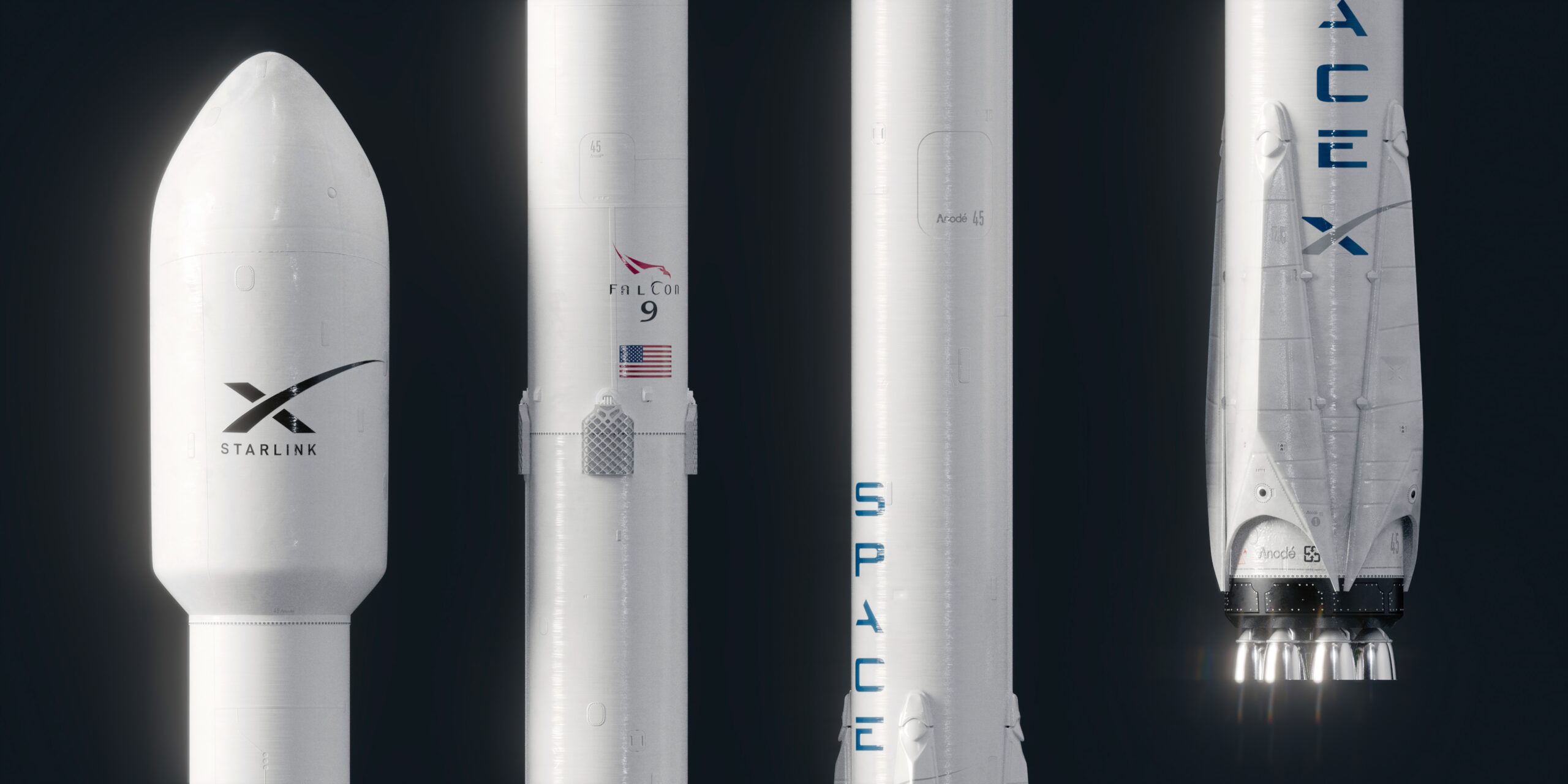
Tonight, July 9, SpaceX is poised to put a new marker down in the practical history of reusable launch hardware. A Falcon 9 carrying 22 Starlink internet satellites is scheduled to lift off from Cape Canaveral Space Force Station in Florida at 8:36 p.m. ET, or 0036 GMT on July 10. If the mission proceeds as planned, its first stage will be making its 16th flight — an unprecedented total for a Falcon 9 booster, according to SpaceX.
The launch is watchable live through SpaceX’s coverage, which is expected to begin about five minutes before liftoff. That short window is typical of a company whose webcasts tend to focus on the operational essentials: the countdown, ascent, stage separation and, in this case, the return of a particularly well-travelled first stage. Viewers can also tune in through Squaredtech.co’s space coverage.
There is a tendency to treat launch records as trivia: a number attached to a vehicle, then quickly replaced by the next number. This one carries more weight. The central promise of rocket reuse is not merely that a booster can fly again, but that it can fly again often enough for recovery and refurbishment to become a normal part of launch operations rather than an exceptional stunt. A 16th mission is a visible expression of that shift.
The booster behind the record attempt
The Falcon 9 first stage assigned to Sunday’s mission last flew in December 2022. Before tonight, it had already completed 15 journeys. Its manifest is not limited to routine satellite flights: among those earlier missions was Demo-2, SpaceX’s inaugural crewed mission, which carried two NASA astronauts to the International Space Station in 2020.
That history gives the record attempt a useful perspective. The same broad vehicle category that has supported crew transportation is also being used to deploy Starlink satellites at a rapid cadence. Spaceflight still demands painstaking engineering and carries real risk at every launch, but reusable hardware changes the character of the work. A booster is no longer a single-use object whose story ends minutes after liftoff. It becomes an operational asset with a flight record, inspection history and a growing body of evidence about how hardware behaves over repeated missions.
This particular stage is not the only Falcon 9 booster pushing those boundaries. Another first stage has reached 15 flights, while several others have launched 14 times. That matters because a reuse program cannot rest on one unusually successful vehicle. A fleet-level pattern is far more meaningful than a one-off record: it suggests that repeated flights are becoming an established capability rather than an isolated achievement.
SpaceX will still need to complete the most delicate part of the mission before that record is fully secured. After separating from the Falcon 9’s expendable upper stage, the booster is expected to head back toward the Atlantic Ocean off Florida’s coast. Around 8.5 minutes after liftoff, it will attempt to land on the deck of the drone ship Just Read the Instructions.
The landing is not an epilogue. It is the part of the mission that preserves the economic and operational value of the first stage for another attempt. Launching a booster repeatedly is only possible if it can repeatedly return from the stresses of ascent, separation and atmospheric re-entry in usable condition. The visual drama of a drone-ship landing can obscure that larger point: the landing is a recovery operation designed to keep a rocket in service.
Starlink’s upgraded “V2 Minis”
While the first stage returns, Falcon 9’s expendable upper stage will continue toward low Earth orbit with the 22 Starlink satellites. They are “V2 Minis,” an upgraded version of SpaceX’s broadband spacecraft. The name should not be mistaken for a claim that they are small in any ordinary sense. These satellites are larger than their predecessors, with approximately 50 fitting within a Falcon 9.
The distinction becomes clearer when placed beside the final V2 satellites. Those are expected to weigh 1.25 tons, or 1.1 metric tons, and are intended to fly on SpaceX’s colossal next-generation Starship vehicle in the future. The “mini” label is therefore relative to that final V2 design, not a description of a lightweight payload. Falcon 9 can carry the interim version now, while Starship is positioned as the vehicle for the larger satellites later.
SpaceX said via Twitter in February that the V2 Minis use enhanced phased array antennas and E-band for backhaul. The company said those technologies allow each satellite to provide about four times the capacity of earlier iterations. Capacity is a key measure for a satellite broadband network because adding satellites alone does not automatically solve the challenge of serving more users and more demanding applications. The value of an upgraded spacecraft lies in what it can do once in orbit, not simply in how many launches are required to place it there.
This mission therefore joins two sides of SpaceX’s strategy. Falcon 9 reuse is intended to make frequent launches more sustainable as an operating model, while upgraded Starlink spacecraft are meant to raise the capability of the network those launches are building. The rocket and the payload are different businesses in practice, but they reinforce one another: a company launching its own satellites can make frequent use of its own launch system, and an increasingly reusable launch system can support a large satellite deployment effort.
Starship remains the larger ambition
The flight also points beyond Falcon 9. SpaceX has presented Starship as the next step in its effort to change the scale and rhythm of launch operations. If all proceeds according to plan, Starship is designed to be fully reusable and is described as the most powerful rocket ever constructed.
That ambition puts tonight’s Falcon 9 milestone in context. Falcon 9 has shown the value of returning a first stage while using an expendable upper stage to complete the mission. Starship’s stated objective is more demanding: reuse of both stages. SpaceX founder and CEO Elon Musk has said that both stages of Starship will be capable of multiple flights in a single day.
That is an extraordinary operational target, and it is distinct from simply reaching orbit. A vehicle capable of flying repeatedly in a day would require not only hardware that survives flight, but turnaround processes able to match that hardware’s potential. Falcon 9’s 16th mission does not prove that future model on its own. What it does provide is a grounded reminder that reuse is built incrementally, flight by flight, landing by landing, and through vehicles that keep returning to the pad’s work queue instead of being discarded after one ascent.