


- The toastr JavaScript library has been rebuilt from scratch, dropping jQuery and shrinking from 87 KB to just 4 KB gzipped.
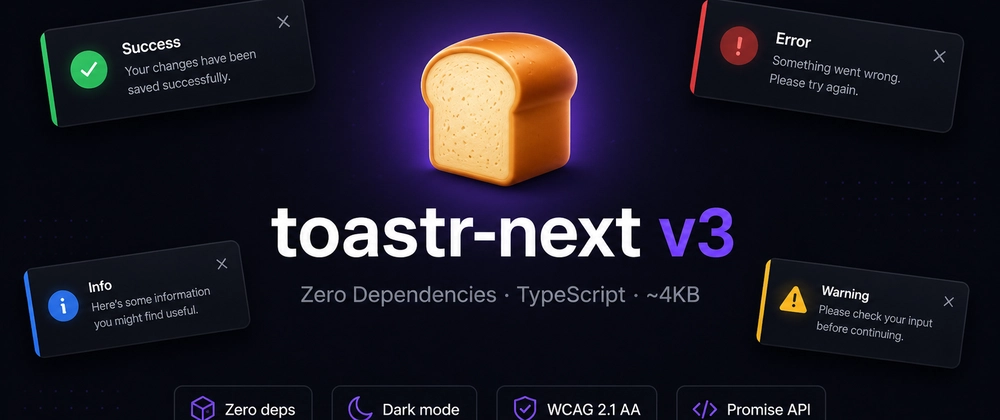
- toastr-next v3 brings the toastr JavaScript library into 2026 with TypeScript, dark mode, accessibility, and a Promise-based API.
- The original repo accumulated 12,000+ GitHub stars but received no meaningful commits for nearly a decade before this revival.
- GitHub Copilot was used as a genuine architectural collaborator throughout the rewrite, not just an autocomplete tool.
The toastr JavaScript Library Was Everywhere — Then It Wasn’t
If you’ve been writing web apps for more than a few years, you’ve almost certainly used the toastr JavaScript library. It was the default answer to one of frontend development’s most repetitive questions: how do I show a quick notification to the user? The API was dead simple — toastr.success(‘Changes saved’) — and it just worked. At its peak, the toastr JavaScript library was pulling in millions of downloads and accumulating GitHub stars at a rate that most projects never see. The CodeSeven/toastr repo sits at over 12,000 stars today. That’s not a niche tool. That’s a staple.
Then it stopped. The last meaningful commit landed in 2016. The web kept moving — ES modules, TypeScript, Vite, accessibility standards, dark mode expectations — and the toastr JavaScript library didn’t move with it. By the early 2020s, using it in a modern project meant dragging in jQuery as a dependency, ignoring TypeScript errors, and shipping roughly 87 KB of JavaScript just to display a small coloured rectangle in the corner of a browser window. Developers knew it was a problem. They used the toastr JavaScript library anyway, or they switched to heavier alternatives and missed the simplicity.
That’s the gap that developer Divyesh has now stepped into with toastr-next v3, a complete ground-up rebuild of the toastr JavaScript library submitted as part of GitHub’s Finish-Up-A-Thon challenge.
What Was Actually Wrong With the Original
The issues with the toastr JavaScript library weren’t superficial. jQuery as a hard dependency was the most visible problem, but it wasn’t the only one. The original toastr had no TypeScript support at all — not even type definition files bolted on afterward. Its build chain ran on Gulp and LESS, tooling that’s been effectively dead for years in the context of modern JavaScript workflows. There was no dark mode support, no consideration for prefers-reduced-motion, and critically, no proper accessibility implementation. Screen reader support was largely absent, and keyboard navigation hadn’t been considered.
The irony is that none of these were insurmountable problems. Toast notifications are not a complex UI pattern. They’re temporary messages. The fact that the reference implementation for this pattern had calcified into a jQuery-dependent relic while the rest of the ecosystem moved on says something about how quickly maintenance debt compounds when a project loses active stewardship.
The toastr JavaScript Library Rebuilt: What toastr-next v3 Actually Delivers
The headline number is the size: toastr-next ships at approximately 4 KB gzipped — around 2 KB of JavaScript and 2 KB of CSS. Compare that to the original toastr JavaScript library’s roughly 87 KB footprint once jQuery was included, and the improvement speaks for itself. But the bundle size reduction is almost the least interesting thing about the rewrite.
The toastr JavaScript library now ships in ESM, CommonJS, UMD, and IIFE formats simultaneously, which means it works equally well whether you’re importing it inside a Vite project, a Next.js app, a legacy Webpack setup, or dropping it directly into a script tag on a plain HTML page. That kind of universal compatibility matters in an ecosystem where teams are often maintaining projects built across wildly different eras of JavaScript tooling.
TypeScript support is native throughout, with full strict-mode compliance and JSDoc annotations. Theming is handled entirely through CSS custom properties rather than inline JavaScript styles, which means dark mode works through a clean combination of prefers-color-scheme media queries and a data-theme attribute on the HTML element. Flip the attribute, theme changes. No JavaScript involved on the CSS side. No flash of the wrong theme on load.
There are four CSS animation presets — Fade, Slide, Bounce, and Flip — and native RTL layout support baked in. The accessibility implementation was clearly thought through carefully. Rather than applying role=”alert” to every toast type, which would cause screen readers to interrupt whatever they were announcing mid-sentence, the toastr JavaScript library distinguishes between assertive and polite ARIA live regions. Errors and warnings use role=”alert”, which is assertive. Success and info toasts use role=”status”, which is polite. It’s a small distinction that WCAG 2.1 AA compliance actually requires, and one that the original library never addressed.
The Promise API Nobody Asked For (But Everyone Needed)
The most technically elegant addition in the toastr JavaScript library’s v3 release is arguably the async API. Every toast call now returns a ToastResponse object that includes a dismissed property — a Promise that resolves when the toast closes. That means you can write code like this:
- Call toastr.success(‘Changes saved’) and get back a response object immediately
- Await toast.dismissed to pause execution until the user has seen the notification
- Subscribe to lifecycle events via toastr.subscribe for more granular control
What’s notable here is that this pattern apparently wasn’t part of the original specification. During the rebuild, GitHub Copilot suggested the dismissed: Promise<void> pattern unprompted during a TypeScript interface design session. It became, according to the developer, the most praised feature of the entire rewrite. That’s a small but instructive example of AI tooling contributing something genuinely useful at the design level rather than just generating boilerplate.
How GitHub Copilot Shaped the Architecture
The role of AI assistance in this project is worth examining honestly, because it goes beyond the usual “AI helped me code faster” narrative. The developer used GitHub Copilot throughout the rebuild of the toastr JavaScript library as a deliberate architectural partner, structuring prompts around specific decisions rather than using it for line-by-line completion.
One particularly instructive example involves the CSS injection problem. Early users of the toastr JavaScript library kept running into the same friction point: they had to import the stylesheet separately, which broke the promise of a true drop-in experience. The solution — a Vite build plugin that extracts CSS at bundle time and injects it as a self-executing style injector inside the JavaScript — is non-trivial to implement correctly. You need to handle the Rollup generateBundle hook, convert CSS to a string, inject it into every output chunk, and add a guard to prevent double-injection when the module is imported multiple times from different entry points.
Copilot apparently drafted this complete Rollup plugin in a single pass — the hook implementation, the string conversion, and the sentinel attribute guard. The developer made minor adjustments and it worked on the first run. That’s a meaningful data point about where AI pair programming is actually useful: not in replacing judgment, but in handling technically complex implementation details that would otherwise eat hours of debugging.
The accessibility review followed a similar pattern. Rather than shipping with an assumption that role=”alert” was universally correct, the developer prompted Copilot specifically to audit the ARIA implementation against WCAG 2.1 AA before release. The review caught the assertive-versus-polite distinction that would otherwise have shipped as a bug affecting screen reader users.
The Open Source Maintenance Crisis This Highlights
The toastr JavaScript library story is one instance of a much larger problem in open source software. The Linux Foundation’s census of critical open source projects has repeatedly found that vast amounts of production software depends on libraries maintained by a single developer or a tiny team with no formal funding or succession plan. The toastr JavaScript library’s 12,000-star abandoned repo is a highly visible example, but there are thousands of less-starred libraries in the same condition, many of them sitting somewhere deep in the dependency trees of enterprise applications that process real data.
GitHub’s Finish-Up-A-Thon challenge, which prompted this rebuild, is an explicit acknowledgment of the problem — essentially a structured incentive for developers to finish, revive, or hand off abandoned projects rather than let them rot in public. Whether that approach can make a meaningful dent at scale is an open question, but the toastr revival is at least a concrete proof of concept that a determined developer can take a calcified, dependency-heavy library and produce something genuinely modern in a reasonable timeframe.
The real measure of toastr-next’s success won’t be the launch attention it receives. It’ll be whether the broader developer community — the teams who’ve been quietly using the toastr JavaScript library with growing unease, and the framework authors who might recommend it — actually adopts it and whether the maintenance keeps up. The original toastr JavaScript library didn’t fail because it was badly written. It failed because no one kept it alive. That’s the challenge every revived open source project faces the moment the launch momentum fades.

