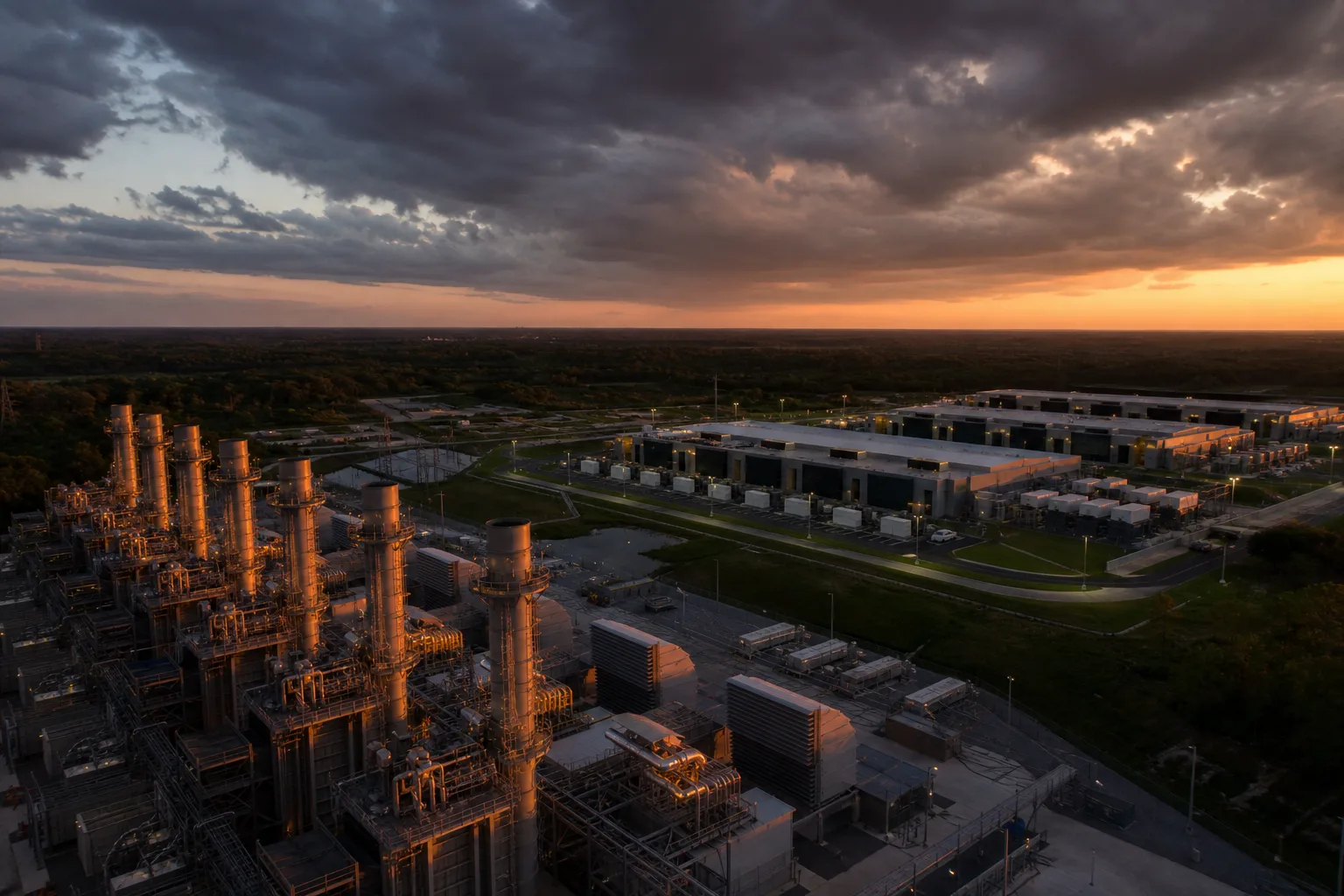
AI data centers have quietly become one of the most powerful forces reshaping the global energy industry — and nowhere is that more visible right now than in the gas turbine market. Orders are surging, lead times are stretching, and manufacturers that spent years restructuring after a sluggish decade are suddenly struggling to keep up with demand. The artificial intelligence infrastructure buildout, it turns out, doesn’t just stress semiconductor supply chains. It stresses the power grid too.
- AI data centers are consuming power at unprecedented rates, pushing gas turbine manufacturers to ramp up production fast.
- The surge in AI data centers is creating a multi-billion dollar windfall for industrial giants like GE Vernova and Siemens Energy.
- Natural gas is emerging as the bridge fuel of choice as electricity grids struggle to keep pace with AI compute demand.
- Demand for new power capacity could outpace grid upgrades for years, making on-site generation a critical short-term fix.
Table of Contents
Why AI Data Centers Are Hungry for Power
To understand what’s driving this, you have to appreciate just how energy-intensive modern AI workloads actually are. Traditional data centers — the kind that host websites or run enterprise software — are power-hungry enough. But AI data centers built around dense GPU clusters for training and running large language models operate on a completely different scale. A single hyperscale AI facility can demand anywhere from 100 megawatts to well over a gigawatt of continuous power, enough to supply power to hundreds of thousands of average American homes.
Microsoft, Google, Amazon, and Meta are all racing to expand their AI infrastructure simultaneously. That kind of synchronized demand is unprecedented, and it’s hitting an electricity grid that was already straining under the pressure of electrification trends — EV charging, industrial electrification, and population growth all competing for the same wires. The result? Utility connection queues that can stretch five to ten years in some regions. For a tech company that wants its data center online in 18 months, waiting a decade for a grid hookup isn’t an option.
Gas Turbines Step Into the Gap
That’s where gas turbines come in. On-site power generation — whether as a primary source or as a firm backup that effectively makes a facility grid-independent — lets operators bypass the interconnection queue entirely. Natural gas turbines can be deployed relatively quickly compared to large transmission infrastructure, they produce reliable baseload power, and modern combined-cycle units are significantly more efficient than older designs. For AI data centers that can’t afford downtime or power fluctuations during sensitive model training runs, that reliability is worth a premium.
The companies manufacturing these machines are having something of a moment. GE Vernova, which was spun off from General Electric in April 2024, has reported a dramatic acceleration in its gas power order book. Siemens Energy, another major player, is in a similar position. Both firms spent years working through a brutal market slump — the global push toward renewables had crimped demand for gas turbines through much of the 2010s — and now find themselves capacity-constrained just as orders spike. Manufacturing a large gas turbine isn’t like printing circuit boards. These are precision-engineered, multi-tonne machines with lead times measured in years, not months. Ramping production quickly is genuinely difficult.
The Numbers Behind the Boom
The scale of the investment flowing into AI data centers is staggering. Microsoft alone has announced plans to spend heavily on data center infrastructure in the coming years. Google has committed to similar capital expenditure levels. When you aggregate the spending plans of the major hyperscalers, you’re looking at hundreds of billions of dollars being deployed into physical computing infrastructure over the next few years — much of it requiring power solutions that the grid simply can’t provide on the required timeline.
Analysts have projected that data center power demand in the US could grow substantially by the end of the decade. That’s a trajectory that makes the current gas turbine order surge look less like a cyclical bump and more like the opening chapter of a longer structural shift. AI data centers are not a passing trend — the compute requirements for frontier AI models are growing faster than efficiency gains, which means power demand keeps climbing even as chips get better.
The Uncomfortable Energy Trade-Off
None of this sits easily alongside the sustainability pledges that Microsoft, Google, Amazon, and others have made publicly. Google committed to operating on 24/7 carbon-free energy by 2030. Microsoft has pledged to be carbon negative by the same year. Running AI data centers on gas turbines — even efficient ones — makes those targets considerably harder to hit.
There’s a real tension here that the industry hasn’t fully resolved. Tech companies are framing natural gas as a necessary bridge: cleaner than coal, reliable enough to support AI workloads, and deployable fast enough to match their infrastructure ambitions. Critics, including many climate researchers, point out that locking in gas infrastructure now creates assets that will be in service for 20 to 30 years — well past the window where decarbonization needs to be essentially complete if climate targets are to be met.
Some operators are pairing gas turbines with carbon capture technology or offsetting their emissions through renewable energy certificates, but neither approach fully satisfies those who argue that new fossil fuel infrastructure simply shouldn’t be built at this stage. It’s a debate that’s going to intensify as AI data centers grow larger and more numerous.
What Comes After Gas?
The longer-term picture is more interesting. Nuclear power — specifically small modular reactors (SMRs) — has emerged as a serious candidate for powering AI data centers over the next decade. Microsoft reportedly signed a deal to restart a unit at Three Mile Island to help supply its data centers. Google has reportedly contracted with a power developer to develop SMRs. Amazon has made similar investments. These are signals that the hyperscalers see a future beyond gas, but that future is still being built, and it won’t arrive before 2030 in any meaningful scale.
In the meantime, the gas turbine industry is enjoying a renaissance it didn’t necessarily expect. For GE Vernova, Siemens Energy, and their peers, AI data centers have become the most consequential new customer segment in a generation. The AI infrastructure boom and the energy sector have become deeply, structurally intertwined — and as the demands of AI data centers continue to grow, that relationship is only going to deepen.
Frequently Asked Questions
Why are AI data centers driving demand for gas turbines?
AI data centers require enormous, continuous amounts of electricity to run their systems. Traditional grid connections often can’t scale fast enough, so operators are turning to on-site gas turbines to guarantee reliable, high-capacity power without waiting for utility upgrades.
Which companies are benefiting most from this gas turbine boom?
Major industrial manufacturers in the gas turbine sector are among the biggest beneficiaries of this trend. Companies with established turbine businesses have seen growing demand tied directly to data center expansion from large cloud operators building out AI infrastructure.
Is natural gas a long-term solution for powering AI data centers?
Natural gas is widely viewed as a transitional rather than permanent solution for data center power needs. It fills the gap while other energy sources scale up, though tech companies face growing pressure from sustainability commitments to move away from fossil-fuel-based generation.
How much power do AI data centers actually consume?
Large-scale AI data centers consume substantial amounts of power to support GPU clusters and related infrastructure. Training large AI models and running inference at scale makes these facilities among the most energy-intensive structures ever built.