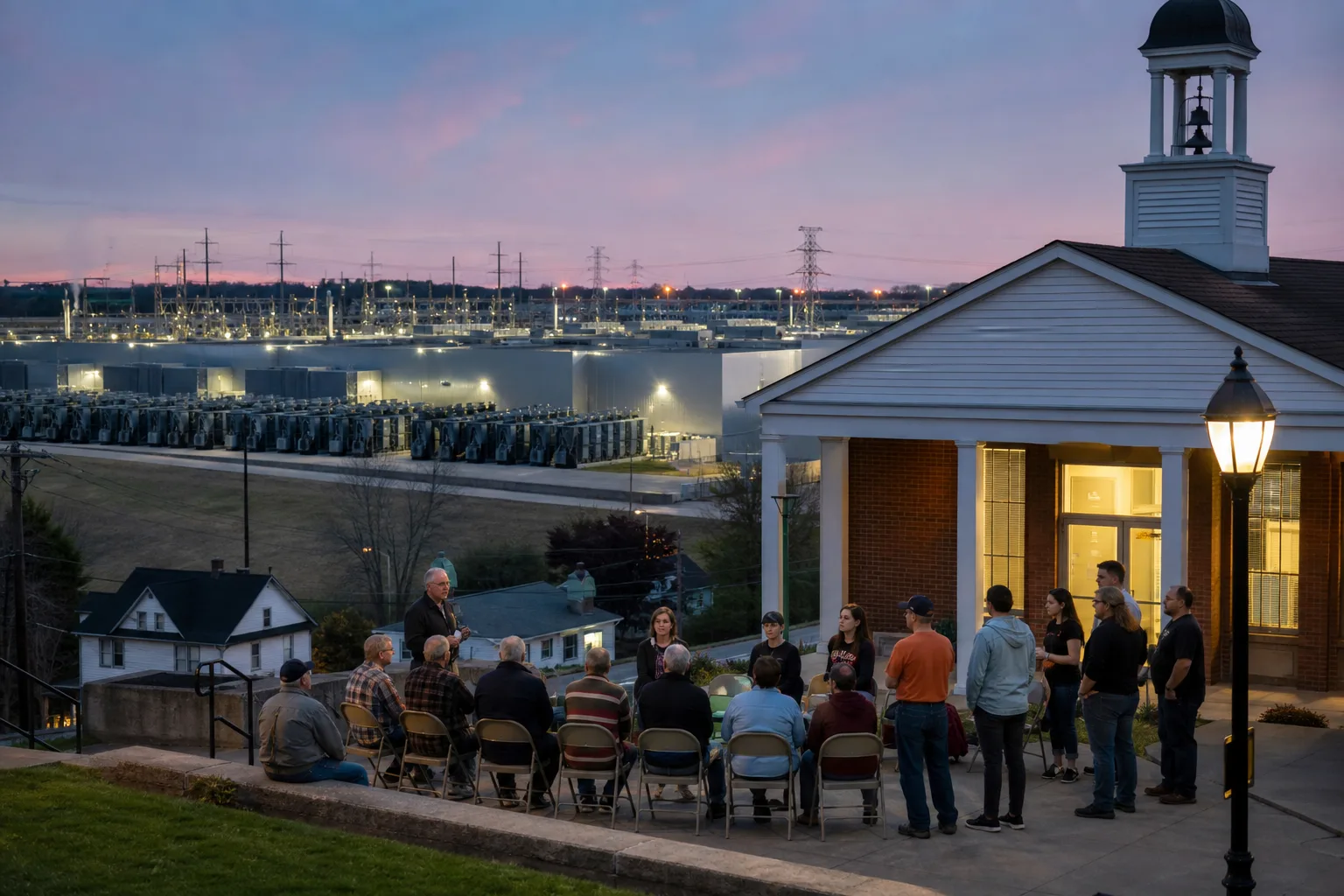
- AI data centers have become a rare bipartisan target as residents challenge energy costs, water use, and opaque development deals.
- Communities want AI data centers to prove they will deliver durable jobs and local value before receiving major tax incentives.
- The conflict is forcing utilities and elected officials to confront who pays for the enormous new infrastructure AI requires.
- Developers can no longer treat local approval as a routine permitting exercise, particularly in power-constrained regions.
Table of Contents
AI data centers are finding a political enemy nobody expected
The fight over AI data centers has landed in one of America’s few remaining bipartisan zones: the place where people don’t want a giant industrial project built near their homes. Conservatives concerned about land rights, grid reliability and sweetheart tax deals are arriving at the same public meetings as environmentalists worried about water, emissions and corporate power.
The alignment matters because the industry has spent the past two years presenting artificial intelligence as inevitable infrastructure. OpenAI needs it. Microsoft needs it. Google, Amazon and Meta need it. Every cloud company wants more of it, and every state that sees a chance at construction spending and property-tax revenue wants a slice.
But a hyperscale campus isn’t a warehouse with server racks. It can demand as much electricity as a small city, require transmission upgrades that take years to build, and reshape land-use debates overnight. The local backlash covered by WDIV captures an awkward truth for the AI boom: a model can be trained in the cloud, but the power plant, substation, cooling equipment and transmission lines have to live somewhere very physical.
And increasingly, somebody nearby is saying no.
Why AI data centers have become such a difficult sell
For years, data centers enjoyed a remarkably smooth political ride. They were marketed as clean, quiet economic-development wins: big capital investments, a few hundred construction jobs, technical employment and none of the smokestacks associated with a traditional factory. Local officials liked the pitch. So did governors competing to announce the next big project.
AI changed the math. Conventional cloud services already consume a huge amount of power, but training and running large language models pushes demand higher. The Electricity 2024 report puts that broader energy picture in context.
That doesn’t mean every proposed campus is a catastrophe. It does mean the old public-relations script has stopped working.
A facility’s employment figures are often where the pitch gets weakest. Building a campus can create real and meaningful construction work, but the completed facility may operate with a comparatively lean permanent staff. For residents watching a developer request tax abatements, new roads, water access and electrical upgrades, the obvious question is fair: what exactly is the community receiving in return?
Frankly, promises of becoming an AI hub don’t answer it. A town cannot pay its water bill with a press release.
The power bill is where the argument gets serious
The sharpest disputes over AI data centers are likely to center on electricity, not chatbots. A large facility can seek hundreds of megawatts of capacity, sometimes more. Serving it may require new substations, transmission lines, gas generation, renewables, batteries, or some messy combination of all four.
Utilities welcome the growth. Big industrial loads can bring predictable revenue and justify investments they have wanted to make anyway. Yet the benefit depends entirely on the deal. If a utility makes a large customer pay its full share of upgrades through a special contract, existing customers may be protected. If costs are spread broadly through regulated rates, households and local businesses can end up subsidizing an operation owned by one of the world’s richest companies.
That concern is not ideological. It’s kitchen-table economics.
In Virginia, northern Virginia’s long-running concentration of server farms has become a warning sign for other regions. Data Center Alley helped turn the area into the world’s largest data-center market, but it also brought fights over transmission infrastructure, noise, land conservation and continued tax policy. Northern Virginia got the jobs, investment and industry clout. It also got the billboards, power corridors and public anger that come with being the place everyone else decided should host the internet.
Other states are now trying to avoid repeating that experience without passing on the opportunity. That’s harder than it sounds. State leaders want investment announcements; utility planners want years of certainty; residents want transparent facts before construction begins. Those timelines collide.
Water, land and secrecy are eroding trust
Power is not the only flashpoint. Some AI data centers use large volumes of water for cooling, a particularly raw issue in places where aquifers are strained or drought restrictions already shape daily life. Operators often say their systems are efficient, and many are investing in reclaimed-water arrangements or less water-intensive cooling designs. Those details are useful, but communities want actual numbers, not general assurances.
They also want to know what happens when the facility expands. The first building may be presented as a contained project. Then comes a second phase, then a third, then new transmission requirements. Residents have seen this movie before with logistics warehouses and sprawling exurban development. The initial site plan is rarely the full story.
Secrecy makes the problem worse. Economic-development negotiations often begin under nondisclosure agreements, with companies identified only as unnamed prospective tenants. There are legitimate competitive reasons for confidentiality, especially when cloud providers are competing for capacity. Still, asking a community to accept unknown water usage, unknown power needs and unknown tax concessions is a terrible way to build consent.
My read is that developers are learning this too late. The era when a vague promise of high-tech investment could glide through a county board has ended.
What a credible deal for AI data centers looks like
The answer is not to ban AI data centers everywhere. AI services, cloud computing, streaming and ordinary business software all rely on physical facilities. Moving the project to another county does not erase the underlying demand; it merely changes who hosts it.
But governments should stop treating every proposed facility as interchangeable. A serious approval process should disclose anticipated peak power demand, projected annual water use, backup-generation plans, major tax incentives and who will finance grid upgrades. It should include enforceable construction timelines and penalties if a developer secures incentives but fails to deliver the promised investment.
Utilities, meanwhile, need tariffs designed for unusually large loads. A company that wants a dedicated substation and a massive share of generation capacity should pay a fair, transparent portion of that buildout. Ratepayers should not be asked to bankroll speculative AI demand because executives fear being left behind in the race for computing capacity.
Better design should count for something. Facilities that use reclaimed water, commit to clean-power procurement, reduce peak demand, or locate near existing transmission should have an easier path than projects that simply pick cheap land and expect the grid to catch up.
The debate around AI data centers is ultimately a test of whether the AI industry can mature into a normal infrastructure business. Normal infrastructure businesses negotiate. They disclose impacts. They accept that local residents are stakeholders, not obstacles to route around.
Silicon Valley has spent a decade insisting that AI will remake the economy. Perhaps. But if the companies behind it cannot explain who pays for the wires, the water and the backup power, they may discover that the most consequential resistance to AI is not online. It’s at a county planning meeting on a Tuesday night.
Frequently Asked Questions
Why are AI data centers facing local opposition?
Residents and local officials worry about the enormous electricity and water requirements of large computing campuses, along with noise, land use, tax breaks, and whether a relatively small number of permanent jobs justifies the public cost. The politics can unite otherwise opposing constituencies.
Do AI data centers raise household electricity bills?
They can, depending on how a utility structures new generation and grid upgrades. If utilities recover the cost of serving giant new customers from all ratepayers, households and small businesses may carry part of the bill unless regulators impose special tariffs or other safeguards.
How much water do modern data centers use?
Usage varies sharply by facility design, climate, and cooling system. Some campuses use substantial water for evaporative cooling, while others rely more heavily on air cooling or recycled water. Local concern is strongest where drought, limited aquifers, or competing municipal demand already exists.