

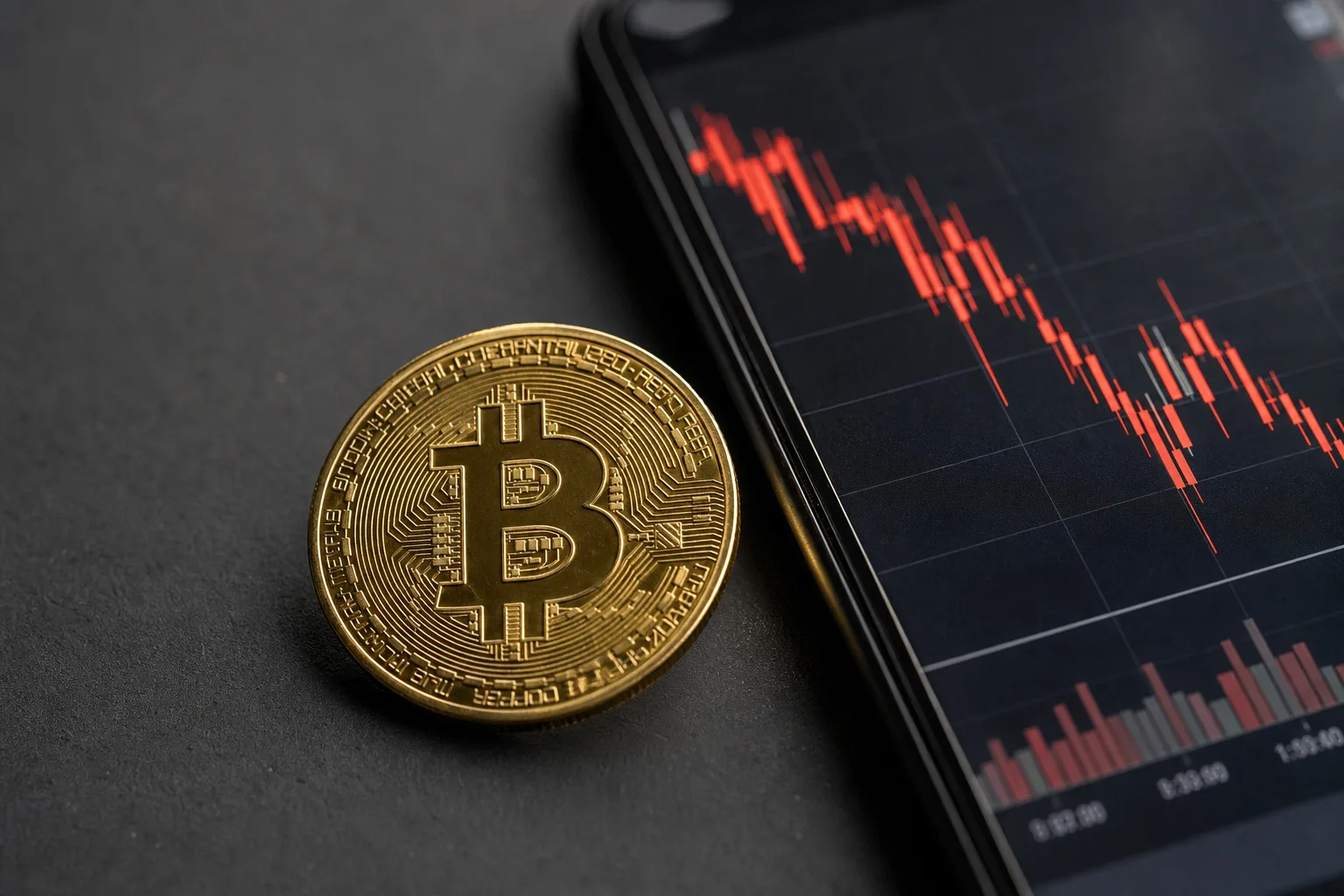
The Bitcoin price briefly cracked below $60,000 this week, touching $59,537 before clawing back to around $61,600 — but the bounce hasn’t done much to calm the market’s nerves. On-chain analytics firm Glassnode has been watching the data closely, and what it’s seeing isn’t a typical leverage-driven flush. This one looks more like genuine holders walking away.
- Bitcoin price dropped below $60,000 before recovering to around $61,600, sitting roughly 23% below Glassnode’s True Market Mean of $77,000.
- Six consecutive weeks of Bitcoin ETF outflows have pulled approximately $6 billion from spot products, including a record $388 million single-day exit from BlackRock’s IBIT.
- Overhead supply between $66,800 and $70,700 represents the clearest structural barrier any Bitcoin price recovery must absorb first.
- A single day of net ETF inflows on June 23 offered the first tentative sign that the relentless selling pressure may be beginning to ease.
Table of Contents
What Actually Broke the Bitcoin Price Below $60K
The mechanics of this selloff matter. Glassnode tracked Spot Cumulative Volume Delta (CVD) falling faster than Futures CVD in the days leading up to the break, while open interest stayed subdued and funding remained positive even as the Bitcoin price slid. That’s not how a liquidation cascade usually looks. It’s the fingerprint of real holders — people who actually own BTC outright — methodically reducing their exposure.
That distinction is important because leverage-driven crashes tend to be self-correcting. Once liquidations clear the system, the forced selling stops and prices often snap back quickly. Spot-driven selling is messier. There’s no automatic floor. Holders can keep hitting the exit until conviction buyers show up in sufficient size to absorb everything they’re offloading.

The ETF picture has made that dynamic considerably worse. US spot Bitcoin ETF net flows averaged nearly negative $300 million per day during the worst of the June drawdown, with six consecutive weeks of outflows pulling roughly $6 billion from the products overall. The single ugliest day was June 2, when BlackRock’s IBIT — the largest spot Bitcoin ETF by assets — shed $388 million in a single session, the biggest single-day redemption of 2026 so far. What’s particularly striking about this is that ETF investors had been reliable dip-buyers during earlier corrections. That pattern has now reversed, turning a group that once cushioned drawdowns into an active source of selling pressure.
The Macro Wall Bitcoin Can’t Ignore
The Bitcoin price doesn’t exist in a vacuum, and June has been a rough month for risk assets broadly. A stronger-than-expected US jobs report in early June led money markets to fully price in a Federal Reserve rate hike by year-end — a jarring reversal from the rate cuts traders had been positioning for. Two-year Treasury yields jumped 12 basis points to 4.16% in a single session. The dollar climbed to a one-year high. The Nasdaq 100 dropped roughly 5% in a day. A chipmaker index fell 10%.
BTC got dragged down alongside all of it, which is what tends to happen when institutional money is rotating out of risk. By June 23, the dollar index had climbed to 101.15, and Glassnode specifically flagged the dollar’s return above its 200-day moving average as a structural headwind for Bitcoin. The compounding effect of weak ETF flows and hostile macro conditions is what finally pushed the Bitcoin price through $60,000.
Bitcoin Price Is Cheap — But Cheap Doesn’t Mean a Floor
Here’s where the on-chain picture gets genuinely interesting. Glassnode places Bitcoin’s True Market Mean — effectively the average cost basis of active market participants — at $77,000. With BTC trading around $61,600, the Bitcoin price is sitting roughly 23% below that level. Glassnode uses this metric as the dividing line between broader bull and bear market regimes, and by that measure, Bitcoin has moved deep into what the firm describes as structural bear territory.
The 90-day average net realized profit and loss is running at around negative $205 million per day, confirming that loss realization is sustained and widespread. That’s pulling Bitcoin’s ‘center of gravity’ toward the Realized Price near $53,400 — the aggregate cost basis of all coins in circulation. That $53,400 level, not $77,000, is the more operative downside reference point as long as this loss-dominant environment continues.
But there are early signs of stabilization at the margin. Glassnode notes that Coinbase’s Spot CVD has returned to positive territory, even while Binance’s remains negative. That divergence suggests US institutional buyers have begun stepping in quietly, while offshore retail traders — who dominate Binance’s volume — are still hanging back. It’s a thin green shoot, but it’s something.
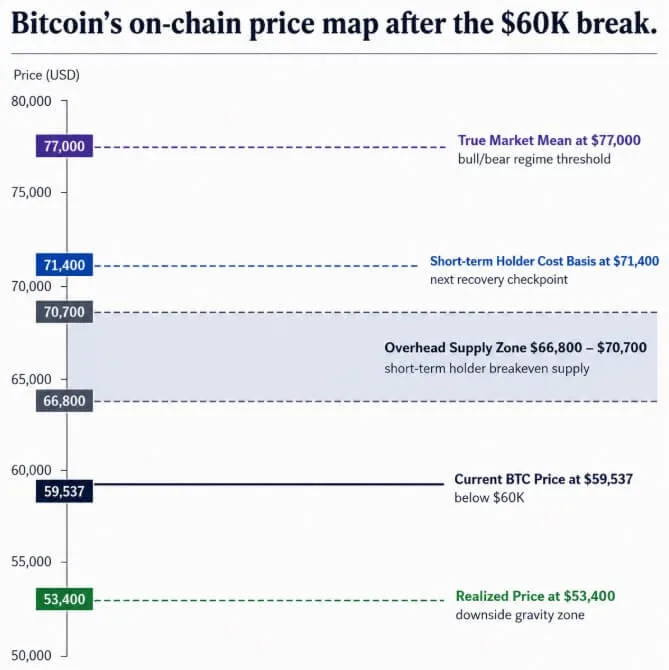
The short-term holder cost basis has also fallen to $71,400, which Glassnode reads as a constructive early development. It means newer buyers are accumulating below the broader cyclical mean for the first time in this cycle — gradually repricing the average entry point of recent participants downward. That’s how accumulation phases tend to begin, even if the process is slow and uncomfortable while it’s happening.
The Overhead Supply Problem Between $66,800 and $70,700
The structural obstacle any Bitcoin price recovery has to clear first is a dense cluster of short-term holder supply sitting between $66,800 and $70,700. These are recent buyers who are now underwater, and Glassnode’s data shows they represent a meaningful concentration of potential sellers into any rally back toward their breakeven. Put simply: every time BTC grinds back toward that range, these holders will be tempted to exit near even rather than hold for more upside. That’s a lot of supply to absorb.
If the Bitcoin price can push through that zone without collapsing back, $71,400 becomes the next real test — the short-term holder cost basis that represents the average entry point of recent participants. A sustained hold above that level would be the first genuine confirmation that the buyers who accumulated during this drawdown are committed rather than just catching a falling knife.
Above $71,400, the True Market Mean at $77,000 is the regime threshold. A Bitcoin price reclaim of that level is what would technically flip Glassnode’s structural bear reading back toward neutral. It’s a long way from $61,600, which is exactly why the options market looks the way it does right now.
What the Options Market Is Telling Us
Derivatives traders aren’t optimistic. Glassnode’s data shows a 25-delta skew has rebuilt across maturities, with the one-week skew climbing from around 12% to 24% and the one-month skew rising from roughly 14% to 23%. Puts are now trading at a meaningful premium to comparable calls. In plain terms: traders are paying up for downside protection, pricing in a real possibility of another leg lower rather than betting on a recovery.
That posture aligns with the on-chain reality. The market has apparently found some value at these levels — otherwise the Coinbase institutional buying Glassnode identified wouldn’t be there — but conviction is too thin for most participants to act on it aggressively. Everyone can see the discount. Not everyone is willing to step in front of the remaining supply overhang to claim it.
Two Scenarios Worth Watching
If ETF flows stabilize and the institutional buying visible on Coinbase spreads into the offshore venues still running negative CVD, Bitcoin has the raw ingredients for a recovery. One data point on June 23 offered a reason for cautious optimism: net ETF inflows came in at $39.2 million — the first positive day in weeks — led by Ark Invest’s ARKB and an instrument listed as MSBT. One day resolves nothing. But the direction matters.
The alternative scenario is that overhead supply between $66,800 and $70,700 proves too heavy, ETF outflows resume as macro conditions stay difficult, and the Bitcoin price gravitates toward that Realized Price support near $53,400 that the loss-realization data keeps pointing to. That outcome wouldn’t be unprecedented. Bitcoin has spent extended periods below its Realized Price in past cycles, and those periods have ultimately set the stage for the next major move up — but they’ve never been comfortable to sit through.
For now, the on-chain data is telling a story of a market at a crossroads: deeply discounted by historical measures, with early signs of institutional accumulation, but still lacking the broad buyer conviction needed to work through the supply that’s stacked above. The next few weeks of ETF flow data will likely determine which story gets written from here.
Frequently Asked Questions
Why does on-chain data suggest the Bitcoin price is cheap right now?
Glassnode places Bitcoin’s True Market Mean — the average cost basis of active investors — at $77,000. With the Bitcoin price trading around $60,000–$61,600, BTC is sitting roughly 23% below that level, which Glassnode defines as structural bear territory but also historically discounted relative to active holder costs.
What is the significance of the $66,800–$70,700 supply zone for Bitcoin?
That range represents a dense cluster of short-term holders who bought BTC at those prices and are now underwater. As Bitcoin price rallies back toward their breakeven, they’re likely to sell, creating meaningful resistance. Clearing that zone without a reversal is considered the first real test of any sustainable recovery.
How much has flowed out of Bitcoin spot ETFs during this downturn?
Six consecutive weeks of net outflows have pulled roughly $6 billion from US spot Bitcoin ETFs. The worst single day was June 2, when BlackRock’s IBIT alone saw $388 million in redemptions — the largest single-day outflow of 2026.
What would confirm a genuine Bitcoin price recovery?
Glassnode identifies two key checkpoints: first, BTC must absorb the overhead supply between $66,800 and $70,700. Then, a sustained move above the short-term holder cost basis at $71,400 would confirm that drawdown buyers are holding, not just flipping into the first relief bounce.

