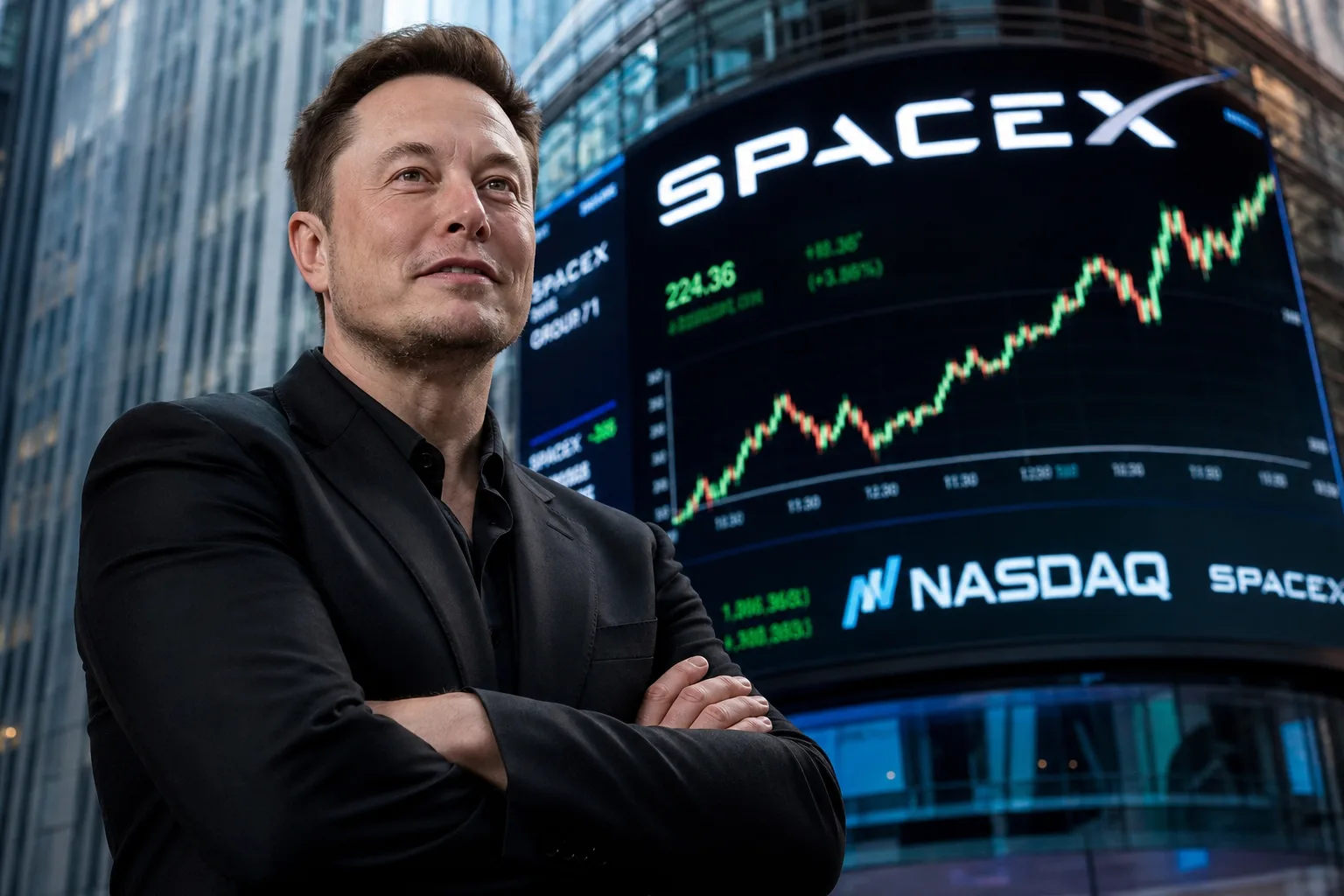
Elon Musk net worth has crossed a threshold no individual has ever reached in modern financial history. According to the Bloomberg Billionaires Index, Musk’s total fortune now sits at $1.11 trillion — a number so large it demands a comparison most people weren’t expecting: it’s bigger than the entire altcoin market.
- Elon Musk net worth hit $1.11 trillion after the SpaceX IPO, making him the first modern person to cross the $1 trillion mark.
- Elon Musk’s net worth now exceeds the entire altcoin market cap, which has fallen roughly 50% from its October 2025 peak.
- SpaceX logged $85 billion in trading volume on day one, setting an IPO record and outpacing Apple’s peak single-day volume.
- SpaceX and Tesla together hold over 30,000 Bitcoin worth over $2 billion, tying Musk’s corporate empire tightly to crypto.
Table of Contents
The SpaceX IPO That Changed Everything
The immediate trigger was SpaceX’s Nasdaq debut. The rocket, satellite, and AI company launched onto public markets at a $2.2 trillion valuation, with underwriters pricing shares at $135 — raising $75 billion before trading even began. What happened next was a textbook demand frenzy. Shares opened at $150, ran to an intraday high of $176.50, and settled at $161 by Friday’s close.
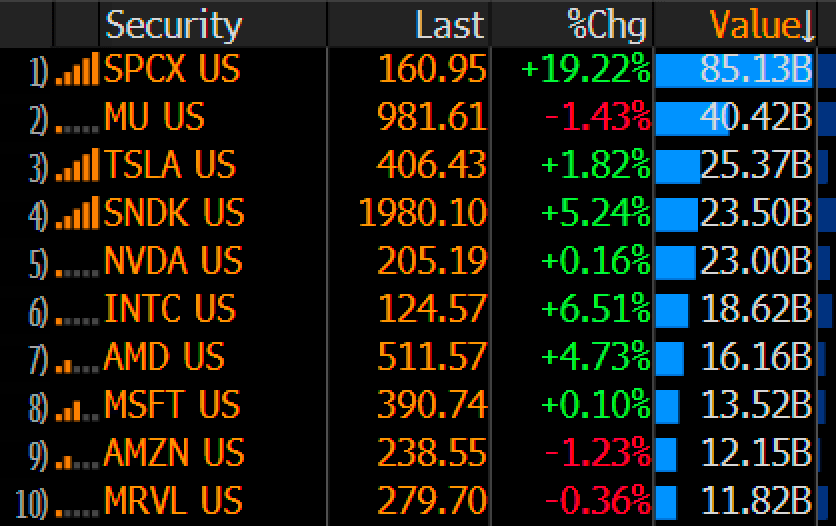
The trading volume figures alone are worth sitting with. Bloomberg ETF analyst Eric Balchunas noted the stock logged $85 billion in trading volume on its first day — a new IPO record, and a figure that ranks among the top ten highest single-day volumes for any stock in market history. For context, it exceeded Apple’s peak single-day volume across the past four decades. That’s not a routine IPO. That’s a restructuring of how much appetite institutional and retail investors have for Musk-branded equity.
Musk holds a 42% ownership stake in SpaceX, giving him not just a financial windfall but what amounts to unilateral strategic control over the company’s direction. That’s an important detail when considering how Elon Musk net worth is structured. His wealth isn’t diversified across dozens of assets — it’s highly concentrated in a handful of founder-controlled firms, each of which he effectively runs.
Elon Musk Net Worth vs. the Crypto Market: A Striking Parallel
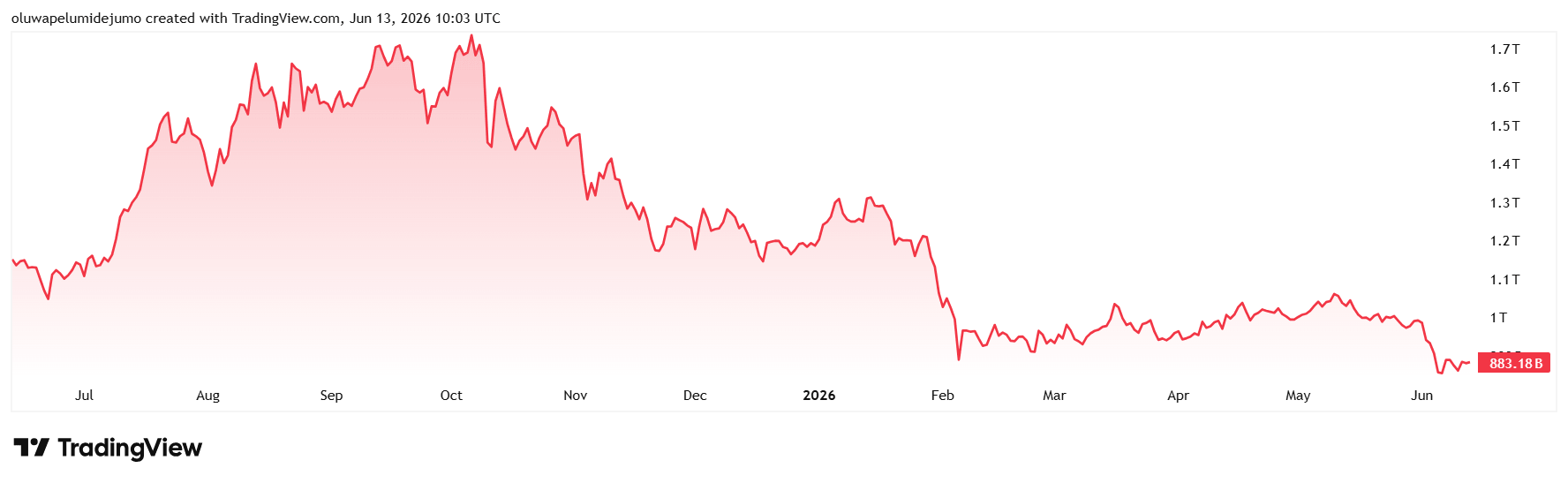
Here’s where the story gets genuinely interesting for anyone tracking digital assets. Elon Musk net worth at $1.11 trillion comfortably exceeds the market capitalisation of every cryptocurrency in existence — except Bitcoin. TradingView’s TOTAL2 index, which tracks the altcoin market excluding Bitcoin, currently sits at around $880 billion. CoinGecko’s broader data puts total crypto at roughly $2.27 trillion, with Bitcoin alone accounting for $1.28 trillion of that. Strip Bitcoin out, and one man’s paper wealth beats the rest of the entire crypto ecosystem.
Even framed generously, Elon Musk net worth represents exactly half the value of the total global crypto market when Bitcoin is included. That’s a striking way to illustrate how much capital has rotated away from speculative digital assets and toward large-cap technology equity — and how extreme individual wealth concentration has become in the founder economy.
The altcoin comparison isn’t just a curiosity. It points to a real structural shift. According to TradingView data, the market cap of crypto assets outside Bitcoin peaked above $1.7 trillion in October 2025. It’s since fallen by roughly half. That’s not a short-term dip — it’s a sustained contraction driven by institutional money moving elsewhere. AI infrastructure, semiconductor companies, and space technology have absorbed much of the liquidity that once flowed into Solana ecosystem tokens or layer-2 networks. SpaceX’s IPO is arguably the most visible expression of that trend, and it’s the single event most responsible for pushing Elon Musk net worth past the trillion-dollar milestone.
Musk’s Crypto Ties Aren’t Going Away
Despite Elon Musk net worth dwarfing the altcoin economy, Musk remains one of the most structurally entangled figures in crypto. He’s publicly confirmed personal holdings in Bitcoin, Ethereum, and Dogecoin — though exact figures beyond a 2018 acknowledgment of receiving 0.25 Bitcoin as a gift have never been disclosed.
More consequential than his personal wallet, though, is what’s sitting on corporate balance sheets. Post-IPO regulatory filings confirm that SpaceX holds 18,712 Bitcoin in its corporate treasury — worth over $1.3 billion at current prices. Tesla, meanwhile, continues to hold 11,509 Bitcoin. If you combined the two, those firms would rank as the fifth-largest public corporate holder of Bitcoin globally, sitting behind MicroStrategy and a handful of institutional players who’ve made crypto treasury allocation a central strategy.
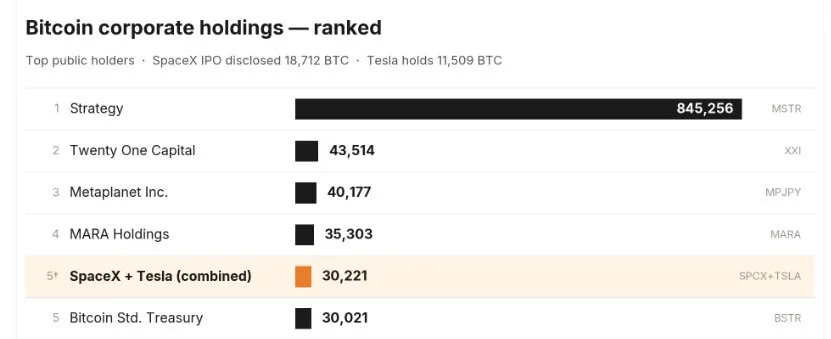
That’s not incidental. Both companies made deliberate decisions to allocate corporate cash into Bitcoin as a reserve asset — a strategy that was considered eccentric when Tesla first announced it in early 2021 and has since become a recognisable playbook for a small but growing number of public companies. The combined Musk corporate Bitcoin position is worth more than $2 billion, and it moves with the market like any other institutional holding.
Then there’s X, the platform formerly known as Twitter, which Musk acquired for $44 billion in 2022. It’s not a crypto exchange, and X corporate statements are careful to describe the platform’s financial data tools as a utility rather than a brokerage. But the integration of ‘cashtags’ — real-time pricing for both equities and digital assets — means crypto price discovery now happens inside one of the world’s most active social media feeds. When Musk posts about Dogecoin, DOGE moves. That relationship hasn’t changed.
What a $1 Trillion Fortune Actually Means
Elon Musk net worth now exceeds the GDP of several developed nations. It’s also almost entirely paper wealth — equity stakes that fluctuate with market sentiment, regulatory decisions, and broader macroeconomic conditions. If SpaceX shares pull back sharply, or if Tesla hits turbulence, the $1.11 trillion figure erodes fast. That’s the nature of founder-controlled equity at this scale: the upside is extraordinary, but so is the concentration risk.
The broader implication is harder to ignore. We’re in an era where individual founders — not funds, not sovereign wealth vehicles, not traditional corporations — are accumulating capital at a pace the financial system wasn’t designed to reason about. Elon Musk net worth is partly a product of his companies’ genuine technical achievements and partly a reflection of how markets reward narrative, control, and scale simultaneously.
For the crypto industry, the comparison to Elon Musk net worth is a useful, if uncomfortable, benchmark. The altcoin market at $880 billion feels substantial until you realise one person’s equity stack just cleared it. That doesn’t mean crypto is irrelevant — Bitcoin alone at $1.28 trillion tells a different story — but it does raise serious questions about where the next cycle of capital flows will land, and whether altcoins can reclaim the ground they’ve lost to AI and space equity before the window closes.