

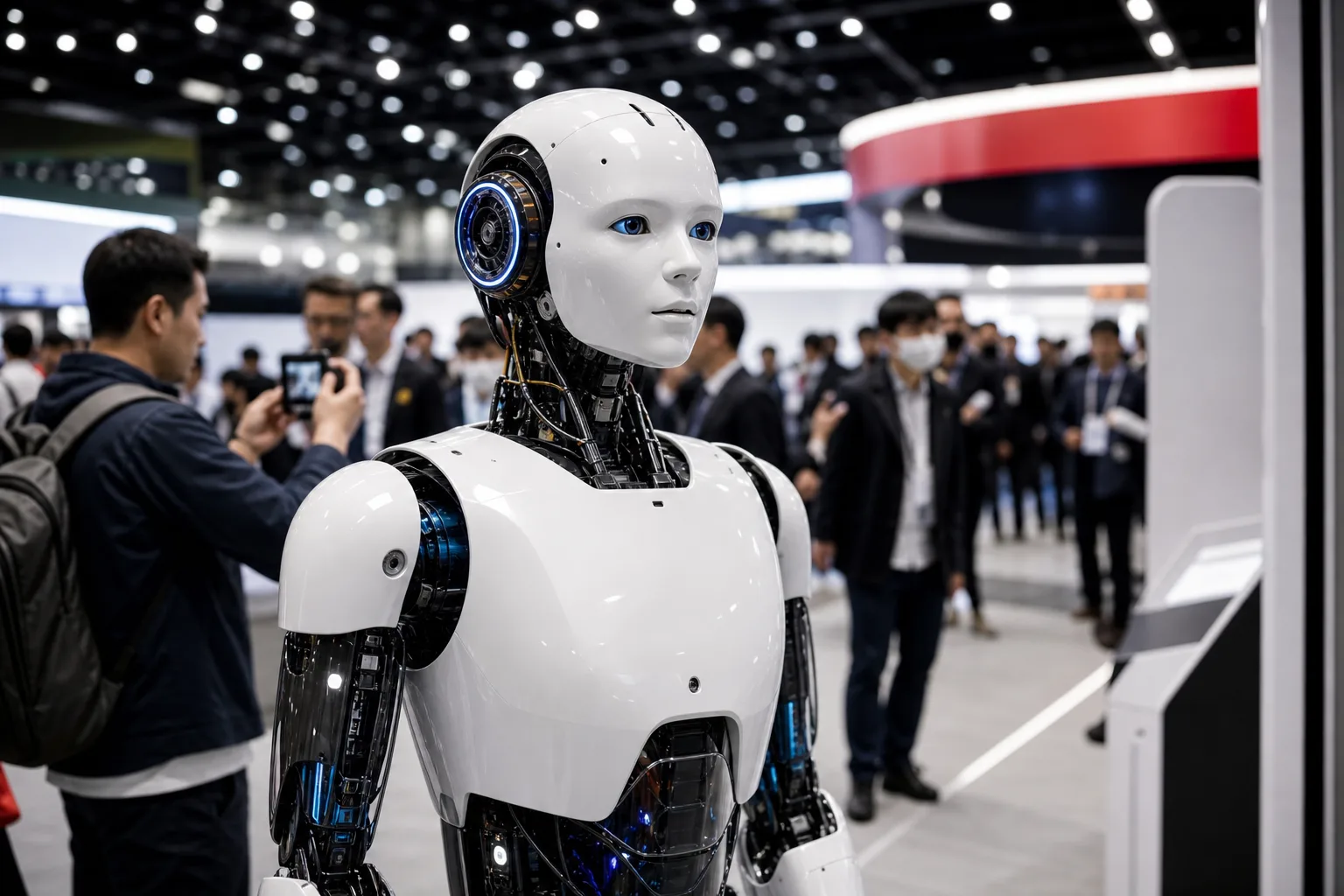
- Embodied AI dominated World Intelligence Expo 2026, signalling a major shift from software-only AI toward physical, real-world systems.
- Dozens of humanoid robots and embodied AI platforms were showcased, reflecting China’s aggressive push to lead this next wave of AI.
- The expo highlighted how embodied AI is moving fast from research labs into manufacturing, logistics, and consumer-facing applications.
- Investors and tech giants alike are betting heavily on embodied AI as the most consequential hardware frontier of the decade.
Table of Contents
Embodied AI Arrives — And It Brought a Crowd
If there was any doubt that embodied AI has moved from academic curiosity to full-blown industry obsession, the World Intelligence Expo 2026 in Tianjin settled it. The annual event, already one of Asia’s most watched technology showcases, drew massive attention this year for one reason above all others: robots that think, adapt, and act in the physical world. Not chatbots. Not dashboards. Machines with arms, legs, sensors, and increasingly, genuine situational awareness.
The shift in tone from previous years was impossible to miss. Where earlier editions of the expo leaned heavily on software platforms, cloud infrastructure, and language models, 2026 belonged to the physical. Booth after booth featured humanoid robots walking, grasping objects, navigating obstacles, and responding to unscripted prompts. The message from exhibitors and organisers alike was clear: the next battleground in AI isn’t the data centre — it’s the factory floor, the hospital ward, and eventually, your home.
What Exactly Is Embodied AI — And Why Does It Matter Now?
Embodied AI refers to artificial intelligence systems that don’t just process information in the abstract, but interact with and respond to a physical environment in real time. Think of it as the difference between an AI that can describe how to pick up a glass of water and one that can actually do it — accounting for the weight, the slipperiness, the angle, and what happens if it miscalculates. It’s a harder problem by several orders of magnitude than pure language or image processing, which is exactly why it’s taken this long to reach serious commercial viability.
The timing of this surge isn’t accidental. Several technological threads have converged simultaneously: large language models have become cheap and fast enough to run inference at the edge, sensor hardware has miniaturised dramatically, battery technology has improved, and — critically — training paradigms that let robots learn from simulated environments have matured. Companies like Boston Dynamics, Figure AI, 1X Technologies, and China’s own Unitree Robotics have all published demos in the past 18 months that would have looked like science fiction just five years ago. The expo floor at Tianjin was, in many ways, the public coming-out party for a technology that has been quietly compounding in labs worldwide.
China’s Strategic Bet on Embodied AI
It’s no coincidence that embodied AI is headlining a Chinese government-affiliated expo. Beijing has made physical AI a national strategic priority. State guidance documents and funding programmes have explicitly targeted humanoid robotics and intelligent manufacturing as sectors where China intends to establish global leadership — not just compete. The World Intelligence Expo, held annually in Tianjin since 2017, has increasingly become a stage for demonstrating that progress to both domestic audiences and international observers.
The numbers back up the ambition. Chinese investment into robotics and AI hardware has grown sharply, with state-backed funds and private venture capital flowing into dozens of homegrown startups. Companies like Unitree, UBTECH, and Fourier Intelligence have all been scaling headcount and production capacity in anticipation of demand that, frankly, hasn’t fully materialised yet at scale — but that most analysts expect to arrive within the next three to five years. The expo was partly a confidence-building exercise: showing investors, partners, and the public that the technology is real and the momentum is genuine.
Who Was Showing What
The range of embodied AI systems on display spanned a wide spectrum of maturity and application focus. On the industrial end, several exhibitors demonstrated robots designed for warehouse logistics — picking, sorting, and palletising with a dexterity that starts to make warehouse automation look genuinely competitive with human labour on complex tasks, not just repetitive ones. That’s a meaningful threshold. Until recently, robots were great at doing the same thing ten thousand times; they were terrible at handling the unexpected. The new generation is getting meaningfully better at the unexpected.
On the more ambitious end, full humanoid platforms drew the largest crowds. These bipedal machines — designed to operate in environments built for humans, using tools designed for human hands — represent the longest-horizon bet in the space. The engineering challenges are immense: balance, manipulation, power efficiency, and the latency requirements for real-time response all push against each other. But the demos at Tianjin showed genuine progress on all fronts, even if commercial deployment at scale remains years away for the most capable systems.
The Gap Between Demo and Deployment
Here’s the part that deserves honest scrutiny. Embodied AI demos at expos are, by their nature, curated. The environment is controlled, the tasks are rehearsed, and the failure modes are carefully hidden from view. That doesn’t mean the technology is fake — it absolutely isn’t — but it does mean that the gap between what you see on a show floor and what you can deploy reliably in a messy real-world environment is still significant.
Reliability is the industry’s hardest unsolved problem right now. A humanoid robot that works 95% of the time is a curiosity; one that works 99.99% of the time is a product. Getting from one to the other in physical systems — where failure can mean broken objects, production stoppages, or safety incidents — is vastly harder than shipping a software patch. The companies that crack this will define the industry. The ones that overpromise and underdeliver will burn through their capital and disappear. We’ve already seen that cycle play out in autonomous vehicles, and there’s no reason to think robotics will be immune.
What the Expo Signals for the Broader Industry
The prominence of embodied AI at World Intelligence Expo 2026 reflects something bigger than any single company or product announcement. It marks the moment the broader tech industry — not just robotics specialists — started treating physical AI as a primary category rather than a niche one. That’s significant. When hyperscalers, chip designers, and software platforms start orienting roadmaps around the requirements of embodied AI, the ecosystem develops faster. Nvidia’s push into robotics simulation with Isaac Sim, for instance, isn’t a side project — it’s a strategic bet that embodied AI will be a major compute consumer within this decade.
For enterprise buyers in manufacturing, logistics, healthcare, and construction, the message from Tianjin is that the window for serious evaluation is now open. That doesn’t mean it’s time to rip out existing automation and replace it with humanoids — far from it. But pilot programmes, vendor assessments, and long-term planning conversations around embodied AI integration are no longer premature. They’re arguably overdue.
The companies that will win in this space aren’t necessarily the ones with the most impressive single demo. They’re the ones who can solve the full stack: hardware reliability, software adaptability, safety certification, integration with existing enterprise systems, and — critically — a service and support model that makes deployment practical for customers who aren’t robotics engineers. That’s a much harder product problem than building a robot that can walk across a stage. But it’s the one that matters.

