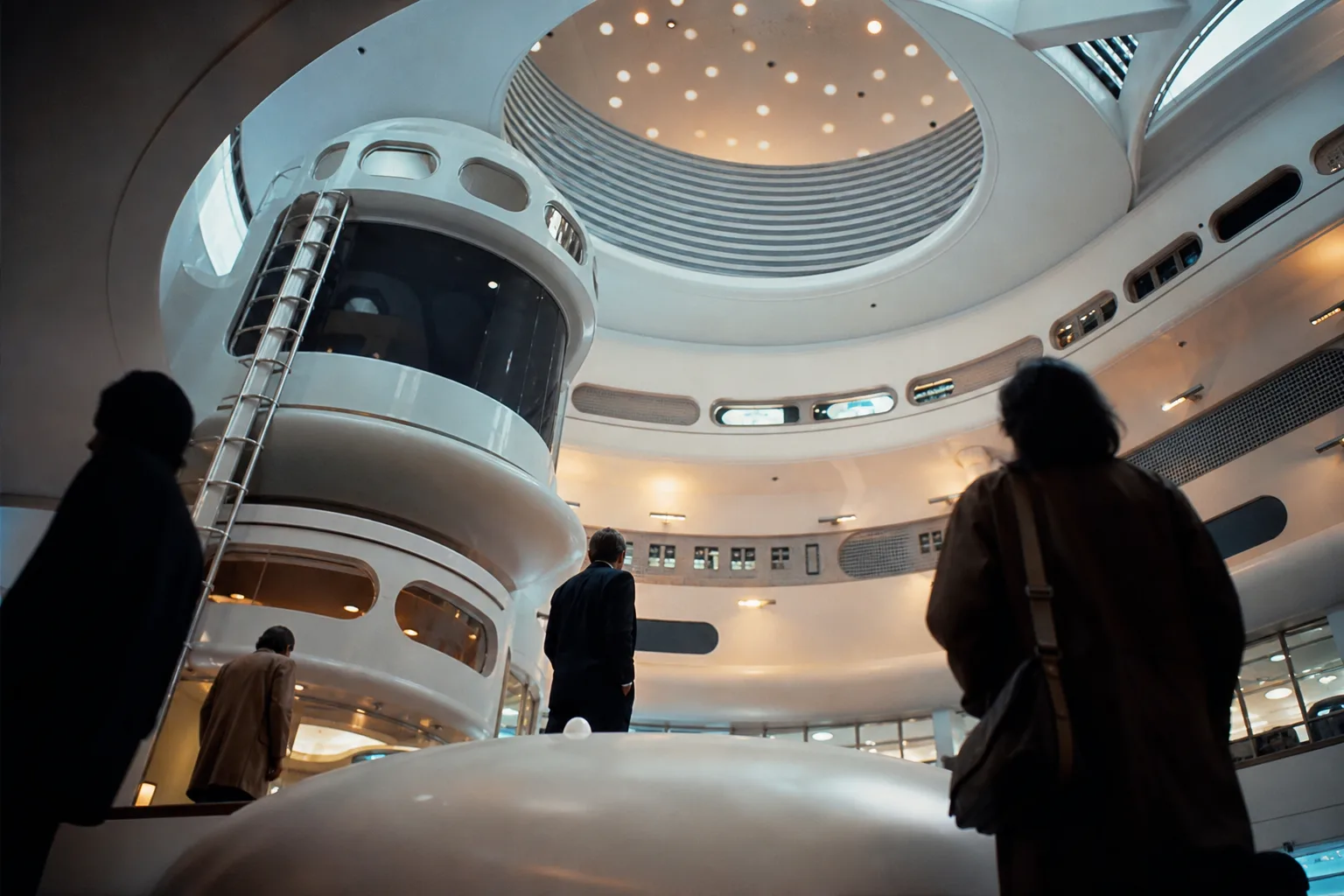
Logan’s Run turns 50 this week, and if you’ve never seen it, or haven’t revisited it since the Carter administration, the anniversary is a genuine excuse to fix that. Released by MGM on June 23, 1976 — just days before America threw itself a 200th birthday party — Logan’s Run was one of the most ambitious science fiction films Hollywood had produced to that point, and it arrived at exactly the right cultural moment to make an impression.
- Logan’s Run celebrates its 50th anniversary in 2026, marking five decades of a genuinely bold dystopian sci-fi vision.
- Logan’s Run won an Oscar for Special Achievement in Visual Effects and was the first film released in Dolby Stereo with 70mm prints.
- The film grossed $25 million domestically against a $9 million budget, making it a legitimate summer blockbuster for MGM in 1976.
- A remake has been rumoured for over three decades, with Ryan Gosling once linked to the project, but nothing has moved forward.
Table of Contents
The World Logan’s Run Walked Into
Before George Lucas took everyone to a galaxy far, far away, before Spielberg gave us close encounters, and well before Ridley Scott landed on LV-426, science fiction cinema existed in a strange purgatory. The genre had its serious-minded outliers — The Andromeda Strain, Silent Running, Soylent Green, Westworld, Rollerball — but for the most part it was still clawing its way out of the B-movie basement. Audiences hadn’t yet been trained to expect spectacle from sci-fi. Logan’s Run helped change that.
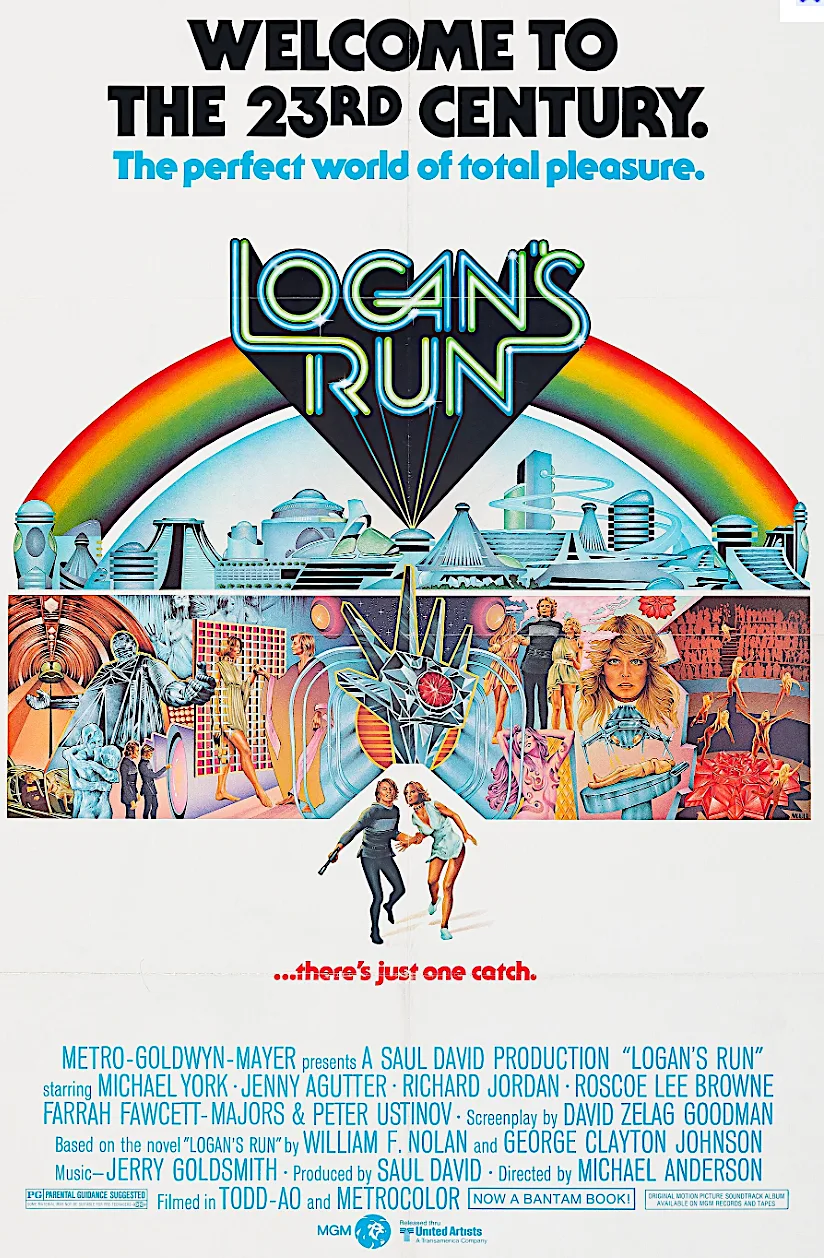
MGM spent $9 million on the production, which was real money in 1976. The result was a film that looked like nothing else on cinema screens at the time: a gleaming, colour-saturated vision of the future that was beautiful on the surface and genuinely unsettling underneath. That contrast was the whole point.
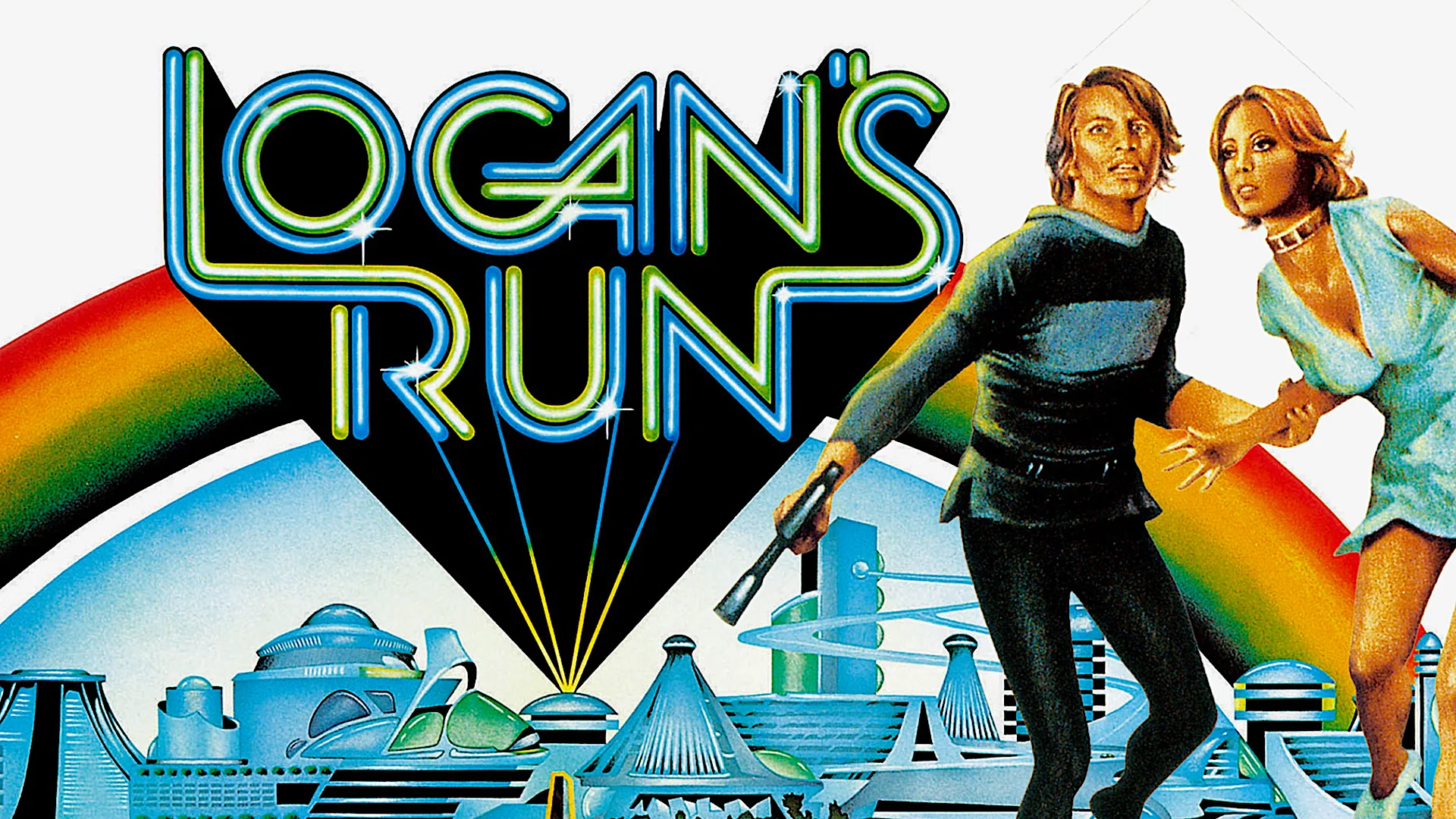
What Logan’s Run Is Actually About
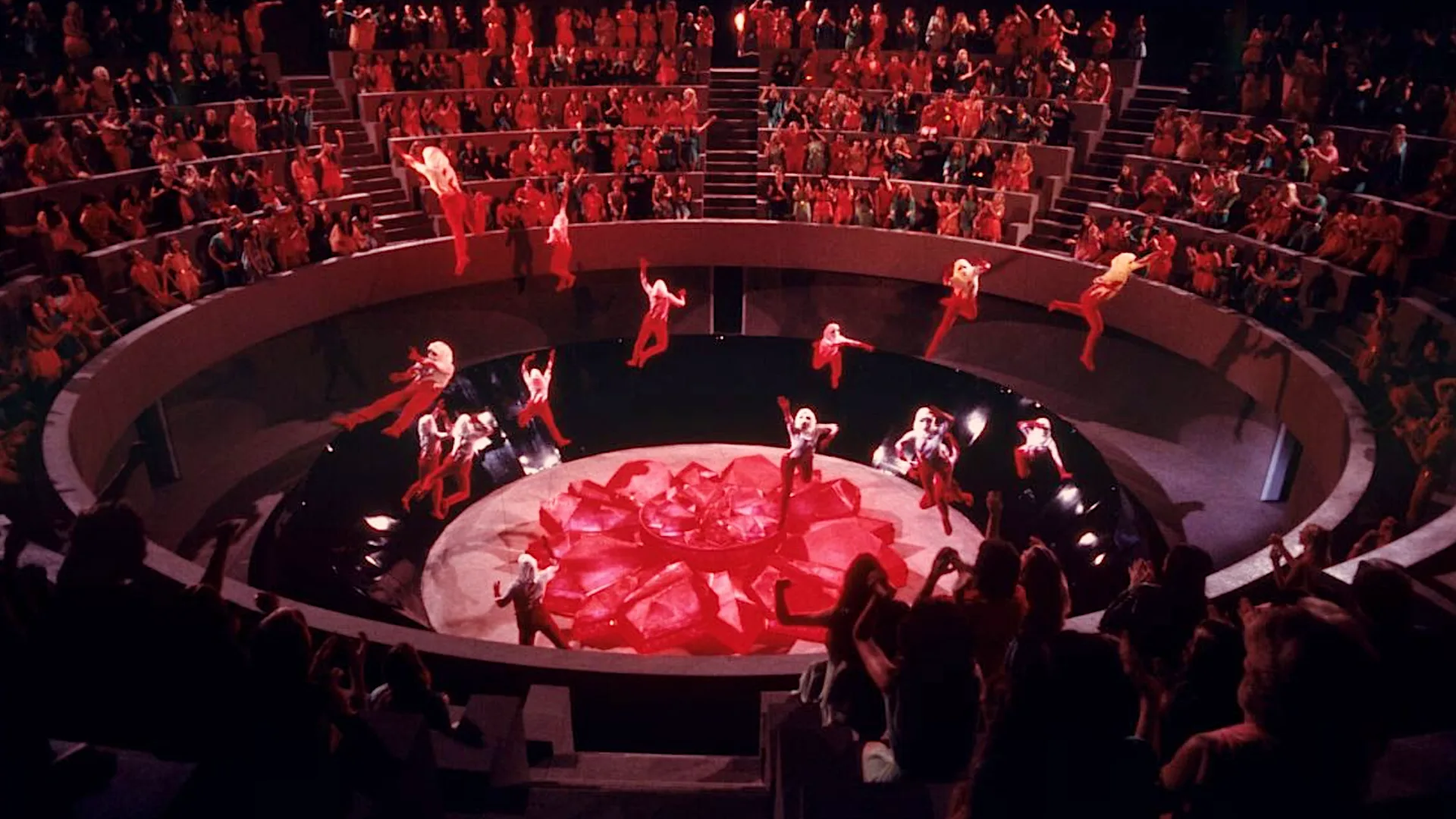
The premise is deceptively clean. Humanity lives inside vast domed cities, insulated from a ruined outside world. Life is comfortable, pleasure is on demand, and nobody has to worry about getting old. The catch? You don’t get to. At 30, every citizen must submit to a public ritual called Carrousel, framed to the population as a chance at reincarnation. It isn’t. It’s state-sponsored execution dressed up as entertainment, performed in amphitheaters to cheering crowds. The regime’s genius is that it’s convinced people to celebrate their own deaths.
Michael York plays Logan 5, a Sandman — essentially a futuristic law enforcement officer whose job is hunting down ‘runners,’ citizens who refuse to go quietly when their time comes. The life-clock implanted in every citizen’s palm turns red as their 30th birthday approaches, and Logan and his partner Francis 7, played with cold relish by Richard Jordan, spend their days tracking down anyone who tries to bolt for the exits.
The story turns when the city’s AI overlord assigns Logan an undercover mission: infiltrate a runners’ network and locate a mythical refuge called Sanctuary, supposedly existing somewhere beyond the domes. To do it, Logan teams up with Jessica 6, played by Jenny Agutter — a performance that’s both warmer and more layered than the film’s critics have ever given her full credit for. What follows is a chase film, a road movie, and a philosophical argument about freedom and truth, all wrapped in a disco-era aesthetic that’s aged into something almost charming.
Logan’s Run and the Themes That Still Land
Logan’s Run is doing something more pointed than its shiny surface suggests. The society it depicts isn’t maintained by obvious brutality — it’s maintained by comfortable lies and manufactured consent. People don’t resist the system because they’ve been given no reason to question it. Youth is fetishised, aging is erased from public consciousness, and the violence of the state is repackaged as spectacle. Sound familiar? The film’s best trick is that it makes the utopia look genuinely appealing for the first fifteen minutes before slowly letting the horror leak through the cracks.
The source material came from William F. Nolan’s 1967 novel, and British director Michael Anderson brought a European restraint to the material that kept the more lurid elements in check. What he got from cinematographer Ernest Laszlo was a Metrocolor palette that’s almost hallucinatory — vivid pinks, greens, and whites that make the domed city feel like a shopping mall fever dream. Jerry Goldsmith’s score adds another layer of unease: lush orchestral passages laced with synthesizer tones that, in 1976, must have sounded like actual transmissions from the future.
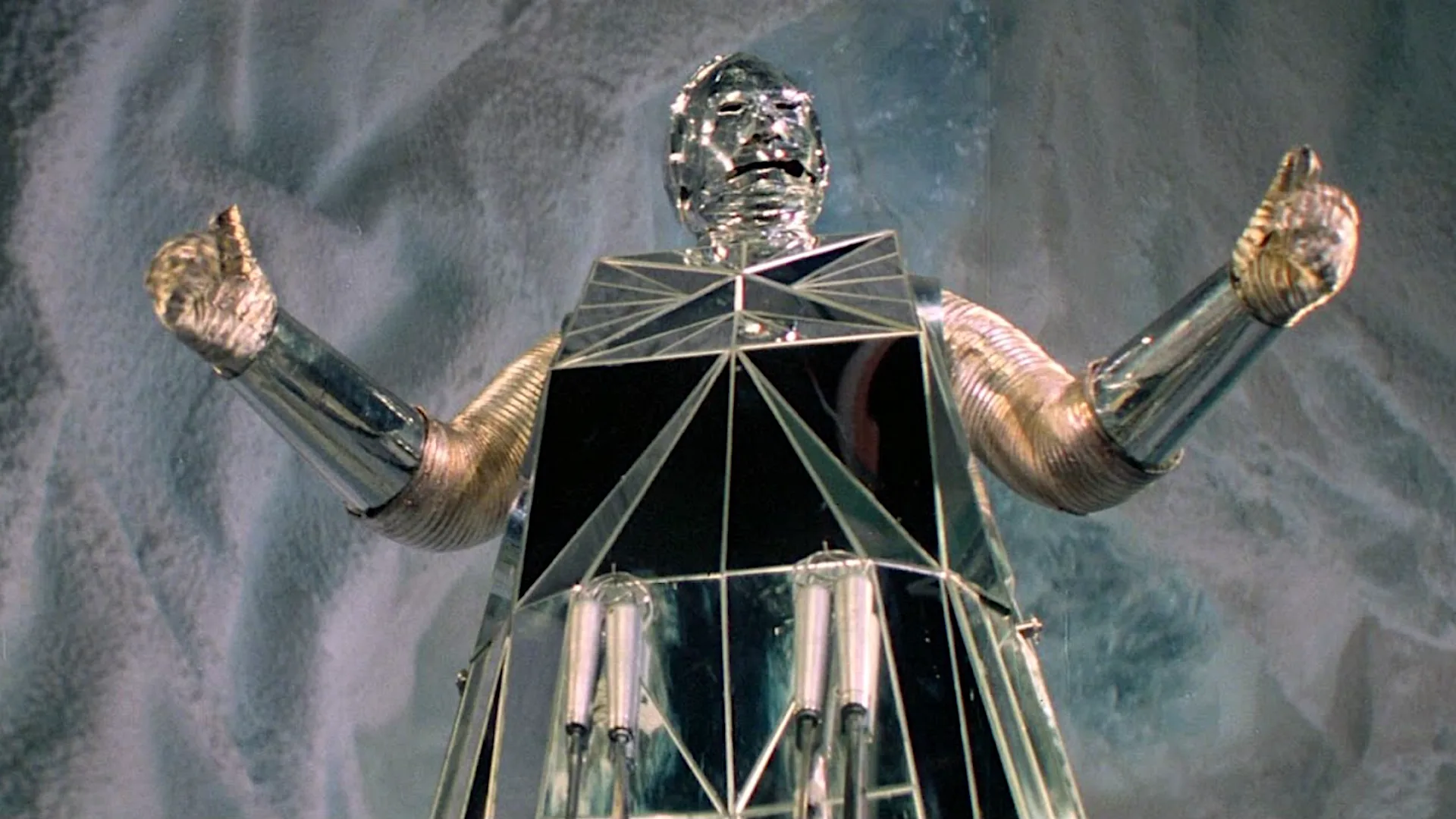
And then there’s Box. The ice cave robot, rendered in a genuinely eerie android suit and voiced and performed by Roscoe Lee Brown, is the kind of creature that lodges in your memory long after the credits roll. Brown was one of the great character actors of his generation, and his Box — a machine that has kept executing its original programming long after any purpose for it remained — is quietly one of the film’s most disturbing ideas made physical.
The Technical Legacy of Logan’s Run
It’s easy to underestimate how technically ambitious Logan’s Run was. The production didn’t just build sets — it found the future in real locations. Houston’s Hyatt Regency Hotel and the Fort Worth Water Gardens in Texas became the film’s most iconic exteriors, the Water Gardens in particular lending an alien grandeur to sequences that no studio backlot could have replicated.
At the 1977 Academy Awards, Logan’s Run received nominations for Best Cinematography and Best Art Direction, and took home a Special Achievement Oscar for Visual Effects — the Academy’s way of acknowledging that the film had done something technically impressive enough to deserve recognition before the formal Visual Effects category existed in its current form. The film also holds a legitimate piece of audio history: it was the first movie ever presented in Dolby Stereo when paired with 70mm prints, a distinction that tends to get buried under the larger cultural noise of everything that happened in cinema the following year.
What Star Wars Did to Everything After
The film grossed $25 million domestically against its $9 million budget, making it a solid commercial success. MGM spun off a short-lived TV series in 1977. And then Star Wars arrived and essentially reset the entire genre’s expectations overnight. The TV series lasted one season. The cultural conversation moved on.
That’s the cruel irony of Logan’s Run‘s place in history. It arrived at a moment when it genuinely could have defined what Hollywood sci-fi looked like for a decade. Instead, it became a footnote in the story of a genre that Lucas then rewrote from scratch. The film’s more philosophical, morally ambiguous approach — closer in spirit to the British sci-fi tradition than to American adventure storytelling — simply wasn’t what audiences wanted once they’d tasted the pure kinetic joy of the Millennium Falcon.
The cast deserves more attention than it typically gets in retrospectives. Michael York brings an appealing everyman quality to Logan that makes the character’s gradual awakening feel earned rather than scripted. Richard Jordan’s Francis 7 is a genuinely menacing antagonist because he believes in the system completely — he’s not a villain in the pantomime sense, he’s a true believer, which is scarier. Peter Ustinov appears in the film’s third act as an eccentric old man the runners encounter outside the domes — a character who functions as living proof that the world the dome-dwellers have been told doesn’t exist is very much real. Farrah Fawcett-Majors, still a year away from Charlie’s Angels making her a household name, has a small but memorable role as Holly 13, a worker at the New You cosmetic shop.
The Remake That Never Quite Happens
For more than 30 years, Hollywood has been trying and failing to remake Logan’s Run. The property has bounced between studios, writers, and directors like a pinball. Ryan Gosling was reportedly in talks to play Logan at one point. Nothing has moved. This is not entirely surprising: the original film’s themes — about manufactured reality, the suppression of uncomfortable truths, the state’s management of death — are if anything more pointed now than they were in 1976, which might be exactly why nobody can agree on how to handle them.
There’s a version of a Logan’s Run remake that could be genuinely powerful in 2026, drawing on surveillance capitalism, algorithmic life-management, and the contemporary cult of youth that makes Instagram look like Carrousel with better lighting. Whether anyone in Hollywood has the nerve to make that film, rather than a straightforward action spectacle with the title slapped on it, is another question entirely. The history of stalled development on this particular property suggests the answer is probably no — at least not yet.
Fifty years on, the original remains worth your time. It’s a film that trusted its audience enough to ask difficult questions, made by people who understood that a beautiful surface and a dark truth underneath are more unsettling in combination than either would be alone. That’s not a lesson the industry has always remembered since.
Frequently Asked Questions
What is Logan’s Run about?
Logan’s Run is set in a 23rd-century domed city where citizens are supposedly reincarnated at age 30 in a ritual called Carrousel. The story follows Logan 5, a government enforcer who begins to question the system and goes on the run to find a place called Sanctuary.
Did Logan’s Run win any Academy Awards?
Yes. Logan’s Run won a Special Achievement Oscar for Visual Effects at the 1977 Academy Awards. It was also nominated for Best Cinematography and Best Art Direction, reflecting the film’s considerable technical ambition for its era.
Is a Logan’s Run remake still happening?
As of 2026, no. A remake has circulated in Hollywood rumour for more than 30 years, with Ryan Gosling reportedly attached at one point. Despite multiple attempts to get a project off the ground, nothing has entered active production.
Where was Logan’s Run filmed?
Several key sequences were filmed on location in Texas, including Houston’s Hyatt Regency Hotel and the Fort Worth Water Gardens, which doubled as the futuristic city’s outdoor spaces. Studio sets and location shooting were combined to create the film’s distinctive visual world.