

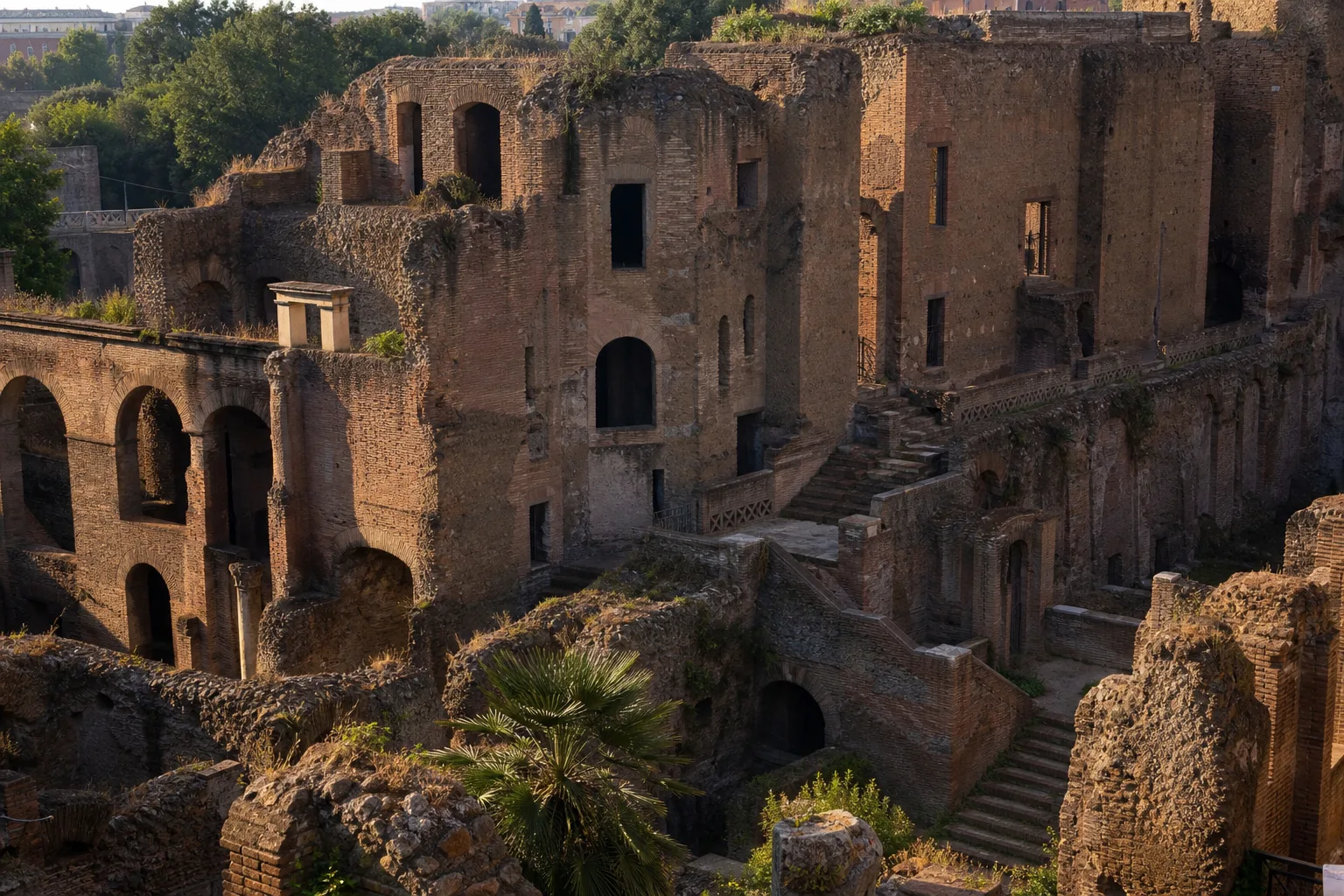
- Roman apartment buildings called insulae could rise eight stories and housed entire urban communities on a single city block.
- Roman apartment buildings inspired the first-ever building codes after the Great Fire of Rome destroyed two-thirds of the city in 64 AD.
- Real estate speculation in ancient Rome was rampant — Marcus Crassus built a property empire by buying fire-damaged insulae for next to nothing.
- Roman concrete made from volcanic ash was so strong it could set underwater, enabling taller and more fire-resistant multi-story structures.
Table of Contents
Roman Apartment Buildings: The Original Urban Housing Crisis
Roman apartment buildings were solving the same problem we’re still arguing about today: how do you house millions of people in a city that keeps running out of space? Two thousand years before Manhattan built upward and Tokyo went vertical, Rome was already stacking residents eight stories into the sky. The structures were called insulae — Latin for “island” — and they occupied entire city blocks, crammed with single-room units, ground-floor shops, and communal staircases that would look familiar to any modern apartment dweller.
A tombstone inscription found outside the city, known as “The Tenant’s Lament,” captures the financial strain with brutal honesty. It was written for an ex-slave named Ancarenus Nothus, and it reads:
“My body knows no longer hunger… now it is no longer paying deposit on the rent, but enjoys for free an eternal lodging.”Even in death, the cost of renting in Rome was apparently worth remarking on. Sound familiar?
The parallels to modern urban housing are almost uncomfortably direct. Waves of migrants arriving in Rome seeking economic opportunity. A chronic shortage of affordable units. Landlords skimping on maintenance. Buildings that were structurally questionable at best, lethal at worst. Rome’s housing market wasn’t just a historical curiosity — it was a template, for better and worse, for nearly every dense city that followed.
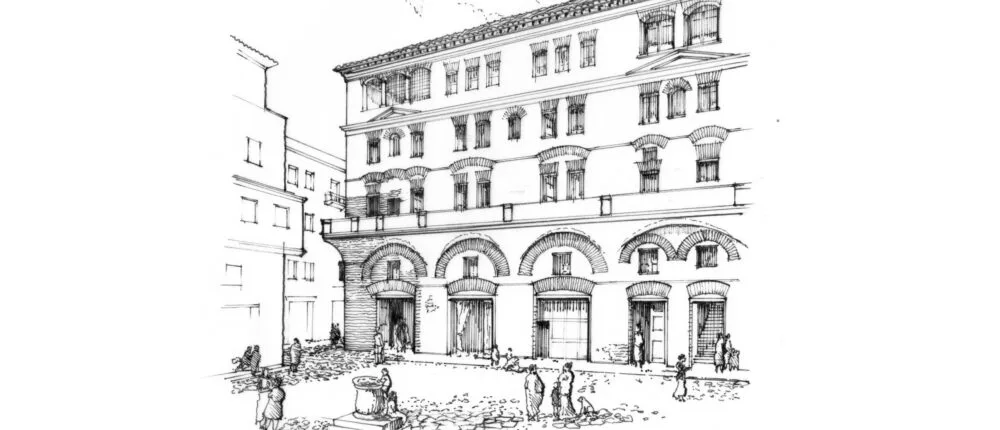
How Insulae Actually Worked — and Why They Were So Dangerous
The typical insula borrowed some architectural DNA from Rome’s elite townhouses, the domus. You’d enter through a narrow passageway flanked by shops. There might be a colonnaded atrium or a light well at the center. But beyond those familiar elements, the insula introduced genuinely new ideas: communal staircases, vaulted arcades, balconies, and mixed-use layouts that blended residential, commercial, and sometimes religious functions inside a single structure. That’s a concept modern architects still treat as innovative.
The historical record stretches back surprisingly far. The Roman historian Livy described what may be an early reference to multi-story Roman apartment buildings when he recounted an incident in which “an ox is reported to have climbed up of its own accord to the third story of a house, and then, frightened by the noisy crowd which gathered, it threw itself down.” Whatever else that story tells us, it confirms that third-floor living was unremarkable enough in Rome by the third century BC that the ox was the strange part, not the building.
But the insulae had a serious dark side. Early construction relied heavily on timber frames and wattle-and-daub infill — branches packed with mud. It was cheap and fast. It was also, as the architect Vitruvius bluntly put it, essentially a torch waiting to be lit. “As for ‘wattle and daub’ I could wish that it had never been invented,” he wrote. “The more it saves in time and gains in space, the greater and the more general is the disaster that it may cause; for it is made to catch fire, like torches.”
The poet Juvenal painted an even grimmer picture of day-to-day life in Roman apartment buildings.
“We live in a city shored up for the most part with gimcrack stays and props: that’s how our landlords arrest the collapse of their property, papering over great cracks in the ramshackle fabric, reassuring the tenants they can sleep secure, when all the time the building is poised like a house of cards.”His complaint about fire was particularly sharp: by the time smoke reached a third-floor apartment, the ground-floor neighbour was already hauling furniture into the street. The higher you lived, the longer it took for the alarm to reach you — and the less time you had to escape.
The World’s First Real Estate Mogul
Where there’s a housing crisis, there’s someone making money from it. Roman apartment buildings became one of antiquity’s most lucrative asset classes, and nobody understood that better than Marcus Licinius Crassus — Roman general, political heavyweight, and arguably history’s first documented property speculator.
Crassus’s playbook was almost cynically modern. According to the first-century biographer Plutarch, he trained a team of slave architects and builders, then waited. When fires broke out — which in Rome, with its wooden insulae and open cooking fires, was constantly — he’d approach the panicked owners of damaged buildings and buy them at “a trifling price.” His crew would then rebuild and rent them out for profit. “In this way the largest part of Rome came into his possession,” Plutarch observed. Crassus was, by most accounts, the wealthiest man in Rome. The strategy wasn’t just opportunistic; it was systematic. He didn’t just benefit from disaster — he built his fortune around the expectation of it.
Cicero, the statesman and philosopher, was also dabbling in Roman apartment buildings as investments, though with considerably less success. In one of his letters, he noted almost casually: “Two of my shops have fallen down and the rest are cracking.” For a man of Cicero’s standing, it was a financial inconvenience. For the tenants inside those cracking walls, it was something else entirely.
Roman Concrete Changed Everything
The technological breakthrough that genuinely transformed Roman apartment buildings was concrete — specifically, the Roman version of it. Earlier civilisations had used lime as a binding agent, but Rome took it further by mixing lime with volcanic ash sourced near Mount Vesuvius. The result was a material of remarkable strength and versatility. As the philosopher Seneca noted: “The dust at Puteoli becomes stone if it touches water.” This wasn’t an exaggeration — modern research has confirmed that Roman marine concrete actually grows stronger over time through a process of mineral crystallisation, something our Portland cement-based concrete can’t do.
This material unlocked a new scale of construction. The Colosseum. The Pantheon. And crucially, more structurally sound insulae. Builders combined concrete with brick facing and vaulting techniques to create ground floors stable enough to support substantial height above them, while also providing covered arcades and commercial spaces at street level. The mixed-use ground floor with residential above it is, in essence, the model for countless modern city blocks.
Still, Roman concrete had limits. Without steel reinforcement — something Rome never developed — Roman apartment buildings above five stories became increasingly prone to cracking. Earthquakes were a genuine threat. The engineering was impressive for its time, but it was operating at the edge of what the materials could support.
When Roman Apartment Buildings Got Building Codes
The turning point arrived in 64 AD. The Great Fire of Rome burned for six days and wiped out nearly two-thirds of the city. Emperor Nero’s reconstruction response was, by the standards of any era, sweeping: new urban planning rules, mandated fire-resistant materials like stone and brick, and — in what may be history’s earliest height restriction — a cap of sixty Roman feet on new insula construction.
It’s a pattern that repeats throughout the history of urban building. London’s Great Fire of 1666 produced the first modern building regulations in England. The 1871 Chicago Fire reshaped American construction law. Disaster has consistently been the forcing function for safety reform. Rome was simply first.
Nero’s codes were probably violated as often as they were followed — enforcement in ancient Rome wasn’t exactly rigorous — but their existence matters. The idea that a city government could dictate how high you could build, what materials you had to use, and how structures had to behave in relation to fire risk: that’s a genuinely modern concept, and Rome got there in the first century AD. Roman apartment buildings were the reason those rules had to be written at all.
What Ancient Rome’s Housing Crisis Tells Us About Ours
Vitruvius, writing around 25 BC, could have been describing any major city today: “With the present importance of the city and the unlimited numbers of its population, it is necessary to increase the number of dwelling-places indefinitely.” He recognised that building upward wasn’t a preference — it was a necessity. “The case has made it necessary to find relief by making the buildings high,” he wrote. “By having many floors high in the air, accommodations within the city walls are multiplied.”
The tension Vitruvius described — between the need for density and the structural and social limits of vertical living — hasn’t gone away. It’s playing out right now in San Francisco zoning fights, London planning inquiries, and debates over Tokyo’s famously permissive height rules. Roman apartment buildings weren’t a historical footnote. They were the proof of concept for the urban apartment as a form, complete with all the trade-offs that still haven’t been fully resolved: affordability versus safety, density versus habitability, the landlord’s profit motive versus the tenant’s need for somewhere decent to live.
Two thousand years on, we’re still building insulae. We’ve just added steel, glass curtain walls, and a more sophisticated approach to fire suppression. The fundamental challenge that made Roman apartment buildings necessary in the first place — more people than space — remains exactly the same.

