The YouTube Shorts update rolling out this week makes it harder than ever to argue that Google’s short-form video product is anything other than a direct TikTok clone. A new clear screen mode, 2x playback speed, a heart-shaped like button, and the removal of the dislike button are all landing in Shorts — and if several of those sound familiar, that’s because they’ve existed on TikTok for years.
- The YouTube Shorts update introduces a clear screen mode that strips away icons, captions, and UI clutter while watching.
- This YouTube Shorts update replaces the thumbs-up with a heart icon and removes the dislike button entirely.
- A new 2x playback speed option lets viewers hold the screen edge to speed up, or swipe down to lock it.
- YouTube is redirecting negative feedback through ‘Not interested’ and ‘Don’t recommend this channel’ menu options.
Table of Contents
YouTube Shorts Update: What’s Actually Changing
YouTube announced the changes in a blog post, keeping the language characteristically upbeat and light on competitive acknowledgement. But the list of new features speaks for itself. The headliner is a ‘clear screen’ mode that strips away the usual overlay — the buttons, icons, usernames, and captions that normally sit on top of a Short while you’re watching it. Hold the screen and the clutter disappears, leaving just the video itself.
TikTok has offered an almost identically named ‘clear mode’ for a long time. It does exactly the same thing. YouTube has essentially taken the feature, renamed it by one word, and shipped it. That’s not necessarily a criticism — there’s a reason TikTok built it, and that reason is that users clearly wanted it — but it does illustrate how transparently the two products are converging. Each YouTube Shorts update makes that convergence more visible.
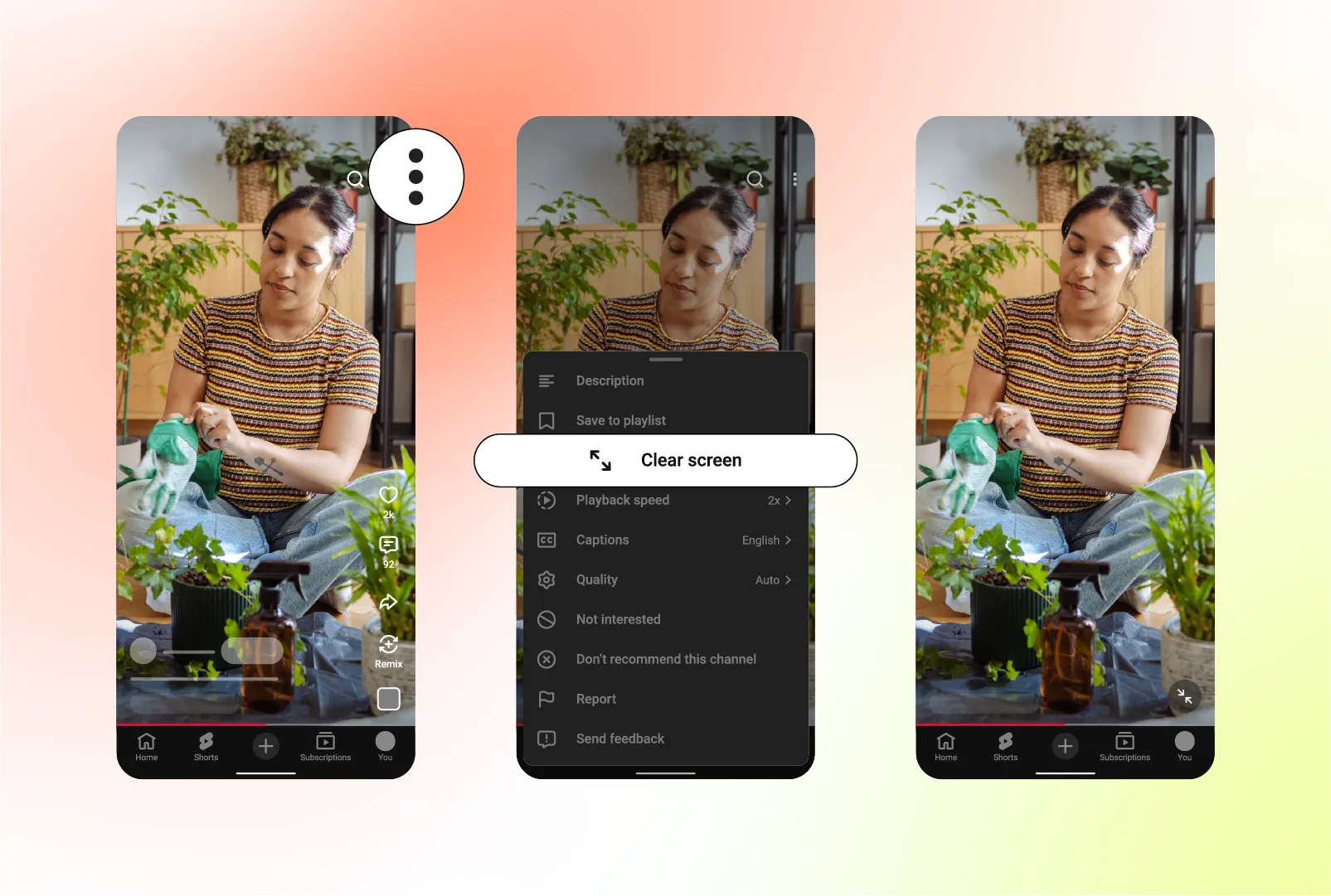
Then there’s the speed control. Shorts now supports 2x playback, and YouTube has built in a gesture system to control it. Hold the edge of the screen to temporarily speed things up, lift your finger to snap back to normal. Want to lock the video at double speed? Press the player and swipe down. It’s a reasonably thoughtful implementation, though again, TikTok has had speed controls for some time. The addition matters less as an innovation and more as a feature-parity milestone.
The Heart Button and the Death of the Dislike
Two of the subtler changes in this YouTube Shorts update are worth unpacking separately. First, the thumbs-up is gone. In its place is a heart icon — the universal shorthand for ‘I liked this’ across Instagram Reels, TikTok, and essentially every social video platform that isn’t YouTube. The thumbs-up was always a YouTube-specific quirk at this point, a visual holdover from the main platform’s design language that never quite fit the swipe-up, fast-scroll energy of Shorts. Replacing it with a heart is a small change that signals something larger: YouTube is willing to let Shorts develop its own visual identity, even if that identity ends up looking a lot like TikTok’s.
The dislike button is also being removed from Shorts entirely. This one is more interesting from a product philosophy standpoint. YouTube’s argument, at least implicitly, is that ‘Not interested’ and ‘Don’t recommend this channel’ are more useful signals than a binary thumbs-down. And honestly, there’s something to that. A dislike can mean anything — wrong audience, bad take, misleading title, just not my thing. ‘Don’t recommend this channel’ is a far more actionable data point for a recommendation algorithm trying to learn your preferences.
That said, the removal also tidies up the interface and reduces visible negativity on content — something creators have quietly lobbied for. YouTube actually removed the public dislike count from the main platform back in 2021, citing creator wellbeing and coordinated dislike campaigns. Extending that logic to Shorts by removing the button altogether is a natural next step, even if it will frustrate viewers who found it a useful quick-signal tool.
Why YouTube Keeps Copying TikTok — and Why That’s Fine
There’s a tired genre of tech commentary that clutches its pearls every time a platform borrows from a competitor. But feature convergence in consumer software is normal, expected, and often good for users. The YouTube Shorts update is a case in point. Clear screen mode is genuinely useful. Speed controls are genuinely useful. Swapping a thumbs-up for a heart takes exactly zero seconds to learn. None of these features are worse because TikTok had them first.
What’s more telling is the strategic picture. YouTube Shorts has been growing fast, with daily view counts that would have seemed absurd when the feature first launched. But raw view counts don’t automatically translate into the kind of creator-platform loyalty that TikTok has built. Creators pick platforms based on tools, discoverability, and monetisation. A YouTube Shorts update that makes Shorts feel more familiar to creators already fluent in TikTok’s interface lowers the friction of cross-posting or migrating.

There’s also a timing angle worth considering. TikTok has spent the better part of two years fighting political and regulatory battles in the US, and its long-term availability in the American market remains uncertain. YouTube has every incentive to make Shorts as comfortable as possible for creators and viewers who might one day need an alternative. Matching TikTok feature-for-feature isn’t laziness — it’s positioning.
The Bigger Short-Form Video Picture
Every major platform now has a short-form video product. Instagram Reels, Snapchat Spotlight, Pinterest’s video push, even LinkedIn has stepped up its video game. They’re all chasing the same behaviour loop that TikTok perfected: frictionless discovery, fast consumption, and a recommendation engine that learns faster than the user realises. Each successive YouTube Shorts update chips away at whatever remaining differentiators TikTok can claim at the product level.
What that means in practice is that the competition increasingly shifts to things like creator payouts, algorithmic reach for new accounts, and platform trust. YouTube has a structural advantage in monetisation — its Partner Programme and mid-roll ad infrastructure are far more mature than TikTok’s. But TikTok still wins on culture. It’s where trends are born before they migrate everywhere else, and no amount of clear screen modes will change that overnight.
Still, the direction of travel is clear. The gap between Shorts and TikTok at a product feature level is narrowing with every YouTube Shorts update. At some point, the only meaningful differences left will be the ones that can’t be copied with a software update — the network, the algorithm’s personality, and the creator communities that have grown up on each platform. That’s the real competition, and it’s only just getting started.