

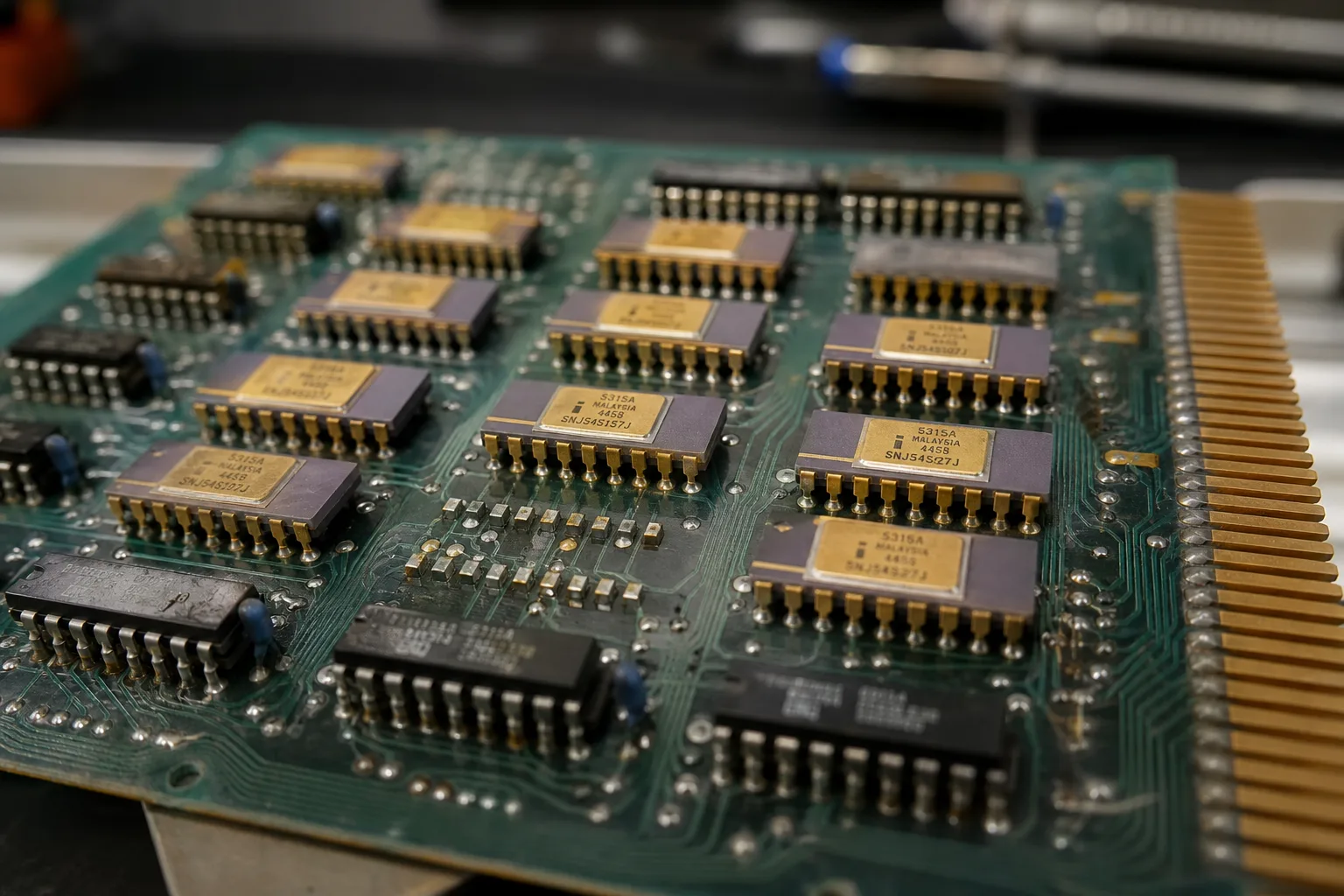
- The Spacelab computer used no microprocessor — its 16-bit CPU was built entirely from discrete TTL logic chips across multiple boards.
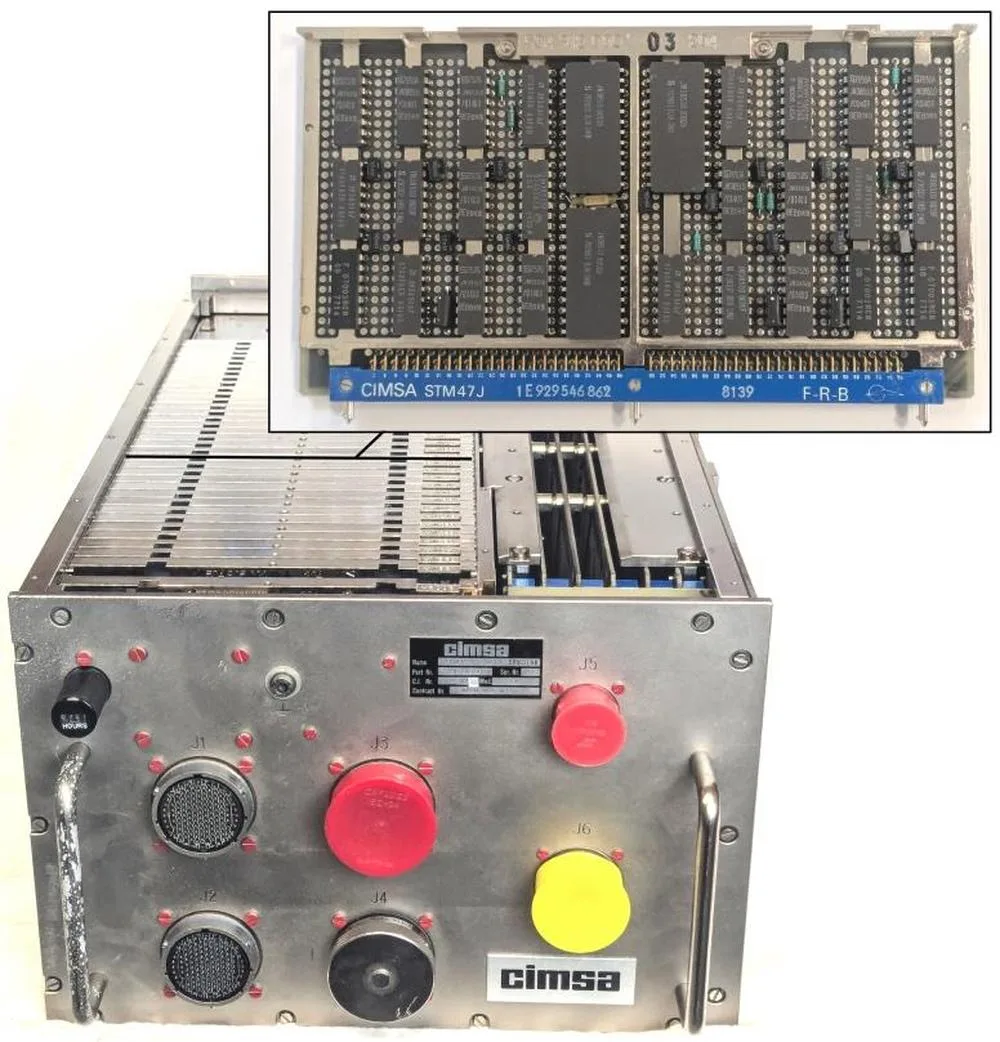
- Reverse engineering the Spacelab computer reveals a French-built Mitra 125 MS minicomputer at the heart of NASA’s reusable orbital lab.
- Eight 74181 ALU chips worked in parallel to give the system a 32-bit arithmetic unit, a serious feat for 1975-era hardware.
- Three redundant computers ran Spacelab missions — one for subsystems, one for experiments, and one backup ready to take over instantly.
Table of Contents
Inside the Spacelab Computer: A Window Into Pre-Microprocessor Engineering
The Spacelab computer that flew aboard NASA’s Space Shuttle wasn’t powered by anything you’d recognise from a modern spec sheet. No Intel chip. No ARM core. The Mitra 125 MS — a militarised French minicomputer built by a company called CIMSA — ran the entire orbital laboratory using boards packed with discrete TTL logic chips, each one doing a tiny slice of work that today a single silicon die handles invisibly. Blogger and hardware historian Ken Shirriff has now reverse-engineered one of those boards in forensic detail, and the result is a fascinating snapshot of how seriously hard computing was before microprocessors made it look easy.
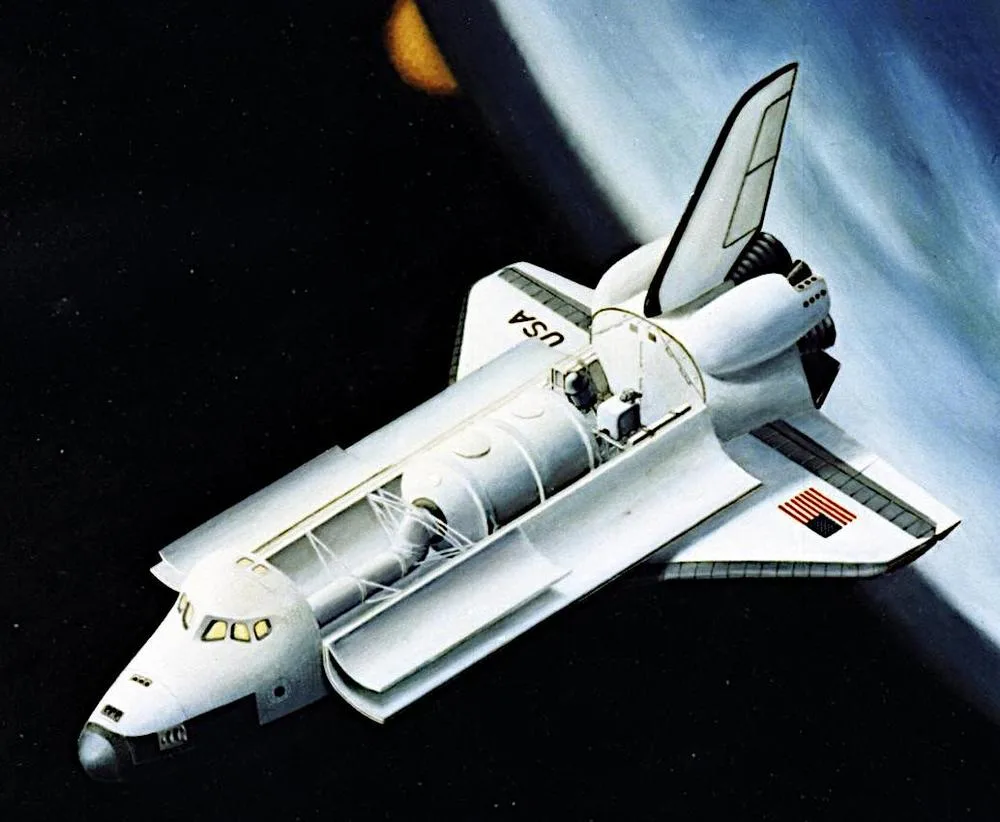
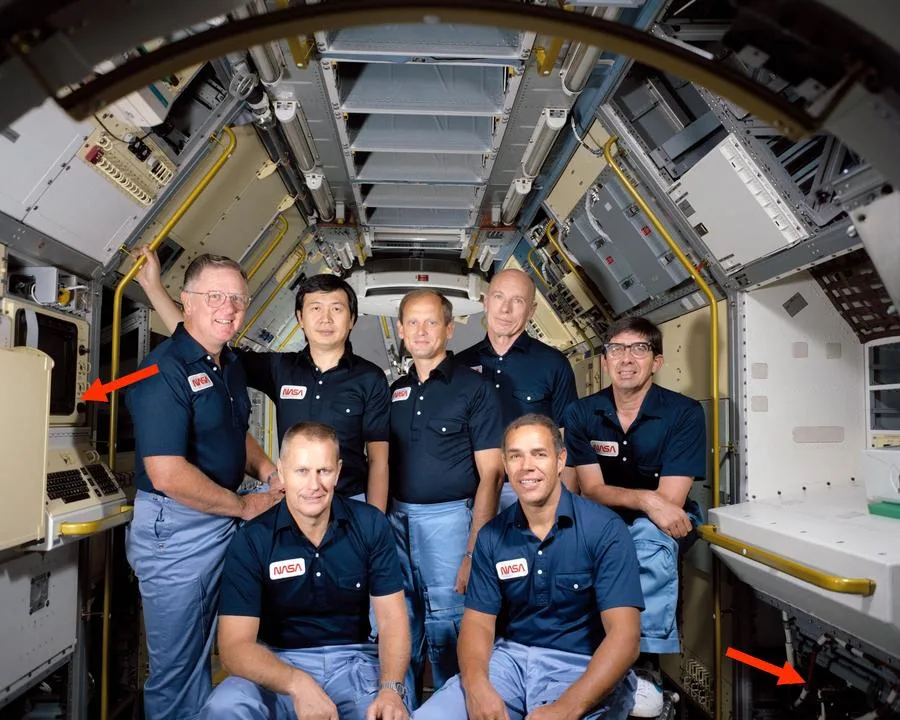
Spacelab itself was a European-built pressurised laboratory that rode in the cargo bay of the Space Shuttle, giving researchers a proper working environment in orbit. A tunnel connected it directly to the Shuttle’s mid-deck, so astronauts could move freely between the two. Beyond the pressurised module, Spacelab could also carry up to five open “pallets” — unpressurised platforms exposed to the vacuum of space, carrying telescopes, spectrometers, and sensors that needed an unobstructed view of the cosmos.
Why the Spacelab Computer Had No Microprocessor
It’s easy to look back and assume that by the late 1970s, microprocessors were everywhere. They weren’t — not in safety-critical aerospace systems, anyway. The Intel 8080 had only arrived in 1974, and the 68000 wasn’t out until 1979. More importantly, space-qualified microprocessors simply didn’t exist yet in any meaningful catalogue. The Spacelab computer predates that world entirely. Instead, its designers turned to what they knew worked: bipolar TTL logic, specifically the military-grade 5400 series chips — the ruggedised cousins of the hobbyist-favourite 7400 series that stocked electronics workbenches worldwide.
TTL, or transistor-transistor logic, uses bipolar transistors rather than the CMOS technology that dominates today. Bipolar is fast — genuinely fast — but it burns power and generates heat at a rate that modern engineers would find alarming. For a space mission, that trade-off was acceptable. Reliability mattered far more than efficiency, and the 5400 series had a proven military pedigree. The chips were radiation-tolerant enough, well-characterised, and available from multiple suppliers. In the context of the late 1970s, it was actually the conservative, sensible choice.
The Mitra 125 MS: France’s Contribution to Orbit
The Spacelab computer’s lineage traces back to 1971, when French company CII introduced the Mitra 15 — a 16-bit minicomputer designed for real-time applications. The name Mitra is a French acronym roughly translating as “Mini-machine for Real-Time and Automatic Computing,” which tells you exactly what the engineers had in mind. It sold well: nearly 8,000 units, a genuinely impressive number for an industrial minicomputer of that era.
CII followed up in 1975 with the Mitra 125, adding memory management, dedicated I/O processors, a performance bump, and an expanded instruction set. The variant that flew in Spacelab was the Mitra 125 MS — the MS standing for its militarised specification, manufactured by CIMSA. The fact that Europe chose a European computer for a European-funded space laboratory was hardly surprising politically, but it also made technical sense. CIMSA’s military-hardened version could handle the temperature extremes and vibration loads of a shuttle launch without flinching.
Each Spacelab mission carried three of these computers. The Subsystem Computer managed the laboratory’s own housekeeping — power, thermal control, communications. The Experiment Computer handled the scientific payloads. And a Backup Computer sat ready to take over from either of the other two the moment something went wrong. In a pressurised lab where the nearest repair shop was 200 miles below, triple redundancy wasn’t paranoia — it was engineering discipline.
The 74181 ALU Chip: The Most Important Component You’ve Never Heard Of
At the centre of the Spacelab computer’s arithmetic muscle sits the Texas Instruments 74181, a chip that deserves far more recognition than it gets in popular computing history. Released in 1970, the 74181 squeezed a complete 4-bit arithmetic/logic unit onto a single piece of silicon — roughly 170 transistors doing addition, subtraction, AND, OR, XOR, increment, decrement, and a handful of other operations. At the time, that was genuinely impressive integration.
The chip’s reach was extraordinary. The 74181 appeared in the DEC PDP-11, one of the most influential minicomputers ever built. It powered the Xerox Alto — the machine that essentially invented the graphical desktop. It sat inside the VAX-11/780, DEC’s “superminicomputer” that defined enterprise computing through the 1980s. When you read the history of computing through that decade, the 74181 is quietly present in nearly every chapter. The Spacelab computer is just one more entry on a very long list.
The chip’s limitations were real, though. It only handled four bits at a time. It couldn’t shift right. Multiplication and division required the processor to loop through repeated additions or subtractions combined with shifts — slow, but workable. Floating-point arithmetic was entirely beyond it, handled instead by software routines that used the 74181 for each individual step. None of this was unusual for the era; it was simply the state of the art.
Building a 32-Bit ALU From Eight Chips
The Spacelab computer’s processor needed to handle 32-bit arithmetic. The solution was straightforward if labour-intensive: chain eight 74181 chips together, each handling four bits of the total word. The specific chips used were the 54S181 variant — “54” for the military temperature rating, “S” for Schottky logic, a refinement that pushed switching speeds higher by clamping transistor saturation.
Chaining ALU chips creates a carry-propagation problem. When the rightmost chip produces a carry, it has to ripple through every subsequent chip before the final answer is valid. With eight chips in series, that delay adds up. The Spacelab computer’s designers solved this with two 54S182 carry-lookahead units — chips that compute carry signals for groups of four 74181s simultaneously, cutting the wait dramatically.
The full board was far more than just eight ALU chips, though. Eight different input sources could feed the ALU depending on the instruction being executed, which required 32 multiplexer chips to route the right data at the right moment. Three 32-bit registers provided local storage for inputs and outputs, needing another 24 chips. Add the two carry-lookahead units, a scattering of inverters and NAND gates to tie the logic together, and a single ALU/register board becomes a dense, complex artefact — not a simple thing to reverse-engineer decades later without documentation.
What Reverse Engineering Old Space Hardware Actually Tells Us
Shirriff’s detailed teardown of the Spacelab computer isn’t just an exercise in nostalgia. It’s a reminder of how much engineering knowledge is embedded in physical hardware that most institutions have no systematic plan to preserve or document. The Mitra 125 MS was never a mass-market product. CIMSA is long gone. French computing history from this era is sparsely documented in English, and even in French, primary sources are hard to find.
There’s a broader pattern here. As the hobbyist reverse-engineering community has shown repeatedly — from the Apple I to the original Xbox to Soviet-era military computers — physical chips and boards contain information that no manual fully captures. The actual transistor-level implementation reveals design choices, constraints, and trade-offs that the engineers never bothered to write down because they were obvious at the time. A decade from now, they won’t be obvious to anyone.
The Spacelab computer flew on missions between 1983 and 1998, supporting everything from materials science to life sciences to atmospheric research. It ran reliably, which is ultimately the only metric that mattered at 28,000 kilometres per hour. The TTL chips that seemed primitive even by the standards of their own era turned out to be exactly right for the job. That’s a lesson the aerospace industry learned long ago and still applies today: proven, well-understood technology beats theoretical performance every time when lives are on the line. Modern spacecraft designers working through radiation-hardened processor selection committees are, in a very real sense, still wrestling with the same question CIMSA’s engineers faced in the mid-1970s — just with a much larger catalogue to choose from.

