

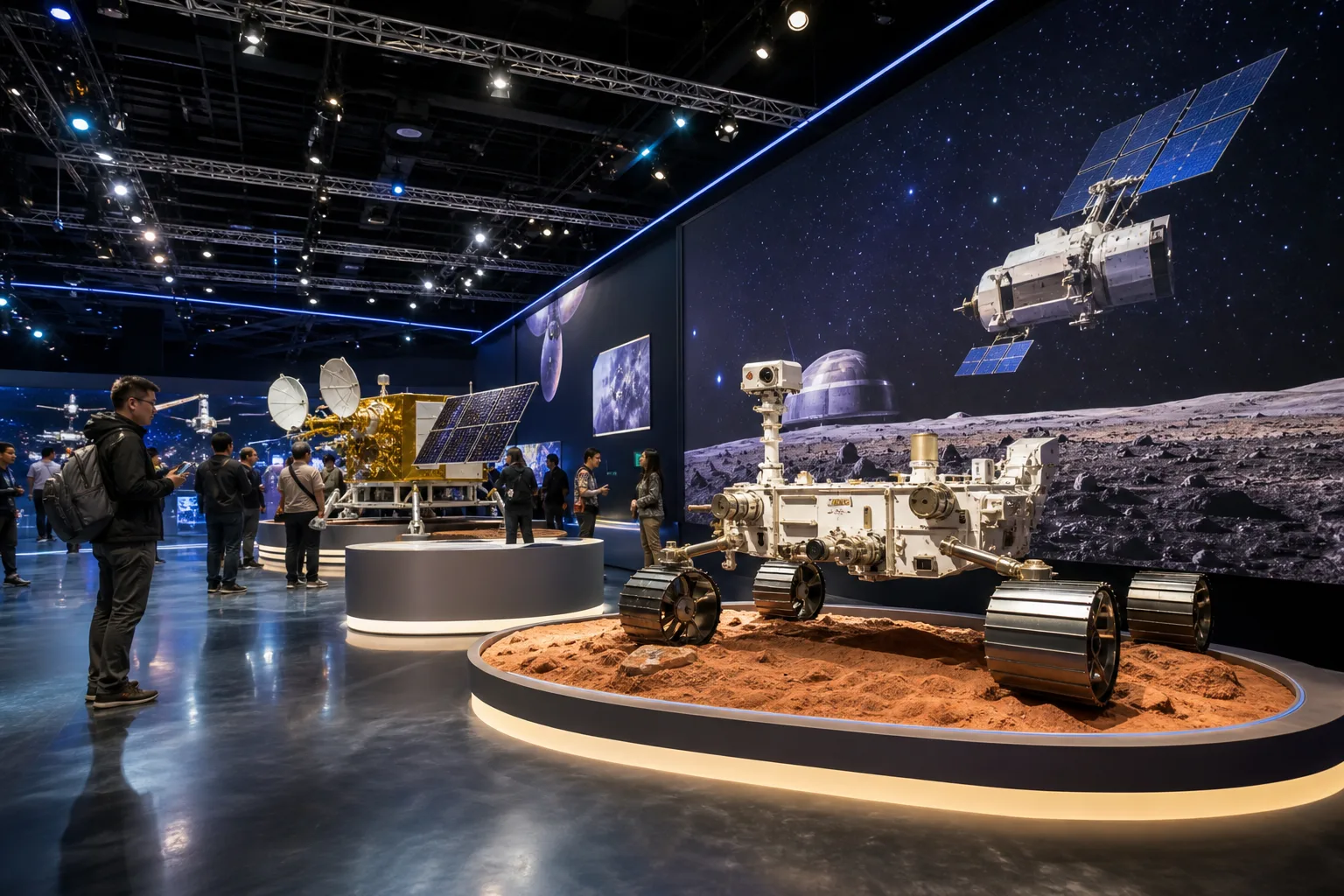
- ESA ILA Berlin 2026 opens 10–14 June at Schönefeld, showcasing Europe’s space ambitions under the ‘Space4Future’ theme.
- ESA ILA Berlin 2026 features four thematic zones covering exploration, climate, operations, and launcher autonomy.
- German astronauts Matthias Maurer and Alexander Gerst headline the inauguration alongside senior ESA and DLR directors.
- Visitors can explore ExoMars rover models, ESOC mission control mock-ups, and live Earth climate visualisations.
Table of Contents
ESA ILA Berlin 2026: Europe Takes Centre Stage
ESA ILA Berlin 2026 is shaping up to be one of the most significant public showcases of European space capability in years — and the timing couldn’t be more deliberate. When the doors open at the ExpoCenter near Schönefeld airport on 10 June, ESA, DLR, and the German Aerospace Industries Association (BDLI) will be making a very public statement: Europe’s space programme is not standing still, and it wants you to know exactly where it’s headed.
The joint pavilion — tucked into Hall B under the banner ‘Space4Future’ — runs through 14 June, with trade days from Wednesday to Friday and public access over the weekend. It’s jointly organised by ESA, DLR, and BDLI, operating under the patronage of Germany’s Federal Ministry of Research, Technology and Space (BMFTR). That level of government backing is telling. Space policy has become inseparable from geopolitical strategy, and European institutions are leaning into that reality hard.
The official inauguration on 10 June brings together a notable line-up: Dorothee Bär, Germany’s Federal Minister of Research, Technology and Space; Dietmar Pilz, ESA Director of Technology, Engineering and Quality; Walther Pelzer, Director General of the German Space Agency at DLR; Anke Kaysser-Pyzalla, Chair of the DLR Executive Board; and BDLI Vice President Space Marc Steckling. Oh, and two of Germany’s most recognisable astronauts — Matthias Maurer and Alexander Gerst — who will likely draw the longest queues of the entire event. ESA ILA Berlin 2026 could hardly have assembled a more compelling opening cast.
Why ‘Space4Future’ Matters Right Now
The choice of theme isn’t accidental. Anne-Sophie Bradelle, Head of ESA’s Communication Department, put it plainly: ‘In today’s geopolitical environment, ILA offers a unique opportunity to showcase Europe’s achievements in space and ESA’s ambitions for the future.’ She went on to reference strengthening Europe’s autonomy in space, advancing science, supporting climate action and security, and inspiring the next generation.
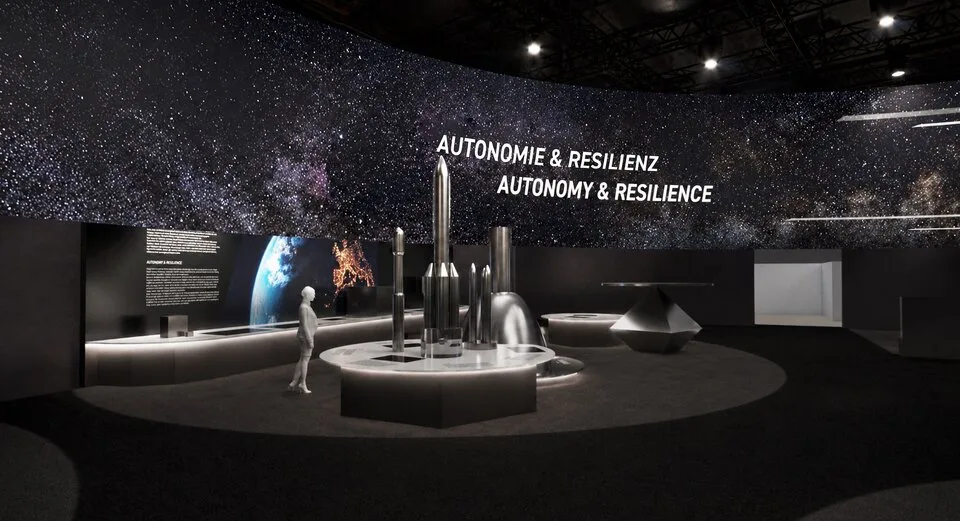
That word — autonomy — is doing a lot of heavy lifting in European space circles right now. With the long-running saga of Ariane 6 finally resolving into something resembling an operational launch cadence, and Vega-C working its way back from its 2022 failure, Europe has spent several uncomfortable years relying on commercial partners for access to orbit. The urgency behind the ‘Autonomy and Resilience’ section of this pavilion isn’t just marketing language. It reflects a genuine strategic anxiety that has been building across ESA member states — and ESA ILA Berlin 2026 is the most visible arena in which that anxiety meets public ambition.
Ariane 6, operating from Europe’s Spaceport in French Guiana, sits alongside Vega-C at the core of that autonomy story. The exhibition also covers the European Launcher Challenge — ESA’s effort to cultivate a new generation of competitive launch vehicles — and strategic programmes developed with the European Commission, including Galileo (Europe’s GPS alternative) and IRIS², the emerging satellite constellation designed to deliver secure connectivity across Europe.
Four Zones, One Moon: The Pavilion Layout
The pavilion is structured around four thematic areas, all connected by a central Moon zone — a design choice that anchors the whole experience in humanity’s most tangible near-term space destination. The Moon has become something of an organisational gravitational centre for ESA’s public messaging, and with good reason: the Artemis programme, European Service Module contributions, and the ESA-DLR LUNA facility for astronaut training all give Europe a legitimate and visible role in what comes next for human lunar exploration. At ESA ILA Berlin 2026, that Moon-centred layout makes the ambition impossible to miss.
Exploration and Discovery
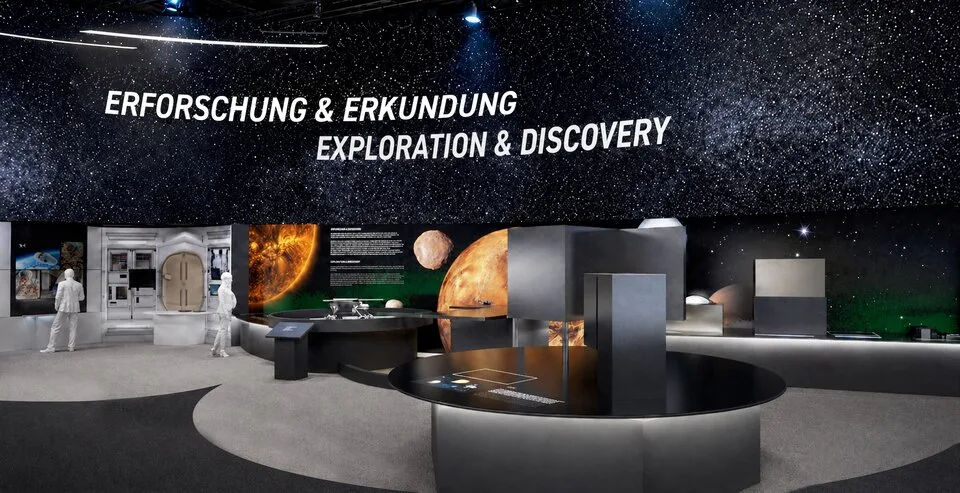
This is where the showstoppers live. Visitors step onto a simulated Martian surface and come face to face with a physical model of the ExoMars Rosalind Franklin rover — the long-delayed but still-alive mission designed to drill beneath the Martian surface and search for biosignatures of past life. Given how much political and financial capital ESA has invested in ExoMars, having it front and centre makes sense. It’s a mission that represents both ESA’s scientific ambition and the frustrations of international collaboration under pressure (the original Russian partnership collapsed following the 2022 invasion of Ukraine).
Beyond Mars, the zone covers deep-space science missions like Euclid — ESA’s dark universe mapper, now delivering genuinely extraordinary data from its L2 orbit — and Plato, the planet-hunting telescope scheduled for launch in the late 2020s. These aren’t small-ticket items. Euclid alone cost around €600 million to develop and build. ESA ILA Berlin 2026 gives the public a rare, close-up encounter with hardware and models that are usually visible only in technical papers and press releases.
Planet and Climate
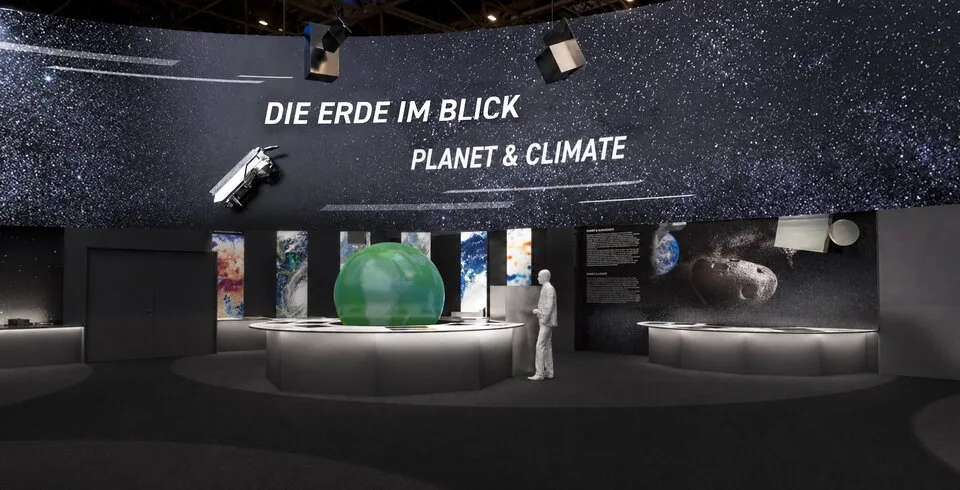
The climate monitoring section is arguably the most immediately relevant part of the entire exhibition for the general public. ESA’s Copernicus Sentinel satellites are the backbone of Europe’s environmental intelligence infrastructure — tracking deforestation, measuring sea surface temperatures, monitoring Arctic ice retreat, and feeding data into the early-warning systems that underpin everything from flood response to agricultural planning.
EarthCare, the joint ESA-JAXA mission launched in 2024 to study clouds and aerosols with unprecedented vertical resolution, features here too. And there’s a striking visual hook: a large Earth sphere displaying atmospheric ozone measurements captured directly from orbit. It’s the kind of exhibit that turns abstract satellite data into something viscerally understandable. The section also addresses planetary defence through missions like Hera — ESA’s follow-up to NASA’s DART impact on asteroid Dimorphos — and space weather monitoring via Ramses and Vigil, both aimed at protecting Earth’s infrastructure from solar storm events. For anyone who has ever wondered what satellite data actually does for daily life, ESA ILA Berlin 2026 answers that question in vivid, interactive terms.
Technology and Operations
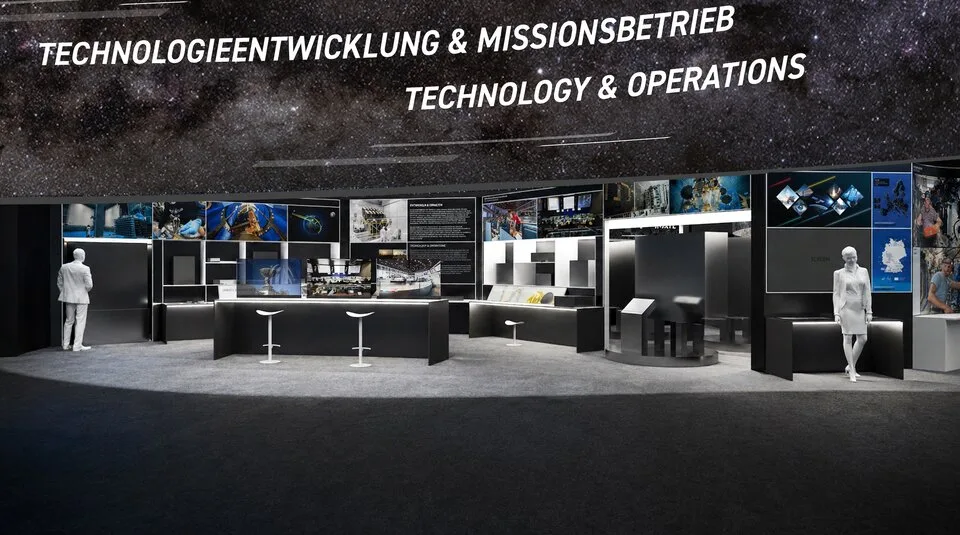
For the engineering-minded visitor, the Technology and Operations zone is where things get genuinely interesting. A mock-up of ESOC’s mission control room — the real facility sits in Darmstadt, Germany, and manages dozens of active ESA spacecraft — gives visitors a feel for the operational complexity behind every mission that makes headlines. It’s easy to celebrate a rover landing; it’s harder to appreciate the years of continuous monitoring and manoeuvring that keep it productive.
The zone also spotlights ESA’s Business Incubation Centres (BICs), which have quietly become one of the agency’s most commercially impactful programmes. With BICs across 22 European countries, they’ve helped spin out hundreds of companies applying space-derived technology to terrestrial markets — from precision agriculture to insurance analytics. SmallGEO, ESA’s flexible geostationary satellite platform developed with OHB, and the forward-looking Hydron water propulsion technology for satellites both get exhibition space here. ESA ILA Berlin 2026 makes the commercial dimension of European space just as prominent as the science.
ESA ILA Berlin 2026: The Bigger Picture
Events like ESA ILA Berlin 2026 serve multiple functions simultaneously. They’re public engagement exercises, yes — but they’re also soft diplomacy, industry networking platforms, and talent pipelines. ESA experts will be on hand throughout the week for career conversations, which matters at a time when the European space sector is competing for engineers and scientists against well-funded commercial players like SpaceX, Rocket Lab, and a growing field of European new-space startups.
There’s also a message being sent to European governments and the European Commission, who hold the funding keys. A packed, enthusiastic Space Pavilion at one of the world’s most visible airshows is exactly the kind of political optics that helps justify budget lines in the next ESA ministerial cycle. The last major ESA ministerial meeting in 2023 secured around €18.5 billion in commitments from member states — the next one will need to sustain and build on that. Showing up at ESA ILA Berlin 2026 with a well-resourced, professionally executed pavilion is part of making that case.
Whether you’re an aerospace professional attending the trade days or a curious member of the public heading in on Saturday, the Space Pavilion at ILA Berlin is a rare chance to see the full breadth of what European space capability looks like in 2026 — warts, ambitions, and all. Europe’s space story is genuinely complex right now: launcher delays, budget pressures, geopolitical realignments, and fierce commercial competition are all real headwinds. But so are Euclid’s dark-matter maps, the Copernicus data feeding climate policy across 27 nations, and a rover that might — just might — one day confirm life existed on Mars. That tension is worth experiencing in person, and ESA ILA Berlin 2026 is the place to do it.
Frequently Asked Questions
What can visitors expect at ESA ILA Berlin 2026?
ESA ILA Berlin 2026 features four themed exhibition zones covering space exploration, climate monitoring, technology and operations, and European launcher autonomy. Highlights include an ExoMars rover model, an ESOC mission control mock-up, Earth climate visualisations, and talks from ESA astronauts and directors.
When and where is the ILA Berlin 2026 Space Pavilion?
The Space Pavilion is in Hall B at the ExpoCenter near Schönefeld airport, Berlin. Trade days run Wednesday 10 to Friday 12 June; public days are Saturday 13 and Sunday 14 June. Opening hours are 10:00 to 18:00 each day.
Which ESA missions will be featured at ILA Berlin 2026?
The pavilion highlights a wide range of missions including ExoMars Rosalind Franklin, Euclid, Plato, EarthCare, Copernicus Sentinel, Hera, Ramses, Vigil, Ariane 6, Vega-C, Galileo, and IRIS². Both current programmes and future exploration goals are covered across the exhibition zones.
Who is organising the Space Pavilion at ILA 2026?
The Space Pavilion is jointly organised by ESA, the German Aerospace Center (DLR), and the German Aerospace Industries Association (BDLI), under the patronage of Germany’s Federal Ministry of Research, Technology and Space (BMFTR).

