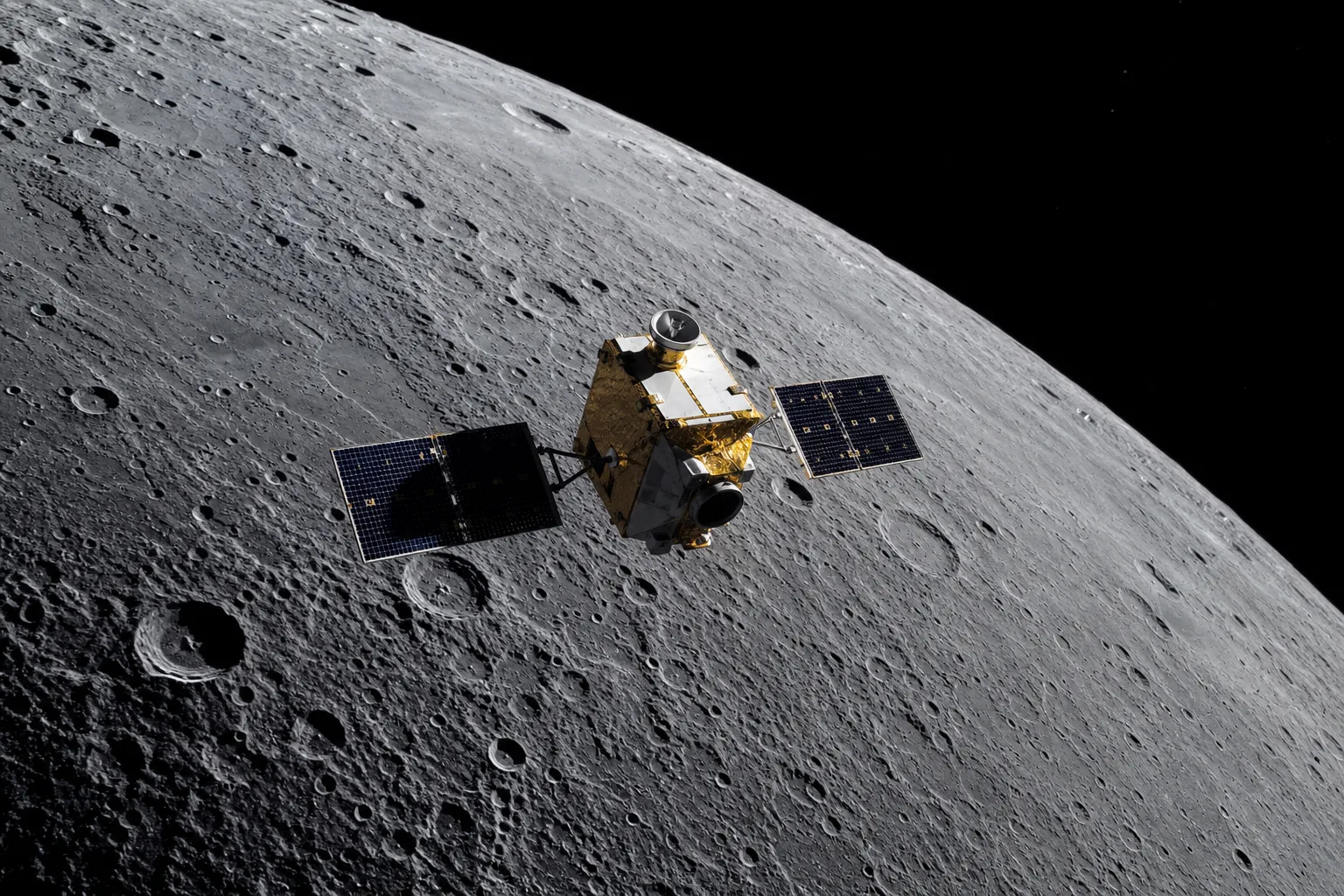
- A new lunar orbiter concept from Tokyo Metropolitan University could map five key elements across the entire moon in two years.
- The lunar orbiter concept uses a compact X-ray telescope simulated with realistic satellite mission modeling to chart surface chemistry.
- A 5-by-5 detector array could significantly boost resolution and accelerate results beyond the two-year baseline estimate.
- Mapping the moon’s elemental composition is considered essential for understanding how the lunar surface geologically evolved over time.
Table of Contents
A Lunar Orbiter Concept That Could Change How We Read the Moon
Researchers at Tokyo Metropolitan University have proposed a lunar orbiter concept that — if it ever gets off the ground — could give scientists the most detailed chemical map of the moon’s surface ever assembled. Using computer simulations of a compact X-ray telescope mounted on a small satellite, the team showed that five key elements could be mapped across the entire lunar surface in roughly two years. It’s the kind of result that sounds straightforward until you consider how little we actually know about what the moon is made of, and why that matters enormously for everything from planetary science to future crewed exploration.
Why X-Ray Fluorescence Is the Right Tool for the Job
The technique behind this lunar orbiter concept isn’t new — X-ray fluorescence spectroscopy has been used to study planetary surfaces since the 1970s — but applying it with a modern, miniaturised detector array is where this proposal gets interesting. When the sun’s X-rays hit the lunar surface, atoms in the soil absorb that energy and re-emit it at characteristic wavelengths. Different elements produce different signatures. An orbiting telescope sensitive enough to detect those signatures can, in principle, build a pixel-by-pixel map of the moon’s chemistry from above without ever touching the surface.
The challenge has always been resolution and sensitivity. Earlier missions like the European Space Agency’s SMART-1 and India’s Chandrayaan-1 both carried X-ray spectrometers and returned useful data, but coverage was patchy and resolution was limited by the instruments available at the time. The Tokyo Metropolitan University team’s approach — building a compact detector that can realistically be flown on a small satellite — is a direct response to those limitations. Smaller, cheaper satellites mean more opportunities to actually get a mission launched. And the simulation work suggests the physics checks out.
Five Elements, Two Years — What the Simulations Actually Show
The Tokyo Metropolitan University team ran detailed models of both the detector hardware and a realistic orbital mission profile to arrive at their two-year estimate. The five elements targeted — chosen because they’re scientifically significant and detectable within the sensitivity range of the proposed instrument — are among the key constituents of lunar regolith.
Two years in orbit is a reasonable mission lifetime for a small satellite, which makes this lunar orbiter concept pragmatically attractive, not just theoretically elegant. The team also modelled a scaled-up configuration: a 5-by-5 array of detectors that would improve spatial resolution and compress the timeline further. More detectors capturing more photons per second means cleaner data faster — a simple principle, but one that has real implications for mission design and cost trade-offs.
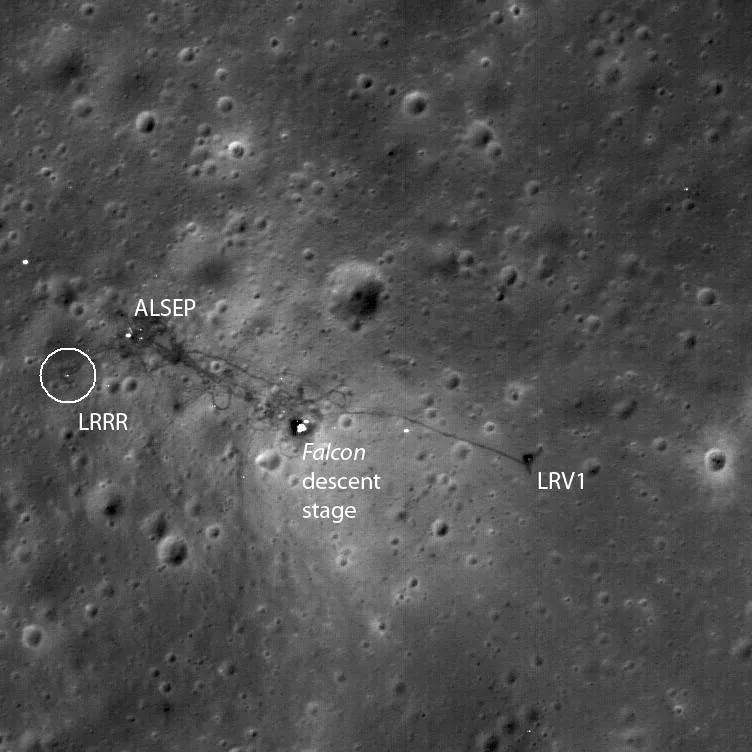
It’s worth stepping back to appreciate what a full elemental map of the moon would actually unlock. Right now, our chemical knowledge of the lunar surface is heavily biased toward the sites visited by Apollo missions and the handful of robotic landers that followed. Those are fascinating data points, but they’re geographically tiny. The moon’s far side, its polar regions, and vast stretches of the highlands remain chemically characterised only in broad strokes from remote sensing data. A lunar orbiter concept like this one could fill in those blanks systematically, from pole to pole.
The Bigger Picture: Moon Geology and the Race Back to the Lunar Surface
Timing matters here. NASA‘s Artemis programme is working toward putting astronauts back on the lunar surface, and the European Space Agency, JAXA, and a growing roster of commercial players — ispace, Astrobotic, Intuitive Machines — are all planning or executing lunar surface missions in the coming years. All of that activity creates an urgent demand for better geological maps. Knowing where concentrations of specific elements are located isn’t just academically interesting; it directly informs where you’d want to land, where you might find resources useful for in-situ manufacturing, and where the geology is most scientifically compelling.
The lunar orbiter concept from Tokyo Metropolitan University fits neatly into this landscape. It’s proposing to do something genuinely useful — a global chemical survey — with a small, relatively affordable platform. That matters in an era when CubeSats and small satellite buses have made it possible for university research groups to contribute meaningfully to space science without needing a flagship-class mission budget.
From Simulation to Launch: What Comes Next
The research is currently at the simulation and concept stage, which means there’s a significant distance between these promising results and an actual satellite in lunar orbit. Simulation work like this is a critical first step — it validates that the physics is sound and that the mission is achievable within realistic constraints — but it needs to be followed by hardware development, funding, and an actual launch opportunity. Japan has a strong track record in small satellite missions, and JAXA’s ongoing investment in lunar science through programmes like SLIM — which successfully landed on the moon in early 2024 — suggests the institutional environment is supportive of precisely this kind of lunar orbiter concept.
The research has been published and is covered in detail by Phys.org, which covers the simulation methodology and the specific performance projections for both the single-detector and 5-by-5 array configurations. For anyone interested in the technical specifics, that’s the place to dig in.
A Compact Telescope With an Outsized Scientific Ambition
What makes this lunar orbiter concept compelling isn’t that it’s trying to do something no one has ever attempted — it’s that it’s trying to do it properly, at scale, with an instrument small enough to actually get funded and built. Global elemental mapping of the moon has been a scientific priority for decades. The question has always been whether you could pull it off affordably and with sufficient resolution to be genuinely useful. The Tokyo Metropolitan University team’s simulations suggest the answer is yes — and if a 5-by-5 detector array can compress the timeline even further, this type of lunar orbiter concept could slot directly into the current wave of lunar activity as a low-cost, high-value science platform.
The moon is about to get a lot more visitors. Having a detailed chemical map waiting for them when they arrive seems like exactly the kind of infrastructure investment the broader lunar exploration community should be pushing for.
Frequently Asked Questions
What is the lunar orbiter concept developed by Tokyo Metropolitan University?
It’s a proposed satellite mission using a compact X-ray telescope designed to map the chemical composition of the entire lunar surface. Simulations show it could detect five key elements across the moon within approximately two years of operation.
Why does mapping the moon’s chemical composition matter?
Understanding which elements are present — and where — gives scientists critical insight into the moon’s geological history and how it evolved over time. The research describes this as a vital breakthrough for understanding the moon’s geological evolution.
How does an X-ray telescope map a planet or moon’s surface?
When solar X-rays strike a planetary surface, elements in the soil emit characteristic X-ray fluorescence signatures. An orbiting X-ray telescope detects these signatures and maps them spatially, identifying which elements are present and in what concentrations across the surface.
Could a 5-by-5 detector array improve the mission’s performance?
Yes. According to the Tokyo Metropolitan University research, scaling up to a 5-by-5 array of detectors would improve spatial resolution and produce results faster than the baseline single-detector mission scenario.