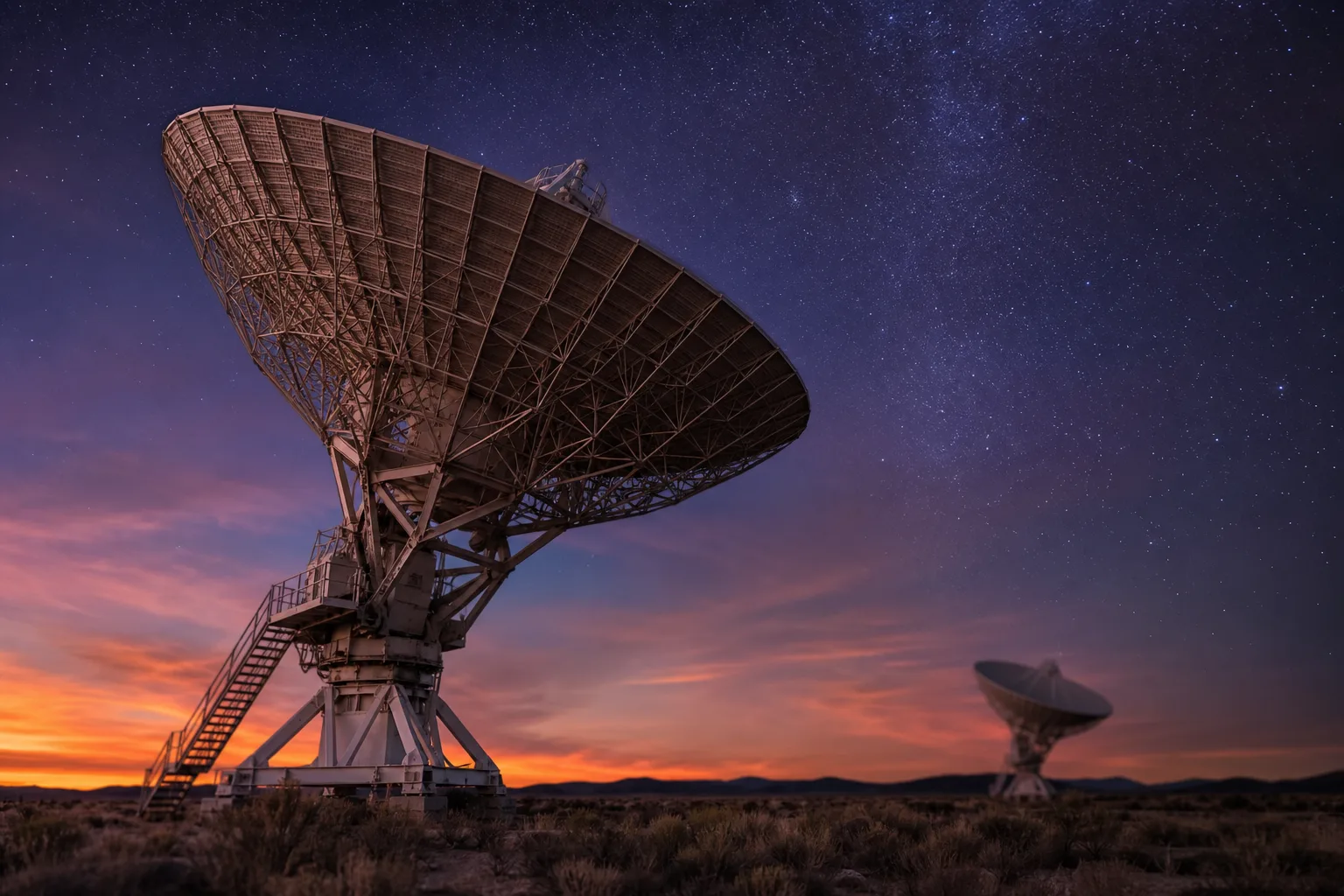
The MeerKAT telescope has done it again. Astronomers using the South African radio observatory have picked up the most distant hydroxyl megamaser ever recorded — a signal that travelled more than 8 billion light-years before landing in the Karoo desert. It’s a remarkable detection that raises the ceiling on what ground-based radio astronomy can achieve, and it tells us something genuinely fascinating about how galaxies behave when they tear each other apart.
- The MeerKAT telescope in South Africa has detected the most distant hydroxyl megamaser ever found, over 8 billion light-years away.
- MeerKAT telescope scientists identified the signal coming from a pair of violently colliding galaxies in the early universe.
- A hydroxyl megamaser is essentially a natural space laser, amplified by cosmic-scale collisions between galaxies.
- The discovery pushes radio astronomy into new territory, showing what next-generation telescope arrays may soon be capable of.
Table of Contents
What Exactly Is a Hydroxyl Megamaser?
The term sounds intimidating, but the concept is elegant. A hydroxyl megamaser is, in straightforward terms, a natural space laser — except instead of visible light, it emits intensely amplified radio waves. The ‘hydroxyl’ part refers to OH molecules: one oxygen atom bonded to one hydrogen atom. These molecules exist in enormous clouds throughout galaxies, and under the right conditions they can act collectively, absorbing energy from surrounding radiation and re-emitting it in a single, tightly focused direction at a specific radio frequency.
Those ‘right conditions’ almost always involve catastrophe. Hydroxyl megamasers are powered by galaxy mergers — events where two massive star systems collide over millions of years in slow-motion cosmic violence. The intense radiation produced during these collisions pumps energy into the hydroxyl clouds, triggering that laser-like amplification. The result is a radio signal so powerful that it can, apparently, cross more than half the observable universe and still be picked up by a sensitive enough instrument.
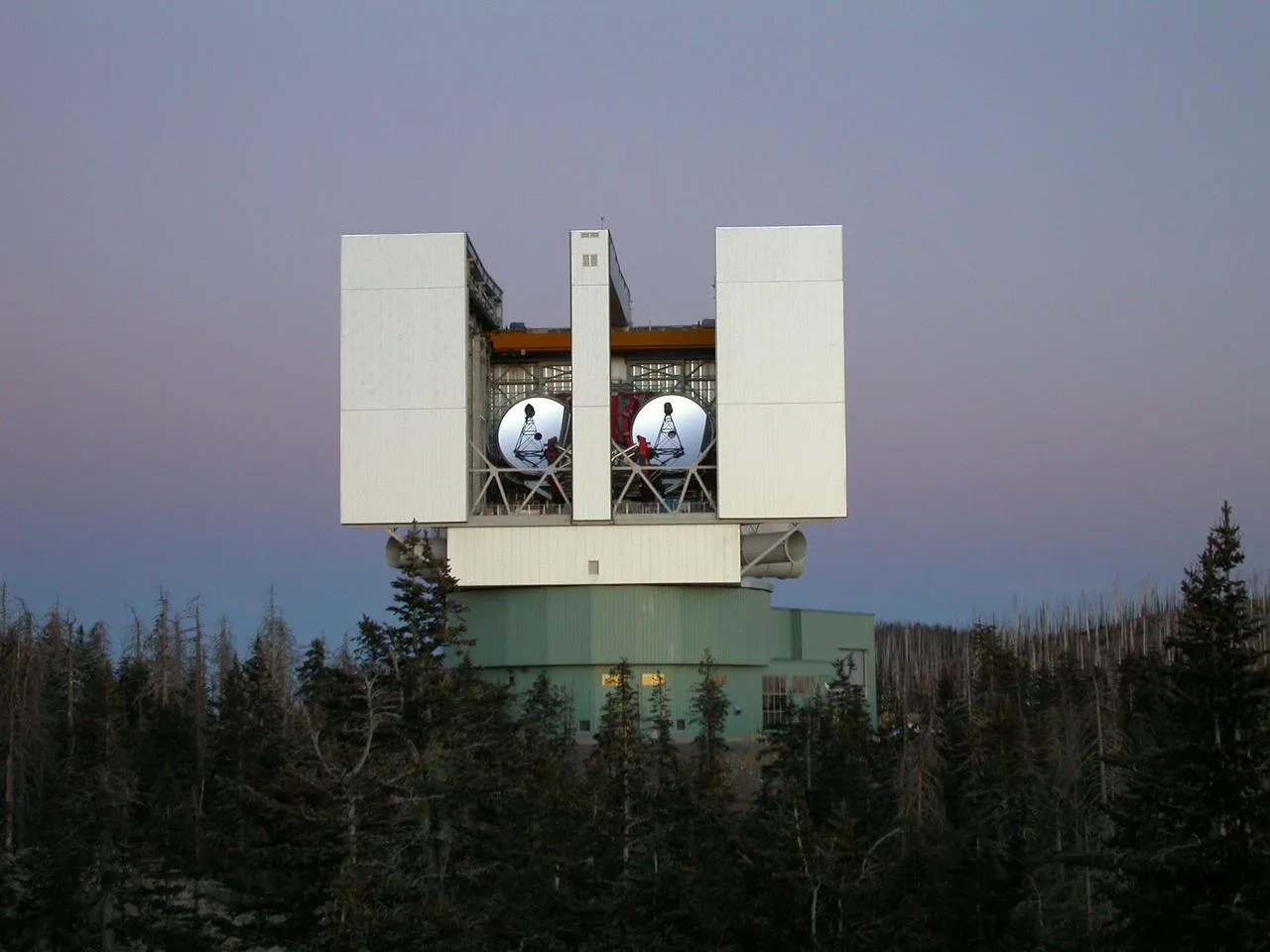
That instrument, in this case, is the MeerKAT radio telescope — a radio array located in the Karoo region of South Africa. The MeerKAT telescope has been steadily building a reputation as one of the most capable radio telescopes currently operating on Earth, and this latest find only adds to that standing.
MeerKAT Telescope Breaks Its Own Record
The newly detected megamaser sits in a galaxy that is merging with another — two enormous structures of gas, dust, and billions of stars grinding together in a collision that has been unfolding for millions of years. At 8 billion light-years away, the signal we’re seeing today left its source when the universe was a fraction of its current age. For context, our sun didn’t even exist yet. Earth certainly didn’t.
What makes this particularly significant isn’t just the distance. It’s what the detection proves about the sensitivity of the MeerKAT telescope and its ability to find faint, specific signals buried in the noise of a universe filled with radio sources. Hydroxyl megamasers emit at a characteristic radio frequency, but because the universe is expanding, that signal gets stretched — redshifted — by the time it arrives. The further away the source, the more that frequency shifts. Identifying a signal at this level of redshift, confirming it as a hydroxyl megamaser rather than something else, is a serious piece of astronomical detective work.
The detection emerges from an ongoing deep-field radio survey specifically designed to study neutral hydrogen and hydroxyl emission across cosmic time, which has already produced notable results. For the MeerKAT telescope, finding a record-breaking megamaser at this distance pushes the project into genuinely new scientific territory.
Why Galaxy Mergers Are Radio Astronomy’s Best Friends
It might seem counterintuitive that destruction at a galactic scale produces some of the most useful signals in astronomy. But mergers are extraordinarily productive from a scientific standpoint. They trigger bursts of star formation, feed supermassive black holes, and — as we’re seeing here — energise molecular clouds to the point where they become cosmic amplifiers.
Hydroxyl megamasers are essentially flags. When you detect one, you know you’ve found a major merger event. And because mergers drive galaxy evolution — transforming spirals into ellipticals, triggering the growth of galactic bulges, redistributing gas and dust throughout a system — being able to spot them across billions of light-years is genuinely useful for understanding how the universe built the structures we see today.
The further back we can detect these events, the better our picture of galaxy evolution across cosmic time. Finding one at over 8 billion light-years means the MeerKAT telescope is now probing galaxy mergers at an epoch when the universe was actively building many of its largest structures. That’s not a trivial data point.
What This Means for Radio Astronomy’s Future
The MeerKAT telescope was always intended as a precursor — a stepping stone toward the Square Kilometre Array Observatory (SKAO), the international megaproject that will eventually place thousands of radio dishes and antennas across South Africa and Australia. The question has always been: what can MeerKAT do in the meantime, and how good a preview does it offer of SKA’s capabilities?
Detections like this one are a direct answer. If a precursor array can find a hydroxyl megamaser at 8 billion light-years, an instrument with hundreds of times the collecting area should be able to find them routinely — and at even greater distances. There are theoretical predictions that the SKA could detect megamasers across most of the observable universe. That would give astronomers a nearly complete census of major galaxy mergers across cosmic history, which is arguably one of the most important datasets you could have for understanding how the universe evolved.
There’s also a broader point worth making about where the centre of gravity in global astronomy is shifting. South Africa has invested heavily in MeerKAT and the broader SKA infrastructure, and the scientific returns are starting to compound. The country is producing world-leading results — not just contributing to international collaborations, but driving them. This megamaser record is one more data point in that trend.
The real excitement here isn’t just breaking a distance record. It’s that each time the MeerKAT telescope pushes the frontier outward, it makes the case that the full SKA could fundamentally change how we read the history of the universe — one radio signal at a time.