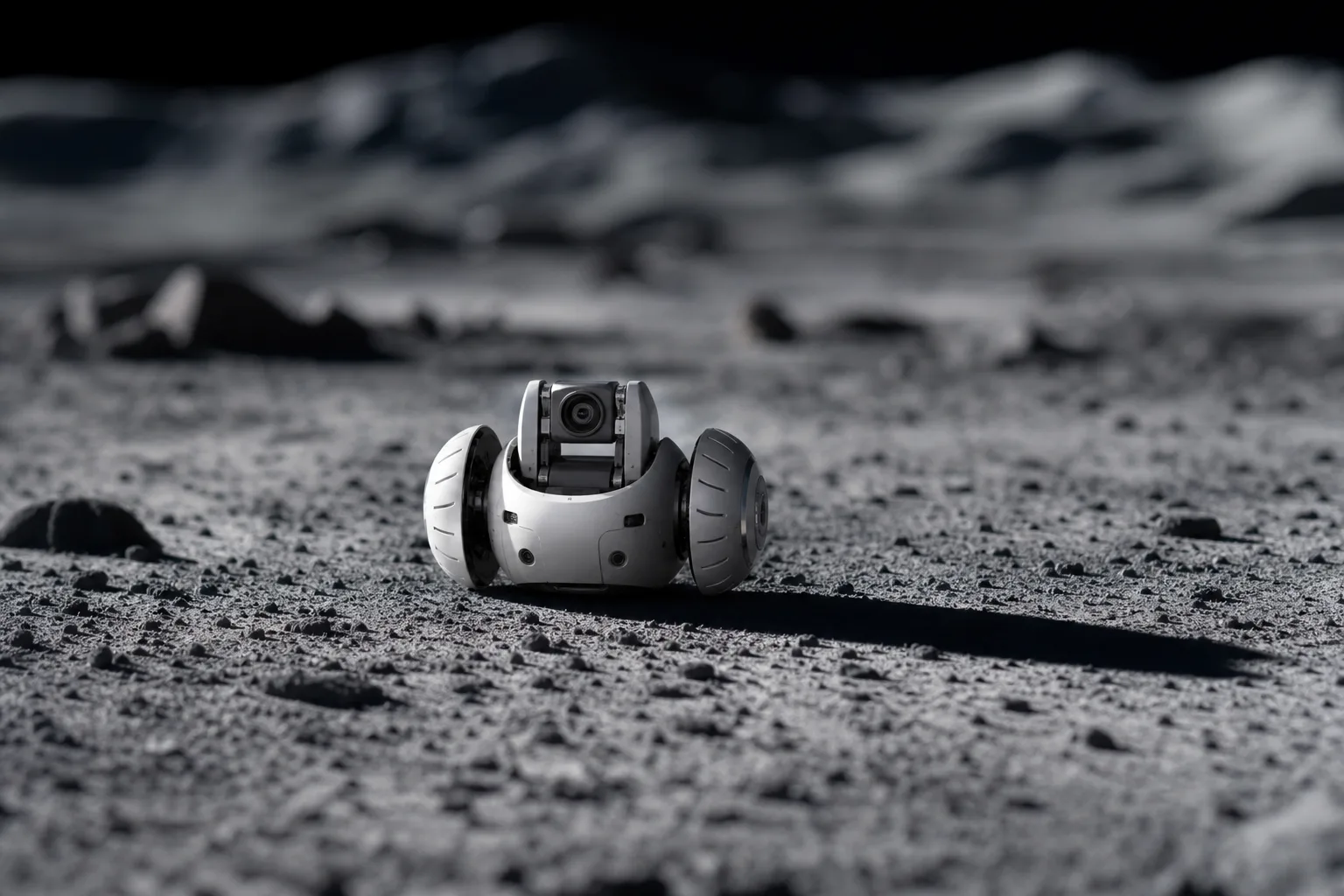
A tennis-ball-sized robot that folds itself flat, sprouts wheels from its own body, and trundles across the moon without any help from mission control sounds like science fiction. But the SORA-Q lunar rover did exactly that in January 2024, and the peer-reviewed results published in Science Robotics are now giving the broader space robotics community a lot to think about.
- The SORA-Q lunar rover, just 8cm across, successfully navigated the moon’s surface autonomously in January 2024.
- SORA-Q lunar rover was co-developed by JAXA, Sony, Doshisha University, and toy giant Takara-TOMY.
- The two-robot team relayed data back to Earth via JAXA’s SLIM lander before comms cut out after roughly 100 minutes.
- Results published in Science Robotics show small rover swarms could access terrain impossible for large spacecraft.
Table of Contents
What SORA-Q Actually Did on the Moon
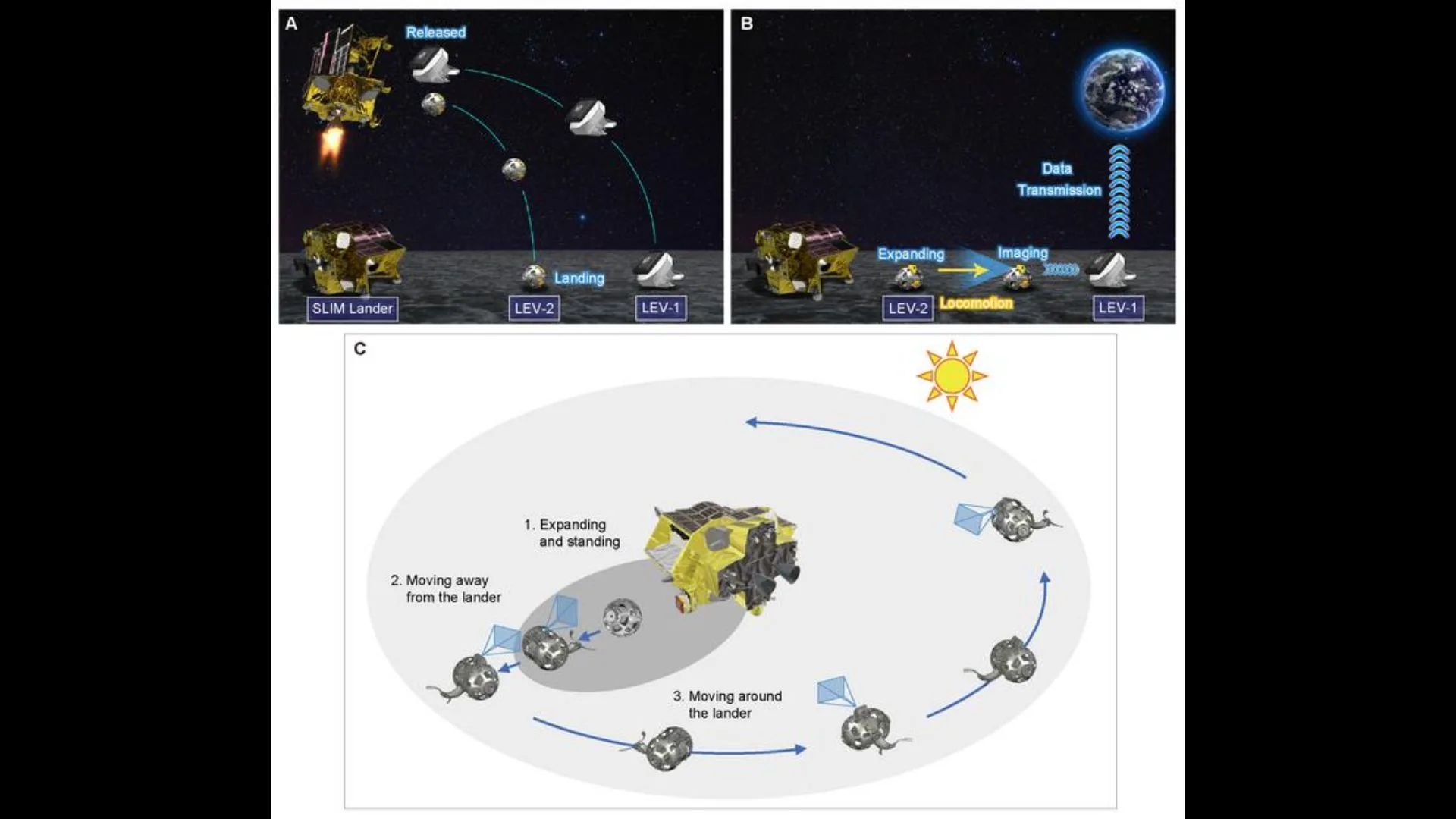
JAXA’s Smart Lander for Investigating Moon (SLIM) touched down on January 19, 2024 — making it the first Japanese spacecraft to achieve a controlled soft landing on the lunar surface. Within moments of landing, SLIM deployed two small robots: LEV-1, a compact hopping machine, and LEV-2, the SORA-Q lunar rover. The pair were designed to work as a team, with LEV-1 and SORA-Q working in tandem to relay data back to Earth.
The SORA-Q lunar rover‘s job once on the ground was to drive around the landing site, photograph the SLIM lander itself, and capture colour images of the surrounding terrain. The site sits close to Shioli crater — a roughly 270-metre-wide bowl — nestled inside the vast Cyrillus impact crater (about 98 kilometres across) in the Mare Nectaris region on the moon’s nearside. It’s not the most forgiving terrain, which makes what happened next all the more impressive.
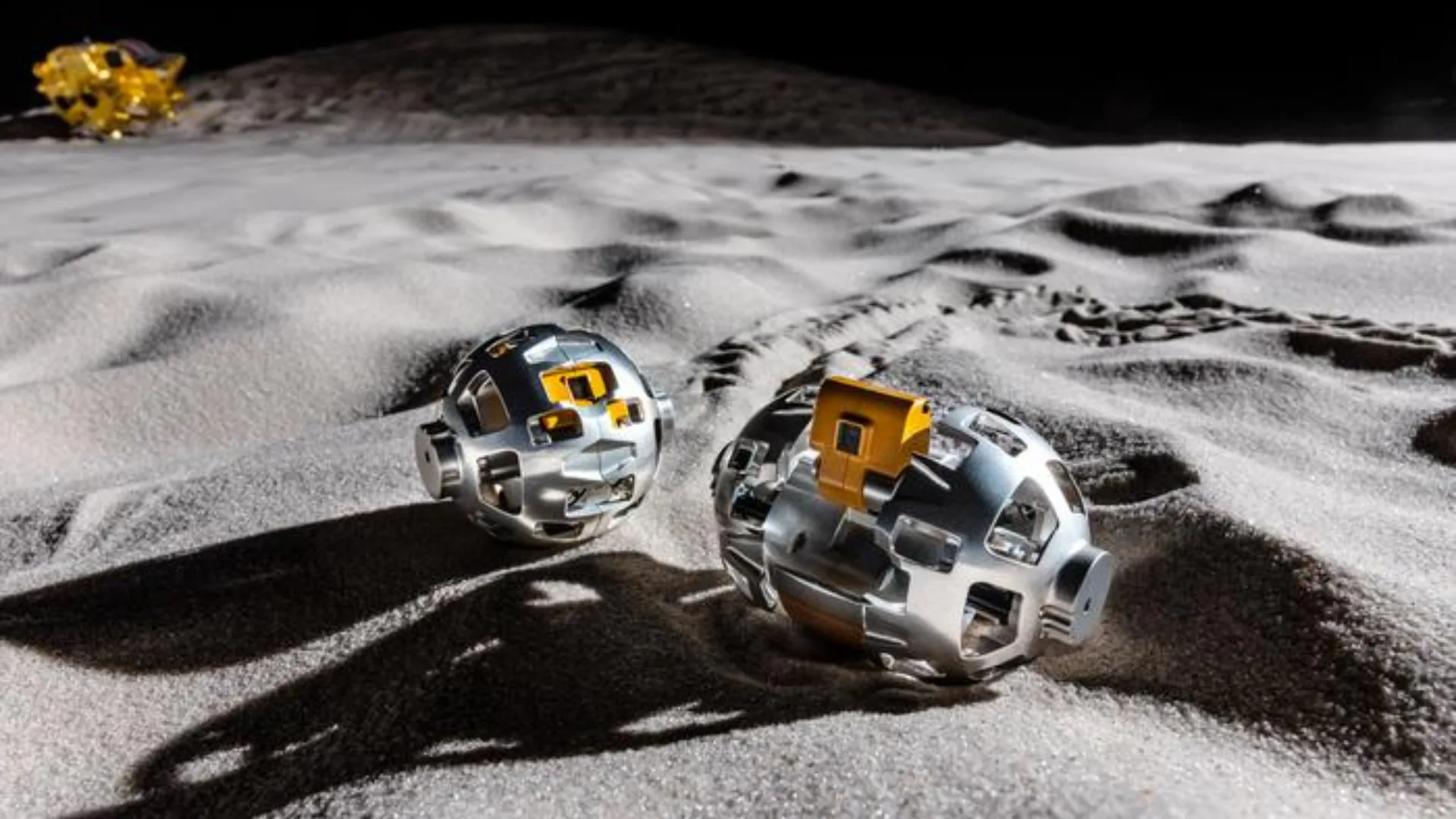
The SORA-Q lunar rover navigated the surface without any real-time input from engineers on the ground. It used its onboard camera feed to detect and route around obstacles — craters, rocks, uneven regolith — entirely on its own. That kind of autonomous decision-making, packed into a robot the size of a baseball, is the headline achievement here. The full motion sequence, from deployment off the lander to driving manoeuvres, has been documented and published by the team led by JAXA’s Daichi Hirano.
How a Toy Company Helped Engineer a Moon Robot
The SORA-Q lunar rover was a genuinely unusual collaboration. JAXA brought the mission architecture and systems engineering; Sony contributed imaging technology; Doshisha University added academic robotics expertise. And then there’s Takara-TOMY — the Japanese toy company that co-owns the Transformers franchise alongside Hasbro.
That last name raises eyebrows, but it makes perfect sense once you understand the mechanical problem JAXA was trying to solve. A rover that launches and lands as a smooth sphere is far easier to protect from the vibrations and shocks of spaceflight than one with exposed wheels and appendages. But a sphere doesn’t drive well. Takara-TOMY’s engineers — who spend their working lives figuring out how to make toy robots fold and unfold reliably — applied that exact knowledge to the SORA-Q lunar rover‘s transformation mechanism.
The process works like this: SORA-Q starts as a compact sphere, roughly 8 centimetres across. On activation, it splits along the equator and extends outward, turning its two hemisphere halves into drive wheels. A camera module flips up into position between the wheels, and a small tail deploys at the rear to keep the rover stable during movement. The whole thing happens without any active guidance from Earth. It’s a genuinely clever piece of miniaturised engineering, and it’s hard not to appreciate that some of the intellectual foundation came from decades of designing Optimus Prime toys.
The Case for Tiny, Autonomous Lunar Robots
Why go small? The answer is cost and access. Large rovers — think NASA’s Perseverance on Mars, which weighs about 1,025 kilograms — demand enormous launch capacity, complex landing systems, and significant mission budgets. They’re also physically unable to squeeze into tight geological features like lava tubes, narrow crevasses, or the shadowed interiors of small craters. A palm-sized robot like the SORA-Q lunar rover sidesteps all of that.
Hirano and his colleagues are candid about the trade-offs. You simply can’t fit the same scientific instrumentation into an 8cm sphere that you can into a 1,000kg rover. That’s why the two-robot approach matters. LEV-1 and SORA-Q each covered different functions — mobility and imaging for SORA-Q, data relay and its own sensor suite for LEV-1 — creating a system whose combined capability exceeded either robot individually. It’s a model that maps well onto how engineers are increasingly thinking about satellite constellations and drone swarms: distributed, redundant, and collectively capable of more than any single unit.
As Hirano’s team wrote in their Science Robotics paper: ‘Although the capabilities of an individual small rover are inherently limited, the results highlight the potential of such platforms … as independent explorers, capable of accessing environments beyond the reach of a primary large spacecraft.’ That’s a pointed argument for rethinking how planetary exploration missions are structured — and it’s one that NASA, ESA, and commercial players like Astrobotic are likely paying attention to.
When the Signal Went Silent
The mission wasn’t without its frustrations. Communications with both rovers dropped out after approximately 100 minutes of surface operations — somewhere between 20 and 30 minutes before the SORA-Q lunar rover was expected to reach the end of its operational life anyway. Hirano’s team believes the cause was most likely either mechanical damage to LEV-1 caused by the physical stress of its hopping locomotion, or a straightforward battery failure. Either way, LEV-1’s role as the data relay was broken, and with it went the communication chain back to Earth.
It’s a reminder that miniaturisation brings fragility. The hopping mechanism that gives LEV-1 its mobility advantage on rough terrain is also the component that may have caused its early demise. For future missions using this architecture, engineers will need to think hard about how to harden relay nodes against their own operational stresses — or build in redundancy at the relay layer itself.
What Comes Next for Small Moon Rovers
The SORA-Q lunar rover mission, despite its brevity, adds a meaningful data point to the growing body of evidence that small autonomous robots can do real science in space. The Artemis programme has reignited serious interest in sustained lunar surface operations, and the question of how to explore efficiently — without sending a billion-dollar rover every time — is increasingly urgent.
Several directions look promising from here. Swarms of coordinated micro-rovers, each specialising in a narrow task, could collectively map terrain, collect samples, or monitor environmental conditions in ways a single large platform can’t match. Advances in edge AI are making genuine onboard autonomy — the kind the SORA-Q lunar rover demonstrated — more achievable in smaller and lower-power packages every year. And the fact that a toy company’s mechanical ingenuity played a meaningful role in a serious space mission is a useful nudge to an industry that can sometimes be too insular about where good ideas come from.
SLIM itself made history as Japan’s first successful soft lunar landing. SORA-Q made history as the smallest transforming robot to operate on another world. Neither record is likely to stand for long — which is precisely the point.
Frequently Asked Questions
What is the SORA-Q lunar rover and how does it transform?
The SORA-Q lunar rover is an 8cm spherical robot that reshapes itself into a cylinder for driving, using its two hemisphere halves as wheels. A camera flips up between the wheels and a tail deploys as a rear stabiliser, allowing it to move across the lunar surface and capture colour images.
Who built SORA-Q, and why was a toy company involved?
SORA-Q was jointly developed by JAXA, Sony, Doshisha University, and Takara-TOMY. The toy firm co-owns the Transformers brand with Hasbro, and its engineers applied expertise from designing transforming toy figures to give SORA-Q its shape-shifting mechanism.
Why did SORA-Q’s mission end early?
Communications with both rovers stopped around 100 minutes into surface operations, about 20–30 minutes short of SORA-Q’s expected lifespan. JAXA’s Daichi Hirano attributes this to either physical damage sustained by LEV-1 during its hopping motion, or the depletion of LEV-1’s battery, cutting the data relay link.
Where exactly did SLIM and SORA-Q land on the moon?
SLIM touched down near Shioli crater — about 270 metres wide — located inside the much larger Cyrillus crater (roughly 98 kilometres across) in the Mare Nectaris region on the lunar nearside.