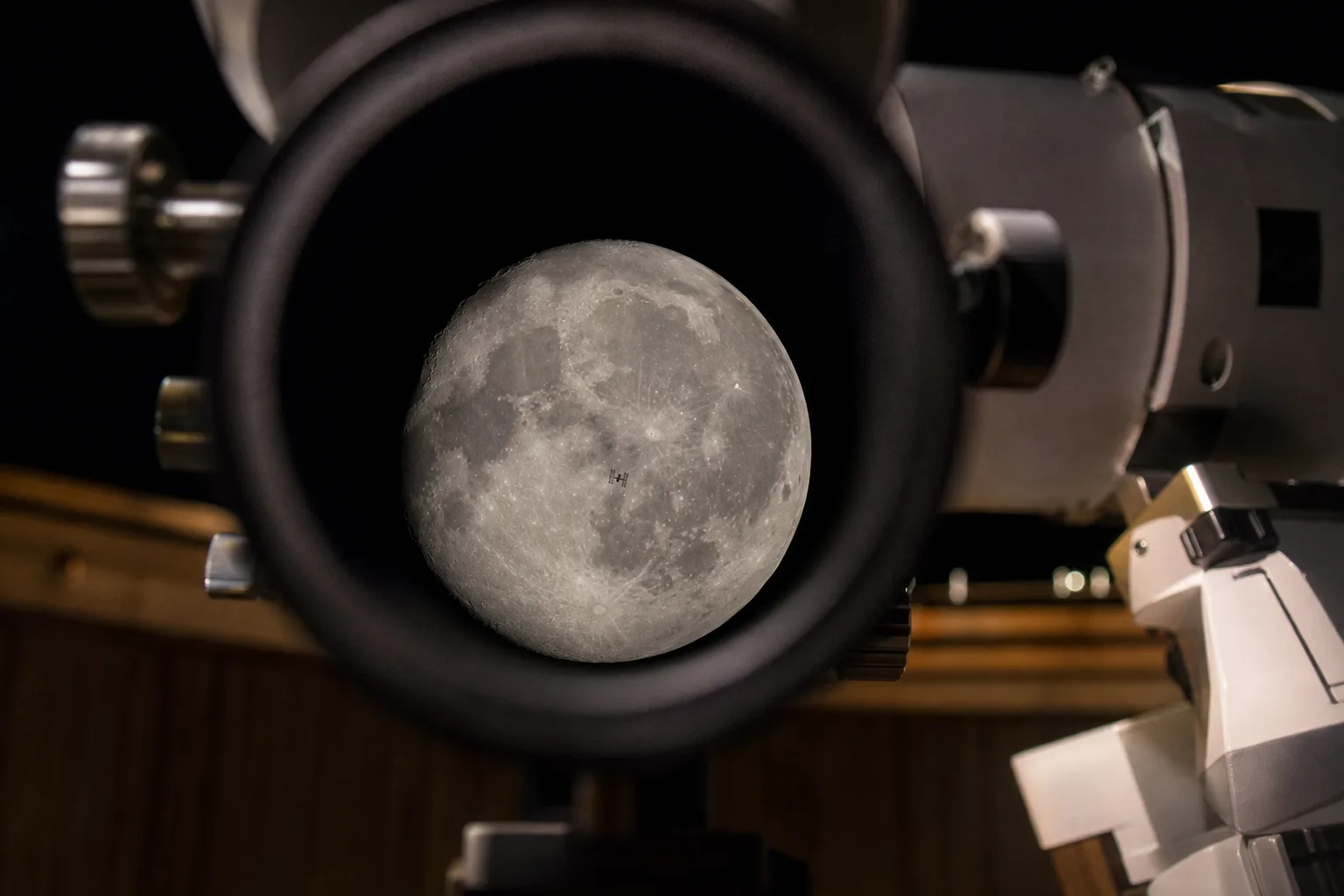
On the night of May 29, with a Blue Moon just one day away, the Tiangong space station briefly photobombed the moon — and an astrophotographer in Puerto Rico was ready for it. What Efrain Morales captured is the kind of footage that makes you stop and actually think about the extraordinary machinery humanity has put into orbit: a Chinese orbital outpost, carrying three taikonauts, silently crossing the face of the moon in less than a heartbeat.
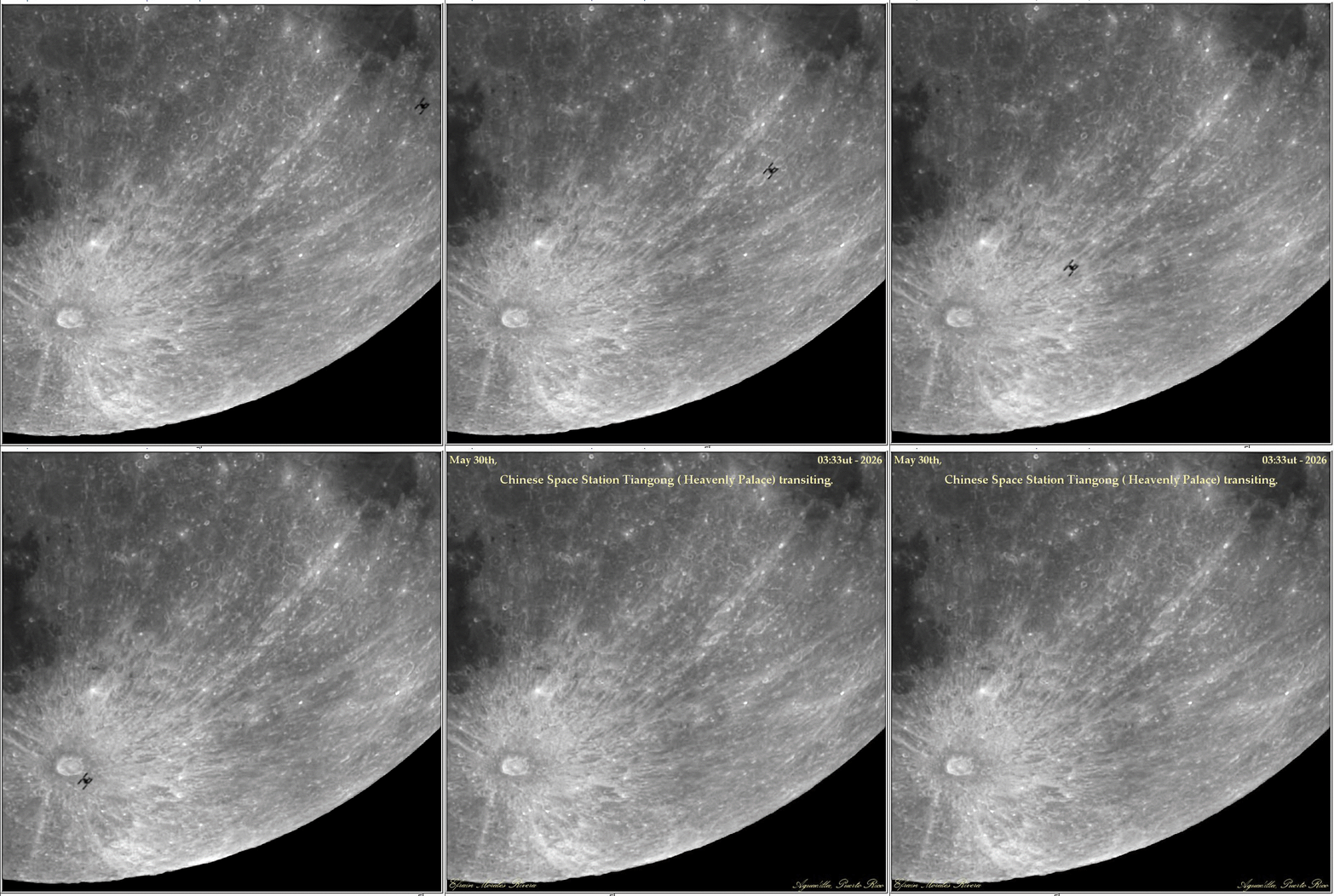
- The Tiangong space station was filmed crossing the moon’s face on May 29 in a sub-second transit event.
- Astrophotographer Efrain Morales captured the Tiangong space station silhouette using a 12-inch telescope from Puerto Rico.
- China’s Shenzhou 23 crew of three taikonauts had launched to the station just five days before the footage was taken.
- Catching a lunar transit requires precise timing tools like ISS Transit Finder and last-minute position corrections.
Table of Contents
A Sub-Second Shot That Took Hours to Plan
Morales recorded the transit at 11:33 p.m. EDT on May 29 using a 12-inch telescope paired with a dedicated astronomy camera. The footage shows the distinct silhouette of the Tiangong space station — solar panels and habitable modules clearly outlined — sliding across the lunar disk and appearing to dive directly toward Tycho Crater, one of the moon’s most recognisable features. Tycho’s impact basin spans 53 miles (85 kilometres) and radiates bright ejecta rays across the southern lunar surface, making it a spectacular backdrop for what amounted to a fraction of a second of actual transit time.
That’s the brutal reality of this kind of astrophotography. The Tiangong space station isn’t hanging up there waiting to be photographed. It’s travelling at roughly 17,000 mph in low Earth orbit, which means the window to catch it crossing the moon is measured not in seconds but in fractions of one. As Morales put it in a message to Space.com: ‘It is a challenge in less than a second to capture this event. Using a program the ISS Transit Finder helps in giving information to capture the space station. Adjusting the FOV and at times calculating last minute deviations in time and positions in which makes it more challenging.’
For context: ISS Transit Finder — which works for Tiangong transits too — is the same tool used by thousands of amateur astronomers worldwide to predict exactly when and where a space station will cross the face of the moon or sun from a specific geographic location. The math is complex, but the tool makes it accessible. What it can’t fully account for are the small, real-time deviations in the station’s orbit that force photographers to make last-minute corrections on the fly. There’s no second chance once the moment passes.
What the Tiangong Space Station Actually Is
It’s easy to forget, amid the daily noise of SpaceX launches and NASA announcements, that China has built and operates a fully functional space station entirely on its own. The Tiangong space station — the name translates from Mandarin as ‘Heavenly Palace’ — is a modular outpost assembled in orbit over the past few years. Its core is the Tianhe module, which handles propulsion, power management, and crew living quarters. Two science laboratories, Mengtian and Wentian, extend from the core, providing research space and additional systems capacity.
It orbits between 217 and 280 miles (340 to 450 km) above Earth, overlapping broadly with the altitude band used by the International Space Station. The comparison is worth sitting with for a moment: when the ISS programme eventually winds down — currently expected sometime around 2030 — the Tiangong space station may be the only continuously crewed orbital outpost on the planet. That’s a significant geopolitical and scientific reality, regardless of how one feels about the broader US-China tech and space rivalry.
Shenzhou 23: The Crew Behind the Silhouette
The three people aboard the Tiangong space station when Morales filmed it had only arrived five days earlier. The Shenzhou 23 mission launched on May 24 atop a Long March 2F rocket — a vehicle standing 203 feet (62 metres) tall — carrying commander Zhu Yangzhu, pilot Zhang Zhiyuan, and payload specialist Lai Ka-ying. They’re there to conduct scientific experiments, maintain the station’s systems, and continue China’s steady cadence of crewed missions, which has been remarkably consistent since the station’s first habitation began in 2021.
That consistency is part of what makes China’s space programme such a serious story. There’s no drama, no near-misses, no public spectacle. Missions launch, crews rotate, science gets done. It’s the kind of operational maturity that takes decades to build, and China has done it faster than most Western analysts expected. The Tiangong space station isn’t a prototype or a demonstration — it’s a working laboratory with a permanent crew schedule.
The Moon as Backdrop: What Morales’s Footage Actually Shows
Beyond the spectacle of catching the Tiangong space station in transit, the footage Morales captured is a genuinely useful reminder of the lunar geography that will matter enormously over the next decade. Tycho Crater — the apparent destination of the station’s silhouette in the clip — sits in the southern lunar highlands and is one of the youngest large craters on the near side, formed roughly 108 million years ago. Its bright ray system makes it visible to the naked eye even from Earth.
Also visible in the footage are Mare Nubium (the Sea of Clouds) and Mare Nectaris (the Sea of Nectar), the dark basaltic plains formed by ancient lava flows that cooled and hardened billions of years ago. These ‘seas’ are actually vast solidified lava fields, relics of a geologically active moon that no longer exists. They appear dark against the brighter highlands precisely because basalt absorbs more light than the highland anorthosite rock.
Why Amateur Footage Like This Matters
There’s a tendency to dismiss amateur astrophotography as a hobby-tier pursuit compared to what professional observatories produce. But footage like Morales’s serves a purpose that no space agency press release can replicate: it makes orbital infrastructure viscerally real for ordinary people. Seeing the Tiangong space station — a structure China assembled in orbit over several years — cross the face of the moon from a backyard in Puerto Rico collapses the abstract into something immediate and tangible.
The equipment required has also come down dramatically in price and complexity over the past decade. A 12-inch telescope paired with a planetary camera and free transit-prediction software is now a realistic setup for a dedicated enthusiast. The barrier isn’t gear anymore — it’s the willingness to do the planning, accept the margin for error, and be outside with everything aligned at 11:33 on a weeknight.
As more countries and commercial operators put hardware into low Earth orbit — from SpaceX’s Starlink constellation to the planned commercial stations from Axiom Space and others — opportunities for exactly this kind of transit photography are only going to increase. The sky is getting busier. Whether that’s entirely a good thing is a separate debate. But for photographers like Morales, every new object in orbit is another potential subject — and occasionally, one lines up perfectly with the moon.