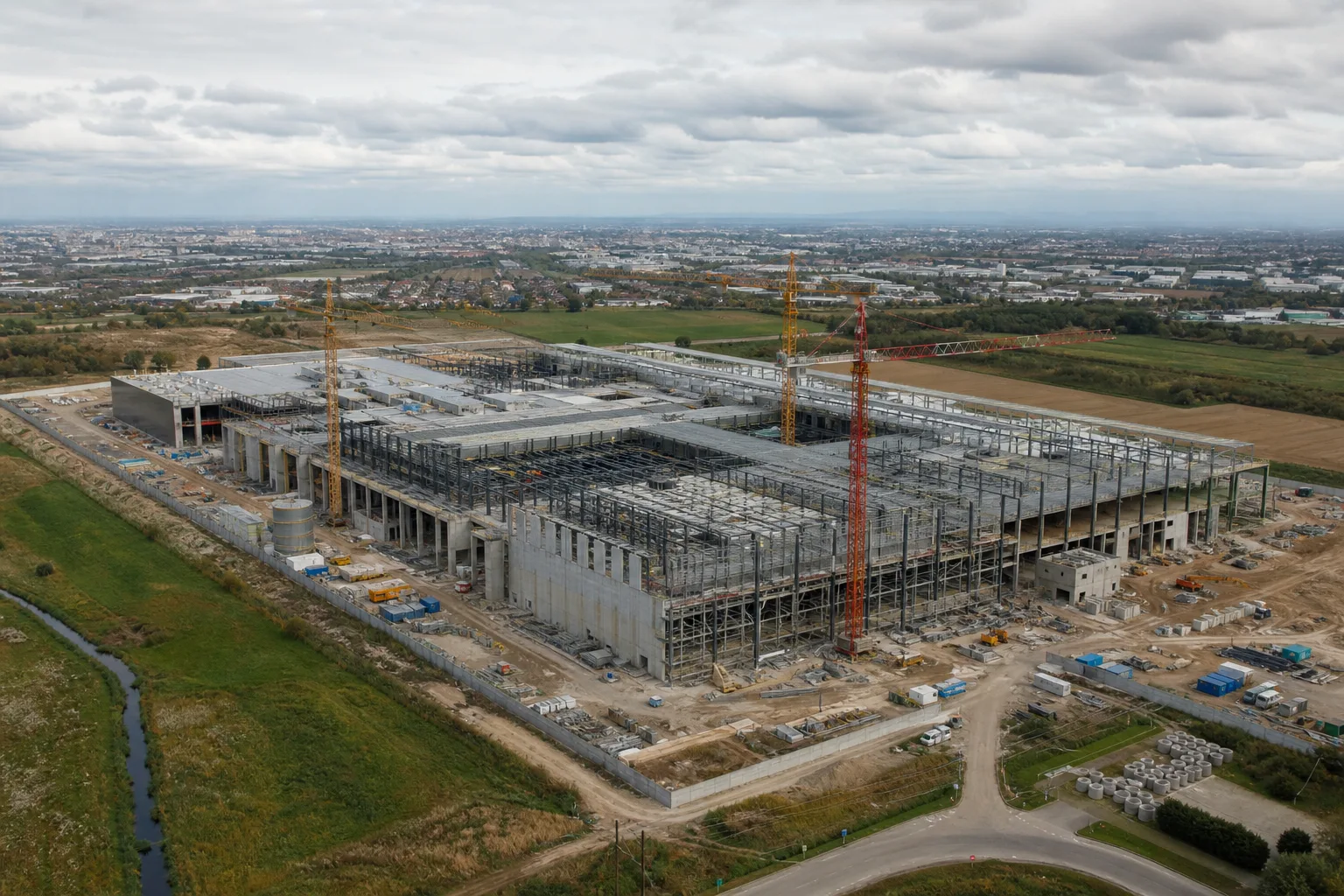
- Exyte has secured three AI data center projects near Frankfurt, safeguarding around 400 jobs in Germany.
- The AI data center projects reflect surging European demand for infrastructure capable of supporting large-scale machine learning workloads.
- Frankfurt is fast becoming one of Europe’s most important hubs for hyperscale and AI-ready data center capacity.
- The wins reinforce Exyte’s growing position in the specialist construction market for high-performance computing facilities.
Table of Contents
Exyte Lands Three AI Data Center Projects as Frankfurt Cements Its Place on the Map
AI data center projects are landing thick and fast across Europe right now, and Germany is increasingly at the centre of that wave. Stuttgart-based engineering and construction specialist Exyte has confirmed it has secured three new data center contracts in the Frankfurt region — developments that will sustain roughly 400 jobs across its German workforce. The announcement is a telling signal of just how quickly the AI infrastructure buildout is reshaping the construction industry, not just the tech sector.
Exyte isn’t a household name outside specialist engineering circles, but it’s exactly the kind of company that makes the AI boom physically possible. The firm focuses on high-technology facilities — cleanrooms, semiconductor fabs, and increasingly, data centers engineered to handle the brutal power and cooling demands of modern AI workloads. Winning three AI data center projects in one cluster near Frankfurt suggests the pipeline is genuinely substantial, not just a one-off deal.
Why Frankfurt, and Why Now?
Frankfurt’s dominance in European data center real estate isn’t accidental. The city sits at the junction of Europe’s most densely interconnected internet exchanges, most notably DE-CIX, which consistently ranks as one of the world’s busiest internet exchange points by traffic volume. That connectivity advantage, combined with Germany’s political stability and relatively predictable regulatory framework, has made the Rhine-Main region a default choice for companies that need to put serious compute capacity in Europe.
The AI-specific pressure on this market is relatively new, though. Until a few years ago, most Frankfurt-area data center demand came from financial services firms, cloud storage providers, and enterprise IT operations. The workloads were important but not especially exotic. AI inference and training are a different animal entirely — they demand far higher power densities per rack, more sophisticated cooling architectures, and facilities engineered from the ground up rather than retrofitted from older stock. That’s where firms like Exyte come in, delivering AI data center projects built to specification from day one.
Across Europe, the gap between available AI-ready capacity and actual demand has been widening at an uncomfortable pace. Research from real estate advisory firms including CBRE and JLL has repeatedly flagged supply constraints as one of the defining infrastructure stories of the mid-2020s. Power grid limitations, planning delays, and the sheer complexity of building at this specification level mean that new capacity can’t simply be switched on overnight. Construction specialists with proven track records in high-spec facilities are, as a result, finding themselves with more work than they can comfortably take on.
What This Means for Germany’s Tech Economy
The jobs angle here deserves more attention than it typically gets in coverage of data center deals. When hyperscalers announce billion-euro investment commitments, the numbers tend to dominate headlines. But the actual employment impact flows through the supply chain — through engineering firms, construction contractors, specialist sub-contractors, and the ongoing operational staffing that follows.
Four hundred jobs isn’t a transformative number for a country the size of Germany, but it’s meaningful, particularly in skilled technical roles. Exyte’s workforce for AI data center projects like these spans structural and mechanical engineers, cleanroom and containment specialists, electrical systems designers, and project management professionals. These aren’t temporary labouring roles; they’re sustained positions tied to a multi-year construction cycle, with the downstream possibility of operational and maintenance work once facilities go live.
Germany has been navigating a difficult industrial moment — high energy costs, sluggish manufacturing output, and a broader debate about where the country’s economic future lies. Data center construction won’t solve any of that on its own. But it does represent one of the cleaner examples of private sector capital creating skilled employment in an area of genuine long-term growth. The German government’s broader push to position the country as a leading European AI hub gives that context an added layer of strategic relevance.
AI Infrastructure Demand Isn’t Slowing Down
It’s easy to look at the current wave of AI data center projects and wonder whether it can possibly be sustained. The capital being deployed is extraordinary. Microsoft, Google, Amazon, and Meta have each announced infrastructure investment programmes running into the tens of billions of dollars globally, with Europe capturing a meaningful share of that spend. Some analysts have raised questions about whether the monetisation of AI services will ultimately justify the infrastructure investment being made ahead of it.
But even the more sceptical forecasters tend to agree that the near-term demand picture is real. Inference workloads — the compute required to actually run AI models in production rather than just train them — are growing faster than most projections anticipated. Every time a company integrates an AI assistant, a recommendation engine, or an automated processing tool into a product, it adds to the persistent compute load that data centers have to carry. That load doesn’t go away.
For Exyte, the timing of these three Frankfurt-area wins puts it in a strong position. Building a reference portfolio of completed, operational AI data center projects is the most valuable thing a construction firm in this space can do right now. Clients commissioning facilities at this specification level want proof that the contractor has done it before — successfully, on time, and within the engineering tolerances that AI infrastructure demands. Three AI data center projects running in parallel near one of Europe’s busiest data center markets is a meaningful portfolio addition.
The Broader Picture for European AI Infrastructure
Frankfurt isn’t the only European market seeing this kind of activity. Dublin, Amsterdam, Madrid, and Warsaw are all absorbing significant data center investment, each with their own mix of connectivity advantages, land availability, and energy supply characteristics. But Frankfurt’s combination of network centrality and engineering talent makes it a particularly attractive anchor point for AI-specific builds.
What Exyte’s announcement reflects, more broadly, is that AI data center projects are no longer just about the technology companies commissioning these facilities. They’re becoming a major driver of activity in construction, engineering, energy supply, and specialist manufacturing. The picks-and-shovels layer of the AI economy is quietly becoming one of its most consequential parts — and the companies building the physical foundations of that economy are starting to feel it in their order books.