

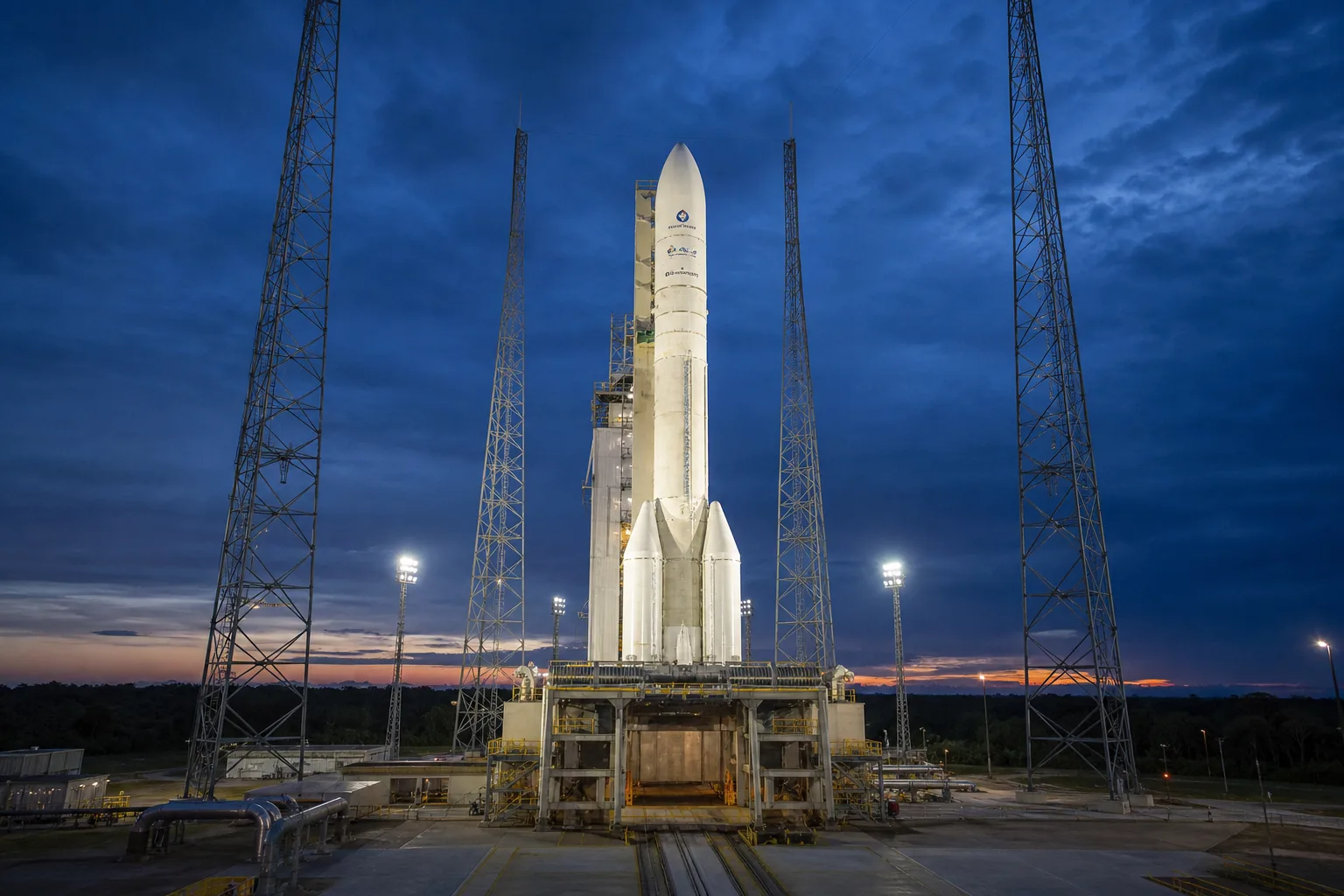
The Ariane 6 launch scheduled for Wednesday, June 17 isn’t just another entry in a launch manifest. It’s a genuine milestone — for Arianespace, for the Ariane 6 programme, and for Amazon’s ambitions in low Earth orbit. Lifting off from Europe’s Spaceport in Kourou, French Guiana during a 29-minute window opening at 7:53 a.m. EDT (1153 GMT), the rocket will carry 36 Amazon Leo broadband satellites — the heaviest payload an Ariane vehicle has ever been asked to haul into space.
- The Ariane 6 launch on June 17 carries 36 Amazon Leo satellites, the heaviest payload ever flown by an Ariane vehicle.
- This Ariane 6 launch marks the debut of the upgraded P160C solid rocket boosters, adding over two metric tons of LEO capacity.
- Amazon Leo — formerly Project Kuiper — is chasing a 3,200-satellite constellation to rival SpaceX’s Starlink, which already has 10,500+ spacecraft.
- Wednesday’s mission is the eighth overall Ariane 6 flight and the third dedicated to Amazon’s broadband megaconstellation.
Table of Contents
Why This Ariane 6 Launch Is Different
The previous two Ariane 6 launch missions dedicated to Amazon’s constellation each carried 32 satellites. Bumping that up to 36 doesn’t sound dramatic until you do the weight math. Based on Amazon’s own technical documentation — which puts 29 satellites at around 37,000 pounds (16,800 kg) — each spacecraft tips the scales at roughly 1,275 pounds (578 kg). Stack 36 of them together and you’re looking at approximately 45,900 pounds, or just over 20,800 kilograms, sitting on top of that rocket. Arianespace itself confirmed this in the mission’s press kit, calling it ‘the biggest stack configuration and heaviest payload ever launched by an Ariane launcher.’
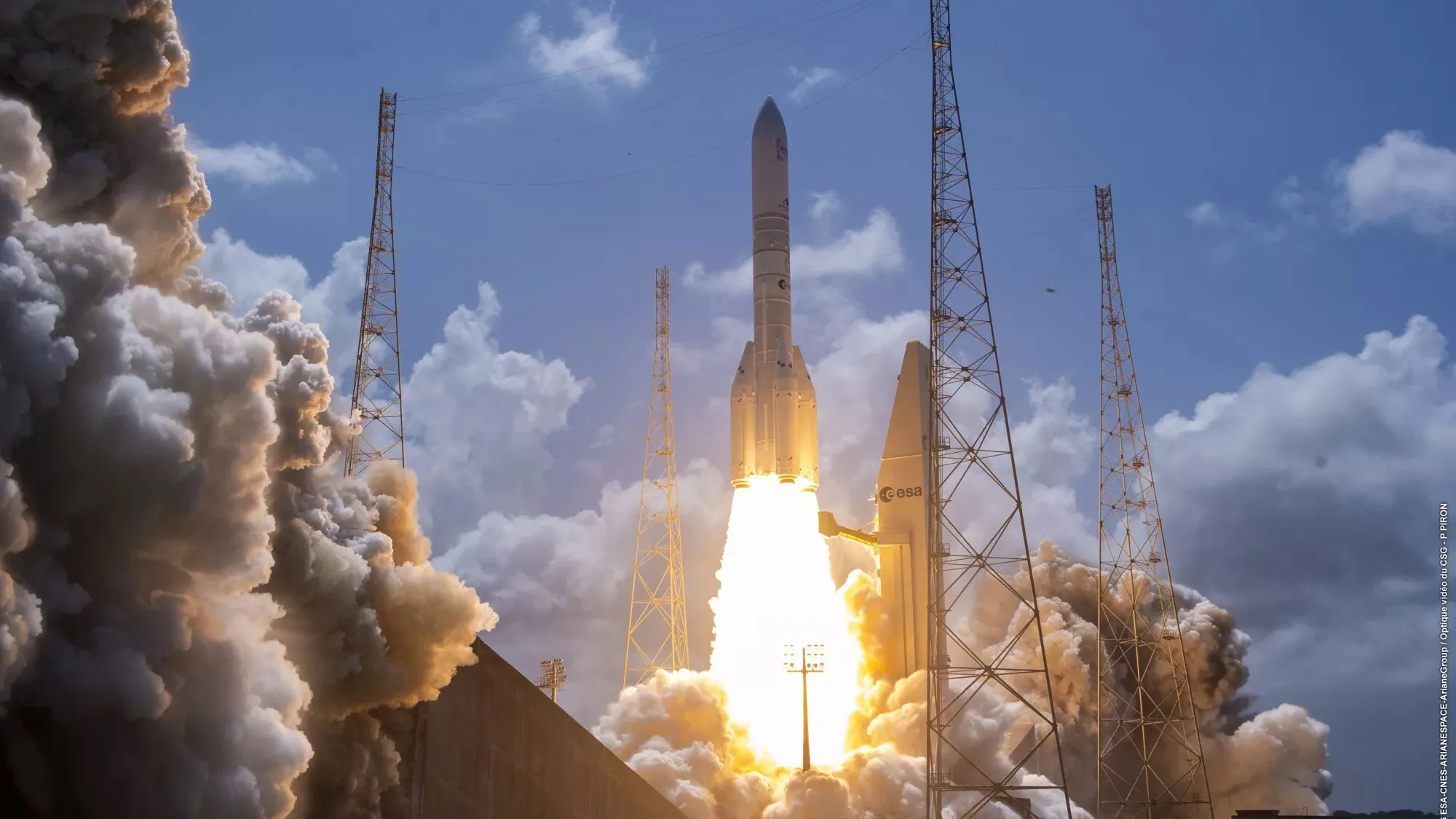
The rocket isn’t carrying that weight on stock hardware, either. Wednesday’s Ariane 6 launch marks the operational debut of the P160C — an upgraded variant of the solid-propellant strap-on boosters that flank Ariane 6’s core stage. Ariane 6 has flown with four solid rocket boosters before, but this particular configuration is new. According to Arianespace, the P160C upgrade pushes the rocket’s LEO payload capacity up by more than two metric tons — a meaningful jump that broadens the range of missions the vehicle can realistically compete for. That’s not a minor tweak; it’s the kind of performance headroom that makes the difference between landing a constellation contract and losing it to a competitor.
Amazon Leo’s Race to Catch Starlink
Amazon Leo — rebranded from its earlier working title, Project Kuiper — is the company’s bet on a future where broadband connectivity flows down from orbit rather than across ground-based cables and towers. The full constellation calls for more than 3,200 satellites spread across low Earth orbit, deployed over the course of more than 80 launches using a mix of launch providers. Wednesday’s Ariane 6 launch is the 14th Amazon Leo launch overall, counting the two prototype spacecraft that flew in October 2023.
That sounds like steady progress, but context matters enormously here. SpaceX’s Starlink already operates more than 10,500 spacecraft and is commercially live in dozens of countries. Amazon is chasing a moving target — and SpaceX keeps accelerating. Starlink’s fleet grows with almost every Falcon 9 launch, which SpaceX runs on a cadence that no other operator can currently match. Amazon’s answer is to use multiple launch providers in parallel: Arianespace’s Ariane 6, United Launch Alliance’s Vulcan Centaur, and SpaceX itself. That diversification strategy makes sense logistically, but it also reflects how high the stakes are. If one provider hits delays, the constellation build-out slips. This is a programme that can’t afford to wait.
A Rocket That Took Too Long to Arrive
It’s impossible to talk about an Ariane 6 launch without acknowledging the programme’s troubled history. The rocket was originally supposed to debut in 2020. It didn’t fly until July 2024 — a four-year delay that cost Europe’s launch industry dearly in terms of market share, customer confidence, and political goodwill. During those lost years, SpaceX’s Falcon 9 hoovered up the commercial launch business that Ariane 6 was designed to contest. The European Space Agency and Arianespace were left watching from the sidelines as the industry restructured around reusability — a design philosophy Ariane 6 was never built around.
The debut Ariane 6 launch itself was a mixed bag. Ariane 6 reached orbit and successfully deployed nine cubesats, but the upper stage failed to complete a final engine burn that would have enabled two experimental reentry capsules to come home as planned. Not a disaster, but not a clean sheet either. Since then, though, the programme has found its footing. All subsequent missions have been fully successful, and Wednesday’s Ariane 6 launch — the eighth overall — will be the most demanding test the rocket has faced in terms of raw payload mass.
What Happens After Liftoff
If everything runs on schedule, the Ariane 6 will separate from its payload at an altitude of around 289 miles (465 kilometres) above Earth. All 36 Amazon Leo satellites should be flying independently within one hour and 51 minutes of liftoff — a deployment sequence that requires the upper stage to perform multiple precisely timed separation events. Each satellite will then use its onboard propulsion to raise and adjust its orbit before slotting into the constellation’s operational pattern.
For Amazon, each successful Ariane 6 launch is a step toward the minimum viable constellation needed to begin commercial service. The company hasn’t confirmed exactly how many satellites that threshold requires, but industry analysts generally peg it in the hundreds. With 36 more heading up on Wednesday, and the P160C boosters now proving themselves, the cadence of future Ariane 6 Amazon Leo missions could accelerate — assuming the upgraded booster performs as advertised.
What This Means for European Launch Ambitions
Beyond the Amazon relationship, Wednesday’s Ariane 6 launch matters for Arianespace as a signal to the broader market. Europe’s launch capability has been in genuine jeopardy. Ariane 5 retired in 2023. The smaller Vega-C rocket remains grounded following a 2022 failure. Ariane 6 is essentially the only operational European launcher right now, and it needs to demonstrate not just reliability but genuine performance growth to stay relevant.
The P160C debut is part of that story. A rocket that can push more mass to orbit is a rocket that can chase bigger contracts — not just constellation deployments but heavier geostationary satellites, deep-space science missions, and government payloads that would otherwise default to SpaceX or ULA. Arianespace framed the upgrade in its press kit as expanding ‘the range of missions that Ariane 6 can serve,’ and while that’s obvious marketing language, it’s also accurate. The question now is whether Ariane 6 can build on this momentum fast enough to matter in a launch market that’s increasingly shaped by vertically integrated players who own both the rocket and the payload.
Wednesday’s mission represents something larger than a single Amazon contract fulfilled. It’s European rocketry trying to prove it still has a seat at the table — with the heaviest stack it’s ever attempted strapped to a new generation of boosters nobody has flown before. That’s a lot riding on a single Ariane 6 launch window of just 29 minutes.

