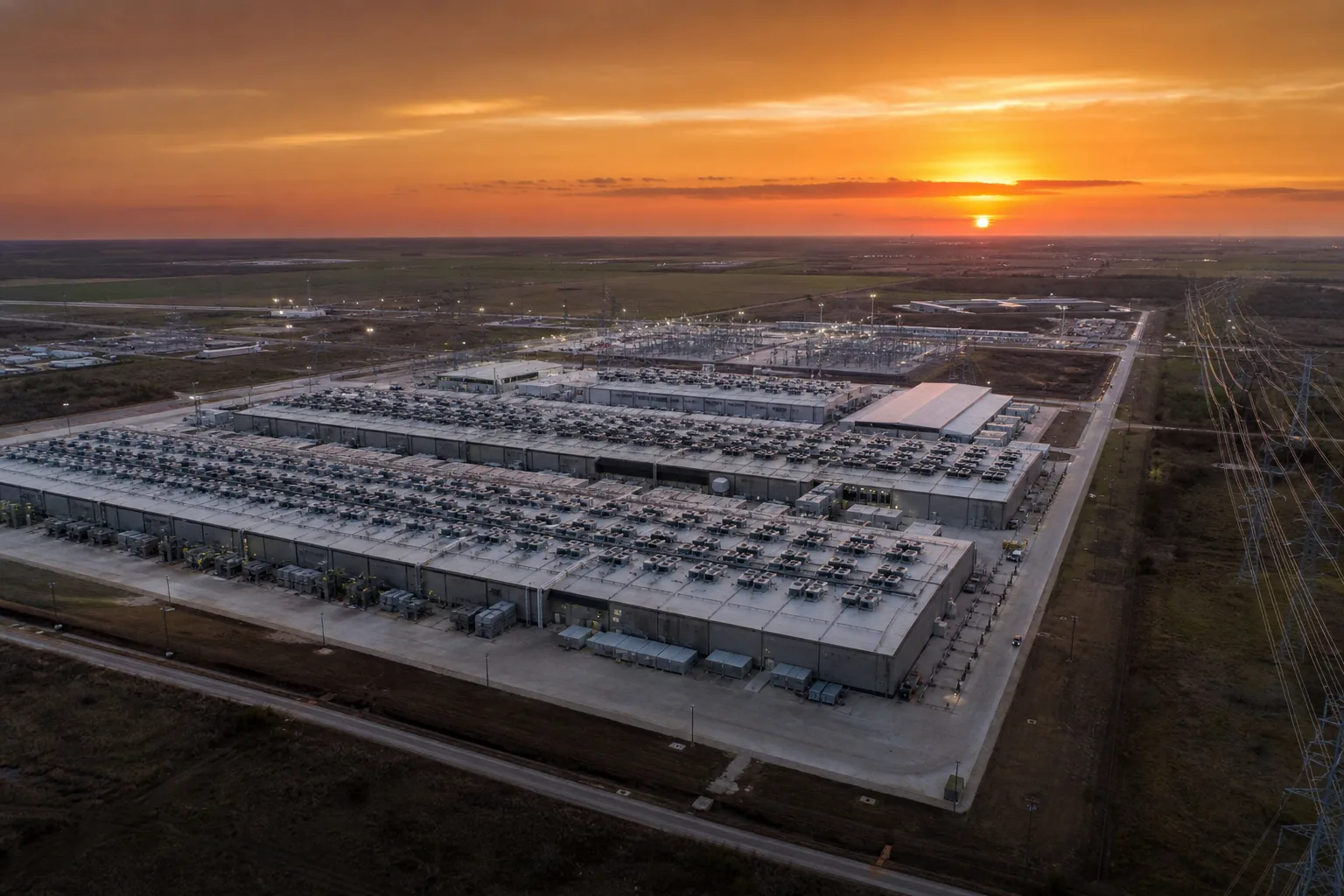
The Texas power grid is staring down one of the most dramatic demand surges in its history — and the entity responsible for keeping the lights on is now working on rules that could quietly hand a significant advantage to a group that’s spent years being treated as the grid’s problem child: bitcoin miners.
- The Texas power grid is under pressure as data centers now represent nearly 90% of the state’s 438 GW large-load demand pipeline.
- A new Texas power grid allocation framework could give bitcoin miners who’ve pivoted to data centers a major structural advantage.
- ERCOT is developing rules to prioritise flexible, interruptible loads — a model that crypto miners have practised for years.
- The policy shift signals how bitcoin mining infrastructure is quietly becoming the backbone of US AI and cloud computing capacity.
Table of Contents
438 GW and Counting: The Texas Power Grid’s Demand Crisis
The numbers from the Electric Reliability Council of Texas are difficult to wrap your head around. ERCOT says there’s currently around 438 gigawatts of large-load demand sitting in its interconnection queue — requests from companies wanting to hook up to the Texas power grid at industrial scale. To put that in context, ERCOT’s entire current installed generating capacity sits somewhere around 150 GW. The queue represents roughly three times what the grid can actually produce today.
And who’s driving that demand? Data centers. According to ERCOT, they account for close to 90% of that 438 GW pipeline. That’s not a typo. The AI infrastructure arms race — where Amazon, Microsoft, Google, and a constellation of startups are racing to build out GPU clusters and cloud capacity — has turned Texas into ground zero for America’s computing buildout. The state’s relatively cheap land, deregulated electricity market, and business-friendly regulatory environment make it a natural magnet. But the sheer scale of inbound demand is now threatening to outpace the grid’s ability to absorb it cleanly.
ERCOT and Texas policymakers know they can’t just say yes to everyone. So they’re building a framework to decide who gets power, when, and on what terms. That’s where things get interesting for the bitcoin mining industry.
Why Miners Are Suddenly Looking Like the Smart Money
For most of the past decade, bitcoin miners have had a complicated relationship with grid operators. They consume enormous amounts of electricity, they show up in large clusters, and at their worst they’ve been accused of straining local infrastructure in states like Kentucky and upstate New York. Texas welcomed them partly because the state’s grid design made them useful — miners could be paid to shut off during peak demand events, acting as a kind of giant, distributed demand-response buffer.
That dynamic shaped how the mining industry built itself. Companies like Riot Platforms and Marathon Digital Holdings didn’t just build mining facilities — they built sophisticated energy management operations. They hired power traders, signed complex interruptible load contracts, and developed real-time systems to dial consumption up or down based on grid signals and electricity prices. That operational discipline has historically been a financial tool. Now it’s becoming a policy asset.
The new Texas power grid allocation framework under development is reportedly designed to prioritise large loads that can demonstrate genuine flexibility — operations that will curtail their draw when the grid is stressed, rather than demanding a steady, uninterruptible supply 24/7. Hyperscale AI data centers, by contrast, are notoriously inflexible. A GPU cluster training a large language model can’t easily pause mid-run without wasting enormous amounts of compute and time. Those operators want firm, reliable power, full stop.
Bitcoin miners, almost by default, are the opposite. Curtailment is baked into their economics. A miner that goes offline for two hours during a heatwave loses some revenue but doesn’t lose a product, a customer, or a training run. That flexibility — which was once seen as a sign of operational instability — now maps almost perfectly onto what ERCOT wants from responsible large-load customers.
The Pivot: From Mining Rigs to Server Racks
What makes this story more layered is that many of the miners best positioned to benefit have already started transitioning their operations. The post-2022 bear market in crypto, combined with the April 2024 Bitcoin halving that cut block rewards in half, pushed a wave of mining companies to diversify. Several have announced plans — or are already executing — to repurpose portions of their facilities for high-performance computing and AI inference workloads.
Core Scientific, which emerged from bankruptcy in early 2024, is probably the most prominent example. The company struck a deal with CoreWeave, an AI cloud provider backed by Nvidia, to host GPU clusters across its data centers. Iris Energy has made similar moves. Even Riot Platforms, which has remained more committed to pure-play mining than most, has spoken publicly about the optionality its infrastructure provides for future HPC tenants.
These companies aren’t just slapping a new label on their operations. They’re investing in the power infrastructure, cooling systems, and network connectivity that AI compute workloads actually require. But they’re also carrying something their hyperscale competitors can’t easily replicate: years of experience managing large electrical loads on the Texas power grid, existing relationships with ERCOT, and demand-response agreements already in place.
If the new framework rewards exactly that kind of track record, miners-turned-data-center operators could find themselves moving closer to the front of an interconnection queue that currently stretches into the mid-2030s for many applicants.
The Texas Power Grid’s Bigger Balancing Act
None of this happens in a vacuum. Texas’s grid has faced genuine reliability scares in recent years — most infamously during Winter Storm Uri in February 2021, when a failure cascade left millions without power for days and killed hundreds of people. ERCOT has invested heavily in weatherisation and generation additions since then, but the incoming wall of data center demand is a different kind of challenge.
Generation is being added — Texas has been one of the fastest-growing states for both utility-scale solar and wind, and there’s a significant pipeline of natural gas peakers being built specifically to back up intermittent renewables. But transmission remains a bottleneck. Getting power from where it’s generated to where the data centers want to be built is a multi-year infrastructure problem, not a software patch.
The flexible-load framework is partly an acknowledgment of that reality. If ERCOT can’t guarantee firm power to every applicant in the queue, it makes sense to favour those who don’t need firm power every minute of every day. It’s a pragmatic solution to a structural constraint — and it happens to advantage exactly the operators who’ve spent years learning to live with interruption.
There are legitimate questions about whether this approach scales. Bitcoin miners represent a relatively small slice of total demand compared to what Amazon Web Services or Microsoft Azure would want for a major campus. And the AI industry is actively developing more flexible workloads — inference and certain training tasks can be time-shifted more easily than others — so the flexibility gap between miners and hyperscalers may narrow over time.
What Comes Next for the Texas Power Grid and Crypto Infrastructure
The details of ERCOT’s framework still need to be finalised, and Texas regulators at the Public Utility Commission will have a say in shaping the final rules. But the direction of travel is clear: the Texas power grid is moving toward a model that prices flexibility as a feature, not just as a nice-to-have.
For bitcoin mining companies that have spent the last two years justifying their existence to investors, grid operators, and local communities, that’s a meaningful shift in the narrative. They’re no longer being framed purely as energy hogs or speculative operations. They’re being recognised as a specific kind of grid-compatible industrial load — one that, somewhat unexpectedly, might be exactly what the AI infrastructure build-out needs as a flexible, distributed counterweight to the relentless, uninterruptible demands of modern GPU clusters.
The irony isn’t lost on anyone paying attention. An industry that grew up on the margins of the financial system, frequently accused of wasting energy, is now being courted as a responsible grid citizen in the state that hosts more electricity demand growth than almost anywhere else in the country. Whether miners can fully capitalise on that moment — by securing long-term grid access, attracting AI tenants, and surviving the brutal economics of post-halving bitcoin — is still an open question. But for the first time in a while, the Texas power grid policy environment looks like it’s moving in their direction.
Frequently Asked Questions
Why is the Texas power grid so attractive for bitcoin miners and data centers?
Texas operates a deregulated electricity market through ERCOT, which gives large consumers more flexibility to negotiate contracts and curtail usage during peak demand. This makes it financially viable for energy-hungry operations like bitcoin mining and AI data centers to set up at scale.
What does the new Texas power grid allocation framework actually change?
The framework is designed to prioritise large loads that can flex their consumption — reducing draw when the grid is stressed. Operators who agree to curtail during peak periods would get faster or preferential grid access, rewarding the kind of demand flexibility that bitcoin miners have long built into their business models.
How much power demand do data centers represent on the Texas grid?
According to ERCOT, data centers account for nearly 90% of the 438 GW of large-load demand in the Texas interconnection queue — a figure that illustrates just how rapidly AI and computing infrastructure is straining the state’s electricity system.
Can bitcoin miners really compete with hyperscale AI data centers for grid access?
In some ways, yes. Miners already operate with interruptible load agreements and sophisticated energy management systems. That operational DNA makes them credible flexible-load partners for grid operators, even as they compete against well-capitalised hyperscalers for the same electrons.