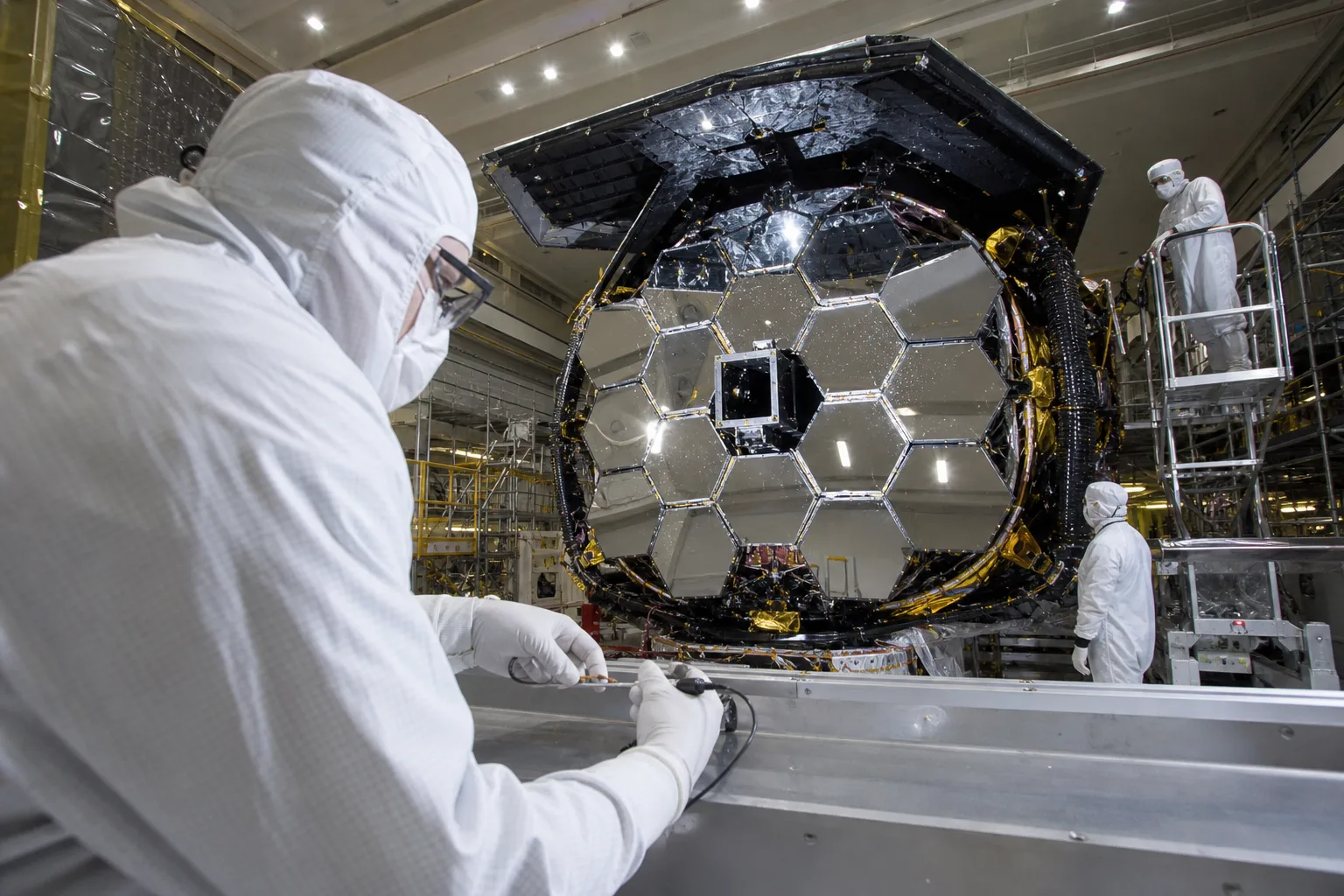
NASA’s Roman Space Telescope has landed in Florida, and the clock is now officially ticking toward one of the most significant astronomy launches in years. The spacecraft arrived at Kennedy Space Center on June 21, making its way down from NASA’s Goddard Space Flight Center in Greenbelt, Maryland, aboard the agency’s Pegasus barge. The destination: a SpaceX Falcon Heavy rocket, a summer launch window, and ultimately a front-row seat to the deepest mysteries of the universe.
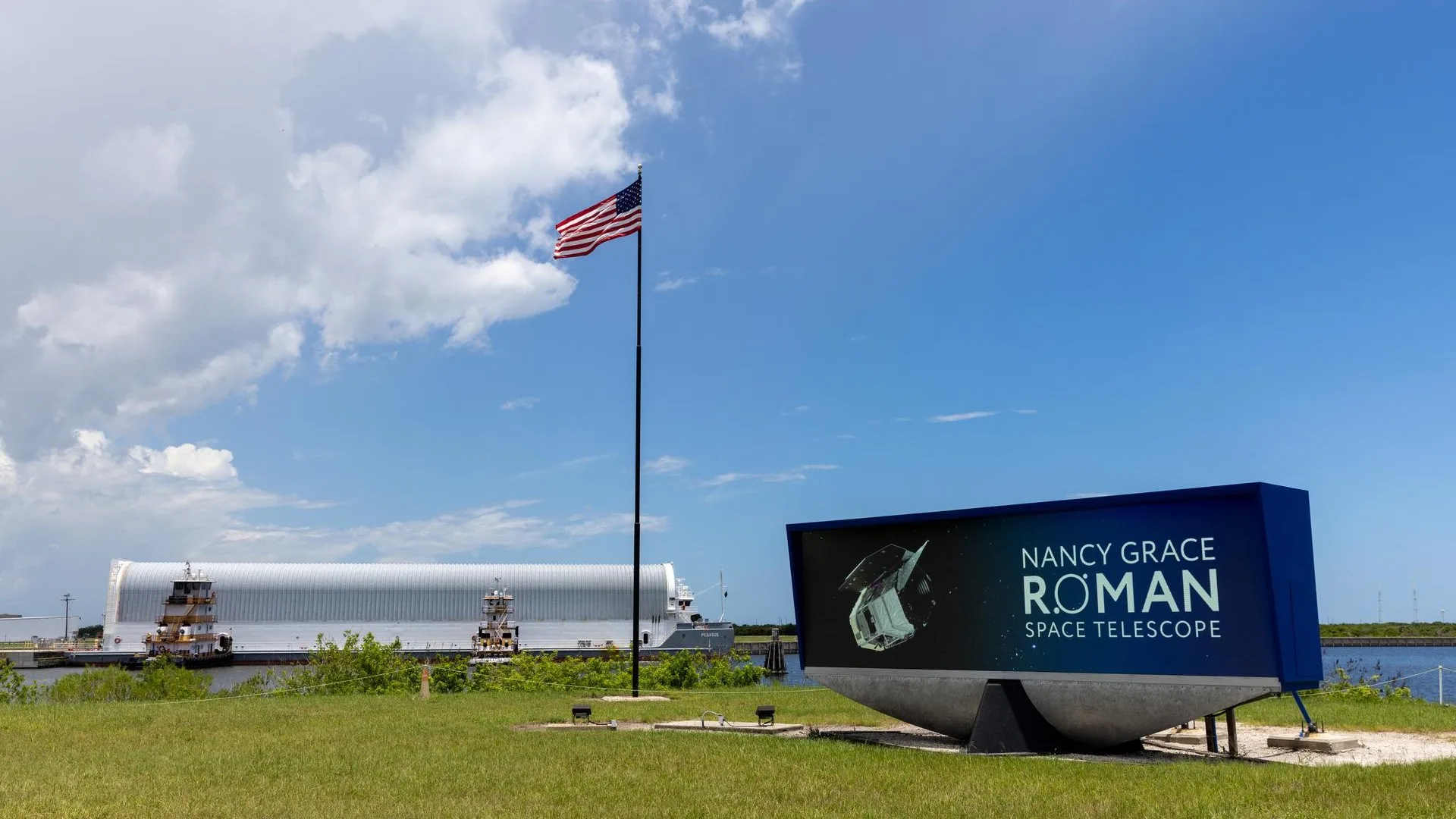
- The Roman Space Telescope arrived at Kennedy Space Center in Florida on June 21, eight weeks ahead of its original schedule.
- NASA is targeting an August 30 launch for the Roman Space Telescope aboard a SpaceX Falcon Heavy rocket.
- Once operational at the L2 Lagrange point, the telescope will hunt dark energy and survey billions of galaxies.
- Roman carries a 300-megapixel camera and a 2.4-metre primary mirror, making it one of the most powerful survey instruments ever built.
Table of Contents
Roman Space Telescope’s Journey to the Launch Pad
Getting a spacecraft the size and sensitivity of the Roman Space Telescope from Goddard to Kennedy isn’t exactly a quick courier job. The telescope travelled by sea from Baltimore to Florida’s Space Coast inside a specialised, environmentally-controlled container designed to protect its optics and instruments from contamination during the voyage. Even a microscopic dust particle in the wrong place can compromise years of science.
Once ashore, the process didn’t get any simpler. Teams first conducted a decontamination and cleaning process on the outer container before opening it inside the Payload Hazardous Servicing Facility (PHSF) airlock — a multi-step protocol that reflects just how much is riding on this hardware. The roughly 18,000-pound (8,200-kilogram) spacecraft then moved into the PHSF’s high bay clean room for the final stretch of prelaunch preparations. NASA refers to Roman’s work platform inside that facility as ‘the Pantheon,’ which feels appropriately grand for a telescope in this league.
The PHSF itself recently underwent upgrades specifically to receive the Roman Space Telescope, which tells you something about where this mission sits in NASA’s current priorities. This isn’t a routine payload.
What Happens Before Launch Day
The summer weeks ahead are packed. Engineers need to run through a checklist of final checkouts that covers the telescope’s six solar panels, its insulation, and heat management components — all of which have to survive not just the violent physics of a Falcon Heavy ascent, but also a lifetime of operating in the thermal extremes of deep space.
One of the more striking tasks on the to-do list: loading approximately 290 gallons (about 1,100 litres) of hypergolic hydrazine propellant. That fuel will power Roman’s thrusters both during the journey to its operational orbit and throughout the station-keeping manoeuvres it’ll need to execute over the following decade or more. Hydrazine is the kind of propellant that demands serious handling protocols — it’s toxic, it ignites on contact with an oxidiser, and there’s no margin for error. That’s partly why the PHSF exists in the first place.
NASA is currently targeting August 30 as the launch date — notably eight weeks earlier than the original schedule. Getting ahead of schedule on a flagship science mission is genuinely rare, and it suggests the integration work at Goddard went smoothly. Whether the Falcon Heavy cooperates on the day is another matter entirely, but the programme team will take the headroom.
The Roman Space Telescope’s Destination: L2
Like the James Webb Space Telescope before it, Roman is headed for Sun-Earth Lagrange point 2 — L2 — a gravitationally stable region sitting about one million miles (1.6 million kilometres) from Earth on the night side, directly opposite the Sun. At L2, the gravitational pulls of the Earth and Sun roughly balance, allowing spacecraft to maintain their position without continuously burning propellant. It’s the ideal parking spot for observatories that need a stable, cold, unobstructed view of deep space.
Webb has already demonstrated how transformative L2 can be as a vantage point. Roman will join it there, though the two telescopes serve meaningfully different purposes. Where Webb is a deep-field specialist, peering at individual objects in extraordinary detail, Roman is built for breadth — a wide-field surveyor designed to map the sky at a scale that Webb simply wasn’t designed for.
Why This Mission Matters: Dark Energy and the Big Picture
The Roman Space Telescope’s primary scientific mission centres on one of the most profound unsolved problems in physics: dark energy. This mysterious force — which astronomers infer from the observed fact that the universe’s expansion is accelerating, not slowing down — makes up an estimated 68% of the universe’s total energy content. We can’t see it, touch it, or directly measure it. We only know it exists because of what it does to everything else.
Roman is designed to map that influence at scale. Using its 7.9-foot (2.4-metre) primary mirror paired with a 300-megapixel Wide Field Instrument, the telescope will survey billions of galaxies, catalogue hundreds of thousands of new exoplanets, identify hundreds of black holes, and generate what NASA describes as ‘vast volumes of daily data for astronomers to study.’ That last part is not an exaggeration — Roman’s data output is expected to rival or exceed that of ground-based sky surveys, all from a platform that doesn’t have to contend with Earth’s atmosphere.
The 300-megapixel figure deserves some context. Hubble’s Wide Field Camera 3, one of its most capable instruments, captures images at around 16 megapixels. Roman’s field of view is roughly 100 times larger than Hubble’s infrared camera. That’s not a modest upgrade — it’s a completely different class of instrument, suited to an entirely different mode of scientific inquiry.
Roman also carries a coronograph — an instrument capable of blocking out a star’s light to reveal the much fainter objects orbiting around it. That opens a direct imaging pathway for exoplanet research that complements the statistical survey work the Wide Field Instrument will conduct.
Where Roman Fits in the Telescope Lineage
NASA’s history of flagship space observatories is a short but remarkable list: Hubble, Chandra, Spitzer, and now Webb. Each one fundamentally changed what astronomy could do. Hubble gave us the deep field images and the first real measurements of the universe’s expansion rate. Chandra revealed the X-ray universe in stunning clarity. Spitzer opened the infrared window before its mission ended in 2020. Webb has already rewritten our understanding of galaxy formation in the early universe.
The Roman Space Telescope enters this lineage with a different mandate — not to look deeper, but to look wider. Its science case is built around statistics and scale: the kind of large-sample surveys that reveal patterns invisible in individual observations. Studying dark energy requires measuring the positions, shapes, and distances of enormous numbers of galaxies across cosmic time. That’s exactly what Roman is built for.
The mission is planned for a minimum of five years, with NASA retaining the option to extend it as long as the hardware and fuel supply hold up. Given that Roman is carrying propellant designed to last ‘ten or more years,’ the odds of a long-running extended mission are reasonable — assuming everything goes well on August 30.
That’s the moment everything else is building toward. A Falcon Heavy — SpaceX’s workhorse heavy-lift rocket — will carry Roman off the pad at Kennedy Space Center, kick it onto a trajectory toward L2, and hand off one of NASA’s most ambitious science missions to the universe. After years of development, months of testing, and a cross-country sea voyage, the Roman Space Telescope is finally where it needs to be.
Frequently Asked Questions
What will the Roman Space Telescope study once it reaches orbit?
The Roman Space Telescope is primarily designed to investigate dark energy and the accelerating expansion of the universe. It will also catalogue billions of galaxies, hundreds of thousands of exoplanets, and hundreds of black holes, generating vast volumes of daily data for astronomers worldwide.
Where will the Roman Space Telescope be positioned in space?
Roman will orbit at Sun-Earth Lagrange point 2 (L2), roughly one million miles beyond Earth on the side opposite the Sun. This gravitationally stable region lets spacecraft maintain position without constantly burning fuel.
How does Roman’s camera compare to other space telescopes?
Roman carries a 300-megapixel camera combined with a 7.9-foot-wide primary mirror, enabling large-scale surveys of the sky. The source does not provide a direct field-of-view comparison to Hubble’s infrared camera or specific multipliers relative to Webb or Hubble.
How long is the Roman Space Telescope mission expected to last?
NASA has planned a minimum five-year science mission, but Roman carries enough hydrazine fuel — about 290 gallons — to last a decade or more. The agency can extend operations as long as the instruments remain functional and fuel holds out.