


Bitcoin holder selling by the market’s most seasoned investors has dropped to its lowest point in 19 months, and the timing couldn’t be more interesting. As on-chain data shows long-term holders stepping back from distribution, a cluster of halving cycle indicators is converging on September 2025 as a possible market bottom — a combination that’s drawing serious attention from analysts watching BTC’s next major move.
- Bitcoin holder selling by OG investors has dropped to a 19-month low, averaging just 962 BTC per day over 90 days.
- Bitcoin holder selling peaked at 3,860 BTC in May 2024 — the current reading signals a sharp retreat in distribution pressure.
- Halving cycle analysis places the 826-day post-halving marker on July 6, pointing to a potential bottom window in early September.
- Short-term holder capital has shrunk by 56% while long-term holder capital has barely budged, suggesting weak hands are exiting first.
Table of Contents
OG Bitcoin Holders Are Stepping Back From Selling
According to data from CryptoQuant, the 90-day moving average of Bitcoin spent by holders who acquired their coins more than five years ago has fallen to just 962 BTC — the lowest reading since November 2024. That’s a dramatic pullback from the peaks seen over the past two years. Bitcoin holder selling hit 3,860 BTC on a 90-day average basis in May 2024, followed by 3,200 BTC in February 2025, and 2,360 BTC in September 2025. Some individual sessions saw outflows that were staggering even by crypto standards — days recording 10,000, 30,000, and at one point 142,000 BTC changing hands from this cohort alone.
Crypto analyst Darkfost, who tracks this data closely, noted that the current cycle has produced the highest aggregate level of spending by long-term holders ever recorded. That context matters. This wasn’t passive HODLing through a bull run — these were investors who had held through multiple cycles, seen paper gains balloon, and decided to take profits at scale. The fact that Bitcoin holder selling has now dialed back so sharply is worth paying attention to.

What’s particularly telling is why Bitcoin holder selling may have slowed. Darkfost points out that the most expensive coins still held by this group were acquired at around $63,200 — which is close to where BTC has been trading recently. In other words, many of these holders are sitting near their cost basis, and they’re still not selling. That kind of behaviour, holding firm even when you’re barely in profit, typically reflects genuine conviction rather than tactical positioning.
Short-Term vs Long-Term: A Market Divided
The picture gets more interesting when you separate the market into its constituent parts. Researcher Axel Adler Jr. flagged a meaningful divergence between short-term and long-term Bitcoin holders that sheds light on where the real stress in the market is concentrated.
Bitcoin’s adjusted net unrealized profit/loss (aNUPL) has fallen to -0.14, down from near zero just a month ago. That shift means the average BTC holder has moved back into unrealized loss territory, with prices recently hovering around $62,500. It sounds grim — but the headline number masks a more important split.
‘STH capital has shrunk by -56%, while LTH capital has barely drawn down. Weak hands are capitulating. Strong hands have not even flinched.’ — Axel Adler Jr.
That framing is significant. Short-term holder capital — typically retail traders and newer entrants who bought closer to recent highs — has contracted sharply. Long-term holders, the same cohort whose Bitcoin holder selling data we’re watching, haven’t budged in any meaningful way. Adler Jr. also noted that the aNUPL metric has spent nearly half of the past three months in negative territory, indicating that the pressure is real but concentrated among newer participants rather than spreading into a broad, market-wide capitulation.
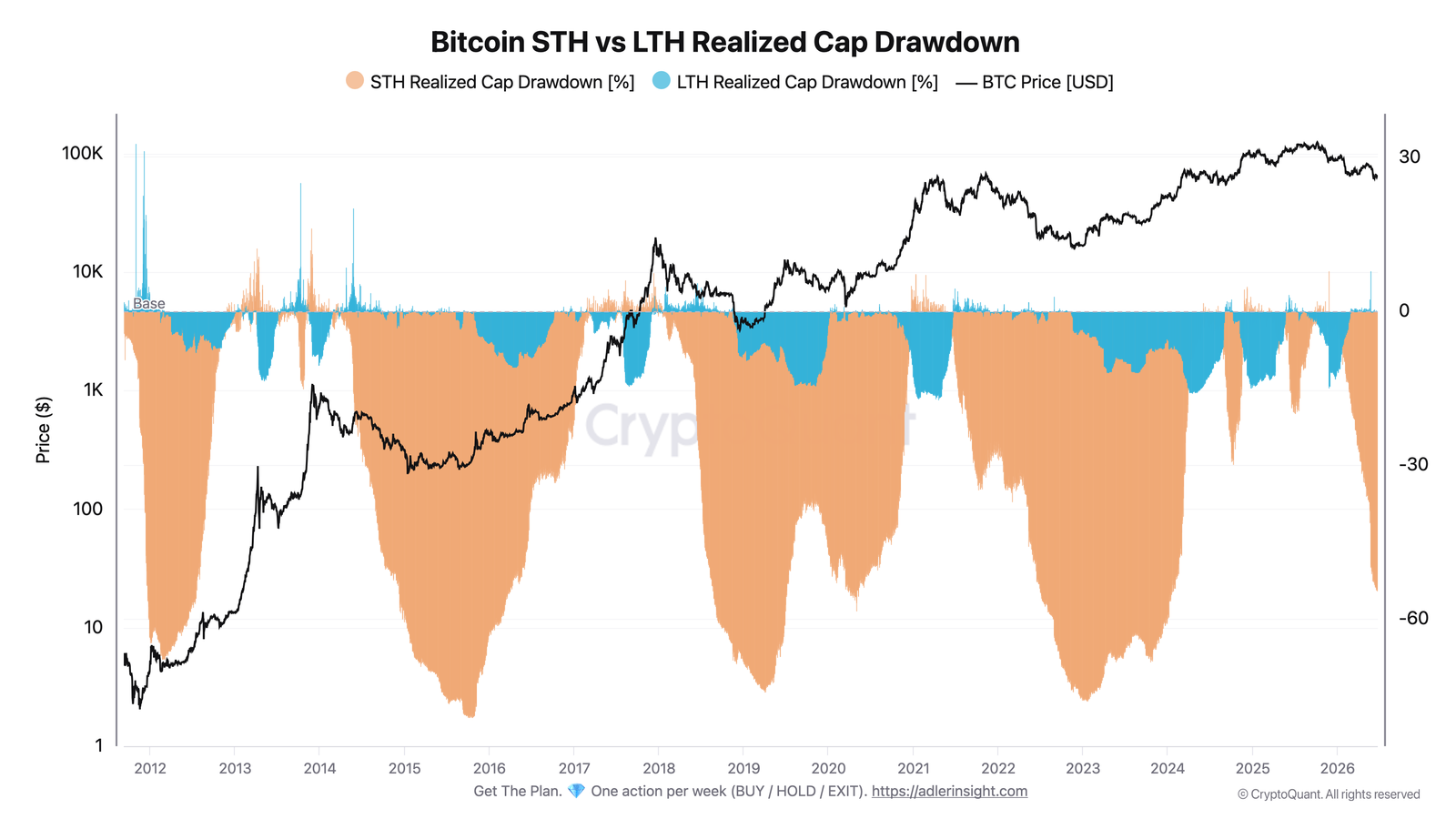
That distinction is critical for reading where we are in the cycle. Broad capitulation — where even long-term holders throw in the towel — tends to mark the most violent market bottoms. The data right now doesn’t look like that. It looks more like a shakeout of leveraged latecomers, which is a meaningfully different (and arguably healthier) market dynamic.
Bitcoin Holder Selling and the Halving Cycle Bottom Model
Separate from the on-chain analysis, there’s a pattern-based framework gaining traction that places the next significant bottom in early September. Analyst LP identified that in the previous Bitcoin bear market cycle, the final capitulation phase arrived 826 days after the halving event, followed by a major low and then a period of sideways consolidation lasting 70 to 110 days.
Applied to the current cycle, that 826-day marker lands on July 6, 2025. Run the consolidation window forward, and you get a potential bottoming zone in early September. LP also noted that this scenario carries more weight if Bitcoin continues to trade at elevated levels going into early July — the idea being that a stronger price into the key date sets up a more decisive reversal rather than a slow bleed. Notably, the relative absence of Bitcoin holder selling pressure from long-term holders during this window adds further weight to that thesis.
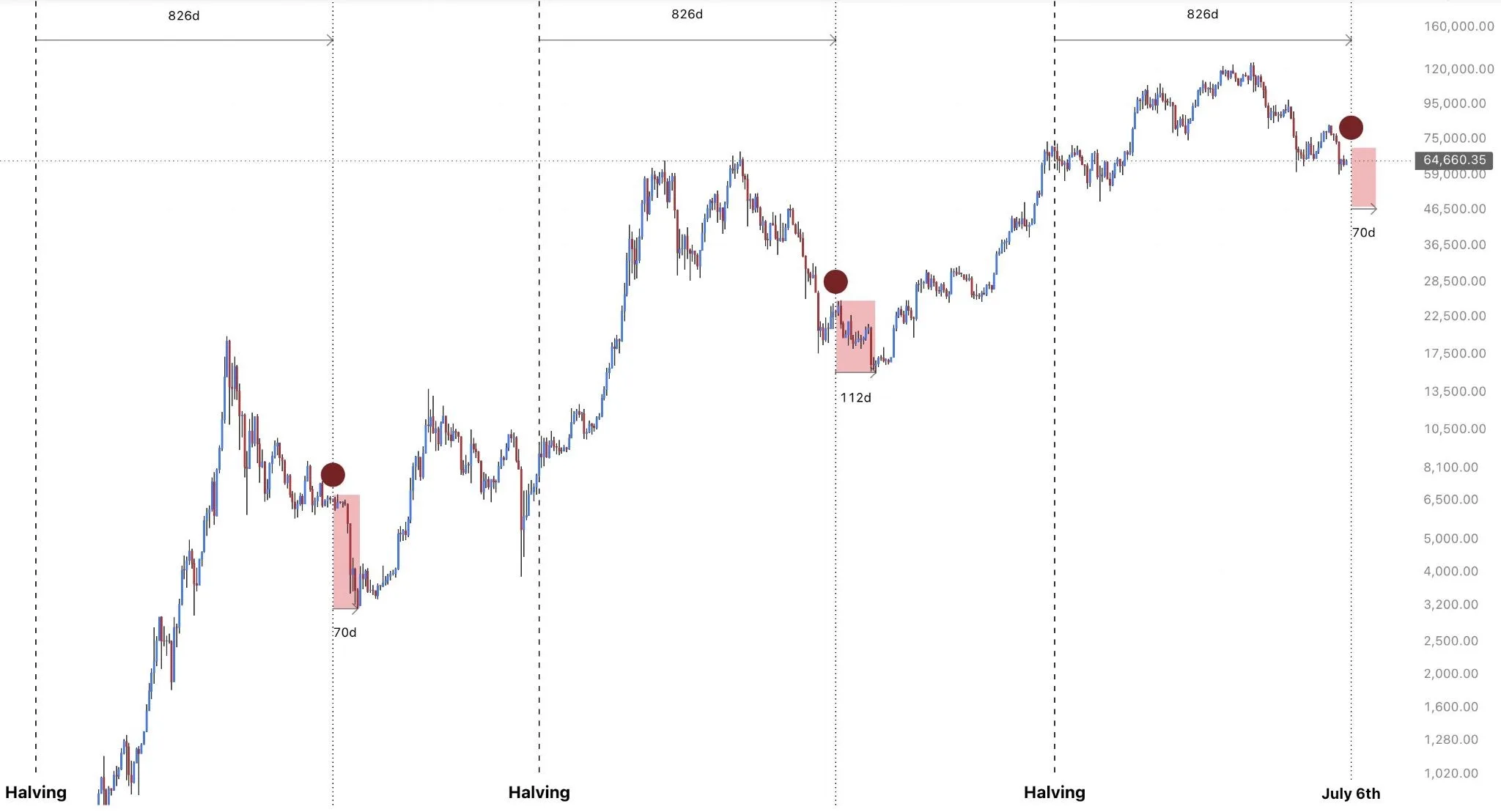
Halving cycle models aren’t perfect — Bitcoin’s market structure has changed considerably as institutional capital has entered the picture, and past patterns don’t guarantee future outcomes. But the framework does have a track record, and the fact that multiple independent indicators are converging on a similar timeframe is harder to dismiss than any single model in isolation.
What the Charts Are Flagging Below Current Prices
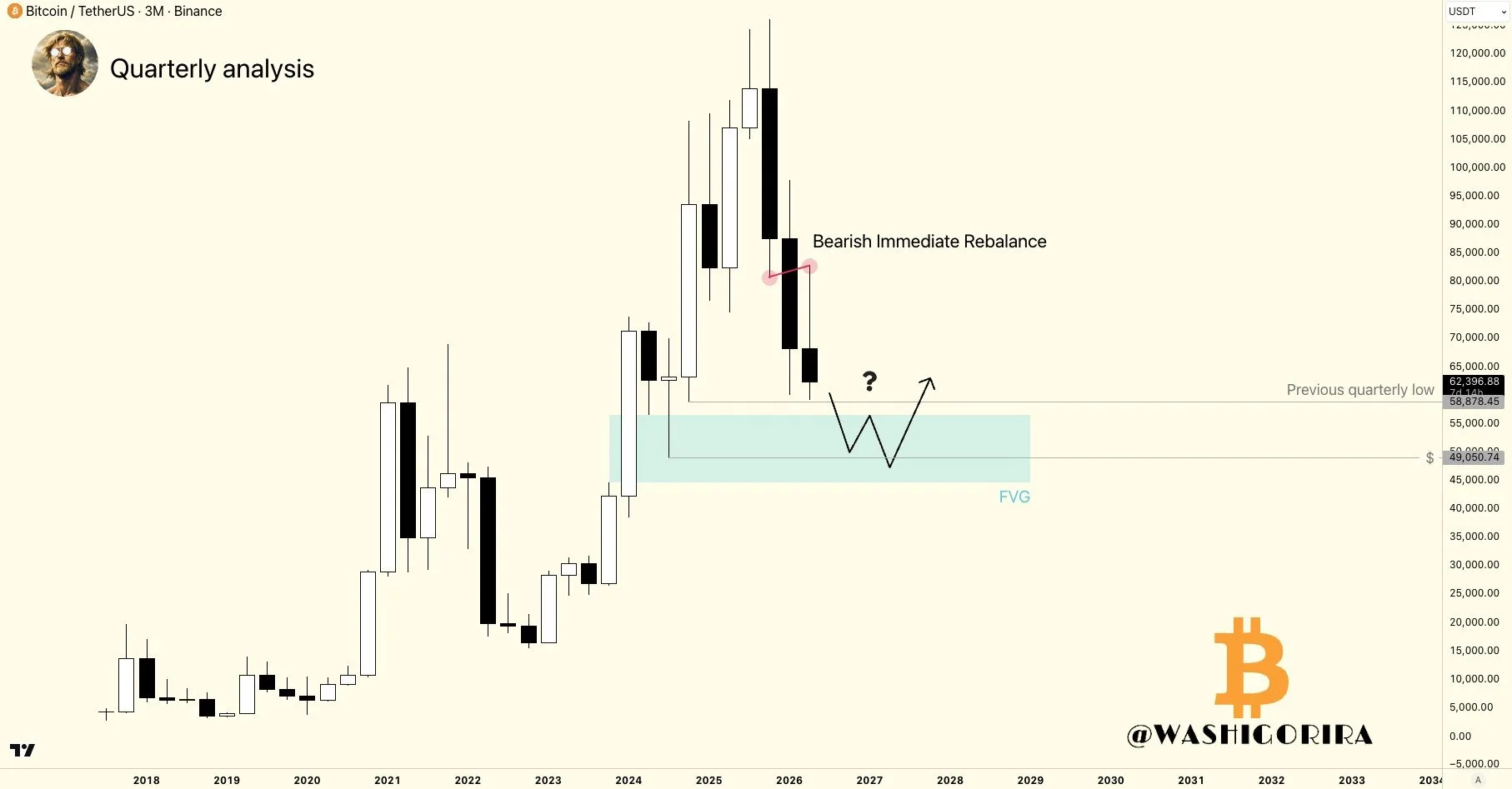
Beyond the cycle models, there’s a more technical case for why the September window could matter. Trader Titan pointed to downside liquidity sitting below current BTC prices that hasn’t yet been tapped. On the quarterly chart, Bitcoin has an unfilled low near $58,900 and an open fair value gap stretching from roughly $49,000 up to $58,900.
The logic here follows a well-established principle in market structure analysis: untouched liquidity zones tend to act as magnets, especially in quieter trading periods. If Bitcoin fails to revisit that quarterly low throughout September, attention may increasingly focus on that gap — and a flush into the $49,000–$58,900 range, followed by a recovery, could represent the Q3/Q4 bottom that the halving model is pointing toward.
None of this is a guarantee, and the crypto market has a long history of making fools of even the most well-constructed models. But the alignment between Bitcoin holder selling data, the STH/LTH divergence, the halving cycle timing, and the technical liquidity gaps is more coherent than the typical patchwork of bullish narratives that circulates during uncertain markets. If September does mark a meaningful bottom, the groundwork being laid right now — long-term holders refusing to engage in Bitcoin holder selling, short-term holders capitulating, and cycle timing pointing to a resolution — would look, in hindsight, like a textbook setup. The question, as always with Bitcoin, is whether the market follows the script.
Frequently Asked Questions
What does the drop in Bitcoin holder selling tell us about market sentiment?
When long-term Bitcoin holders stop selling, it typically signals they expect higher prices ahead. The current 90-day average of 962 BTC is the lowest in 19 months, suggesting OG investors are holding firm even as prices trade near their cost basis around $63,200.
What is the halving cycle model predicting for Bitcoin in 2025?
Analyst LP identified that the previous Bitcoin bear market hit final capitulation 826 days after the halving. Applying the same framework to the current cycle places that marker on July 6, with a potential bottoming window in early September after 70 to 110 days of consolidation.
What is the difference between short-term and long-term Bitcoin holder behavior right now?
According to analyst Axel Adler Jr., short-term holder capital has contracted by 56% while long-term holder capital has barely declined. This split suggests newer market participants are capitulating under pressure, while seasoned holders are largely staying put.
What price levels are traders watching for a Bitcoin quarterly low?
Trader Titan flagged an untapped quarterly low near $58,900 and an open fair value gap between roughly $49,000 and $58,900. If that zone remains unfilled through September, it could attract significant attention and act as a magnet for a market bottom in Q3 or Q4.

