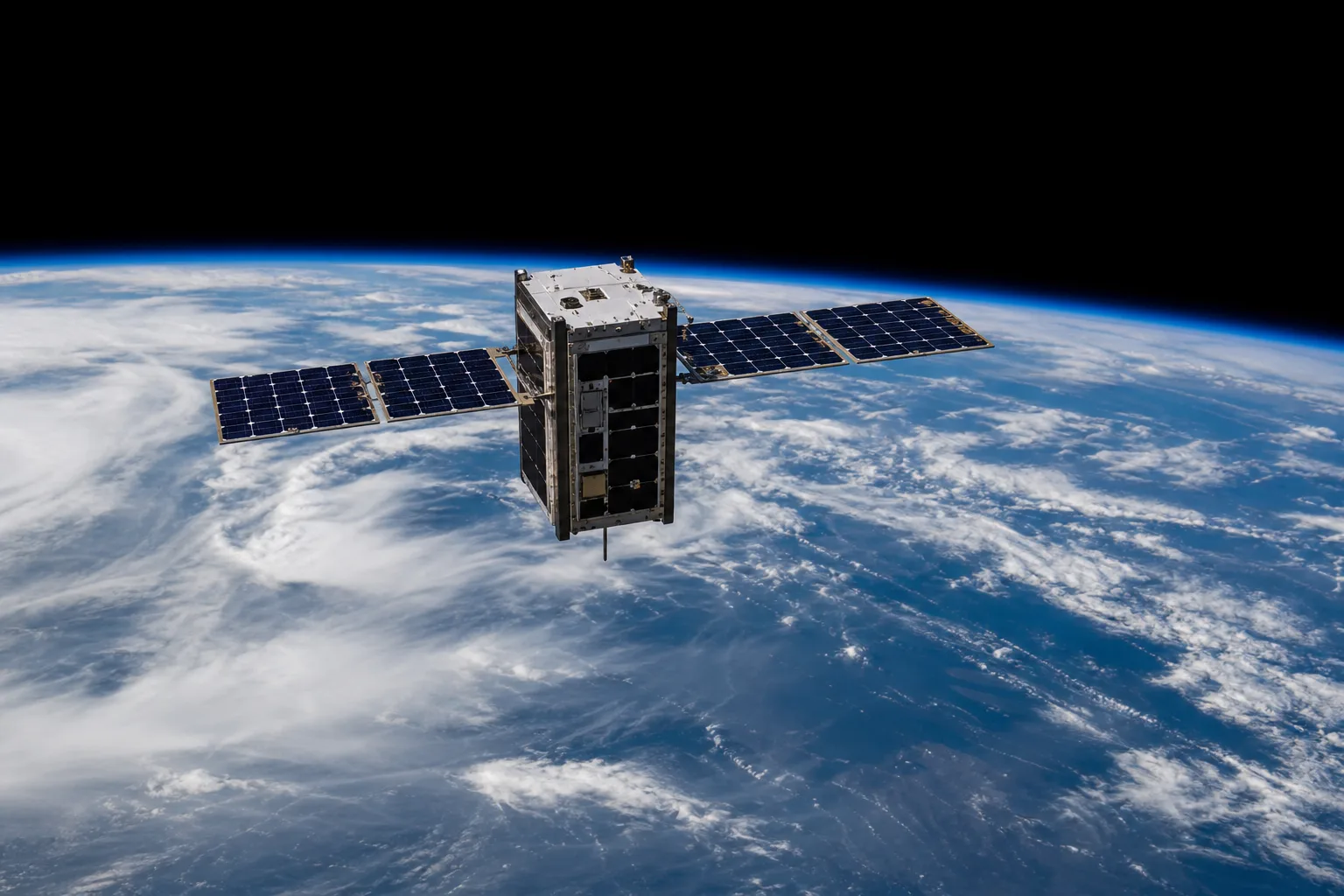
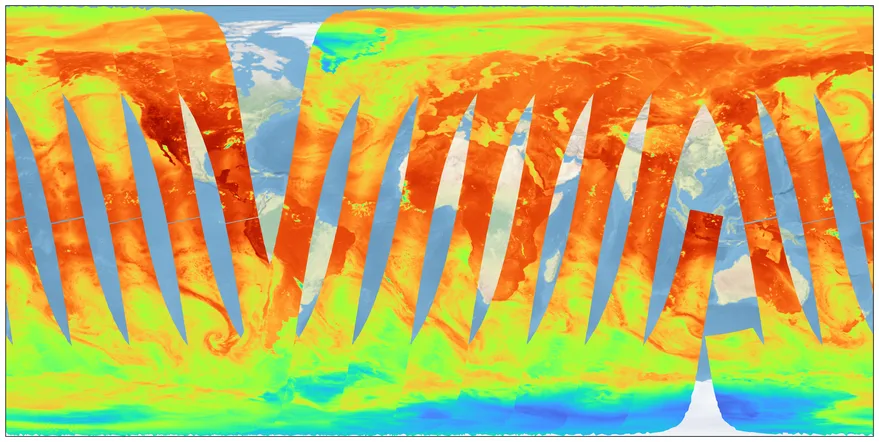
A small cubesat drifting 600 kilometres above Earth is quietly doing something that used to require a billion-dollar government programme. Weather Stream’s GEMS2-Amethyst, the company’s latest microwave radiometer satellite, has begun returning its first images of the atmosphere — 3D slices showing temperature and moisture layered through the air column in ways that conventional cameras simply can’t see.
- Weather Stream’s GEMS2 microwave radiometer satellite launched March 30 and has released its first atmospheric imagery from low Earth orbit.
- The microwave radiometer satellite covers a nearly 2,000-km swath and delivers global atmospheric data roughly every 12 hours.
- NOAA awarded $2.7 million to Weather Stream’s Orbital Micro Systems subsidiary to assess the satellite data’s impact on forecast models.
- Weather Stream plans to expand into a full constellation capable of refreshing atmospheric data as frequently as every 15 minutes.
Table of Contents
What the GEMS2 Microwave Radiometer Satellite Actually Does
Launched on March 30 aboard SpaceX’s Transporter 16 rideshare mission from Vandenberg Space Force Base, GEMS2-Amethyst is a six-unit cubesat built around a GomSpace bus carrying a dual-band passive microwave radiometer. The instrument doesn’t snap pretty pictures of clouds — it listens. It detects the natural microwave energy radiated by atmospheric gases and uses those readings to construct vertical profiles of temperature and humidity across a swath nearly 2,000 kilometres wide. Each pass of this microwave radiometer satellite adds another layer of atmospheric intelligence to the growing dataset.
That kind of data is extraordinarily valuable to forecasters, and not just for telling you whether to carry an umbrella. It feeds directly into numerical weather prediction (NWP) models — the mathematical engines that underpin every serious weather forecast on the planet. A 2021 NOAA report on satellite microwave sounding concluded that these instruments on polar-orbiting satellites ‘have been the most impactful remote sensing observations in numerical weather prediction models for the past two decades, and are expected to continue to be so in future.’ That’s a remarkable statement when you consider everything else that’s been launched into orbit in that time. For any microwave radiometer satellite operating commercially, that endorsement from NOAA carries enormous weight.
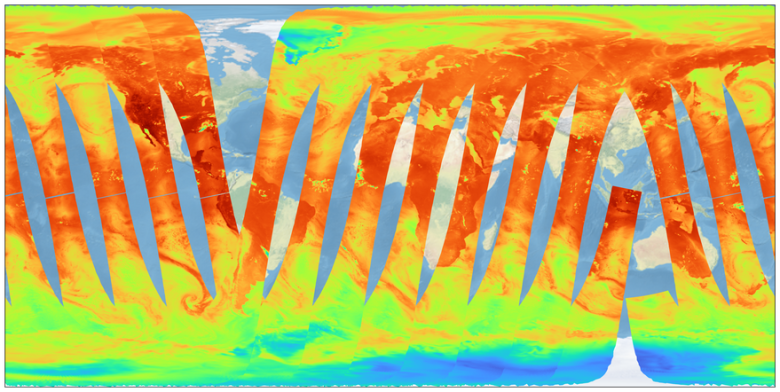
The single GEMS2-Amethyst microwave radiometer satellite currently provides global coverage roughly every 12 hours, which is already useful. Weather Stream plans to build that out into a full commercial constellation of microwave radiometer satellite assets capable of refreshing data every 15 minutes — a cadence that would put commercial operators in direct competition with, or more accurately direct partnership with, government systems that have historically owned this territory.
From a Three-Unit Cubesat to a Growing Commercial Network
Weather Stream, headquartered in Boulder, Colorado, isn’t new to this space. Back in 2019 the company launched what it says was the first commercial microwave radiometer satellite in a cubesat — a three-unit spacecraft under the original GEMS programme. That microwave radiometer satellite collected atmospheric temperature data until it re-entered the atmosphere in 2021. GEMS2-Amethyst is the next step up: physically larger at six units, and instrumentally broader, adding humidity and precipitation measurements alongside temperature.
It’s a classic small-satellite maturation arc. First mission proves the concept and the hardware. Second mission scales the capability. Third and beyond build the constellation that generates the revenue. The question is always whether the data is good enough to attract paying customers before the money runs out — and that’s precisely where NOAA’s involvement becomes critical.
NOAA’s Contracts Signal Real Commercial Momentum
On June 18, NOAA awarded contracts to two companies to evaluate whether commercial microwave sounding data is ready for prime time in operational forecasting. Weather Stream’s subsidiary, Orbital Micro Systems, received a $2.7 million contract. Boston-based Tomorrow.io — which operates its own weather satellite constellation and has been one of the more aggressive commercial players in this sector — landed a significantly larger $7.3 million award.
Both contracts are framed around the same objective: assess the quality and impact of commercial microwave sounder data on NOAA’s forecast models and specifically on tropical cyclone forecasting. Hurricanes and typhoons remain among the deadliest and most economically damaging weather events on Earth, and better atmospheric profiling in the hours and days before landfall can translate directly into better evacuation decisions and fewer casualties. A well-validated microwave radiometer satellite dataset is central to achieving that improvement.
NOAA was explicit about where it hopes this leads. ‘Successful studies are intended to lead to sustained commercial data purchases to enhance the government backbone supporting NOAA’s operational forecasts,’ the agency said. That language — ‘sustained commercial data purchases’ — is the part the industry has been waiting for. Pilot contracts are one thing. Long-term procurement agreements are what make the business model work.
The U.S. Air Force has also been active in encouraging commercial microwave sounding development, recognising the military applications in a sector where atmospheric data quality can influence mission planning, logistics, and operational risk assessment in contested environments.
The Bigger Picture: Commercial Data Filling Government Gaps
Weather Stream CEO Michael Hurowitz put it plainly: ‘Weather affects everything. From forecasting severe storms to supporting military operations to helping the insurance industry assess risk, the observation gaps we are filling with GEMS2-Amethyst touch decisions that billions of people depend on every day.’
That framing — observation gaps — is the key concept here. The global network of government weather satellites is impressive but finite. Polar-orbiting platforms like NOAA’s JPSS series and the European MetOp satellites provide excellent coverage, but they’re expensive, take years to build, and launch infrequently. When one experiences an anomaly, the gap in coverage is real and immediate. A commercial microwave radiometer satellite offers something the traditional model struggles to deliver: redundancy and refresh rate, at a fraction of the cost and timeline of legacy programmes.
Tomorrow.io has been making this argument loudly for several years, launching its own radar-equipped satellites and signing data agreements with national meteorological agencies. Planet Labs built an entire business around the equivalent premise in Earth observation imagery. The pattern is familiar — commercial operators prove out a capability in a niche, government agencies start buying the data, and eventually the ecosystem matures to where private infrastructure is genuinely supplementing public systems rather than merely competing with them.
With GEMS2-Amethyst now in orbit and returning first-light data, and with NOAA actively funding validation studies, Weather Stream is at exactly that inflection point. The microwave radiometer satellite is expected to operate in its 600-kilometre sun-synchronous orbit for more than five years, giving the company time to demonstrate sustained data quality. If those NOAA evaluations go well, the path to commercial-scale procurement opens up — and the case for building out the full 15-minute constellation becomes a lot easier to make to investors. The race to own the atmospheric data layer of commercial weather forecasting is very much still on.