
Solana’s native token SOL bounced back to $72 on Friday after briefly touching $64 lows the day before — a 14% swing that had traders talking. But the SOL price recovery deserves a closer look, because the onchain data telling the real story underneath that headline number is considerably less encouraging.
- The SOL price recovery to $72 looks promising, but falling TVL and collapsing DEX volumes suggest fragile demand beneath the surface.
- SOL price recovery enthusiasm is partly driven by tokenized stock trading, which hit $113 million in 24-hour volume on Solana.
- Pump.fun accounts for 30% of Solana DApp revenue, creating dangerous concentration risk tied to volatile memecoin activity.
- Hyperliquid and OKX partnerships with NYSE parent company on Ethereum systems are mounting competitive threats to Solana’s tokenization lead.
Table of Contents
SOL Price Recovery Built on Shaky Ground
The SOL price recovery didn’t happen in a vacuum. It was propelled largely by a surge of excitement around tokenized stock trading on the Solana blockchain, with Jupiter Aggregator data showing those assets clocked over $113 million in 24-hour trading volume. For a relatively new product category, that’s a headline-grabbing number — and it clearly got traders’ attention.
But here’s the problem: excitement and liquidity are two different things. Automated market-making pools underpinning these tokenized stocks remain thin, with multiple issuers competing for overlapping products. Some of these tokens only launched recently, which partly explains why most of them have a small holder base. That’s either an early opportunity or a fragility warning, depending on how optimistic you want to be.
Meanwhile, futures traders were clearly in a buying mood. The annualised funding rate on SOL perpetual futures climbed to its highest point since June, hitting around 10%. That sounds alarming on the surface, but context matters — anything in the 6% to 12% range is generally considered neutral territory. The key takeaway is that the market went from negative funding rates (active bearishness) to a more balanced posture, which is genuinely constructive, even if it’s not the kind of extreme that signals a full-blown breakout. Analysts watching the SOL price recovery closely note that funding rate normalisation alone is rarely enough to sustain a rally without improving onchain fundamentals.
The TVL Problem Solana Can’t Ignore
If the SOL price recovery has an Achilles heel, it’s the Total Value Locked data. According to DefiLlama, TVL on Solana fell 11% over the past month — a meaningful drop that undermines the narrative of a network firing on all cylinders. The declines aren’t small or isolated either. Kamino, one of Solana’s larger lending protocols, shed 19% of its TVL. Binance Staked SOL dropped 20%. Raydium, the network’s flagship decentralised exchange, fell 17%.
The one bright spot in that picture is xStocks, a tokenization platform that posted 31% TVL growth. But a single category growing amid a broader contraction is a pretty narrow foundation to get excited about.
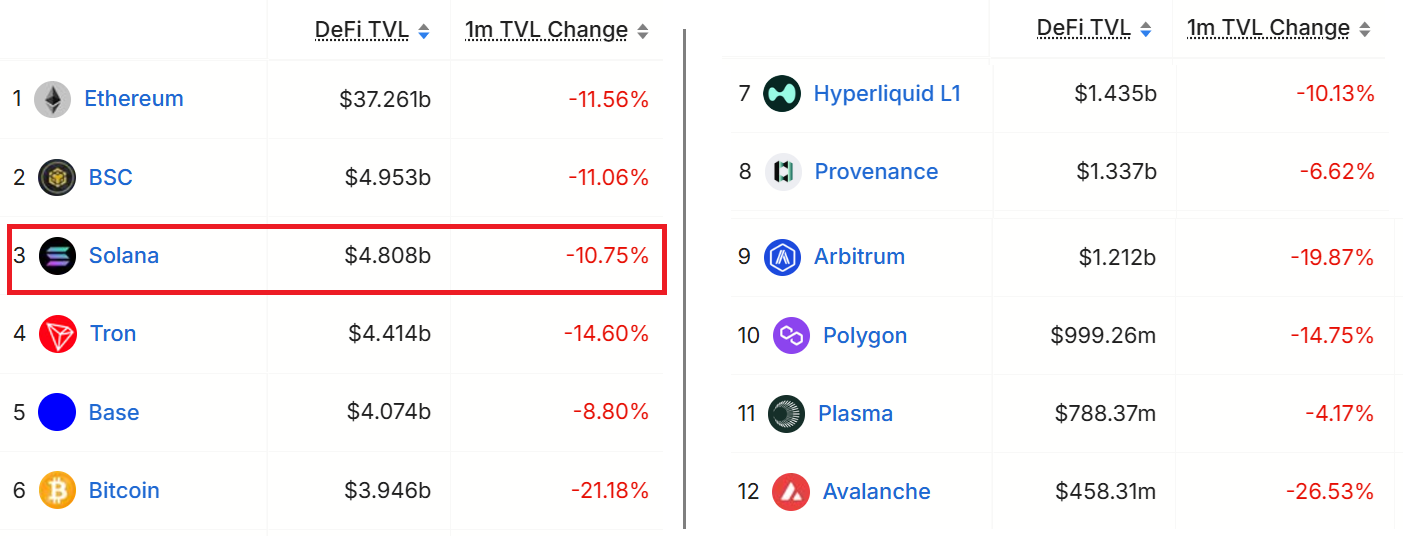
What makes this more pointed is the timing. Ethereum’s layer-2 network Base has been narrowing the gap with Solana on TVL, and the speed of that convergence is something the Solana ecosystem should be watching carefully. Ethereum’s scaling solutions have historically struggled to match Solana’s throughput advantages, but Base’s developer momentum and DeFi activity tell a different story right now. A durable SOL price recovery will be difficult to sustain if TVL continues contracting while competing networks gain ground.
DEX Volumes Tell the Full Story of Fading Demand
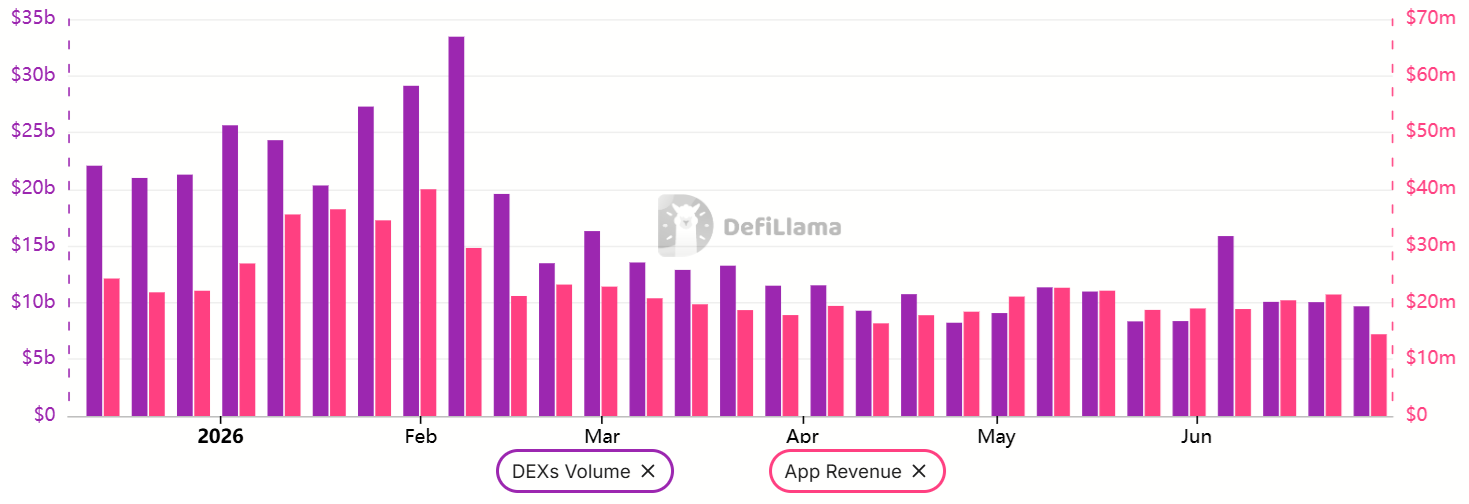
Weekly decentralised exchange volumes on Solana have collapsed from $30 billion in early February to around $10 billion — a two-thirds decline in roughly four months. That’s not a dip; that’s a structural pullback in network activity. And it’s dragging DApp revenue down with it.
This is where the SOL price recovery runs into its most serious headwind. Onchain processing demand — the actual usage that drives sustained token value — remains subdued. Tokenized stock trading can generate headlines, but it hasn’t yet translated into the kind of broad-based activity that $30 billion weekly DEX volumes once reflected.
Some of that February peak was memecoin mania, admittedly. Solana became the go-to chain for speculative token launches during that period, and those volumes were never going to be permanent. But the question is whether the ecosystem has built enough genuine, durable activity to hold relevance without the memecoin tailwind — and the current numbers suggest the answer is still uncertain.
Pump.fun Dependency Is a Structural Risk
Speaking of memecoins — around 30% of all DApp revenue on Solana currently flows through Pump.fun, the viral token launch platform that turned speculative coin creation into a social activity. That concentration is a red flag regardless of how you feel about memecoins as a category.
A CoinGecko report put the scale of Pump.fun’s activity in sharp relief: 80% of the 18.7 million tokens ever launched on the platform vanished within 48 hours of creation. Dune Analytics data shows that 55% of wallet addresses involved in those launches lost up to $1,000. These aren’t the metrics of a healthy, sustainable revenue base — they’re the metrics of a platform running on speculative energy that can evaporate quickly when sentiment shifts.
Tying nearly a third of your network’s DApp income to that kind of activity is a concentration risk that Solana’s advocates tend to gloss over. When memecoin activity fades — and it always does eventually — the hole it leaves in the revenue picture is substantial. Any SOL price recovery that rests heavily on Pump.fun-driven revenue is, by definition, built on an unstable base.
Competition Is Closing In on Solana’s Tokenization Lead
One of the most compelling parts of the SOL price recovery narrative has been Solana’s early dominance in tokenized equities — reportedly capturing around 95% of tokenized stock trading volume at its peak. That’s the kind of first-mover position that can define a chain’s identity for years. But it’s also the kind of lead that attracts serious competition fast.
Hyperliquid, the high-performance derivatives platform that’s been gaining serious traction in 2025, is moving into tokenized stock trading directly. That’s not a peripheral threat — Hyperliquid has demonstrated real product velocity and a loyal user base willing to trade there specifically for its performance characteristics.
Then there’s the OKX-NYSE angle. OKX has announced a strategic partnership with the parent company of the New York Stock Exchange, and that partnership is being built on Ethereum-based infrastructure. That’s a significant institutional endorsement of Ethereum’s ecosystem for real-world asset tokenization — exactly the space Solana was hoping to own. When a major exchange pairs with the world’s most famous stock exchange parent and chooses Ethereum, it sends a message that the tokenization race is far from settled.
Centralised exchanges on competing chains are also building tokenized equity products, meaning Solana’s $113 million in daily volume — impressive as it is — is about to face genuine pressure from multiple directions simultaneously.
Airdrop Anticipation: Hope or Hype?
One more factor underpinning the SOL price recovery is investor anticipation around upcoming airdrops on the Solana network. Several protocols are drawing attention: OnRe, a reinsurance platform with $200 million in TVL; Bulk, a perpetual DEX carrying $325 million in aggregate open interest; and Loopscale, a lending platform sitting at $79 million in TVL. Each of these could generate real activity and token distribution events that bring users back to the network.
But airdrop-driven optimism is notoriously hard to time and easy to disappoint. The timing of these launches remains unclear, and the history of airdrop anticipation in crypto is littered with situations where the hype outran the actual event. That’s not a reason to dismiss it entirely — genuine protocol launches do drive real activity — but it shouldn’t be mistaken for underlying demand that already exists.
Reclaiming $80, the level SOL last touched on June 1, is possible, but it’s going to require more than tokenized stock headlines and futures funding rate momentum. The network needs to show genuine recovery in TVL and DEX volumes, reduce its dependence on Pump.fun’s memecoin engine, and hold its ground in tokenized equities against an accelerating competitive field. All three of those challenges are very much live right now — and none of them are simple. The SOL price recovery story is real, but so are the structural questions that still surround it.
Frequently Asked Questions
What is driving the SOL price recovery to $72?
The SOL price recovery to $72 was fuelled by growing excitement around tokenized stock trading on Solana, which recorded over $113 million in 24-hour volume, alongside rising bullish futures demand and anticipation of upcoming airdrops on the network.
Why is Solana’s Total Value Locked declining?
Solana’s TVL dropped 11% over the past month, with notable declines from Kamino down 19%, Binance Staked SOL down 20%, and Raydium falling 17%. The Ethereum layer-2 Base has been reducing the gap with Solana during this period.
How dependent is Solana on Pump.fun for revenue?
Pump.fun accounts for roughly 30% of all DApp revenue on Solana. A CoinGecko report found 80% of the 18.7 million tokens launched on the platform disappeared within 48 hours, and Dune data shows 55% of participating addresses lost up to $1,000.
Is Hyperliquid a real threat to Solana’s tokenized stock market?
Hyperliquid is emerging as a direct competitor in tokenized equity trading, and OKX has formed a strategic partnership with the NYSE parent company using Ethereum-based systems, signalling that Solana’s early lead in this space isn’t guaranteed.