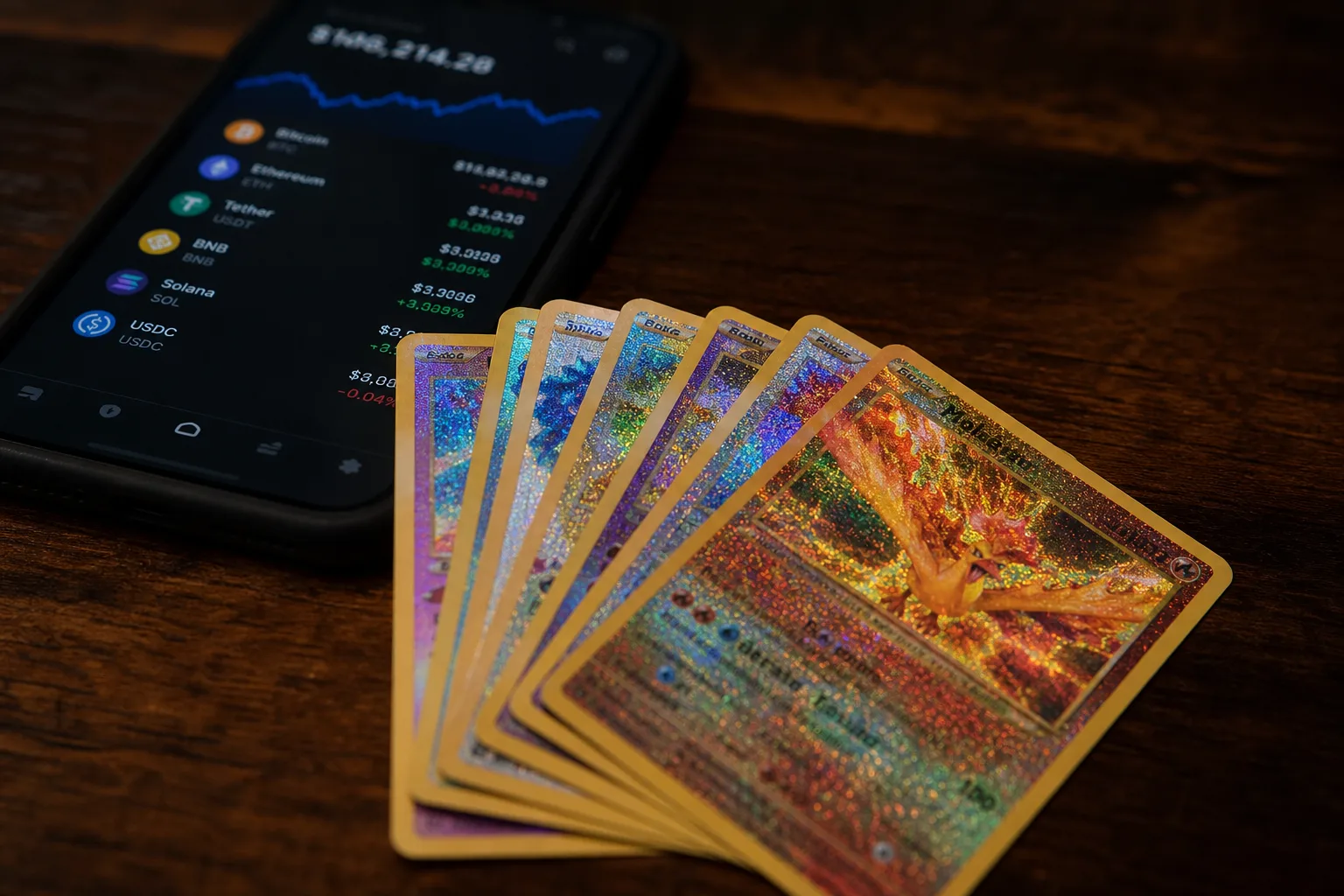
The real-world asset narrative in crypto has spent most of its life pitching institutional products — tokenized Treasuries, money-market funds, private credit. Collector Crypt RWA is doing something different, and noisier: it’s selling mystery packs of trading cards on-chain, letting users rip open randomized NFTs, and backing the whole thing with USDC sellbacks and physical redemption. The numbers coming off that loop are hard to dismiss, but so are the questions it raises.
- Collector Crypt RWA generated $60.98 million in annualized fees, signaling genuine retail demand beyond tokenized Treasuries.
- The Collector Crypt RWA model uses randomized pack openings, USDC sellbacks, and physical card redemption to drive on-chain activity.
- CARDS token trades near $0.27 with a $111 million market cap, but a 2 billion total supply creates real dilution risk.
- Arthur Hayes amplified the CARDS ticker on June 23, sparking social attention that inflated short-term trading volume.
Table of Contents
How the Loop Actually Works
Collector Crypt RWA describes itself as a bridge between physical collectibles and the blockchain. In practice, that means a gacha-style purchasing flow: users buy a mystery pack, a verifiable random function (VRF) determines what’s inside, and they receive NFTs representing real trading cards held in custody. From there, the options branch. You can hold the digital representation, trade it on secondary markets, sell it back immediately through a USDC buyback endpoint, or submit a redemption request and have the physical card shipped to you.
That last option is what keeps Collector Crypt RWA inside the RWA conversation. The platform’s shipping API describes a submit-pay-burn flow — users burn the NFT, pay a shipping fee, and receive the underlying physical card. It’s real-world asset infrastructure. The experience of using it, though, is closer to a collectible arcade than anything you’d find in a BlackRock product sheet.
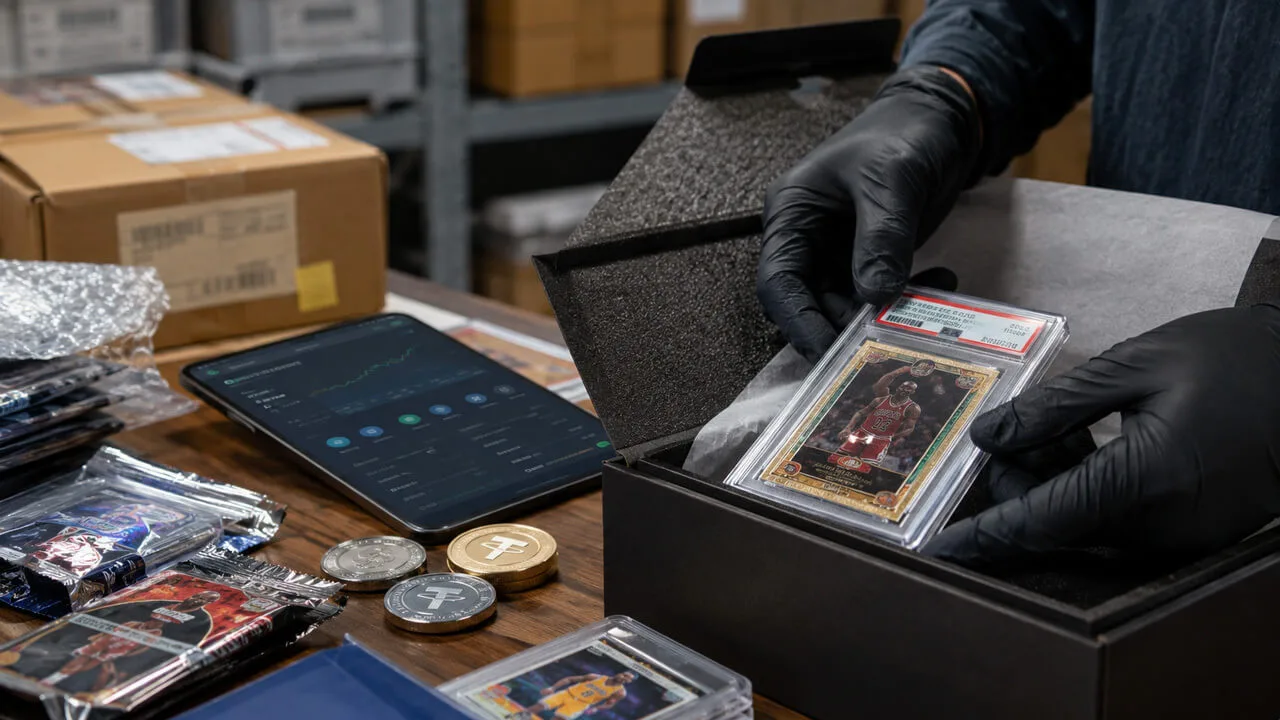
The randomness is documented and verifiable. Collector Crypt’s VRF implementation publishes live card weights and odds before purchase, and the platform gates pack purchases to users aged 18 and over. A June 11 release from Solflare about a co-branded ‘Solflare Packs’ drop confirms this approach — it explicitly classifies the packs outside financial products and investment offerings, and separates Solflare from responsibility for sourcing, grading, storage, and fulfilment. That legal architecture matters for what comes next.
The Data Behind Collector Crypt RWA
On June 24, DeFiLlama’s Collector Crypt RWA dashboard showed $60.98 million in annualized fees and revenue, $15.15 million over the trailing 30 days, $4.16 million over 7 days, and $142.39 million in 30-day DEX volume. For a consumer crypto app built around trading cards, those are serious numbers. They also invite serious scrutiny.
DeFiLlama’s standard methodology defines fees as amounts paid by users to the protocol, and revenue as what the protocol retains after any distributions. Collector Crypt’s own dashboard breaks this down further — separating pack sales, marketplace transactions, and pack-buyback adjustments. That granularity is genuinely useful, and rarer than it should be in consumer crypto. But the figures remain unaudited operating signals, not verified financial statements. The dashboard tells you activity is happening. It doesn’t tell you precisely why.

That distinction matters because the activity spike coincided with a very specific social catalyst. Arthur Hayes — co-founder of BitMEX and one of crypto’s most-followed voices — amplified the CARDS ticker on X on June 23. Social heat from a single post by someone with Hayes’s reach can move tokens, inflate volume, and distort short-term usage metrics in ways that take weeks to unwind. The operating data is real; whether it’s durable is a different question entirely.
Collector Crypt RWA vs. the Institutional Model
To understand why Collector Crypt RWA is generating attention inside the RWA sector, it helps to understand how narrow that sector has been. The dominant model — tokenized Treasuries, money-market funds, private credit instruments — is aimed squarely at institutional and high-net-worth capital. Projects like Ondo Finance have built real traction tokenizing US Treasury exposure, but the typical user isn’t someone opening a pack of Pokémon cards at midnight. The assets are yield-bearing, the users are sophisticated, and the interfaces look like Bloomberg terminals dressed in Web3 clothing.
Collector Crypt RWA is the opposite of that. Its users are retail. Its interface is a pack-opening animation. Its underlying asset is a trading card. And yet it sits legitimately within the RWA category because the asset is real, custody is documented, and physical redemption is a live product feature — not a whitepaper promise. That puts it in a more complicated regulatory and analytical corner than tokenized Treasuries, which at least have clear precedent as financial instruments.
The consumer-facing nature of the product is both its strength and its complication. Most people understand what a trading card is. Almost nobody needs to understand what duration risk means to buy a pack. That accessibility lowers the barrier to entry dramatically — which is exactly why the DeFiLlama volume numbers look the way they do.
The CARDS Token: Ecosystem Asset or Reflexive Risk?
No analysis of Collector Crypt RWA is complete without a hard look at CARDS. As of late June, the token was trading around $0.27, up roughly 66% over the prior month but down 13% over the trailing week. Market cap sat near $111 million with a 24-hour trading volume of approximately $22.8 million. Circulating supply is around 416 million tokens — against a total supply of 2 billion.
That supply gap is where things get uncomfortable. A circulating supply of 416 million against a 2 billion ceiling means the majority of tokens haven’t entered the market yet. Unlock schedules and emission rates determine whether CARDS holds value or bleeds it over time. If the platform sustains genuine demand from collectors who want the underlying physical cards, CARDS becomes a utility token with a real use case. If attention drifts — as it tends to after a Hayes tweet cycle completes — and the remaining demand is mostly reward-chasers rotating through the buyback loop, the token’s valuation rests on shakier ground.
This is the central tension in the CARDS debate, and it’s not unique to Collector Crypt RWA. Most consumer crypto incentive programs face the same flywheel problem: rewards drive usage, usage drives metrics, metrics attract more users, and the whole structure depends on continuous new demand to sustain itself. When that demand comes from genuine collectors who want to own the physical card at the end of the chain, the loop is self-reinforcing in a healthy way. When it comes primarily from token farmers, the loop is self-reinforcing in a fragile one.
The Off-Chain Questions No Dashboard Answers
There’s a layer of risk in Collector Crypt RWA that no DeFiLlama chart can capture. Physical redemption sounds simple — burn the NFT, pay for shipping, receive the card. In practice, physical collectibles carry real-world complications that on-chain infrastructure wasn’t designed to handle.
Who holds the underlying cards between purchase and redemption? How are grading disputes resolved if a card arrives in worse condition than its on-chain representation suggests? What happens if redemption queues back up during a demand spike? What’s the insurance coverage on physical inventory? The Solflare partnership release from June explicitly distances Solflare from ‘sourcing, fulfillment, grading, storage, and redemption’ responsibilities — which is reasonable partner liability management, but also a signal that the answers to these questions live entirely with Collector Crypt RWA’s own operations team.
None of this means Collector Crypt RWA is operating in bad faith. It means that consumer RWA — particularly when it involves physical goods, custody, and shipping logistics — carries an operational complexity that institutional RWA products mostly avoid by staying on-chain. A tokenized Treasury doesn’t need a warehouse.
What the Trading Card Model Reveals About Crypto’s Retail Appetite
Step back from the specifics and there’s a genuinely interesting signal buried in the Collector Crypt RWA story. The broader RWA sector has spent years arguing that tokenization will unlock trillions in previously illiquid assets. The assets most commonly cited — real estate, private equity, infrastructure debt — are things retail investors nominally want access to but rarely interact with emotionally. A trading card is different. People collect them as kids. They remember specific cards. They have opinions about condition and rarity and market value. The emotional surface area is enormous compared to a tokenized Treasury.
If Collector Crypt RWA can hold onto users beyond the initial attention cycle, it will have demonstrated something the institutional RWA market has struggled to prove: that real-world assets can generate durable on-chain consumer behavior, not just AUM numbers in a dashboard. That’s a meaningful experiment, regardless of how the CARDS token performs. The question isn’t whether the model is interesting — it clearly is. The question is whether the collectors stick around after the incentives cool, and whether the cards they’re redeeming are worth what they paid for the packs. That answer will take longer than one Hayes tweet to surface.
Frequently Asked Questions
What is Collector Crypt RWA and how does it work?
Collector Crypt is a platform where users buy randomized mystery packs, open NFTs representing physical trading cards, and can either sell them back for USDC or redeem them for physical delivery. It combines gacha-style mechanics with real-world asset infrastructure.
How much revenue has Collector Crypt generated?
According to DeFiLlama data recorded on June 24, Collector Crypt posted $60.98 million in annualized fees and revenue, $15.15 million over 30 days, and $142.39 million in 30-day DEX volume. These figures are unaudited operating signals, not formally verified revenue.
What is the CARDS token and what are its risks?
CARDS is the native token of the Collector Crypt ecosystem, trading around $0.27 with a circulating supply of roughly 416 million against a 2 billion total supply. That gap between circulating and total supply means future unlocks could meaningfully pressure the token’s price.
Is Collector Crypt RWA different from tokenized Treasuries?
Yes. Most RWA crypto projects tokenize institutional assets like Treasuries or money-market funds. Collector Crypt targets retail consumers with physical trading cards, gacha-style pack mechanics, and secondary-market trading — making it far more consumer-facing than the typical RWA model.