


For years, Michael Saylor’s Strategy — the company formerly known as MicroStrategy — made public markets look like a personal ATM for Bitcoin purchases. Strategy Bitcoin financing, the practice of issuing stock, preferred shares, and convertible debt to fund an ever-growing Bitcoin treasury, turned the company into the world’s largest corporate holder of the asset. It was an audacious loop, and for a while it worked brilliantly. Now, several of the instruments powering that loop are cracking at once.
- Strategy Bitcoin financing is under pressure as preferred stock STRC has fallen roughly 25% below its $100 stated par value.
- The Strategy Bitcoin financing model faces an estimated $8 billion cash wall from preferred dividends and convertible debt maturing by 2028.
- Strategy’s enterprise market-to-NAV ratio briefly dropped below 1, erasing the premium that once made its capital-raising loop so powerful.
- With only around $1.4 billion in cash reserves, the company’s options are narrowing to dilution, debt, or slowing Bitcoin purchases.
Table of Contents
STRC Collapse Signals Strategy Bitcoin Financing Stress
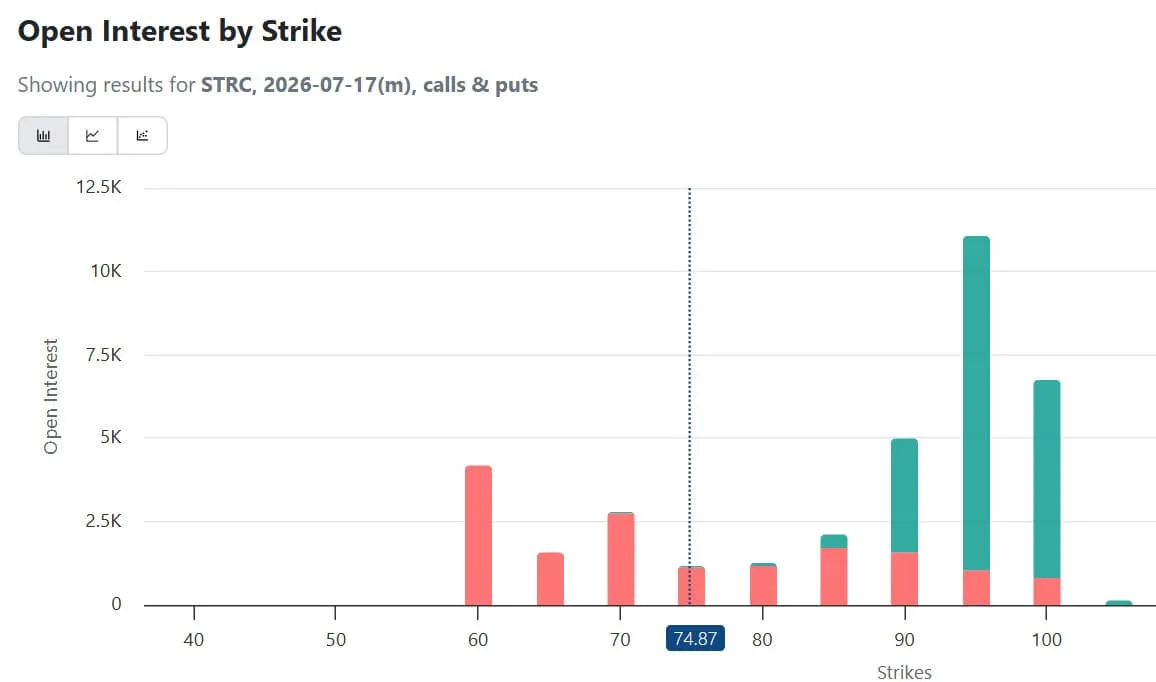
The most visible fault line right now is STRC — Strategy’s Variable Rate Series A Perpetual Stretch Preferred Stock. It was built to trade near a stated value of $100, acting as a relatively stable, high-yield instrument that could attract income-focused investors while funneling fresh capital into Bitcoin. Instead, STRC hit a record low near $71 on Friday before clawing back to around $75. That puts it roughly 25% below par, a level that transforms what was once a cheap Strategy Bitcoin financing tool into something considerably more expensive and troublesome.
The variable dividend rate was supposed to be a self-correcting mechanism — as the security drifts below par, the rate rises to pull it back. But that same feature now works against Strategy. At roughly $75, STRC’s effective yield has climbed to around 15%, well above the headline rate tied to the $100 stated amount. That’s not a sign of a functioning stabiliser. It’s a sign that investors want substantially more compensation for holding junior exposure to a company whose entire balance sheet is built around a single volatile asset.
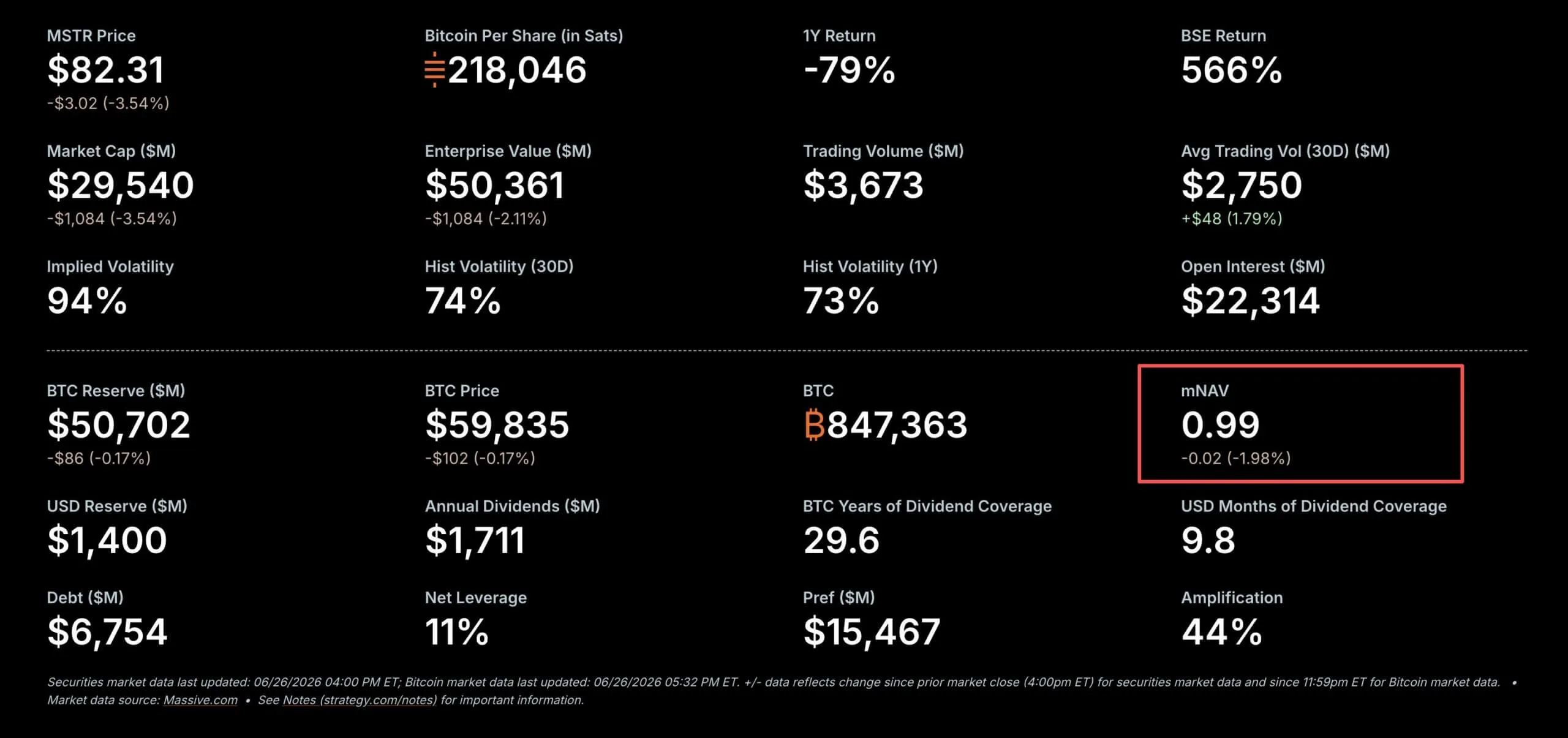
The broader preferred-stock stack is already generating a heavy recurring cost. Glenn Cameron, global head of institutional at Ooramp Bitcoin, estimates Strategy’s annual preferred dividend burden at roughly $1.7 billion, with STRC alone accounting for approximately $1.2 billion of that — based on about 104.9 million STRC shares and an 11.5% annualised rate on the $100 stated amount. That’s a significant fixed-cost base for a company whose primary asset doesn’t generate yield. The scale of this burden illustrates why Strategy Bitcoin financing decisions carry such outsized consequences for the company’s balance sheet.
The $8 Billion Cash Wall Taking Shape
The preferred dividend burden is only part of the pressure. Cameron has identified roughly $4.5 billion in convertible notes that holders may be able to put back to Strategy for cash between September 2027 and June 2028. The schedule is concentrated: approximately $1.01 billion could come due on September 15, 2027; around $2 billion on March 1, 2028; and roughly $1.5 billion on June 1, 2028. Stack those repayment windows on top of two years of preferred dividends, and the total potential cash demand approaches $8 billion. Each of these obligations traces directly back to Strategy Bitcoin financing decisions made during the accumulation phase.
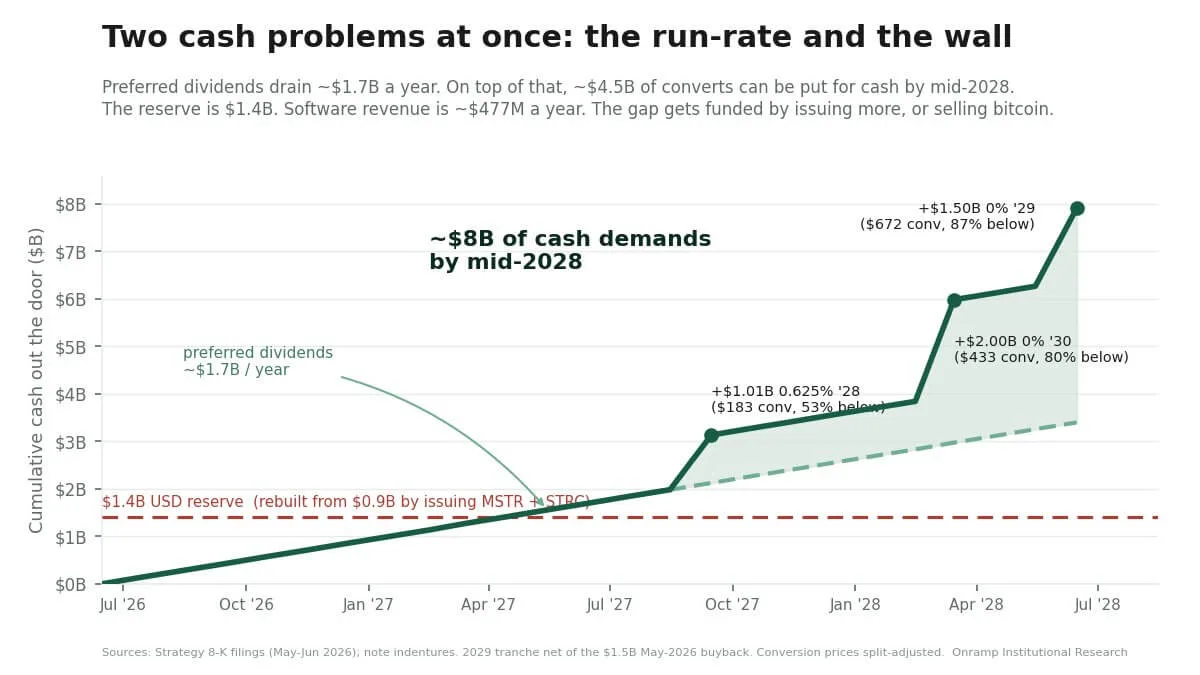
Strategy’s current cash reserves stand at around $1.4 billion. The company rebuilt that buffer after drawing it down earlier, but it did so by selling securities into a weaker market — preserving liquidity at the cost of added dilution risk. Against potential obligations approaching $8 billion, $1.4 billion is a thin cushion. The arithmetic forces a hard question: where does the money come from? The answer will likely define how Strategy Bitcoin financing evolves over the next two years.
The convertible note problem is self-reinforcing in an uncomfortable way. Those notes only convert into equity attractively if Strategy’s common stock is trading well above the conversion prices. With shares hitting a two-year low of $82 on Friday — down sharply from prior highs — many of those conversion prices are out of reach. Note holders have far less reason to exchange into equity and far more reason to seek cash repayment when their put windows open. The lower the stock goes, the more cash-hungry the convertible structure becomes.
The Premium That Made the Loop Work — and What Happens Without It
To understand why this matters so much, you have to understand what made Strategy Bitcoin financing special in the first place. For years, Strategy’s shares traded at a significant premium to the net asset value of its Bitcoin holdings. Investors were essentially paying extra — not just for the Bitcoin itself, but for Saylor’s ability to keep accumulating more of it using public-market capital at scale. That premium created a virtuous cycle: a high market valuation meant Strategy could sell stock or preferred shares at favourable prices, use the proceeds to buy Bitcoin, and those purchases in turn reinforced the company’s status as the definitive listed Bitcoin proxy, keeping the premium elevated.
That loop is far harder to maintain when the common stock and preferred shares are selling off simultaneously. On Friday, Strategy’s enterprise market-to-net asset value ratio briefly slipped below 1 — meaning investors were no longer paying extra for what Saylor has built. They were discounting it. A sub-1 reading doesn’t just represent a bad day; it suggests the market is treating the complexity of the capital structure around the Bitcoin treasury as a liability rather than a feature. The debt, the preferred dividends, the dilution risk — suddenly those look more significant than the Bitcoin upside. When Strategy Bitcoin financing instruments trade at distressed levels, the entire valuation framework shifts.

Bitcoin itself wasn’t helping matters. The asset was struggling to hold the $60,000 mark at the same time Strategy’s securities were selling off — a double blow to a thesis that depends on both Bitcoin appreciation and favourable capital-market conditions. When both legs of the trade weaken together, the feedback loop that powered the strategy’s rise can start working in reverse.
What Strategy’s Options Actually Look Like Now
Strategy’s choices are narrowing, and none of them are painless. It can continue selling shares or securities to raise cash — but doing so into a depressed market means heavier dilution for existing shareholders and higher borrowing costs. It can slow or pause Bitcoin purchases, which would undermine the core identity of the company and potentially accelerate the premium compression that’s already underway. Or it can find ways to restructure or refinance the convertible notes and preferred stack before the cash wall arrives — a complex task in an environment where STRC is trading 25 points below par. Each of these paths represents a meaningful shift in how Strategy Bitcoin financing operates going forward.
There’s also a scenario where Bitcoin stages a strong rally before 2027, common shares recover above conversion prices, and note holders choose equity over cash repayment. That would relieve a significant portion of the pressure. But that’s a bet on market conditions, not a financial plan — and Strategy’s investors are increasingly asking for the latter rather than the former.
What’s telling is how quickly the conversation around Strategy has shifted. Six months ago, analysts and crypto enthusiasts were debating how many Bitcoin Saylor could accumulate. Today, the more pressing questions are about preferred dividends per quarter, put option windows on convertible notes, and what $1.4 billion in cash actually covers. That’s a very different kind of company story — and not necessarily the one Strategy’s boldest backers signed up for. The sustainability of Strategy Bitcoin financing as a long-term model is now the central debate among institutional observers. Whether Saylor can engineer his way out of the cash wall the same way he engineered his way into the world’s largest corporate Bitcoin position remains the defining question for the company heading into 2026 and beyond.
Frequently Asked Questions
What is Strategy Bitcoin financing and how does it work?
Strategy Bitcoin financing refers to the company’s model of raising capital through stock sales, preferred shares, and convertible debt — then using those proceeds to buy Bitcoin. The resulting premium on its market valuation historically enabled the company to keep buying more Bitcoin at scale.
What is STRC and why has it fallen so sharply?
STRC is Strategy’s Variable Rate Series A Perpetual Stretch Preferred Stock, designed to trade near a $100 stated value. It fell to a record low near $71 before recovering to around $75, because investors are demanding higher yields to hold junior exposure to a company whose common stock and Bitcoin holdings are both under pressure.
How much cash could Strategy need over the next two years?
According to Glenn Cameron of Ooramp Bitcoin, Strategy could face roughly $8 billion in potential cash demands — made up of around $1.7 billion per year in preferred dividends plus approximately $4.5 billion in convertible notes that holders may be able to redeem for cash.
What happens if Strategy’s common stock stays below convertible note conversion prices?
If Strategy’s common shares remain deeply out of the money relative to conversion prices, convertible note holders have little incentive to swap into equity. That increases the probability they’ll demand cash repayment when put windows open between September 2027 and June 2028.

