
Every DeleteMe review eventually lands on the same uncomfortable truth: the internet already knows where you live, and getting that information back is a slow, grinding negotiation — not a switch you flip. Founded in 2010, DeleteMe claims to be one of the oldest data-removal services in the business. After spending months using it, the results are real but modest. That’s not a knock — it’s the honest ceiling of what any service like this can actually deliver.
- This DeleteMe review finds the service genuinely reduces spam calls and scrubs personal data from Google results over time.
- A DeleteMe review reveals the service takes a slower, targeted approach than rivals — which may actually prevent your data spreading further.
- Data brokers aren’t legally obligated to comply with removal requests in most US states, making the process slow and imperfect.
- At roughly $100 a year, DeleteMe has retained average customers for three years, suggesting real-world value despite its limitations.
Table of Contents
What DeleteMe Actually Does
The core idea behind DeleteMe — and rivals like Incogni — is straightforward enough. You hand the service your personal details, and it contacts data brokers on your behalf, demanding they scrub your name, addresses, phone numbers, and email from their databases. These brokers are the companies quietly aggregating your information and selling it to marketers, background-check firms, and anyone else willing to pay. The goal is to make you harder to find, harder to spam, and harder to stalk. Any thorough DeleteMe review has to start here, with a clear picture of what the service is actually attempting.
In practice, this means DeleteMe is playing a relay game between you and hundreds of shady data businesses you’ve almost certainly never heard of. Some comply quickly. Others drag their feet, request identity verification, or outright ignore the request. That’s not DeleteMe failing — that’s the legal reality of the US data privacy landscape, where there is no single federal law governing how private companies can collect and sell your personal information. Most protections exist at the state level, and they vary enormously. California residents enjoy relatively strong rights under the California Consumer Privacy Act. Residents of many other states have essentially none.
DeleteMe Review: The Dashboard and Day-to-Day Experience
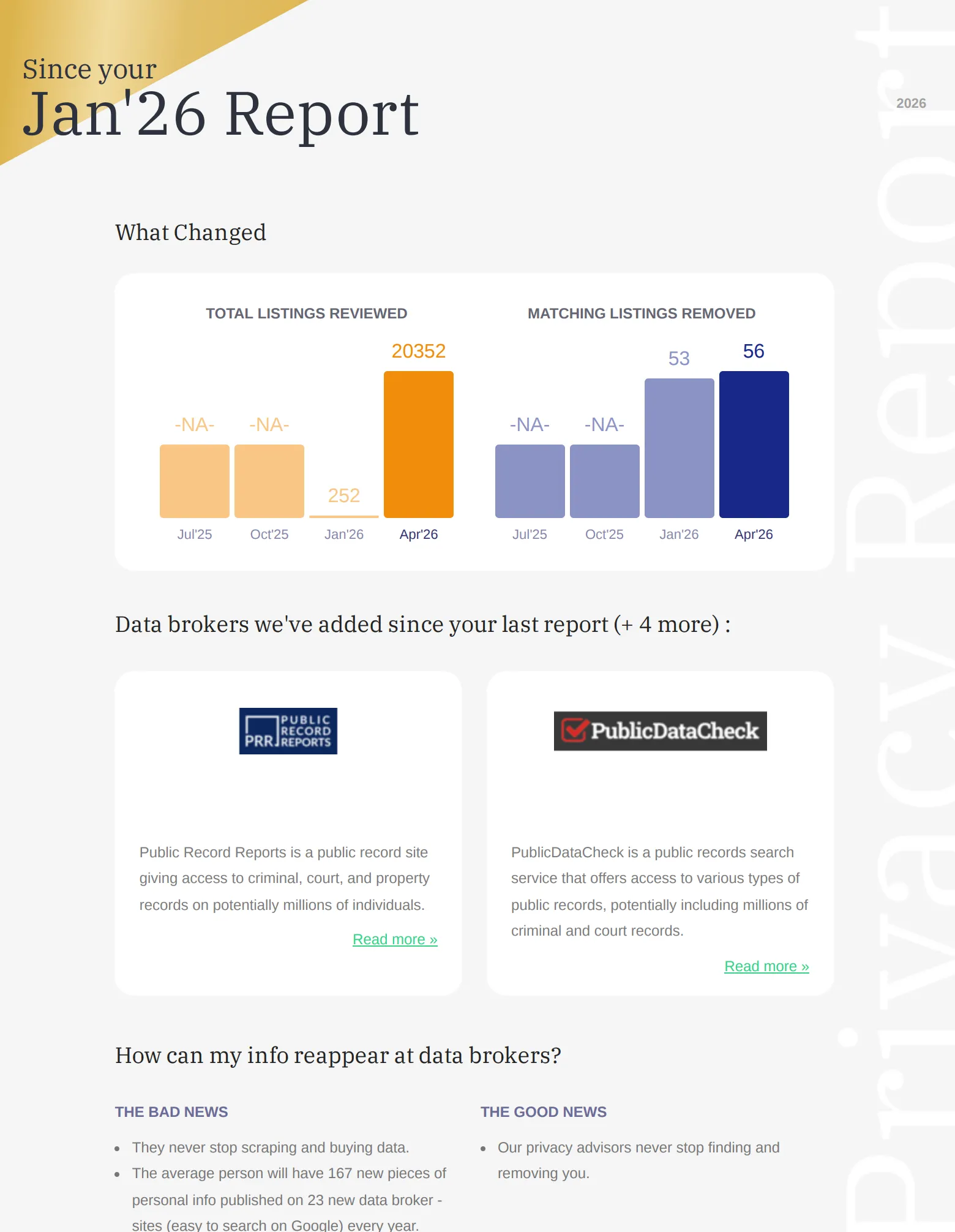
One of the clearest differences between DeleteMe and its closest competitor, Incogni, shows up in the dashboard experience. Incogni updates constantly — log in every couple of days and you’ll see the service actively crawling brokers, rating each one on speed and compliance, and racking up status changes across thousands of sites. It’s oddly satisfying, like watching a progress bar fill in real time.
DeleteMe takes a different approach. It generates a detailed report every few months covering a smaller set of brokers. For some users, that infrequency will feel frustrating. DeleteMe executive Jason Dalrymple pushes back on this criticism, framing the slower cadence as a deliberate design choice rather than a deficiency. His argument: casting too wide a net too fast can actually make things worse. This is one of the most important distinctions any DeleteMe review should flag for prospective subscribers.
‘It can actually exacerbate the problem because they send your information out to these companies to make sure they don’t have it — but then they have it,’ Dalrymple says. ‘They’re adding databases that you’re never going to be on, where you have less than a one in 100,000 chance to be, and then your information is being sent all over.’
It’s a legitimate concern, and one that’s hard to dismiss. Every time a service pings a data broker to confirm you’re not in their system, there’s a real risk that broker now has a confirmed, live data point about you to store or sell. Whether DeleteMe’s more cautious approach meaningfully reduces that risk in practice is genuinely difficult to measure — the data simply isn’t available to run a clean comparison.

Real-World Results: Fewer Spam Calls, a Cleaner Google Footprint
After using DeleteMe since January, there are tangible improvements to report. Unsolicited marketing calls have dropped noticeably. A Google search of your name is more likely to surface something you actually wrote or said than to surface your current home address. Those aren’t dramatic outcomes, but for most people that’s exactly the kind of low-grade digital exposure that grates on you over months and years. For everyday users weighing up a DeleteMe review, these incremental gains represent the realistic upside.
Incogni produced similar results when managing an account for an elderly parent — a demographic that’s disproportionately targeted by phone scammers. Dalrymple says that tracks with what DeleteMe sees broadly: ‘Services like DeleteMe and others all basically do the same thing. We’re bound by the same laws and constraints in compliance. It’s a cat-and-mouse game.’
That cat-and-mouse framing is worth sitting with. Data brokers don’t simply purge your record and move on. They re-aggregate data from new sources constantly, which means even a successful removal today doesn’t guarantee your information stays gone next quarter. This is why DeleteMe’s average customer sticks around for three years — and why some have been subscribers for over eight. You’re not making a one-time purchase. You’re paying for ongoing maintenance of your digital footprint.
The Bigger Picture: Privacy in an Era Built Against It
DeleteMe launched in 2010, and Dalrymple recalls pitching venture capitalists on a data-removal company at a moment when the entire internet culture was moving in the opposite direction. Facebook — not yet rebranded as Meta — was still privately held, and users were enthusiastically posting every detail of their lives online. A DeleteMe review conducted back then would have seemed almost absurd; today, that same review feels overdue for millions of people.
‘Everybody was excited to share; no one was thinking about the implications of all that data being shared,’ Dalrymple recalls. ‘Everyone told us: Privacy’s dead, privacy’s dead, privacy’s dead.’
Fifteen years on, that cultural moment looks naïve in hindsight. The data that people freely posted in the early 2010s didn’t disappear — it propagated across broker databases, background-check sites, and marketing lists, where it still sits today. DeleteMe has spent the better part of a decade and a half trying to claw it back, one broker at a time.
There’s a certain irony in comparing this to the Do Not Call Registry, which launched in 2003 with similar optimism. That list technically still exists, but it’s become nearly useless — charities, political campaigns, and survey companies are all exempt, and it does nothing to address your digital footprint. The registry has also attracted criticism that signing up may actually expose your number to more parties by confirming it’s active. The lesson is clear: voluntary, patchwork solutions to systemic data-harvesting problems tend to erode over time. A long-term DeleteMe review bears out the same conclusion — sustained effort matters more than any single intervention.
Should You Sign Up? What a DeleteMe Review Really Tells You
Any honest DeleteMe review has to set realistic expectations upfront. This isn’t a service that makes you invisible on the internet. It’s a service that gradually reduces the surface area of your exposure over months and years. If you sign up expecting your spam calls to stop within a week, you’ll be disappointed. If you sign up understanding you’re committing to a long-term relationship with your own privacy, you’ll likely see genuine improvements.
At roughly $100 a year, DeleteMe is priced accessibly enough that the value calculation isn’t particularly difficult for most people. The stickier question is whether you trust any third-party service with the personal details required to submit removal requests on your behalf — a reasonable concern that doesn’t have a clean answer. That tension sits at the heart of every DeleteMe review worth reading.
What’s clear is that the underlying problem isn’t going away. Without a comprehensive federal privacy law in the US, data brokers will continue operating in a regulatory grey zone, complying with removal requests when it suits them and ignoring them when it doesn’t. That makes services like DeleteMe less of a permanent solution and more of an ongoing countermeasure — one that requires patience, realistic expectations, and probably a multi-year commitment. The fact that DeleteMe has been running this particular race since before most people understood what data brokers even were suggests the company knows the terrain better than most. That experience counts for something, even if it can’t promise a finish line.
Frequently Asked Questions
Does DeleteMe review well compared to Incogni?
Both services do essentially the same thing — contacting data brokers to remove your personal info. DeleteMe updates its dashboard less frequently and contacts fewer brokers, but argues this prevents your data being sent to sites you were never on. Incogni’s dashboard feels more active and satisfying to use day-to-day.
How long does it take for DeleteMe to work?
There’s no overnight fix. DeleteMe generates progress reports every few months rather than constant updates. Most users should expect to stay subscribed for some time before seeing meaningful, lasting reductions in spam calls and searchable personal data.
Is DeleteMe worth the money?
At around $100 per year, DeleteMe appears to deliver genuine results for many users — fewer spam calls and a cleaner Google footprint. Average customers stay for three years, which suggests most find the service valuable enough to keep renewing.
Can data brokers legally refuse to delete your information?
Yes. There’s no comprehensive federal US privacy law forcing brokers to comply. Brokers can request identity verification, deny the removal request outright, or simply ignore it. Protections vary wildly by state, with California offering stronger rules and many states offering none at all.