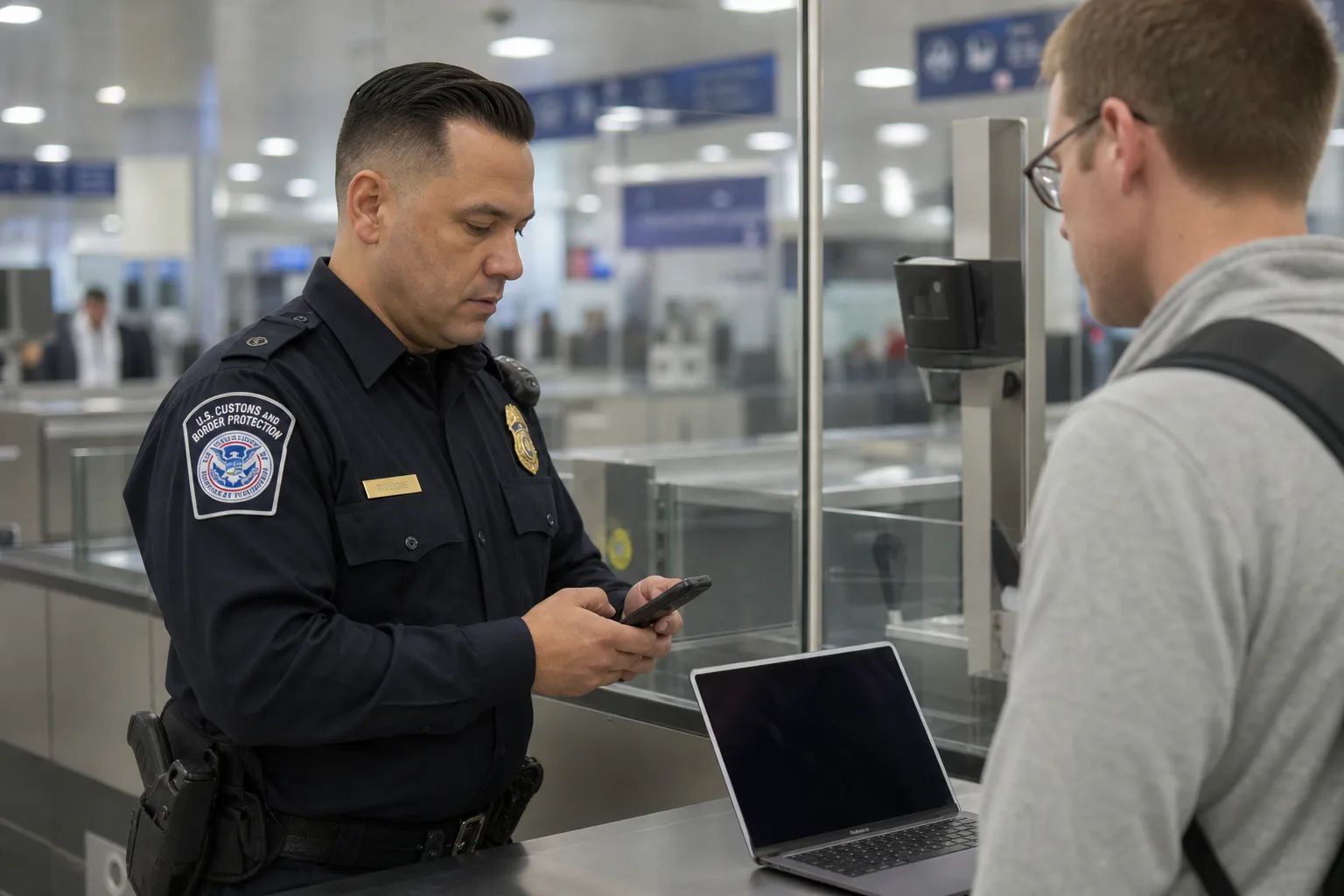
- CBP border device searches apply to phones, laptops, cameras, and removable media entering or leaving the US.
- CBP border device searches can happen without a warrant — and the legal standard is far lower than inside the country.
- Agents can retain copies of your device data and share it with other federal agencies under the directive.
- Knowing your rights before you travel could meaningfully change how you prepare and what you carry.
Table of Contents
CBP Border Device Searches: The Official Policy Explained
CBP border device searches are not a grey area. They are codified, deliberate policy — and the official directive that governs them, CBP Directive 3340-049B, lays out exactly what U.S. Customs and Border Protection agents can do when they pull you aside at an airport, land crossing, or seaport. We’re talking about your phone, your laptop, your tablet, your camera, USB drives, SD cards, music players — essentially any device that stores or transmits digital data. If it has memory and you’re crossing a U.S. border, it’s potentially fair game.

The directive was updated to reflect the realities of modern travel, where a single smartphone holds more personal and professional information than a filing cabinet full of documents ever could. CBP’s mandate is to inspect people and goods at the border, and the agency’s position is that electronic devices are simply an extension of your luggage. Courts have largely — though not completely — agreed with that framing.
What Agents Are Actually Authorized to Do
The scope here is broad. Under the directive, CBP agents can conduct two types of searches: basic and advanced. A basic search means an agent manually scrolls through your device — your photos, messages, contacts, apps, browsing history. No special approval needed. An advanced search goes further, connecting your device to external equipment to extract, copy, and analyze data. That one requires supervisory sign-off and reasonable suspicion, but reasonable suspicion at a border crossing is a meaningfully lower bar than probable cause, which is what law enforcement needs in the general interior of the country.
Critically, CBP border device searches don’t require a warrant. The so-called border search exception to the Fourth Amendment has existed for decades, but it was designed for checking whether someone was smuggling contraband in their suitcase — not for extracting a complete forensic image of a device containing years of emails, financial records, and personal communications. The directive is legally defensible under current case law, but that doesn’t make it uncontroversial.
Data that agents find can be retained. It can be shared with other federal agencies. The directive gives CBP authority to hold onto copied data for an extended review period — potentially up to 75 days — and longer if there’s an ongoing investigation. Your information doesn’t necessarily walk out of that encounter when you do.
Who Gets Searched — and How Often
CBP conducts tens of thousands of device searches every year. According to DHS statistics, the agency searched roughly 41,700 devices in fiscal year 2022 — up from about 37,000 the year before. That sounds like a lot, but it represents a fraction of the hundreds of millions of traveler crossings annually. Still, if you’re one of those 41,000 people, the statistics aren’t particularly comforting.
Searches aren’t random. CBP agents use a mix of targeting criteria — prior travel history, watchlists, intelligence tips, and frankly, discretion — to decide who gets flagged. That discretion element has drawn criticism from civil liberties organizations including the ACLU and the Electronic Frontier Foundation, who argue the process lacks transparency and creates conditions for discriminatory enforcement. Non-citizens and people traveling from certain regions are statistically more likely to be searched, though CBP doesn’t publish a breakdown by nationality or ethnicity.
The Cloud Question
Here’s where things get genuinely interesting from a technical standpoint. The directive draws a distinction between data stored locally on a device and data stored in the cloud. Agents are instructed to focus CBP border device searches on locally stored content — they’re supposed to put your device into airplane mode or otherwise disable network connectivity before starting the search, specifically to avoid pulling in cloud-synced data.
In practice, this is harder to enforce than it sounds. Modern devices are deeply integrated with cloud services. Your iPhone’s Photos app, Google Drive folders, and Microsoft OneDrive files can all appear locally cached depending on your sync settings. The line between “on the device” and “in the cloud” is increasingly blurry, and the directive’s attempt to draw that line reflects a policy framework struggling to keep pace with how people actually use technology in 2024.
The practical upshot: if you’re traveling with a device that has cloud apps installed and data cached locally, that data could be within scope even if CBP’s stated intention is to stay on-device.
What Travelers — Especially Professionals — Should Know
For most people crossing the border, this never comes up. But for journalists, lawyers, doctors, and business executives, the implications of CBP border device searches are serious enough to warrant proactive planning. Attorney-client privilege, journalist source protection, and HIPAA-covered patient data don’t evaporate at the border in terms of ethical obligations — but CBP agents aren’t bound by those confidentiality frameworks the way courts are.
The Committee to Protect Journalists and several press freedom organizations have published guidance advising journalists not to travel to high-risk assignments with devices containing source information. That same logic arguably applies to anyone traveling with sensitive professional or personal data.
Practical steps that privacy-conscious travelers take include:
- Traveling with a clean, dedicated travel device rather than their primary phone or laptop
- Using full-disk encryption (which doesn’t prevent a search but limits what an agent can access without a passcode)
- Logging out of cloud services and removing apps before crossing
- Storing sensitive files in encrypted cloud storage rather than locally on the device
- Knowing — and exercising — the right to ask why a search is being conducted, even if they can’t legally refuse
Refusing to unlock a device is legally complex. U.S. citizens generally cannot be compelled to provide a passcode (Fifth Amendment implications around self-incrimination), though biometric unlocks — Face ID, fingerprint — occupy murkier legal territory. Non-citizens who refuse risk being denied entry. The directive doesn’t resolve this tension; it largely sidesteps it.
The Bigger Picture: Privacy at the Border in 2024
CBP border device searches sit at the intersection of national security policy and digital privacy rights — two areas where U.S. law has never been fully reconciled. The Alasaad v. Mayorkas case, brought by the ACLU and EFF on behalf of travelers whose devices were searched, pushed courts to require reasonable suspicion for advanced searches. That was a meaningful win. But basic searches — the kind most travelers face — still require nothing more than an agent deciding to look.
Congress has periodically introduced legislation to tighten the rules, including bills that would mandate a warrant for device searches. None have passed. Meanwhile, the volume of searches keeps climbing, the sophistication of the forensic tools agents use keeps improving, and the amount of sensitive data people carry on their devices keeps growing.
The directive itself is a procedural document — it tells agents how to conduct searches correctly, not whether the underlying authority is appropriate. That question is still very much open, and given the trajectory of digital privacy litigation in federal courts, it probably won’t stay unanswered indefinitely.