

The Article Tells The Story of:
- Overheating Issues: Nvidia’s Blackwell GPUs overheat in high-capacity servers, causing delays for customers like Google and Meta.
- Design Changes: Nvidia is redesigning server racks and making adjustments to address the overheating problem, leading to delays.
- Previous Flaws: A design flaw in Blackwell GPUs caused production delays, requiring modifications to improve reliability.
- Customer Impact: The delays affect Nvidia’s clients’ AI deployment timelines.
Nvidia’s Blackwell GPUs are meant to be the company’s next-generation processors for AI and high-performance computing (HPC). But moving a new GPU architecture from a product announcement to a working data-center deployment is not simply a matter of shipping chips. The surrounding system matters just as much: power delivery, rack layout, cooling, packaging, interconnects and the ability to operate all of it reliably at scale.
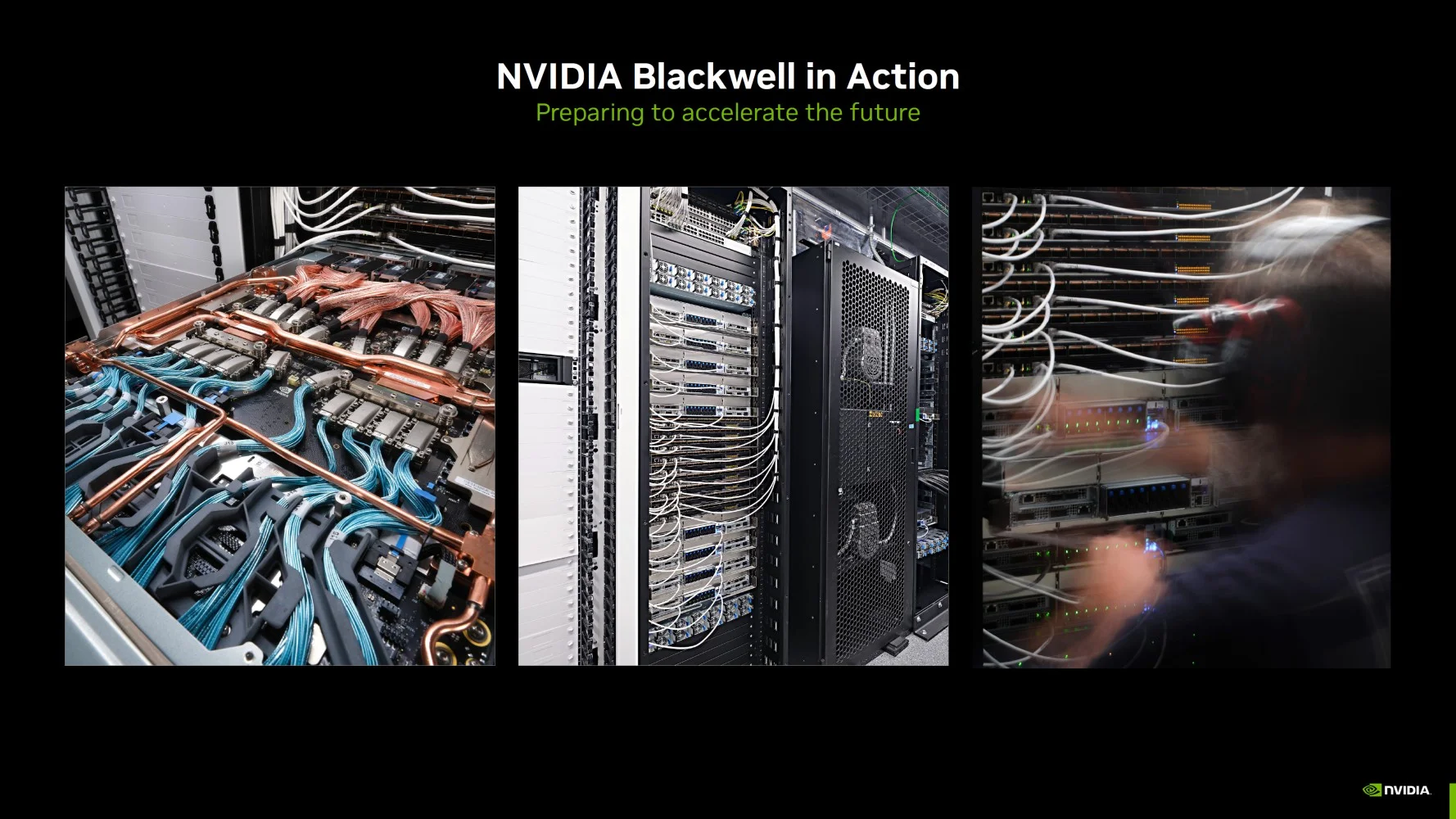
That reality is at the center of reports that Blackwell GPUs have encountered overheating problems when installed in servers with 72 GPUs per rack. Nvidia has been forced to redesign its NVL72 servers and delay shipments. For major prospective users including Google, Meta and Microsoft, the concern is not merely that hardware will arrive later than expected. Their AI infrastructure plans depend on predictable deployment schedules, and a rack-level issue can affect the timing of everything built around it.
Table of Contents
Overheating Problems Impact Performance
The reported overheating occurs in high-capacity racks consuming up to 120kW of power. At that level, thermal management is no longer a secondary engineering consideration. Heat can limit performance, reduce the room available for sustained operation and risk damaging components. A processor may be extraordinarily capable on paper, but the system has to keep it within safe operating conditions while it is doing the intensive work customers bought it for.
That is why the focus on the NVL72 rack design matters. Nvidia is not dealing with an isolated component problem in a conventional server. It is working on a dense AI system in which many GPUs, networking elements and power-hungry supporting hardware operate together. Small changes in spacing, airflow, cooling hardware or the path heat takes out of the rack can have consequences for the whole machine.
Nvidia has instructed suppliers to modify rack designs to improve cooling. The adjustments include engineering updates intended to deliver better thermal management. This kind of revision is common in large-scale technology rollouts, particularly where vendors are pushing high-density systems toward the practical limits of power and cooling. Still, “common” does not mean trivial. Every design change must work not only in engineering tests but across manufacturing, supplier integration and customer data centers.
For customers, the important question is whether those changes produce a reliable configuration rather than simply a quicker shipment. AI workloads can run continuously and place sustained demands on equipment. A rack that reaches high temperatures under real use can create operational uncertainty long after installation. Nvidia’s collaboration with suppliers and cloud providers to refine the racks is therefore a necessary part of getting Blackwell into production environments, even if it extends the timeline.
Readers looking for background on the earlier chip issue can see SquaredTech’s Nvidia Fixes Design Flaw in Blackwell AI Chips.
Technical Challenges and Delays
The overheating concerns arrived after an earlier setback during Blackwell’s development. Nvidia previously faced delays because of a design flaw in the processor’s packaging technology. Packaging is often treated as an invisible part of a chip story, but it is central to advanced AI processors. It determines how different pieces of silicon are connected, how signals move between them and how the finished processor handles physical stress.
Blackwell GPUs rely on TSMC’s CoWoS-L packaging, which uses local silicon interconnect (LSI) bridges to achieve high data transfer speeds. In this case, a mismatch in thermal expansion properties caused warping and failures. Different materials respond differently as temperatures rise and fall; when that behavior is not aligned closely enough, physical strain can build across the package. For a product designed around demanding data movement and large-scale computation, that is a reliability problem rather than a cosmetic manufacturing defect.
Nvidia addressed the flaw by modifying the chip’s top metal layers and bump structures to improve production reliability. The fixes required new masks and delayed mass production until late October. Those details show why hardware schedules can move even after a product is publicly positioned as the next step in AI computing. Correcting a package-level flaw requires changes that ripple into the production process, not a simple software update deployed after the fact.
As a result, shipments of Blackwell GPUs are now scheduled to begin in late January. The subsequent rack overheating issue adds another layer of complexity: first the GPU package must be reliable enough to manufacture, then the completed systems must be able to run at their intended density without thermal trouble. These are related challenges in the sense that both concern dependable deployment, but they require different fixes. One is rooted in the processor package; the other is rooted in how the server rack manages heat.
What the Rack Redesign Means for AI Deployment
There is a temptation to view delays in AI hardware only through the lens of chip competition. That misses the larger issue. Google, Meta and Microsoft depend on Nvidia’s GPUs to train large language models and power advanced AI applications. Their plans involve data-center capacity, software teams, infrastructure planning and product rollouts. If the processors or the racks that house them arrive later, those connected plans may need to move as well.
The immediate impact is on deployment timelines. A cloud provider or major technology company cannot treat a delayed GPU rack as a standalone missing part when its facilities, power budgets and AI services are planned around expected capacity. The delay may affect when new processing resources become available for model training and advanced AI applications. It can also force customers to make harder decisions about how they allocate the compute they already have.
At the same time, the redesign should not be confused with a verdict on Blackwell’s long-term value. The article’s reported problems point to the difficulty of deploying highly concentrated computing systems, not to a lack of demand for AI infrastructure. The more performance is packed into a rack, the less room there is for error in cooling and physical design. This is the trade-off behind the push for denser systems: greater capability can create greater engineering pressure around the equipment that supports the chips.
Nvidia acknowledges the challenges but maintains that such setbacks are part of developing advanced technology. That position is reasonable only if the company’s revisions result in stable systems rather than recurring delays. Customers buying or planning around Blackwell do not need a promise that difficult engineering will be easy. They need confidence that the processor package, cooling design and production schedule will hold up under the conditions in which these systems are intended to operate.
For a look at the competitive pressure around Nvidia’s plans, see SquaredTech’s AMD Launches Powerful New AI Chip to Challenge Nvidia’s Blackwell.
The Practical Path Forward
Nvidia’s Blackwell GPUs promise powerful AI capabilities, but the deployment hurdles are substantial. The company is working to resolve overheating through design updates and collaboration with partners. The practical solution is not a single adjustment; it is a validated rack design that improves cooling while preserving the high-capacity system customers expect.
Delays are unwelcome, especially for clients with AI deployment plans already in motion. Yet shipping systems that cannot manage heat reliably would create a deeper problem than a postponed launch. Nvidia’s task is to turn the engineering revisions into an efficient final product that can meet customer expectations in real data centers. Until then, the Blackwell story is as much about the limits of high-density infrastructure as it is about the GPUs themselves.
Stay updated: Tech News

