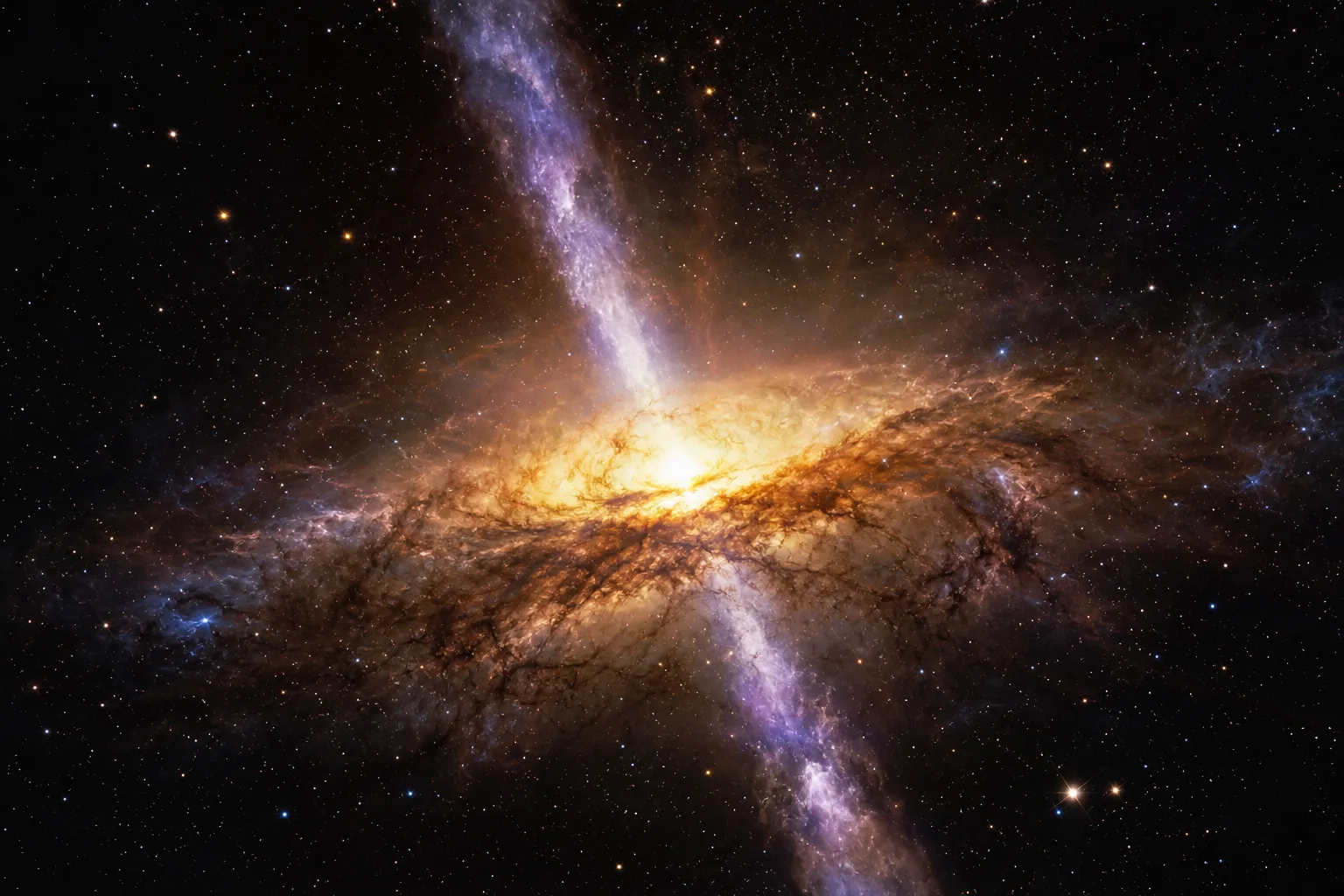
- JWST detected overmassive black holes existing just 2 billion years after the Big Bang, far earlier than models allow.
- These overmassive black holes challenge the standard theory of how quickly black holes can accumulate mass.
- One leading explanation suggests they may simply be rare statistical outliers at the extreme end of a normal distribution.
- If the outlier theory holds, it would preserve existing cosmological models rather than requiring a complete rethink.
Table of Contents
The Black Holes That Shouldn’t Be There
When the James Webb Space Telescope started returning data from the early universe, astronomers expected surprises. What they didn’t expect was a population of overmassive black holes so large, so early in cosmic history, that our best models of the universe simply can’t account for them. These objects existed when the universe was roughly 2 billion years old — a period cosmologists call Cosmic Noon — and they were already sporting masses that should have taken far longer to accumulate. The physics, as we understood it, said this was impossible. And yet, there they were.

The discovery sent a genuine jolt through the astrophysics community. Not because one anomalous object had turned up, but because JWST appeared to be finding these things repeatedly. When you see one inexplicable object, you call it a fluke. When you see a pattern, you start questioning the textbook.
Why Overmassive Black Holes Are Such a Problem
To understand why overmassive black holes at Cosmic Noon are so troubling, it helps to know how black holes are supposed to grow. The standard model involves a process called Eddington-limited accretion — essentially, a physical speed limit on how fast a black hole can pull in surrounding matter and convert it into mass. Radiation pressure from infalling gas pushes back against gravity, creating an upper boundary on the growth rate.
Under this framework, even a black hole that formed from a massive stellar remnant very early in the universe’s history would need hundreds of millions, if not billions, of years of near-constant feeding to reach the sizes JWST has been detecting. The universe at Cosmic Noon simply hadn’t been around long enough. It’s a bit like finding a fully grown oak tree in soil that was only seeded two years ago — the timeline doesn’t add up.
Astronomers have proposed a range of explanations. Some suggest that early black hole seeds were themselves far more massive than expected — perhaps collapsing directly from enormous gas clouds rather than forming through stellar death. Others have floated the idea of super-Eddington accretion: brief, chaotic periods where the normal speed limit breaks down and black holes gorge on matter at extraordinary rates. A few have even entertained more exotic ideas, including primordial black holes formed in the immediate aftermath of the Big Bang.
Are These Overmassive Black Holes Just Statistical Outliers?
Now a more conservative — and frankly more reassuring — hypothesis is gaining traction among researchers. What if these overmassive black holes aren’t evidence of exotic physics at all? What if they’re simply the extreme tail end of a normal distribution? Every statistical population has outliers. When you’re observing billions of galaxies across cosmic history, you’d expect to find some objects at the very far edge of what’s theoretically possible under standard growth models.
The argument goes something like this: JWST is extraordinarily sensitive. It can detect objects that previous telescopes like Hubble couldn’t even see. And because it’s probing the universe so deeply and so precisely, it’s naturally finding the rarest, most extreme objects that exist. That doesn’t mean those objects break the rules — it might just mean we’re now powerful enough to observe the outliers that the rules always predicted but that we’d never actually spotted before.
Think of it like measuring human height. If you survey a small village, you’ll probably find people clustered around the average. But survey a billion people, and you’re going to find some individuals whose height seems almost implausible by normal standards. They’re not violating biology. They’re just the far end of the bell curve.
If this explanation holds up, it would be a significant relief for cosmologists. It would mean the standard model of black hole formation doesn’t need a major overhaul — just some recalibration around the edges. The existing framework for how structure formed in the early universe, including the observations accumulated over decades by telescopes like Hubble, would remain largely intact.
Why This Debate Actually Matters Beyond Academia
It might be tempting to file this under “scientists arguing about things very far away and very long ago.” But the implications here are broader than they might seem. The models we use to understand black hole growth are deeply connected to our understanding of how galaxies form — including our own Milky Way. Supermassive black holes sit at the centers of most large galaxies, and the relationship between a black hole’s mass and the size of its host galaxy is one of the tightest correlations in all of astrophysics.
If overmassive black holes in the early universe genuinely break the standard growth model, that correlation breaks too. And if that correlation breaks, some of our most fundamental assumptions about galaxy formation and cosmic structure need to be rebuilt from scratch. That’s not a trivial undertaking — it would cascade through decades of published research and force a rethink of how we interpret observations across the entire field.

On the other hand, if the outlier hypothesis is correct, it validates something important about JWST itself: that the telescope is working so well it can detect the cosmic equivalent of statistical edge cases. That’s a remarkable engineering and scientific achievement. The telescope, which began science operations in 2022 after years of delays and a price tag that ballooned to roughly $10 billion, was always expected to push boundaries. Finding objects at the extreme edges of theoretical possibility might be exactly what pushing those boundaries looks like in practice.
What Comes Next
The scientific community isn’t going to settle this debate quickly. What’s needed now is a much larger statistical sample of these early, massive objects — enough data points to determine whether their abundance genuinely exceeds what standard models predict, or whether they fall within the range that a sufficiently sensitive telescope would naturally expect to find.
JWST is still early in its operational life. It has enough propellant to operate for well over a decade, and astronomers are only beginning to scratch the surface of what it can observe. Follow-up spectroscopic studies of these overmassive black holes — pinning down their masses more precisely, understanding the environments they inhabit, looking at the galaxies around them — will be critical to building the case either way.
There’s also the question of what ground-based observatories and upcoming space telescopes can add to the picture. The European Space Agency’s Euclid mission, launched in 2023, is surveying enormous swathes of the sky and could help establish whether these extreme objects appear at the frequency models would expect or at rates that demand a new explanation.
For now, the honest answer is that we don’t know. What we do know is that JWST has handed astrophysicists one of the most genuinely compelling puzzles in modern cosmology. Whether overmassive black holes turn out to be exotic physics or just the universe’s version of extreme outliers, the process of figuring that out is going to reshape our understanding of how the cosmos built itself.