
The Liquid AI edge model just got a serious upgrade. The Boston-based AI startup has released LFM2.5-8B-A1B, a mixture-of-experts model trained on 38 trillion tokens that the company says runs comfortably on an entry-level laptop while matching or beating models several times its size on key benchmarks. That’s a bold claim — and the numbers behind it are hard to ignore.
- The Liquid AI edge model LFM2.5-8B-A1B was trained on 38 trillion tokens, up from 12 trillion in its predecessor.
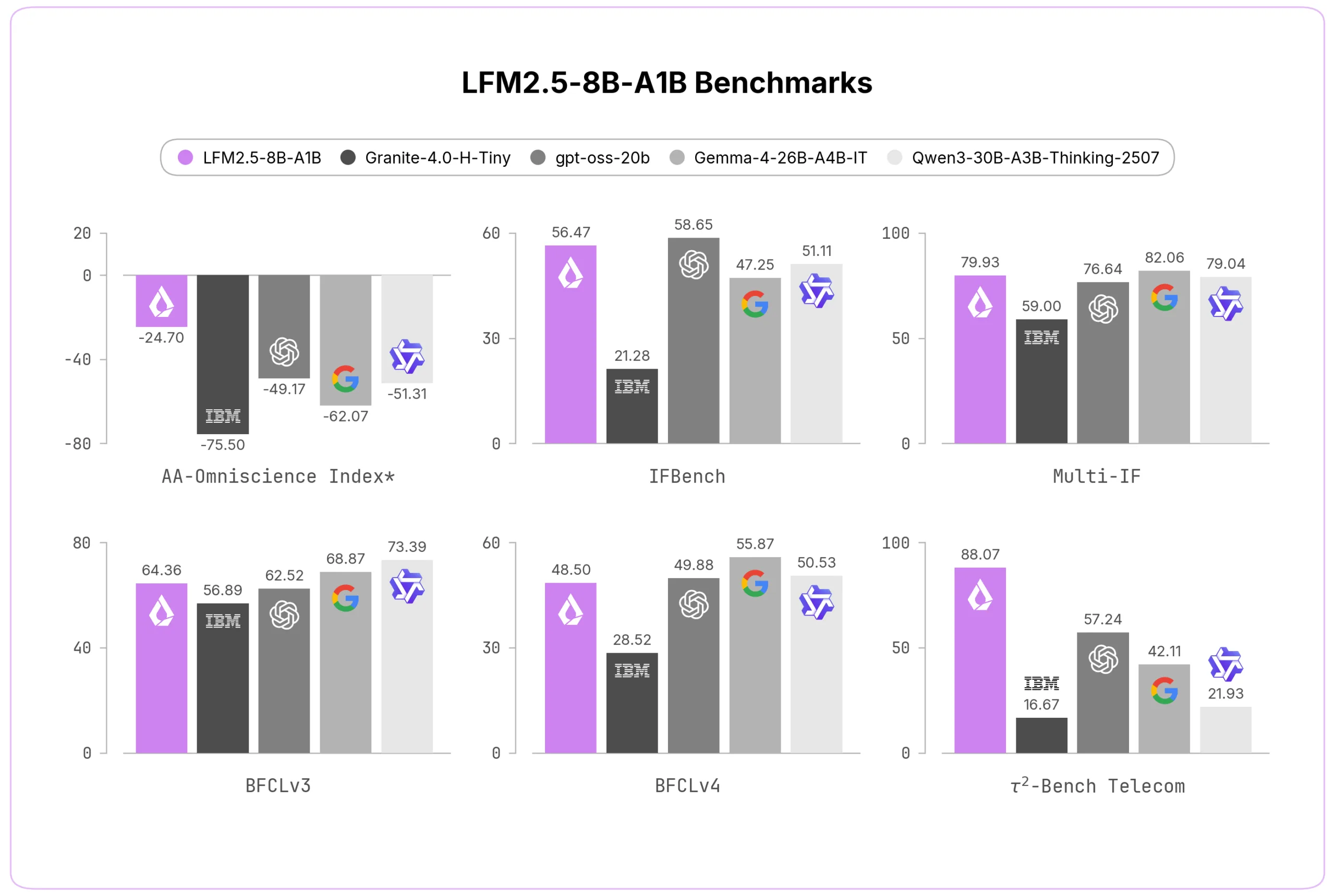
- Liquid AI edge model benchmarks show it matching much larger models like Gemma 4-26B on instruction-following tasks.
- Context window expands to 128K tokens, making longer document reasoning viable on everyday consumer hardware.
- Day-one support for llama.cpp, MLX, vLLM, and SGLang makes deployment across CPU and GPU environments straightforward.
Table of Contents
What the Liquid AI Edge Model Actually Is
LFM2.5-8B-A1B is a Mixture of Experts (MoE) model, meaning it activates only a fraction of its total parameters at inference time. The “8B” refers to total parameters; “A1B” means roughly 1 billion are active per token. That architecture choice is central to why the Liquid AI edge model is fast on CPU hardware — you’re not pushing all 8 billion weights through the compute pipeline every step.
The Liquid AI edge model builds directly on LFM2-8B-A1B, which Liquid released in October 2025. But the gap between the two versions is substantial. Training data scaled from 12 trillion to 38 trillion tokens. The context window jumped from 32,768 tokens to 128,000 — putting it well into territory that was, until recently, the exclusive domain of cloud-hosted frontier models. And the vocabulary doubled from 65,536 to 128,000 tokens, with a particular focus on improving tokenization for non-Latin scripts.
That last point matters more than it might seem. Most English-centric tokenizers are notoriously inefficient with languages like Hindi, Arabic, Thai, Vietnamese, and Indonesian — requiring far more tokens to represent the same amount of text, which inflates compute costs and degrades model quality. Liquid says the new tokenizer delivers meaningfully higher characters-per-token ratios across all 16 languages it tested. For developers building multilingual products, that’s a genuine improvement.
38 Trillion Tokens and What It Took to Get There
Scaling training data by 3x isn’t just a matter of throwing more text at the model. Liquid describes a multi-stage training pipeline that included a 2 trillion token midtraining phase to push the context window from 32K to 128K, followed by a further 400 billion token stage focused on long-document and long-trajectory data. The company also used Hugging Face to release both base and post-trained checkpoints for public use.
The post-training pipeline for this Liquid AI edge model includes some genuinely interesting engineering choices. One is what Liquid calls “doom loop” mitigation. Large reasoning models — particularly MoE architectures — can get stuck in repetitive thinking patterns, endlessly restarting with words like “Wait” before arriving at an answer. Liquid added a preference optimization stage that identifies tokens likely to trigger looping in specific contexts and redistributes probability toward better alternatives. During reinforcement learning, a lightweight reward signal also actively penalizes excessive use of common loop-inducing restart words.
There’s also a targeted hallucination-reduction stage built into the Liquid AI edge model. Edge models are inherently constrained — fewer parameters means less stored knowledge, which means more confident-sounding wrong answers. Liquid’s approach uses an avg@k-based reward over a diverse knowledge dataset to reinforce what they call “abstention” — the model learning to say it doesn’t know, rather than fabricating. The goal is a sharper knowledge boundary rather than blanket uncertainty. Whether that translates cleanly into real-world use cases is worth watching, but the framing is more honest than most vendors offer.
Benchmark Performance: How Does It Actually Stack Up?
Liquid claims the Liquid AI edge model LFM2.5-8B-A1B matches Google’s Gemma 4-26B on instruction-following benchmarks — a model with more than three times the active parameters. On the Tau2-Telecom agentic benchmark, which tests multi-step tool use in domain-specific environments, the Liquid AI edge model posts particularly strong results relative to its weight class.
The hallucination scores tell an interesting story too. Using their avg@k-based reward training, Liquid reports a significantly lower hallucination rate than comparable models while maintaining reasonable accuracy — a trade-off that’s genuinely hard to optimize for without degrading one side or the other. Most teams choose accuracy and live with the hallucinations.
These are still vendor-reported benchmarks, which always warrant some skepticism. But the Liquid AI edge model is publicly available on Hugging Face right now, which means the broader research community can stress-test these claims independently. That transparency is worth something.
Why Reasoning-Only Mode Changes the Speed Equation
Unlike its predecessor, LFM2.5-8B-A1B is a reasoning-only model — it produces an explicit chain of thought before giving a final answer. For most users, that means you’ll see the model “thinking” before it responds. That’s become a familiar pattern since OpenAI popularized it with o1, but Liquid’s implementation in this Liquid AI edge model is tied directly to the MoE architecture.
The logic is smart: MoE models are typically compute-bound, not memory-bound. With only 1 billion parameters active at a time, each reasoning token is cheap to generate. So the model can afford to think for longer without the cost penalty you’d pay on a dense 8B model. The result, Liquid says, is a significant quality boost without a meaningful speed regression. That’s a meaningful architectural advantage, not just a marketing narrative.
Inference Everywhere: From iPhones to Data Centers
One of the strongest parts of this release is the day-one inference ecosystem support. The Liquid AI edge model ships with GGUF checkpoints for llama.cpp, MLX-optimized weights for Apple Silicon, vLLM and SGLang for GPU-accelerated server deployments, and ONNX for cross-platform use. It also integrates with LEAP, Liquid’s own Edge AI Platform targeting iOS and Android.
That breadth matters. One of the persistent frustrations in the open-weights model space is the lag between a model release and when it actually becomes usable in production tools. Shipping day-one support for the most widely used inference backends removes that friction almost entirely. A developer with an M3 MacBook can pull the MLX weights and be running locally within minutes.
CPU inference support via llama.cpp is worth calling out specifically. GPU access is still a bottleneck for many enterprise deployments — particularly in regulated industries where on-premise requirements mean you can’t always rely on accelerated hardware. A Liquid AI edge model that runs acceptably fast on CPU opens doors that GPU-only models simply can’t reach.
The Bigger Picture for On-Device AI
Liquid AI isn’t alone in pushing hard on edge performance. Microsoft’s Phi-4 series, Google’s Gemma 3 family, and Meta’s Llama 3.2 1B and 3B models are all competing in overlapping territory. But the Liquid AI edge model’s architectural approach — combining MoE sparsity, gated short convolution blocks, and Grouped Query Attention — is genuinely different from the transformer-only approach most of those models use. The company has consistently argued that hybrid architectures offer better efficiency at the edge, and LFM2.5’s benchmark results are the clearest evidence yet that the bet is paying off.
The doubling of vocabulary for multilingual support is also a strategic signal. The next billion users of on-device AI are not predominantly English speakers. Any model that can process Hindi or Arabic as efficiently as English has a structural advantage in the markets that actually represent growth. That’s a long-term play, not just a feature checkbox.
If Liquid can sustain this trajectory — bigger training runs, better multilingual coverage, faster inference — the question for the broader market isn’t whether capable AI can run on a laptop. It’s whether cloud-hosted inference still makes sense for the majority of everyday tasks. The Liquid AI edge model LFM2.5-8B-A1B isn’t the final answer to that question, but it makes the case more convincingly than most models at this scale have managed to so far.