

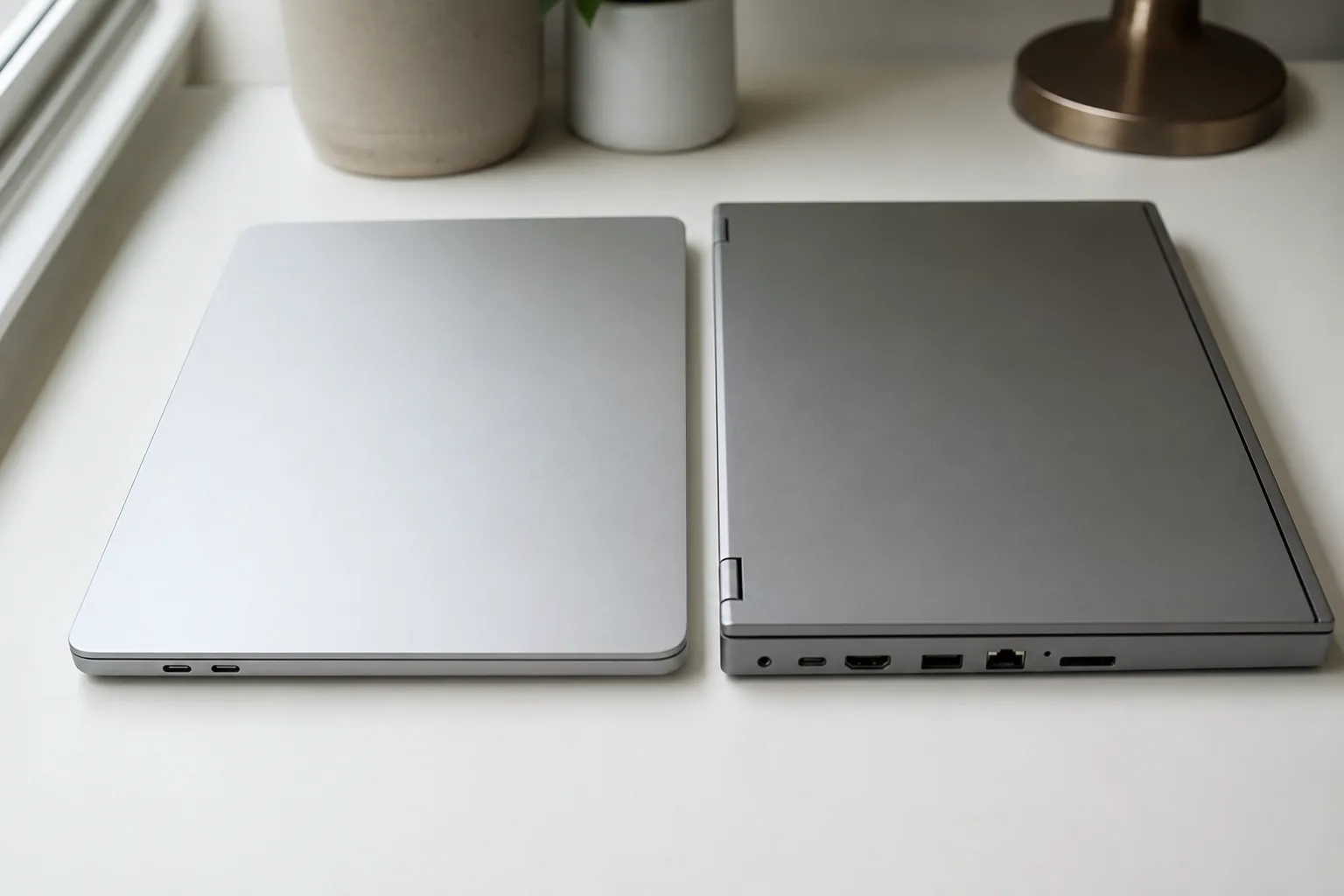
- This Framework 12 review finds the laptop costs 20–40% more than Apple’s MacBook Neo while delivering a slower, louder experience.
- The Framework 12 review reveals Apple’s $499 MacBook Neo outperforms it in benchmarks, display quality, and build quality.
- Framework’s modular port system and repairability remain genuine strengths, but they can’t offset the value gap for most buyers.
- For students or anyone prioritising value, the MacBook Neo has flipped the script on what a budget laptop can deliver.
Table of Contents
Framework 12 Review: When the Underdog Story Gets Complicated
The Framework 12 review most people expected to write would go something like this: scrappy hardware startup builds a repairable, Linux-friendly laptop and sticks it to the big guys. It’s a great narrative. The problem is that Apple went and rewrote the script with the MacBook Neo — a machine that somehow manages to be faster, quieter, better-built, and dramatically cheaper than the Framework 12. That’s not a sentence that should exist in 2026, yet here we are.
Jeff Geerling, a well-known hardware tinkerer and tech blogger, found himself in exactly this bind when his high-school-graduate nephew needed a laptop. Geerling had both machines on hand — a Framework 12 he’d been testing and his own MacBook Neo — and after running both through a thorough benchmark suite, he handed the choice to his nephew. The kid picked the Neo without much hesitation. Hard to blame him.
The Numbers That Make the Framework 12 Review Uncomfortable Reading
Let’s talk price first, because it sets the whole context. The Framework 12 starts at $749 if you go the DIY route — and that’s after you source a used 8GB stick of RAM and a 256GB SSD yourself. The pre-built version is $799. Apple’s MacBook Neo base model is $499. That’s a $250–$300 gap for a machine that, by most objective measures, performs worse.
In Geekbench 6, Apple’s low-end CPU cores leave Intel’s in the dust. Geerling notes that while Geekbench isn’t a perfect proxy for real-world workloads on large systems, it’s a reasonable indicator for machines with under 16 cores — which both of these are. The Neo also runs completely silently, since it has no fan, and consumes close to half the power of the Framework 12 for equivalent tasks. That kind of efficiency gap isn’t noise in the data — it’s a fundamental architectural difference between Apple Silicon and Intel’s current offerings at this price tier.
The Framework 12 does claw back some ground in sustained performance. When you throw a prolonged, CPU-hammering workload at it — Geerling used HPL, a floating-point HPC benchmark — the Framework’s fan lets it maintain slightly higher sustained clock speeds than the fanless Neo, which has to throttle more aggressively to manage heat. But Geerling himself acknowledges that even here, the delta isn’t dramatic. And the cost of that marginal sustained-performance edge is a fan spinning at 100% capacity, generating 40–45 dBa. That’s not silent-library territory — you’ll hear it.
GPU performance is where Intel’s side of this Framework 12 review gets genuinely painful. Using GravityMark, the Neo’s integrated GPU pulls significantly ahead. In everyday use — UI responsiveness, 4K video playback — you might not notice. But in gaming or any GPU-accelerated compute workload, the gap opens up wide.
Build Quality and Display: The Hidden Cost of Scale
There’s a structural reason the Framework 12 review keeps circling back to Apple’s advantages, and it’s not just engineering talent — it’s manufacturing scale. Apple ships tens of millions of MacBooks per year. That volume gives them the power to commission displays built exactly to their specifications, negotiate component prices that smaller manufacturers can only dream about, and absorb R&D costs across a huge install base.
Framework is a startup. They have to buy off-the-shelf panels that roughly fit their requirements. The result, in the Framework 12, is a display that Geerling describes as noticeably off in colour accuracy — better than a $300 Chromebook, sure, but well behind the Neo’s screen. That’s a meaningful concession for a machine that costs more.
The physical compromises stack up elsewhere too. The Framework 12 is thicker and heavier than the Neo, despite having a smaller screen. The speakers are genuinely poor — they hollow out the low end of audio in ways the Neo’s speakers, which are themselves unremarkable, don’t. The plastic top cover picks up dirt when the laptop is folded into tablet mode, pressing against the rubber feet in a way that Geerling finds consistently annoying. None of these are dealbreakers on their own, but together they paint a picture of a machine under serious cost pressure.
The webcam and microphone are serviceable, and Framework does something genuinely useful here: physical privacy switches for both. It’s a small thing, but it’s exactly the kind of thoughtful, user-respecting feature that Framework’s audience appreciates, and it’s something you won’t find on the Neo.
Where the Framework 12 Actually Wins
This Framework 12 review isn’t a eulogy. There are real, concrete reasons someone might choose it over the Neo — they’re just a shorter list than Framework would probably like.
The modular port system is the biggest practical win. Framework’s expansion module approach lets you slot four ports of your choosing around the edges of the laptop — Geerling configured his with two USB-C ports, a USB-A, and a full-size HDMI. The MacBook Neo has two ports total, only one of which hits USB 3.2 Gen 2×1 speeds. If you’re someone who regularly needs to plug things in without hunting for a dongle, that matters.
Repairability and upgradeability are the other genuine differentiators. The Framework 12 accepts a DDR5 SODIMM for RAM upgrades, a 2230-sized NVMe SSD, a replaceable WiFi card, and — obviously — those swappable port modules. Framework has built its entire brand identity around this principle, and it’s a legitimate one. The right-to-repair movement isn’t just ideological at this point — it’s practical for anyone who wants to extend the useful life of a laptop beyond the manufacturer’s preferred upgrade cycle. For repairability-focused buyers, this Framework 12 review acknowledges that no competing machine at this price point comes close to matching that story.
The 360-degree hinge and touchscreen add genuine flexibility too, even if Geerling found the tablet mode more cumbersome than expected in practice. A laptop-as-tablet is inherently a compromise form factor, and the older stylus technology Framework is using doesn’t help. It’s not in the same league as an iPad or a Surface for drawing or note-taking.
The Bigger Picture: Framework’s Difficult Position
Zoom out from this Framework 12 review and the situation Framework finds itself in is genuinely tricky. They’ve spent years building a community of users who care deeply about repairability, upgradeability, and Linux support — and they’ve earned real loyalty there. But Apple’s move into the budget segment with the MacBook Neo hasn’t just taken a slice of the market. It’s reframed what buyers think they should expect for their money at the $500–$800 price point.
Framework can’t match Apple’s manufacturing economics. They can’t commission custom display panels or negotiate component costs at the same scale. What they can do — and what Geerling suggests they’re doing better elsewhere in their lineup — is lean harder into the specific strengths that Apple structurally can’t or won’t match. The Framework 13, for instance, remains a more compelling proposition for users who prioritise repairability and want top-tier Linux compatibility. Lenovo has also entered this space more seriously, giving buyers another option worth considering.
The Framework 12’s awkward middle position — trying to compete on price with a machine it can’t beat on performance or build quality, while offering a tablet mode that doesn’t quite deliver — suggests the product needs a sharper identity. Either go harder on the things Framework does uniquely well, or find a way to close the performance and quality gap. Right now, this Framework 12 review shows a machine that asks buyers to pay a premium for a worse experience, justified by repairability that most users — including a freshly graduated teenager picking his first real laptop — aren’t prioritising.
That’s not a fatal position, but it is one Framework will need to address if the Neo represents Apple’s new normal rather than a one-time pricing anomaly. And given Apple’s trajectory with silicon efficiency and manufacturing scale, there’s little reason to expect the pressure to ease.

